
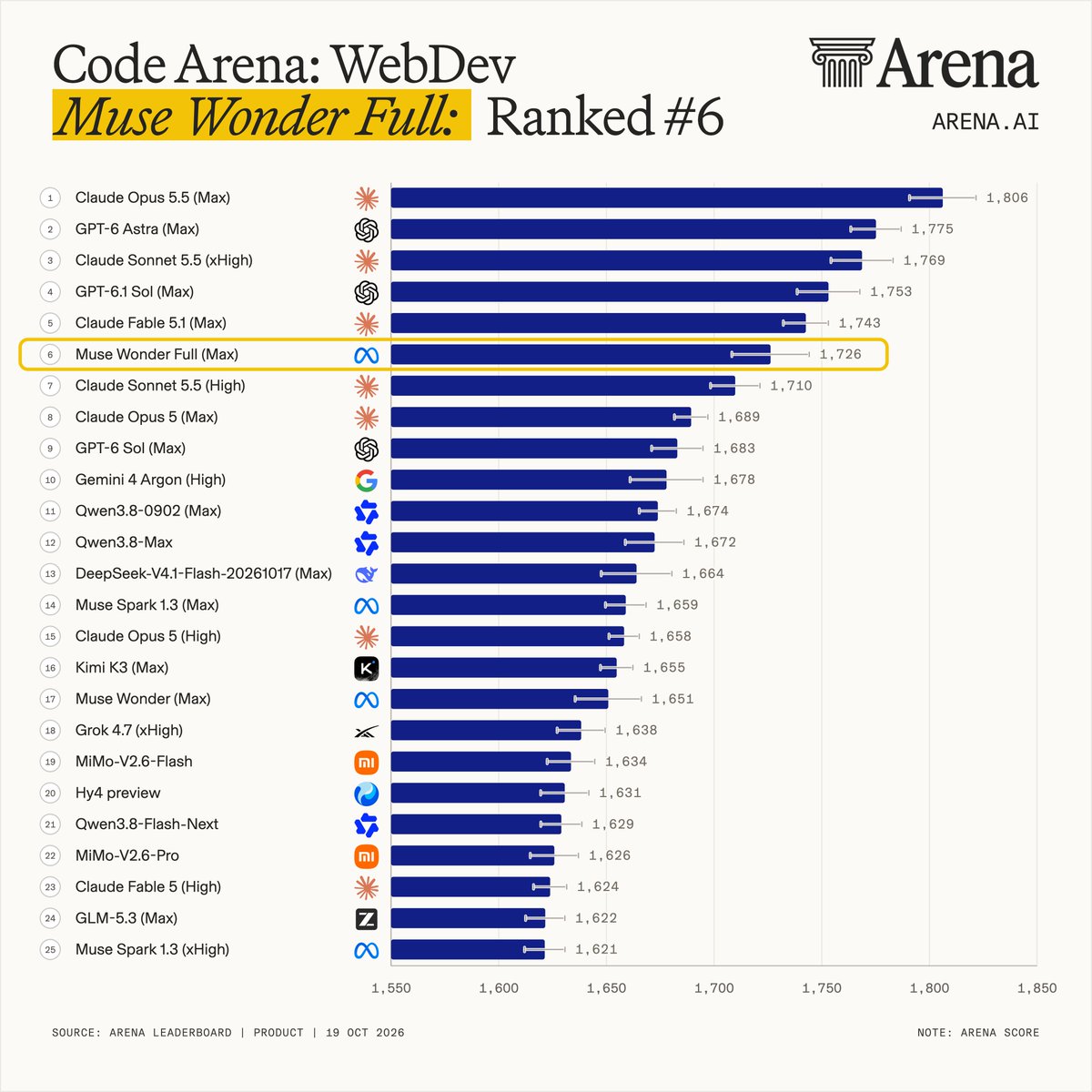
Meta officially disclosed its gigawatt-scale AI supercluster Prometheus in New Albany, Ohio, housing hundreds of thousands of frontier GPUs with 85%+ pretraining goodput and 90%+ in reinforcement learning. Powered by this infrastructure, Meta's latest coding flagship Muse Wonder Full surged to #6 globally on LMSYS Code Arena: WebDev with 1726 Elo points (surpassing Claude Sonnet 5.5 and Gemini 4 Argon), lifting Meta to the #3 AI research lab worldwide.
Key Takeaways
- ✓Meta unveiled its gigawatt-scale Prometheus supercluster in Ohio with hundreds of thousands of GPUs, delivering 85%+ pretraining goodput
- ✓Exceeded 90%+ goodput on RL workloads, recording ~47,000 GPU-hours MTBF during Muse Wonder's training cycle
- ✓Muse Wonder Full scored 1726 Elo on LMSYS Code Arena: WebDev (#6 globally), outperforming Claude Sonnet 5.5 (+16) and Gemini 4 Argon (+48)
- ✓Elevated Meta to the #3 AI lab worldwide; confirmed Muse Glimmer 30B open weights capable of 4-bit local execution on a single consumer GPU
Turn your technical choice into a development budget
Compare 40 dev plans & simulate token costs vs $20/mo subscriptions
Project Links & Resources
Direct AccessIn-Depth Technical Analysis
Background and the Problem
The progression of frontier foundation models and agentic workflows has firmly entered the era of gigawatt-scale infrastructure and massive reinforcement learning. For clusters deploying hundreds of thousands of GPU accelerators, the preeminent operational challenge is "goodput degradation" caused by hardware failures, silent data corruption, and network desynchronization. Frequent node failures trigger expensive checkpoint restores, wasting millions of dollars in compute capital. Meta officially pulled back the curtain on its flagship Prometheus Supercluster and shared milestone results on Muse Wonder across global developer arenas.
Architecture and How It Works
- Gigawatt-Scale Prometheus Infrastructure (New Albany, Ohio):
- Houses hundreds of thousands of top-tier GPUs interconnected via an ultra-high-bandwidth fabric;
- Delivers sustained 85%+ goodput on pretraining and 90%+ goodput on reinforcement learning pipelines;
- Achieved approximately 47,000 GPU-hours mean time between failures (MTBF) during the training run of Muse Wonder, setting a benchmark for ultra-large distributed system stability;
- Next-Generation Agentic Foundation: Muse Wonder:
- Architected specifically for long-horizon multi-step planning, tool orchestration, and full-stack web software synthesis;
- Complemented by Muse Glimmer 30B, an open-weight 30B parameter model engineered to run in 4-bit precision on a single consumer GPU or desktop workstation.
Benchmarks and Measured Results
According to LMSYS official announcements and Meta technical disclosures (Figure 1, Arena WebDev, Meta Telemetry):
- LMSYS Code Arena: WebDev Blind Pairwise Elo:
- Muse Wonder Full debuts with 1726 Elo points, securing #6 globally;
- Decisively surpasses Anthropic's Claude Sonnet 5.5 (+16 pts) and Google's Gemini 4 Argon (+48 pts);
- Catapults Meta to #3 among all AI research organizations worldwide, surpassing Google;
- Full-Stack Web Engineering Capabilities:
- Demonstrates superior compilation integrity on dynamic UI component synthesis, multi-route state machines, and modern enterprise frameworks (React 19, Next.js, and modern styling libraries).
Getting Started for Developers
- Live Testing: Developers can immediately test and benchmark Muse Wonder in Code Arena: WebDev on
arena.lmsys.org; - On-Device Agent Strategy: Meta confirmed upcoming open weights for Muse Glimmer 30B, enabling developers to run self-hosted 30B agent pipelines within 16GB–24GB of VRAM for local, privacy-preserving coding assistants.
Benchmark side-by-side against alternatives, or calculate monthly token cost vs subscription break-even.
Discussion & Comments
0Sign in to join the discussion
Connect with AI developers to exchange benchmark insights.