
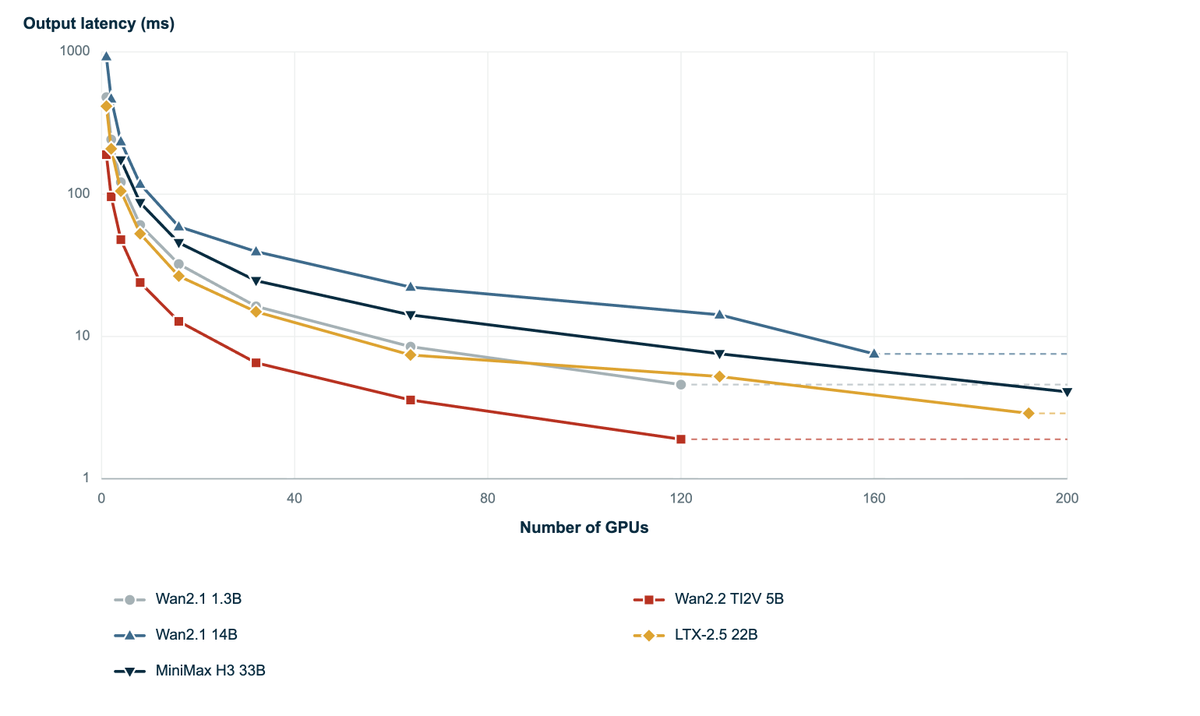
The vLLM Project officially announced that PhysisServe's core physical-world serving techniques are being integrated into vLLM-Omni. Addressing the severe memory bottlenecks and latency spikes of multi-step video diffusion and physical AI generation, PhysisServe introduces cross-denoising-step pipeline parallelism across Transformer blocks, time-shared batching, and virtual-rank joint scheduling. Benchmarked on MiniMax H3 33B across 200 GPUs, it generates a chunk every 4.1 ms (~1,000 FPS without VAE decoding), while cutting single-GPU latency for Wan2.2 5B from 173 ms down to 98 ms.
Key Takeaways
- ✓The vLLM project announced the upstream integration of PhysisServe's serving architecture into vLLM-Omni for physical AI and video models
- ✓Introduces cross-timestep block pipelining and time-shared batching to eliminate GPU communication bubbles in multi-step diffusion
- ✓Generates a video chunk every 4.1 ms on MiniMax H3 33B across 200 GPUs (~1,000 FPS), cutting Wan2.2 5B single-card latency to 98 ms
- ✓Expands 24-GPU serving concurrency by 1.7x to 3.3x, with full open-source code merging into the vLLM-Omni mainline
Not enough VRAM? Compare cloud API and self-hosting costs
Compare 40 dev plans & simulate token costs vs $20/mo subscriptions
Project Links & Resources
Direct AccessIn-Depth Technical Analysis
Background and the Problem
With the proliferation of video diffusion transformers (Sora, Wan2.1/Wan2.2) and robotic world models, physical-world generative AI is transitioning from offline rendering to real-time interactive generation. However, modern high-throughput serving systems (such as standard vLLM, SGLang, and TensorRT-LLM) were engineered primarily for autoregressive text token generation. When deployed on iterative diffusion denoising with 3D spatio-temporal attention blocks, these engines suffer from massive GPU communication bubbles, memory fragmentation, and poor request concurrency. To overcome this infrastructure gap, the vLLM Project officially announced the integration of PhysisServe into vLLM-Omni.
Architecture and How It Works
- Pipelining Across Denoising Steps and Transformer Blocks:
- Dismantles the barrier of full-barrier synchronous waiting between sequential diffusion timesteps, interleaving computation across Transformer depth layers with inter-GPU communications;
- Time-Shared Multi-Request Batching:
- Schedules requests at heterogeneous denoising stages into unified execution batches, eliminating pipeline bubbles and maximizing hardware tensor core saturation;
- Virtual Ranks and Joint Dynamic Scheduling:
- Abstracts physical GPU topology into dynamic virtual ranks, dynamically balancing variable video lengths and resolutions across clusters; core components are merging into the official vLLM-Omni repository.
Benchmarks and Measured Results
According to official PhysisServe benchmarks and vLLM telemetry (Figure 1, Benchmark Disclosures):
- Millisecond-Grade Video Chunk Generation:
- Across a 200-GPU cluster running MiniMax H3 33B, the system outputs one video latent chunk every 4.1 milliseconds (delivering approximately 1,000 FPS throughput prior to VAE decoding);
- Minimum delivery latency across five tested foundation models was compressed to a window between 1.895 ms and 7.547 ms;
- Single-Card Latency & Cluster Concurrency:
- On a single GPU, Wan2.2 5B latency dropped from 173 ms down to 98 ms (a 43.4% reduction);
- On a 24-GPU cluster under concurrent loads, served capacity expanded by 1.7x to 3.3x across four of five evaluated video models (e.g., Wan2.1 1.3B concurrency climbed from 12 to 39 simultaneous streams).
Getting Started for Developers
- Open-Source Repository: Accessible at
github.com/Physis-AI/PhysisServe, with official vLLM-Omni integration merging into upstream releases; - Engineering Recommendation for Video Infrastructure: Teams serving real-time virtual avatars, autonomous vehicle simulations, or commercial video APIs can adopt PhysisServe's pipelining recipes to double or triple cluster concurrency without expanding GPU hardware footprints.
Benchmark side-by-side against alternatives, or calculate monthly token cost vs subscription break-even.
Discussion & Comments
0Sign in to join the discussion
Connect with AI developers to exchange benchmark insights.