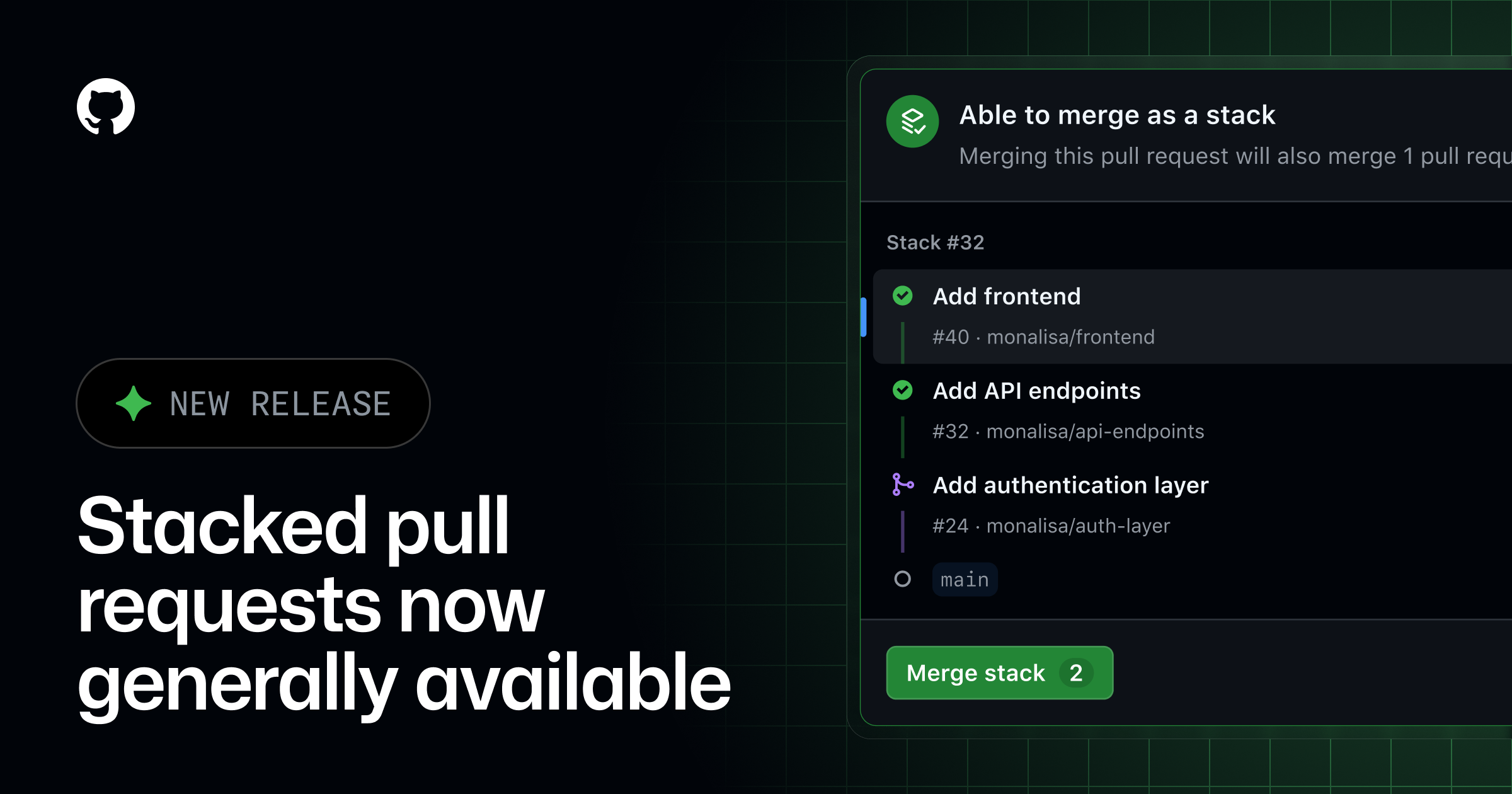
On 2026-10-06 GitHub made stacked pull requests generally available on all github.com plans, with GitHub Enterprise Server support coming in a later release. Since the public preview, repos using stacks have merged 9% more code than their peers, and more than two-thirds of the top 1% of repos now use them, with a 5% faster time-to-merge. New in GA: approvals are kept for unchanged code after a rebase, replacement commits are signed automatically, a whole stack enters the merge queue as one merge group, stacks retarget automatically when their base branch is deleted, and stack auto-merge is rolling out over the coming weeks. The gh-stack CLI extension (v0.2.0) now supports Git worktrees, and gh skill install github/gh-stack teaches AI coding agents how to split large changes into stacked PRs.
Key Takeaways
- ✓Impact (changelog): repos using stacks merge 9% more code; over 2/3 of the top 1% of repos use them, with 5% faster time-to-merge
- ✓Approvals and signing: Rebase stack keeps approvals on unchanged code even when stale approvals are dismissed; replacement commits are signed and keep the original authorship
- ✓Merge queue: a stack lands as 1 merge group; with the merge-commit method, each PR gets its own merge commit; stack auto-merge rolls out over the next few weeks
- ✓Agents: gh-stack v0.2.0 (2026-10-02, 1.6k stars) supports worktrees and installs an agent skill via
gh skill install github/gh-stack; the pull_request webhook gains astackedaction - ✓Coverage: all github.com plans now, GHES in an upcoming release; requires gh v2.0+ and Git 2.36+
Key Decision Metrics at a Glance
Turn your technical choice into a development budget
Compare 40 dev plans & simulate token costs vs $20/mo subscriptions
Project Links & Resources
Direct AccessIn-Depth Technical Analysis
Stacked pull requests are now GA on every github.com plan (GHES in an upcoming release), after a public preview that began on 2026-07-30. A stack is an ordered chain of branches: the bottom PR targets main, each PR above targets the branch below it, and reviewers see only the diff for that layer. This matters more as AI coding agents produce larger changes.
GA changes: Rebase stack keeps approvals on unchanged code, even in repos that dismiss stale approvals; replacement commits are signed and keep the original authorship, including automatic rebases after partial merges; users with bypass permission can merge the lowest unmerged PR; a stack enters and lands through the merge queue as a single merge group, and the merge-commit method now creates one merge commit per PR; stacks retarget automatically when their base branch is deleted; stack auto-merge rolls out over the coming weeks. The UI adds a persistent stack header, Shift+J/K navigation and timeline events, and the pull_request webhook gains a stacked action.
Numbers (GitHub's own): repos using stacks merge 9% more code than peers, and over two-thirds of the top 1% of repos use stacks, with a 5% faster time-to-merge. There is no independent benchmark.
Getting started: gh extension install github/gh-stack (gh v2.0+, Git 2.36+), then gh stack init, add, push and submit. v0.2.0 (2026-10-02) supports Git worktrees, and gh skill install github/gh-stack gives AI coding agents a ready-made skill for stacked workflows.
Benchmark side-by-side against alternatives, or calculate monthly token cost vs subscription break-even.
Discussion & Comments
0Sign in to join the discussion
Connect with AI developers to exchange benchmark insights.