
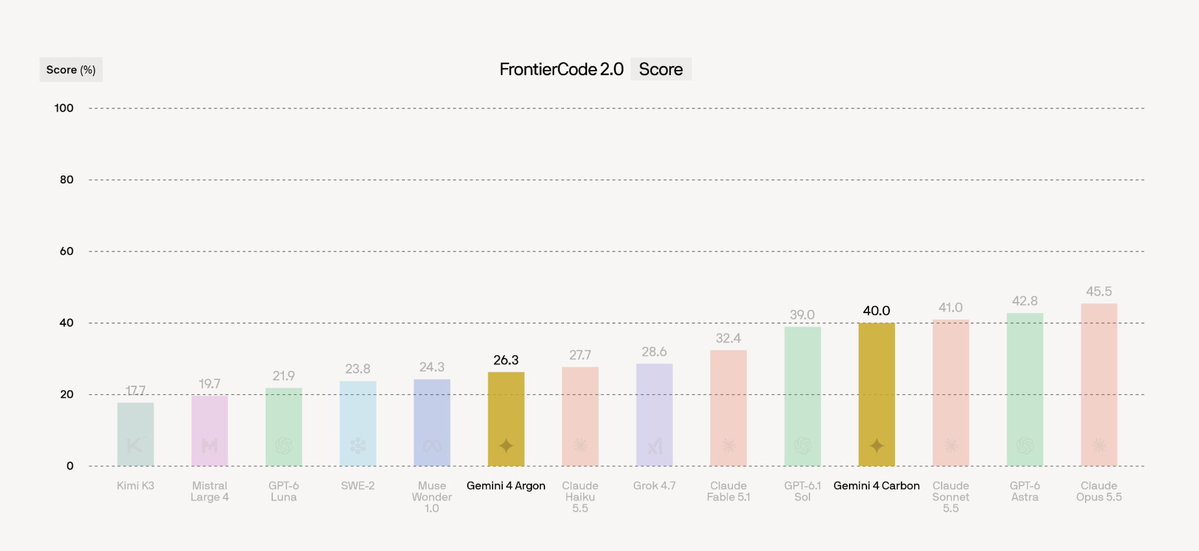
Cognition, the company behind Devin, posted on X at 01:45 UTC on Oct 30 that Google's new Gemini 4 Carbon scores 40% on its FrontierCode 2.0 coding benchmark at $4.04 per task, near the top and behind only Claude Opus 5.5, GPT-6 Astra and Claude Sonnet 5.5. The earlier Gemini 4 Argon scores 26.3% at a higher $6.41 per task. The results are Cognition's own runs, and the leaderboard on its site has been updated.
Key Takeaways
- ✓Gemini 4 Carbon scores 40% on FrontierCode 2.0 at $4.04 per task, behind Claude Opus 5.5 (45.5%), GPT-6 Astra (42.8%) and Claude Sonnet 5.5 (post)
- ✓Gemini 4 Argon scores 26.3% at $6.41 per task, ahead of Muse Wonder 1.0 but behind Claude Haiku 5.5 and Grok 4.7
- ✓From Argon to Carbon the score rises about 13.7 points while cost per task drops about $2.37
- ✓The changelog shows Gemini 4 Carbon was added on Oct 28; FrontierCode 2.0 has 132 tasks scored on whether a maintainer would merge the PR (leaderboard)
- ✓All figures are Cognition's own runs; Google has not published FrontierCode results itself
Key Decision Metrics at a Glance
Turn your technical choice into a development budget
Compare 40 dev plans & simulate token costs vs $20/mo subscriptions
Project Links & Resources
Direct AccessIn-Depth Technical Analysis
Background
Most coding benchmarks only check whether code passes tests. FrontierCode, built by Cognition with open-source maintainers, asks something closer to real work: would the maintainer merge this PR? Version 2.0, released Oct 27, expanded to 132 tasks, added security patches and performance work, and raised the bar for mergeability; Claude Opus 5.5 led at 45.5%, so the benchmark is far from saturated. After Google launched Gemini 4 Carbon on Oct 28, the open question for developers was how it handles real codebases, and Cognition has now published its own numbers.
How the benchmark works
The FrontierCode score is a weighted aggregate of rubric items, and any solution that fails a blocking criterion scores 0. Cost is the mean spend per rollout at list API pricing, including public discounts. Internet use is restricted: models may read docs and search error messages like an engineer, but runs that consult solution-bearing sources such as the original PR are scored zero. Cognition's post does not say which reasoning effort or harness Carbon used; the leaderboard lets you expand each model by harness and effort.
Benchmarks
According to Cognition's post, Gemini 4 Carbon scores 40% at $4.04 per task, near the top and behind Claude Opus 5.5, GPT-6 Astra and Claude Sonnet 5.5. At the 2.0 launch Cognition reported 45.5% for Opus 5.5 and 42.8% for GPT-6 Astra; the post does not give Sonnet 5.5's exact score. Gemini 4 Argon scores 26.3% at $6.41 per task, ahead of Muse Wonder 1.0 (24.3%) but behind Claude Haiku 5.5 and Grok 4.7 (28.6%). So Google's newer model gains about 13.7 points on this test while costing about $2.37 less per task. These are Cognition's runs, not Google-reported results.
What developers should do
If you are choosing a base model for a coding agent, Carbon is now the strongest FrontierCode option after the top Anthropic and OpenAI models, and it is cheaper per task than Argon, so it is worth comparing against Opus 5.5 and GPT-6 Astra on your own codebase. The FrontierCode leaderboard plots score against cost, which helps find the best model and reasoning effort for a given budget. A 40% score still means most solutions fall short of the merge bar, so human review and tests remain necessary.
Benchmark side-by-side against alternatives, or calculate monthly token cost vs subscription break-even.
Discussion & Comments
0Sign in to join the discussion
Connect with AI developers to exchange benchmark insights.