
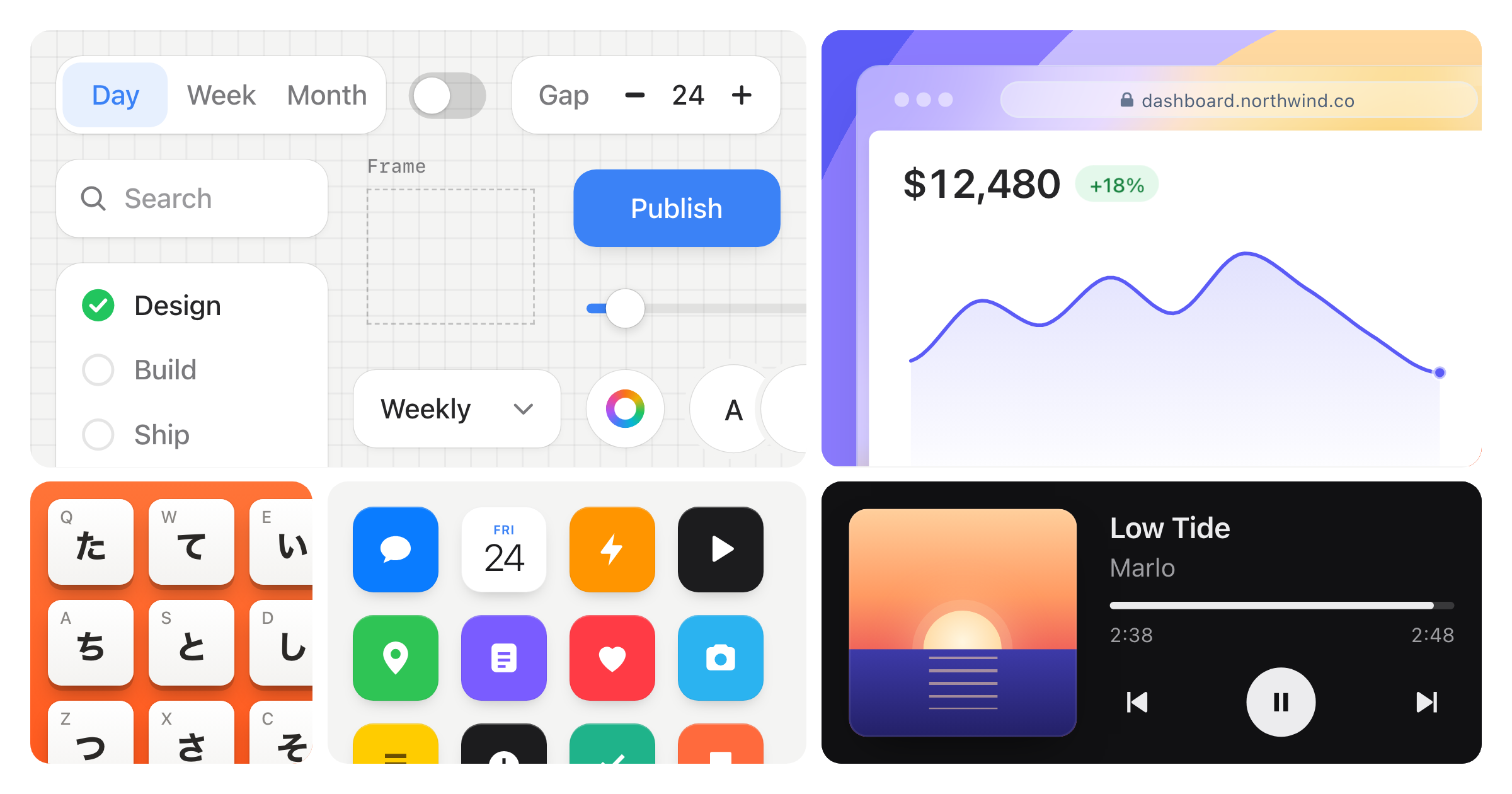
On Oct 31, Benji Taylor, head of design at X and SpaceXSI, released Stageshow on X: an open-source skill (MIT license) for coding agents that helps them produce faux product UI that looks real, including stills, cursor demo animations, and bento grids, delivered as ordinary React components. It installs with one command, and he says it works with Grok Build, Claude Code, Codex, Gemini, and others. The launch post drew about 4,500 likes and 6,500 bookmarks. He notes it rarely nails a demo in one shot and most still take a few rounds of feedback.
Key Takeaways
- ✓Install:
npx skills add benjitaylor/skills --skill stageshow; the author says it works with Grok Build, Claude Code, Codex, Gemini, and other agents (author's post) - ✓Contents: a seven-step workflow in SKILL.md, reference rule docs, dozens of gold examples, a React kit, and self-check scripts such as film.mjs (GitHub)
- ✓License: the stageshow folder is MIT licensed; the repo was created Oct 26 and had about 61 stars at writing time
- ✓Reach: the launch post had about 4,521 likes, 6,561 bookmarks, and 213k views as of Nov 1, 08:00 SGT
- ✓Quality claims are the author's own: the same prompts did better with the skill, but no quantitative evaluation was published
Key Decision Metrics at a Glance
Turn your technical choice into a development budget
Compare 40 dev plans & simulate token costs vs $20/mo subscriptions
Project Links & Resources
Direct AccessIn-Depth Technical Analysis
Background and pain point
The faux UI illustrations and cursor demo animations on landing pages, feature cards, and docs used to be hand-built by designers and take a long time. Today's models can write these React components, but the results are often too busy, too wireframe-like, or shrink a whole window into a card, and they look machine-made. Benji Taylor, head of design at X and SpaceXSI, writes on his blog that he has built many of these by hand: no single step is hard, but there are a hundred small decisions, and Stageshow writes those decisions down so an agent can make them too. Note that this is his personal open-source project, not an official X or SpaceXSI product.
Architecture
Stageshow is a standard agent skill. SKILL.md opens with one core principle and five common failures (too much, wireframe, boxed, flat, bland), then lays out a seven-step workflow: pick the medium and placement, the look, and the story, then start by copying the closest gold example. The references folder covers type, motion, framing, and real-product brand rules; kit is a small set of React parts; and in scripts, film.mjs films a demo into a contact sheet and reports measurements, jumps.mjs catches one-frame snaps, and layout.mjs checks that text fits its boxes. In short, the agent films, reviews, and fixes its own work.
Benchmarks
No quantitative evaluation has been published. The author says he tested it by recreating small moments from everyday apps such as Figma, Gmail, Finder, and Spotify, and the skill consistently beat the same prompts without it, with before-and-after videos; this is his own claim and there is no third-party test.
Getting started
Run npx skills add benjitaylor/skills --skill stageshow in your project, then ask for something small, such as a looping homepage hero demo where someone assigns an issue to a teammate. Running npm install && npm run dev inside the skill folder opens a playground with every example and good-versus-bad comparisons. The author warns that the first pass is usually a big step up from what an agent makes alone, but most demos still take a few rounds of feedback; the output is an ordinary React component you can drop into existing code.
Benchmark side-by-side against alternatives, or calculate monthly token cost vs subscription break-even.
Discussion & Comments
0Sign in to join the discussion
Connect with AI developers to exchange benchmark insights.