
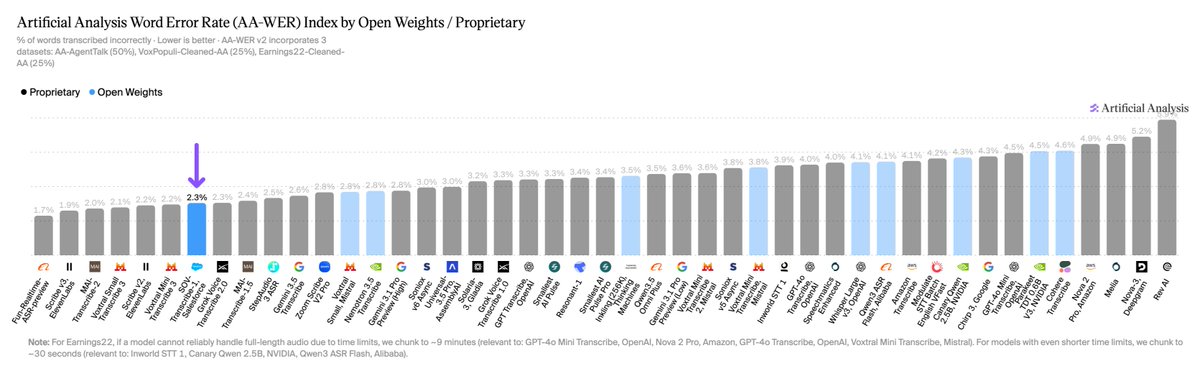
At 00:30 Singapore time on November 13, Artificial Analysis (@ArtificialAnlys) posted that Salesforce's newly released SOV-Transcribe-1 is now the #1 open-weights speech-to-text model: 2.3% word error rate on the AA-WER Index, ranking 7th of 44 models including proprietary ones. That is 0.5 points better than the next open-weights models, Mistral Voxtral Small and NVIDIA Nemotron 3.5 Transcribe (both 2.8%). Built by Salesforce's Missionforce Sovereign AI team, the model has 26.6B total and 4.6B active parameters, pairs a Whisper large-v3 audio encoder with a Gemma 4 26B A4B MoE decoder, and ships on Hugging Face under Apache 2.0. It is non-streaming, so it suits recorded audio rather than live captions.
Key Takeaways
- ✓AA-WER 2.3%: #1 among open-weights models and #7 of 44 overall; Voxtral Small and Nemotron 3.5 Transcribe both score 2.8%
- ✓By dataset: 4.1% on Earnings22 earnings calls (Voxtral Small 4.8%), 1.5% on VoxPopuli (rivals 1.8%), and 1.8% on AA-AgentTalk voice agent conversations, level with Nemotron
- ✓26.6B total / 4.6B active parameters; Whisper large-v3 encoder + projector + Gemma 4 26B A4B MoE; BF16, tested on audio up to 30 minutes, 7 languages (EN, FR, DE, ES, IT, PT, NL)
- ✓Salesforce reports a 76.3% task success rate and 93.4% entity recovery on VoiceCodeBench (phone numbers, emails), #2 of 23 systems; 8.21% average WER across 14 English accents on AppTek, lowest on 8 of them including Singaporean English
- ✓Apache 2.0; deploy with a vLLM plugin (vLLM 0.32.0) or Transformers; Salesforce measured up to 1,039 seconds of audio transcribed per second on one RTX PRO 6000 Blackwell with the DFlash draft model
Key Decision Metrics at a Glance
Not enough VRAM? Compare cloud API and self-hosting costs
Compare 40 dev plans & simulate token costs vs $20/mo subscriptions
Project Links & Resources
Direct AccessIn-Depth Technical Analysis
Background and Industry Pain Points
Speech-to-text is the first step for voice agents, meeting notes and call-center QA. If the transcript is wrong, even a strong LLM downstream will get it wrong too, especially for phone numbers, emails and account IDs, where one wrong character fails the whole task. Until now the most accurate transcription has mostly come from closed APIs, while government, finance and healthcare customers often cannot send audio to third-party servers. Salesforce released SOV-Transcribe-1 through its Missionforce Sovereign AI team, pitching accuracy close to top closed services while running entirely on your own infrastructure. Early on November 13 (Singapore time), independent evaluator Artificial Analysis published its results: it is now the best open-weights speech-to-text model.
Architecture Highlights and Mechanism
SOV-Transcribe-1 is not a classic dedicated ASR model but a speech-augmented language model. An OpenAI Whisper large-v3 audio encoder turns 16 kHz audio into features, a projector feeds them into Google's Gemma 4 26B A4B mixture-of-experts language model, and the language model writes the transcript directly. It has 26.6B total parameters with about 4.6B active per token (including the audio encoder), stored in BF16. Because the decoder is a language model, it follows natural-language instructions: you can ask for a verbatim transcript or a cleaned-up one without fillers, and control punctuation, capitalization and number formatting. You can also pass names, domain terms or a topic description for context biasing on hard words. Salesforce also ships a separate DFlash draft model for speculative decoding. Note that it is non-streaming: it transcribes complete recordings, tested up to 30 minutes each.
Benchmarks and Measured Results
On the Artificial Analysis AA-WER Index, SOV-Transcribe-1 scores a 2.3% word error rate (2.28% in Salesforce's blog), 7th of 44 models and 1st among open-weights models. The next open-weights models, Mistral Voxtral Small and NVIDIA Nemotron 3.5 Transcribe, both score 2.8%; Voxtral Small uses about 24B active parameters, more than 5x as many. By dataset: 4.1% on Earnings22 earnings calls (Voxtral Small 4.8%), 1.5% on VoxPopuli parliamentary speech (rivals 1.8%), and 1.8% on AA-AgentTalk voice agent conversations, level with Nemotron. On speed, AA measured a 60x speed factor on Salesforce's hosted endpoint, about 1 second per minute of audio. The following figures come from Salesforce: on VoiceCodeBench (phone numbers, emails, URLs and other entities) it reaches a 76.3% task success rate and 93.4% entity recovery, #2 of 23 systems and #1 among open models; on AppTek call-center dialogues across 14 English accents it averages 8.21% WER and is lowest on 8 accents, including Australian, British, Indian and Singaporean English; on HALAS, a set of hard real earnings-call audio, it scores 25.69%, below Qwen3-ASR 1.7B (26.01%) and Voxtral Small (27.35%).
Developer Guide
Weights are on Hugging Face at salesforce-sovereign-intelligence/SOV-Transcribe-1 under Apache 2.0, so commercial use is allowed. Native vLLM and Transformers support is still being upstreamed: for vLLM, install the plugin in the repo's vllm_plugin folder (it installs vLLM 0.32.0); for Transformers, use a version from 5.19 up to 5.23 with trust_remote_code enabled. Salesforce measured up to 1,039 seconds of audio transcribed per second on one 96 GB RTX PRO 6000 Blackwell with the DFlash draft model, returning a 30-second clip in 0.22 seconds. With about 26.6B parameters in BF16, plan for 80 GB or more of GPU memory for single-GPU serving. Good fits: recorded audio, meeting notes, call-center QA, and voice forms that must capture phone numbers and emails exactly. Poor fits: live captions or low-latency voice assistants, which still need a streaming model.
Benchmark side-by-side against alternatives, or calculate monthly token cost vs subscription break-even.
Discussion & Comments
0Sign in to join the discussion
Connect with AI developers to exchange benchmark insights.