AI Coding Live News

Suhail launches Particle and its first model, Particle-1: a DeepSeek V4.1 Flash post-train that uses about 45% fewer tokens on coding tasks

On Oct 28, Mixpanel founder Suhail Doshi announced his new company Particle on X, with its first model, Particle-1, live now. Particle's blog says it is a reinforcement-learning post-train of DeepSeek V4.1 Flash that uses 28.4% to 52.2% fewer output tokens and costs 34.4% to 51.6% less per task across four coding and data engineering benchmarks, with pass rates inside the base model's confidence intervals. It is available through the Particle API, OpenRouter and Vercel AI Gateway; Particle's docs list $0.25 input and $1.00 output per million tokens with a 1,048,576-token context window.

Suhail launches Particle and its first model, Particle-1: a DeepSeek V4.1 Flash post-train that uses about 45% fewer tokens on coding tasks

Key Takeaways

  • Across four benchmarks (Terminal-Bench 2.1, ReactBench, ADE Bench, DeepSWE 1.1), 28.4% to 52.2% fewer output tokens and 34.4% to 51.6% lower cost per task (vendor-reported)
  • Particle's summary table: $0.2211 per task versus $0.3368 for DeepSeek V4.1 Flash and $0.6523 for GLM 5.3 Flash; 59,580 mean output tokens versus 83,246 and 98,155
  • Task pass rate 72.57% versus 71.15% for the base model and 66.82% for GLM 5.3 Flash; GPQA Diamond 90.40% (base 90.91%), MMLU 86.08% (base 85.98%)
  • Training: a rank-64 LoRA on the experts in all layers, about 1.25% of the model's parameters, trained with sequence-level GSPO in two RL stages
  • Pricing: Particle docs currently list $0.25 input, $0.03 cached input and $1.00 output per million tokens, a 1,048,576-token context and a 131,072-token output ceiling
Read full story

Inception launches Mercury 3 diffusion LLM: 1,068 tokens/s and 1M context, beating GPT-6 Luna and Haiku 5.5 on several benchmarks per the vendor

On October 19 Inception released Mercury 3, which it calls the most capable diffusion LLM (dLLM) to date. Per the vendor, it is more than 40x the size of Mercury 1, outputs 1,068 tokens/s, expands context from 260K (Mercury 2.5) to 1M tokens, and beats GPT-6 Luna and Claude Haiku 5.5 (both medium) on GPQA Diamond, IFBench, SWE-Bench Atlas and more. List price is $0.20/M input and $0.70/M output, 50% off at launch. It is live on the Inception API, OpenRouter, Baseten and Vercel AI Gateway with an OpenAI-compatible API. All scores are vendor-reported and not yet independently reproduced.

Inception launches Mercury 3 diffusion LLM: 1,068 tokens/s and 1M context, beating GPT-6 Luna and Haiku 5.5 on several benchmarks per the vendor

Key Takeaways

  • Speed: 1,068 tokens/s output; the vendor table lists GPT-6 Luna at ~130 and Haiku 5.5 at ~240 (vendor figures).
  • Scores: GPQA Diamond 89.23, IFBench 76.84, SWE-Bench Atlas 51.08, all above Luna and Haiku 5.5; but DeepSWE v1 at 46.31 trails Haiku 5.5 (51.62), and MRCR v2 also trails Haiku.
  • Scale and context: more than 40x the parameters of Mercury 1, with a 1M-token window (260K on Mercury 2.5).
  • Price: $0.20/M in and $0.70/M out list, 50% off at launch ($0.10/$0.35), cached input 90% off; new API keys get 100M free tokens.
  • Access: Inception API, OpenRouter, Baseten and Vercel AI Gateway, OpenAI-compatible as a drop-in replacement.
Read full story

Perplexity Releases Open-Weight Multimodal Decision Models pplx-decider-v1.2 (27B) and Flash (4B) on OpenRouter and Vercel AI Gateway

Perplexity Developers (@perplexitydevs) announced the launch of pplx-decider-v1.2 (27B) and pplx-decider-flash-v1.2 (4B) across OpenRouter and Vercel AI Gateway. Taking both text and images as input, these open-weight multimodal decision models return typed answers with calibrated probabilities at just $0.02 per million input tokens for the 27B checkpoint and half the cost for the 4B Flash variant.

Perplexity Releases Open-Weight Multimodal Decision Models pplx-decider-v1.2 (27B) and Flash (4B) on OpenRouter and Vercel AI Gateway

Key Takeaways

  • Dual open-weight multimodal decision models: launches 27B pplx-decider-v1.2 and 4B pplx-decider-flash-v1.2 taking text or images and returning typed answers with probabilities
  • Ultra-low $0.02/1M token pricing: 27B checkpoint costs $0.02 per million input tokens, while 4B Flash runs faster at half the price
  • Live on OpenRouter and Vercel AI Gateway: provides drop-in rolling aliases for low-latency agent routing and multimodal classification
Read full story
Linked Models & Agents:

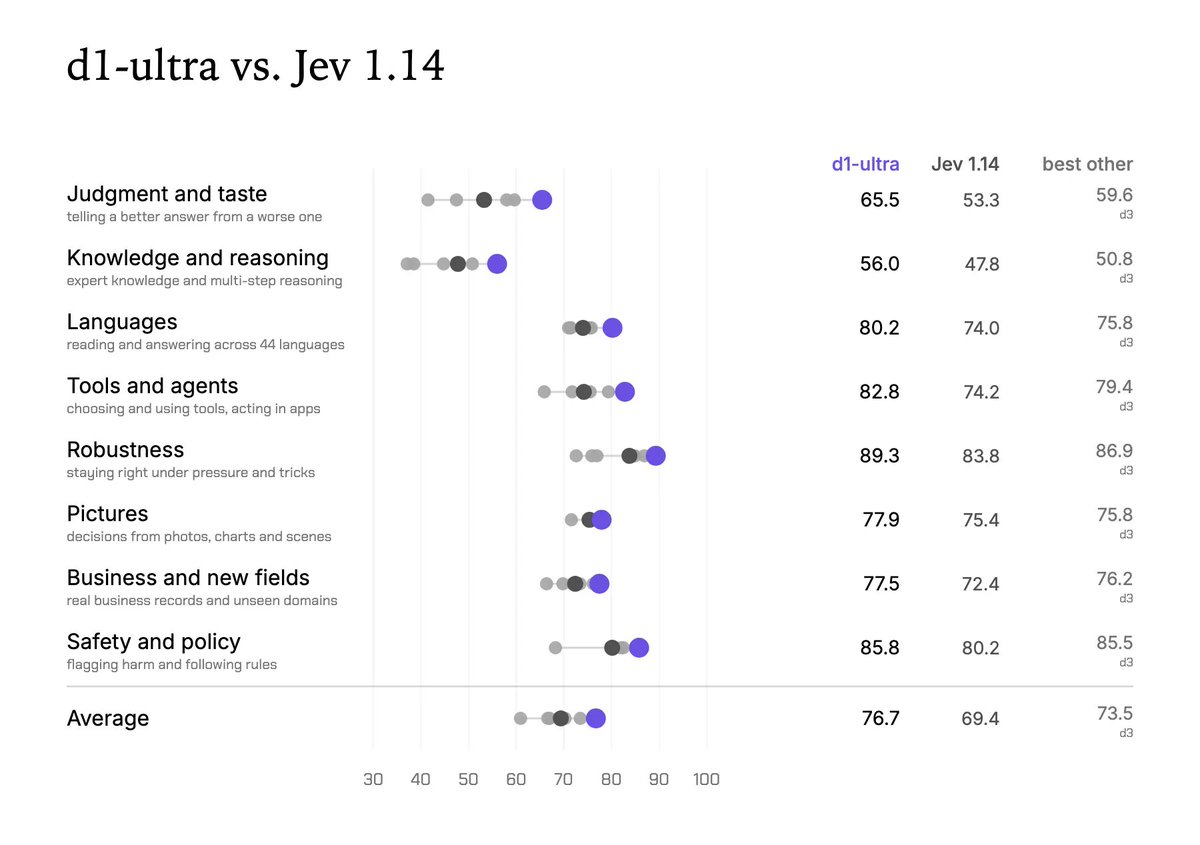
Liquid AI releases d1-ultra decision model: calibrated probabilities with zero generated tokens, #1 on Artificial Analysis Decision Index (65), $0.042 per M input tokens

Liquid AI released d1-ultra on Oct 15: a multimodal decision model that takes text and images and, in one forward pass, returns probabilities for yes/no, choice and score questions without generating tokens; billed on input only. Artificial Analysis ranks it #1 on Decision Index v1.0 at 65, at least 8 points ahead, with an 85% non-hallucination rate. Available on the Liquid API, Vercel AI Gateway and OpenRouter.

Liquid AI releases d1-ultra decision model: calibrated probabilities with zero generated tokens, #1 on Artificial Analysis Decision Index (65), $0.042 per M input tokens

Key Takeaways

  • Artificial Analysis Decision Index v1.0: 65, ranked #1 and at least 8 points ahead (independent)
  • AA-Omniscience-Decision non-hallucination 85% vs 40% for runner-up Microsoft-Decision-1; more abstention drops accuracy to 32% vs d1's 41%
  • $0.042 per M input tokens, output free; a 1024x1024 image counts as 1,536 tokens
  • 32,768-token context, 44 languages, leads all eight categories of Liquid's 112-eval suite (vendor)
  • Call via Liquid /decisions/v1/systemone with model d1-ultra, or liquid/d1-ultra on Vercel AI Gateway / OpenRouter
Read full story
Linked Models & Agents:
ADSponsored

InclusionAI Ling-3.1-flash: 560B/25B-active MoE; vendor SWE-Pro 65.39 & CyberGym 87.9; free on Vercel/OpenCode through Oct 13

On 2026-09-30 InclusionAI (Ant Group) announced Ling-3.1-flash: ~560B total / ~25B active MoE hybrid-reasoning model, designed for up to 1M context (trial/gateway routes often expose 256K–262K). Weights are not on Hugging Face yet. Vercel AI Gateway and OpenCode Zen list limited-time free access (~through 2026-10-13). Vendor-reported scores include SWE-Pro 65.39, Terminal-Bench 4.0 40.40, CyberGym 87.90—not independently reproduced.

InclusionAI Ling-3.1-flash: 560B/25B-active MoE; vendor SWE-Pro 65.39 & CyberGym 87.9; free on Vercel/OpenCode through Oct 13

Key Takeaways

  • Scale: ~560B total / 25B active (vs Ling-3.0-flash 124B/5.1B); design target 1M context; trial/gateway often 256K–262K
  • Architecture (vendor summary): 7×KDA : 1×Gated MLA; 512 routed experts pick 8 + 1 shared
  • Vendor benches (unreproduced): SWE-Pro 65.39, TB4.0 40.40, CyberGym 87.90, BrowseComp 91.67
  • Access: Vercel AI Gateway inclusionai/ling-3.1-flash(-free) via Novita free ~to Oct 13; OpenCode Zen ling-3.1-flash-free
  • Caveats: no public weights yet; free routes may use data to improve the model; some scores are environment-qualified
Read full story

Cloudflare Web Search API open beta: Ceramic/Exa/Linkup via AI Gateway for structured agent grounding

On 2026-10-02 Cloudflare launched Web Search API (open beta): agents query the live web through AI Gateway and get structured titles/URLs/snippets. Default Ceramic.ai ($0.25/1k, ZDR); Exa ($7) and Linkup ($5) also available. Partners meet Verified-bot rules; REST, Workers env.AI.websearch(), BYOK, list pricing with no markup.

Cloudflare Web Search API open beta: Ceramic/Exa/Linkup via AI Gateway for structured agent grounding

Key Takeaways

  • Announced 2026-10-02; docs https://developers.cloudflare.com/web-search/ (open beta)
  • Providers: ceramic default $0.25/1k ZDR; exa $7/1k with highlights; linkup $5/1k fast mode
  • Surfaces: REST /ai/websearch/ and Workers env.AI.websearch(); AI Gateway credits, no markup; BYOK supported
  • Crawlers meet Verified-bot rules and return source links; Server Tools for web search coming
  • Replaces guess-then-curl URL fetches for live grounding (e.g. Birthday Week docs)
Read full story

Cloudflare OS open-sourced: company agent workspace with Gatekeeper capability security (10k+ GitHub stars)

On 2026-10-01 Cloudflare open-sourced Cloudflare OS (github.com/cloudflare/cloudflare-os, Apache-2.0): a browser agent workspace with company context/skills, modifiable Gadgets, and a Gatekeeper capability-security layer (zero default access, observation-following policy, deferred simulated approvals). Deploy via starter or https://os.cloudflare.app/deploy; inference through AI Gateway.

Cloudflare OS open-sourced: company agent workspace with Gatekeeper capability security (10k+ GitHub stars)

Key Takeaways

  • Announced 2026-10-01; github.com/cloudflare/cloudflare-os Apache-2.0; >10k stars near launch (GitHub API)
  • Trio: context-grounded agent workspace + Gatekeepers + per-user Gadgets (Dynamic Worker Facets + SQLite)
  • Security: zero default access; credentials isolated; egress only via bindings; observation log follows sharing/egress
  • Gatekeepers can simulate side effects and defer bulk approval vs sync HITL or auto-approve
  • Try: pnpm run-local, os.cloudflare.app/deploy, cloudflare-os-starter; AI Gateway for models/budgets; early access
Read full story
Linked Models & Agents:

OpenCode 1.18.33: Cloudflare AI Gateway honors timeouts, MCP browser launch failures surface, debug config redacts credentials

OpenCode v1.18.33 (2026-09-28) makes Cloudflare AI Gateway models honor provider response/stream timeouts, reports MCP browser launcher exits, redacts credentials in debug config output, and aligns Gemini thinking defaults/effort options with supported controls across model generations.

OpenCode 1.18.33: Cloudflare AI Gateway honors timeouts, MCP browser launch failures surface, debug config redacts credentials

Key Takeaways

  • Shipped v1.18.33 — CF AI Gateway timeouts honored
  • MCP browser launcher immediate-exit failures reported
  • Debug config redacts credentials/sensitive headers
  • Gemini thinking defaults/effort aligned across generations
Read full story
Linked Models & Agents:

Vercel: Grok 4.7 on AI Gateway with 40% off through September 27

@vercel announced Grok 4.7 is available on Vercel AI Gateway with 40% off through September 27, and can be tried with v0, eve, and fx. For developers building apps and coding agents on the Vercel stack, this lowers the cost of trying Grok 4.7.

Key Takeaways

  • Grok 4.7 is live on Vercel AI Gateway.
  • 40% off on AI Gateway through September 27.
  • Try it with v0, eve, and fx.
Read full story

Databricks Unity Gateway on Neon: claimed fastest AI Gateway for Kimi K3

Databricks engineer Yuchen Jin says Databricks Unity Gateway is coming to developers on Neon (@neondatabase) and calls it the fastest AI Gateway for Kimi K3, noting Databricks inference is moving quickly. For teams building agents/apps on Neon that need low-latency Moonshot Kimi K3 access, this is a new managed gateway path.

Key Takeaways

  • Unity Gateway is being brought to Neon developers and called the fastest AI Gateway for Kimi K3.
  • Targets teams building agents/apps on Neon that need low-latency Kimi K3 inference.
  • Source: @Yuchenj_UW on 2026-09-19; notes Databricks inference velocity.
Read full story
ADSponsored

Vercel: TypeSafe Jev is the fastest-adopted model in AI Gateway history

Vercel reports TypeSafe Jev became the fastest-adopted model in AI Gateway history within 24 hours of launch: nearly 13% of paid teams on day one, about 2x the GPT-5.6 family and over 6x Fable 5.1. It crossed 10% of teams in about 18 hours, while other recent launches stayed below 7% after a full day. The post frames durability of that early lead as the next test.

Key Takeaways

  • Official: Jev reached ~13% of paid AI Gateway teams on day one, the fastest adoption on record.
  • About 2x GPT-5.6 family and 6x+ Fable 5.1; ~10% of teams within 18 hours.
  • Details at vercel.com/blog/ai-gateway-jev-model-launch; next question is whether the lead lasts.
Read full story
Linked Models & Agents:

Cline ships jev-browser plugin: give TypeSafe Jev a background Chrome in Desktop

Cline released a Marketplace plugin named jev-browser that gives TypeSafe Jev a background Chrome inside Cline Desktop. After installing and saving a Vercel AI Gateway API key, browser tasks can launch Chrome in the background; the team says results have been striking.

Key Takeaways

  • Install jev-browser from Cline Desktop Marketplace under Customize > Plugins.
  • Save a Vercel AI Gateway API key to ~/.cline/plugins/cline-jev-browser.config.json and restart.
  • Browser tasks launch Chrome in the background, pairing Jev decisions with real web actions.
Read full story

OpenRouter lists TypeSafe Jev in beta: typed probabilistic decisions, no JSON prompting

OpenRouter announced TypeSafe Jev is available in beta. Jev is framed as a System One model: given app state plus a typed question, it returns a typed decision with a probability—no JSON prompting, parsing layer, or schema validation. Developers can now route Jev through OpenRouter in addition to the earlier Vercel AI Gateway path.

Key Takeaways

  • Jev is live in beta on OpenRouter for typed probabilistic decisions over app state, not free-form text.
  • No JSON prompting, parsing, or validation layer is required, cutting structured-output friction for agents.
  • Complements the earlier Vercel AI Gateway listing so teams can route the same decision model across gateways.
Read full story
Linked Models & Agents:

Vercel AI Gateway Sept index: open-weight models hit 56% tokens; Astra doubles Fable 5.1 spend

Vercel published its AI Gateway Production Index for September 2026 (data through August). Open-weight models processed a majority of gateway tokens for the first time, rising from 7% in December to 56% in August, while average token price fell another 23.2%. A special report says GPT-6 Astra took 7.7% of all gateway spend in its first twelve days, roughly twice Fable 5.1 at 3.7%.

Key Takeaways

  • Open-weight models ran 56% of AI Gateway tokens for the first time, up from under 10% in December 2025.
  • Average token price fell another 23.2% in August, the third straight monthly drop; median spend for high-volume teams fell 7.6%.
  • GPT-6 Astra took 7.7% of all gateway spend in its first twelve days, about twice Fable 5.1, and a third of OpenAI spend within two days.
Read full story

TypeSafe Jev now live on Vercel AI Gateway as a probabilistic decision model

TypeSafe AI said Jev is now available on Vercel AI Gateway. Jev is a probabilistic decision model for software: state goes in, declared questions are evaluated in parallel, and typed Choice, Score, and Boolean answers come back with probabilities—skipping generate-then-parse. TypeSafe reports up to 193.6× faster and 444.6× cheaper than LLMs on its workflow evaluations. Use cases include choosing the next tool or subagent, continue/retry/ask/stop, urgency/risk scoring, and output guardrails. AI SDK 7 (7.0.105+) exposes it via experimental evaluate with model typesafe-ai/jev; Zero Data Retention and No Training can be enabled per request, and calls appear in Gateway logs and budgets.

Key Takeaways

  • Jev is live on Vercel AI Gateway: parallel typed Choice/Score/Boolean answers with probabilities
  • TypeSafe reports up to 193.6× faster and 444.6× cheaper than LLMs on workflow evals
  • AI SDK 7 evaluate API uses typesafe-ai/jev; per-request ZDR/No Training; counts toward Gateway budgets
Read full story
Linked Models & Agents: