AI Coding Live News

Meituan ships LongCat-2.5, a 1.6T-parameter (about 48B active) native multimodal agentic model, with API pricing of $0.30/$1.20 per 1M tokens

On Nov 2 Meituan's LongCat team listed LongCat-2.5 in its API platform change log as the full release of September 25's LongCat-2.5-Preview. The official technical blog says it has 1.6 trillion total parameters with about 48 billion activated per token, builds on LongCat-2.0 with stronger native visual understanding and agentic coding, and was trained and served with W4A4 inference on domestic AI accelerators. Vendor-reported scores include 88.4 on Terminal Bench v2.1, 38.5 on Terminal Bench v4.0, 91.9 on BrowseComp and 83.1 on MCP Atlas. The API speaks both OpenAI and Anthropic formats with a 1M-token context and up to 128K output tokens, at a limited-time price of $0.30 per 1M uncached input tokens, $0.006 cached input and $1.20 output.

Meituan ships LongCat-2.5, a 1.6T-parameter (about 48B active) native multimodal agentic model, with API pricing of $0.30/$1.20 per 1M tokens

Key Takeaways

  • Scale: a 1.6-trillion-parameter MoE with about 48B active per token, a 1M-token context and up to 128K output tokens (official blog, API docs)
  • Code agents (vendor-reported): Terminal Bench v2.1 88.4 (Claude Opus 5 89.1, GPT-5.6-Sol 88.8), Terminal Bench v4.0 38.5 (GPT-5.6-Sol 37.3, Claude Opus 5 53.9), DeepSWE v1.1 64.6
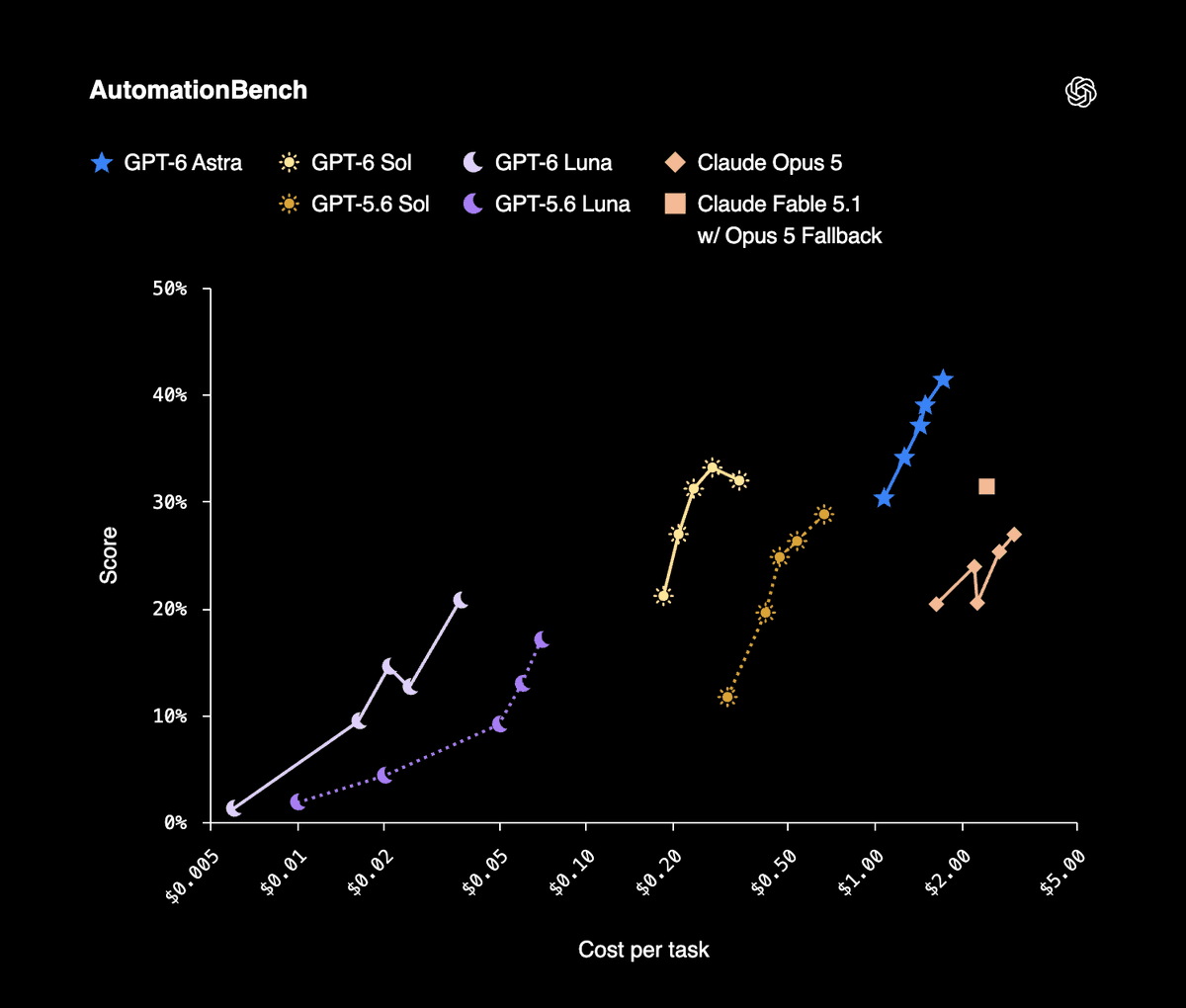
  • General agents (vendor-reported): BrowseComp 91.9, MCP Atlas 83.1, AutomationBench v1.0.6 51.8, HLE with tools 63.1; AutomationBench jumps from 15.8 on LongCat-2.0
  • Pricing: limited-time $0.30 per 1M uncached input tokens, $0.006 cached input and $1.20 output (pricing page)
  • Engineering: W4A4 inference raises prefill throughput 43.3% and decode throughput 42.77% over a W8A8 baseline; FSDP gives 86% higher per-device throughput than DDP in long-sequence SFT
Read full story

OpenAI launches GPT-6.1 Terra: fast, low-cost computer use at $1/$5 per million tokens, half the price of GPT-5.6 Terra and GPT-6.1 Sol

On Oct 26 OpenAI released GPT-6.1 Terra, an efficient model for visual reasoning, precise computer use and natural writing. It is rolling out today to Plus, Pro, Enterprise and Edu users in ChatGPT Work and Codex, and in the API as gpt-6.1-terra. Standard API pricing is $1 input, $0.05 cached input and $5 output per million tokens, which OpenAI says is 50% lower than GPT-5.6 Terra and GPT-6.1 Sol, with a 1,050,000-token context window. By OpenAI's figures it scores 15 points higher than GPT-5.6 Terra on Agents' Last Exam at medium effort for about a third of the cost, and solves 50.3% of Terminal-Bench 4.0 at max effort.

OpenAI launches GPT-6.1 Terra: fast, low-cost computer use at $1/$5 per million tokens, half the price of GPT-5.6 Terra and GPT-6.1 Sol

Key Takeaways

  • Pricing (official docs): $1 input, $0.05 cached input, $1.25 for 30-minute cache writes and $5 output per million tokens; requests over 272K input tokens are billed at 2x input and 1.5x output; Batch/Flex are half price and Fast mode is 2x
  • Specs: 1,050,000-token context, 922,000 max input and 128,000 max output tokens, Jun 1 2026 knowledge cutoff; reasoning.effort from none to max, and tool calling requires the Responses API
  • Computer use (OpenAI figures): on Agents' Last Exam at medium effort it beats GPT-5.6 Terra by 15 points at about one-third the cost, and matches GPT-6 Astra at one-tenth the price per token; it finishes tasks over 3x faster than GPT-6 Astra and GPT-6.1 Sol
  • Coding and factuality (OpenAI figures): 50.3% on Terminal-Bench 4.0 at max effort, more than double GPT-5.6 Terra's published 21.5%; error rate on an internal error-inducing prompt set fell from 53.6% to 16.7% at low effort
  • Safety: OpenAI says it meets the Critical cybersecurity threshold under its Preparedness Framework and keeps the safeguards built for GPT-6 Astra
Read full story

Moonshot launches Kimi K3.1 Pro: 2.8T-total / 104B-active open-weight MoE with 1M context, 65.7% on Terminal-Bench 4.0, API at $2/$10, weights by Nov 4

On 2026-10-23 (17:15 UTC) the official @Kimi_Moonshot account launched Kimi K3.1 Pro, alongside K3.1 Pro Highspeed (2-3x faster). Both are live on Kimi.ai, Kimi Work, Kimi Code and the Kimi API, and full weights are promised by 2026-11-04. The official tech blog describes it as a post-trained version of K3 with much larger multi-domain joint RL: a 2.8T-total / 104B-active MoE, 1M-token context, multimodal. Vendor-reported scores: 65.7% on Terminal-Bench 4.0 (GPT-6 Astra 58.2%, Claude Opus 5.5 66.4%) and 92.7% on BenchCAD with tools. The Kimi API pricing page lists kimi-k3.1-pro at $2 input, $10 output and $0.20 cached input per million tokens, down from K3 at $3/$15.

Moonshot launches Kimi K3.1 Pro: 2.8T-total / 104B-active open-weight MoE with 1M context, 65.7% on Terminal-Bench 4.0, API at $2/$10, weights by Nov 4

Key Takeaways

  • 2.8T-total / 104B-active MoE, 1M-token context, multimodal; full weights promised by 2026-11-04 (official blog)
  • Vendor-reported: 65.7% on Terminal-Bench 4.0, ahead of GPT-6 Astra (58.2%) and just behind Claude Opus 5.5 (66.4%); 61.2% on the internal Kimi Code Bench 3.0 Long-horizon (K3: 55.95%)
  • API pricing: kimi-k3.1-pro at $2 input / $10 output / $0.20 cached input per million tokens; Highspeed at $4 / $20 (pricing page)
  • On the internal Kimi Hallu Bench Hard stress test, claim-level hallucination fell from 23.4% (K3) to 8.3%; Moonshot notes this is not a daily-use error rate
  • Cyber-related data was removed from mid-training and RL for the open-weight release: xdev-bench-hard pass@3 drops from 90.5% (unmitigated checkpoint) to 81.0%
Read full story
Linked Models & Agents:

Inception Unveils Mercury 3: Diffusion-Based LLM Breaks 1,000+ Tok/s with 1M Context Window

Inception co-founder Stefano Ermon officially unveiled Mercury 3, the company's next-generation diffusion-based large language model. Delivering an astonishing 1,068 tokens per second inference speed on NVIDIA GPUs, Mercury 3 scales to 40x the size of Mercury 1 with a native 1M context window. Benchmarked on IFBench, GPQA Diamond, and SWE-Bench Atlas, it matches frontier closed baselines with standard API pricing of $0.20 / $0.70 per 1M input/output tokens (with 50% promotional pricing of $0.10 / $0.35).

Inception Unveils Mercury 3: Diffusion-Based LLM Breaks 1,000+ Tok/s with 1M Context Window

Key Takeaways

  • Inception co-founder Stefano Ermon officially launched Mercury 3, a diffusion LLM generating 1,068 tokens per second on NVIDIA GPUs
  • Scales model size by 40x over Mercury 1 with a native 1M context window; priced at $0.20 / $0.70 per 1M tokens ($0.10/$0.35 promotional)
  • Triples baseline intelligence on IFBench, GPQA Diamond, and SWE-Bench Atlas, with live availability via OpenRouter
  • Bypasses autoregressive sequential bottlenecks via parallel diffusion denoising, accelerating multi-step agent workflows
Read full story
Linked Models & Agents:
ADSponsored

MiniMax Releases M3.1 Flash: 1M Context Window, $0.15/M Token Pricing, Surging +106 Points in WebDev Code Arena

MiniMax officially announced M3.1 Flash, its next-generation lightweight frontier model (previously dominating leaderboards as the secret model Space Bunny across 200T+ tokens). Featuring a native 1M context window, flat-rate API pricing of $0.15 / $0.60 per 1M input/output tokens ($0.015 cache reads), and 3x faster inference at 1/3 the cost of M3. It surged +106 points to 1588 on LMSYS Code Arena: WebDev (#12 among open models), with full weights set for open release on October 23.

MiniMax Releases M3.1 Flash: 1M Context Window, $0.15/M Token Pricing, Surging +106 Points in WebDev Code Arena

Key Takeaways

  • MiniMax officially launched M3.1 Flash, unveiling that it was the mystery model Space Bunny evaluated across 200T+ tokens
  • Features native 1M context with flat-rate API pricing of $0.15/$0.60 per 1M tokens ($0.015 cache reads), offering 3x speed at 1/3 cost of M3
  • Debuts on LMSYS Code Arena: WebDev at 1588 Elo (+106 pts over M3), ranking #12 among open models with major leaps in Gaming (+179) and Reference Design (+155)
  • Artificial Analysis benchmark confirms Intelligence Index of 42 and HLE of 48% at half the token consumption of rivals; weights release on Oct 23
Read full story
Linked Models & Agents:

Liquid AI open-sources LFM2.5-24B-A2B: a 24B-total, ~2B-active reasoning MoE built for on-device agents and tool use

On Oct 13 Liquid AI released LFM2.5-24B-A2B, the largest and final LFM2.5 model: 24B total parameters, ~2.45B active per token, 131K context, and always-on reasoning. By Liquid's own numbers it leads or matches Qwen3.6-35B-A3B on 5 of 8 tool-use/agent benchmarks (AutomationBench 27.69 vs 8.72) while trailing on SWE-Bench Verified, GPQA and other knowledge/coding tests. Open weights are on Hugging Face with GGUF, MLX, FP8 and ONNX builds; API pricing is $0.10 / $1.00 per million tokens and it is also on OpenRouter.

Liquid AI open-sources LFM2.5-24B-A2B: a 24B-total, ~2B-active reasoning MoE built for on-device agents and tool use

Key Takeaways

  • Specs (model card): 24.0B total / 2.45B active, 40 layers (30 gated short-conv + 10 GQA), 64 experts top-4, 131,072 context, 128K vocab
  • Agent benchmarks (vendor-reported, vs Qwen3.6-35B-A3B): AutomationBench 27.69 vs 8.72, LiveClaw 48.09 vs 38.19, ToolSandbox 80.71 vs 75.02, BFCLv4 65.01 vs 65.00
  • Disclosed weaknesses: SWE-Bench Verified (OpenCode) 51.00 vs 66.20, GPQA Diamond 74.42 vs 83.69, WebArena Verified 26.75 vs 37.62
  • Speed: 184 tok/s decode on Apple M5 Max, 114 tok/s on Ryzen AI Max+ 395, 21K+ output tok/s on one B300 with SGLang
  • Training: pretraining scaled 17T to 33T tokens; agentic RL inside OpenClaw, Hermes Agent, Pi and OpenCode; API $0.10 in / $1.00 out per M tokens
Read full story
Linked Models & Agents:
⚡ LFM2.5-24B-A2B⚡ LFM2.5-24B-A2B-Base⚡ LFM2-24B-A2B⚡ Qwen3.6-35B-A3B⚡ Gemma-4-26B-A4B-it🤖 Hermes Agent🤖 OpenClaw🤖 OpenCode🤖 Pi🌐 Liquid AI🌐 Hugging Face🌐 OpenRouter

Claude Code 2.1.280: default Opus is Opus 5.5 (1M context) at $4/$20 per MTok

Claude Code changelog account (@ClaudeCodeLog) said 2.1.280 shipped with 114 CLI changes. The official CHANGELOG adds Claude Opus 5.5 (claude-opus-5-5) as the default Opus model with a 1M context window and API pricing of $4/$20 per million tokens plus $0.20/MTok cache reads. Auto mode also denies once on declined safety reviews and backs off on silent checks to avoid retry loops.

Claude Code 2.1.280: default Opus is Opus 5.5 (1M context) at $4/$20 per MTok

Key Takeaways

  • Default Opus model is now Claude Opus 5.5 (claude-opus-5-5) with 1M context.
  • API pricing $4/$20 per MTok; cache reads $0.20/MTok.
  • Auto mode denies once on declined safety reviews and backs off on silent checks.
Read full story

Anthropic launches Claude Opus 5.5: kicks off 5.5 family with 40% cost reduction and 30%+ speedup

Anthropic officially launched Claude Opus 5.5 as the frontier pioneer of the new Claude 5.5 family. Benchmark audits show Opus 5.5 matches previous flagship Claude Fable 5.1 on core agentic coding and reasoning tasks while slicing operating costs by 40% compared to Opus 5. API pricing is set at $4/M input and $20/M output with $0.20/M prompt cache reads.

Key Takeaways

  • Flagship launch kicking off Claude 5.5 family, matching Claude Fable 5.1 performance on primary workflows.
  • Operating costs slashed by ~40% with over 30% faster token output speed.
  • API pricing at $4/M input, $20/M output, and $0.20/M prompt cache reads ($5/M cache write).
  • Highest automated behavioral safety audit score recorded by Anthropic to date.
Read full story
Linked Models & Agents:

OpenAI launches GPT-6 Sol & Luna: dual enterprise workhorses cut API pricing by 50% down to $0.10/M

OpenAI introduced GPT-6 Sol and GPT-6 Luna, faster and more affordable models that carry forward much of GPT-6 Astra’s strength for work at scale. Caching and inference efficiency cuts yield 50% lower API prices versus GPT-5.6 promotional pricing: Sol is priced at $2/$10 per million tokens for deep reasoning, while high-volume Luna costs just $0.10/$0.50 per million tokens with a 90% prompt caching discount.

OpenAI launches GPT-6 Sol & Luna: dual enterprise workhorses cut API pricing by 50% down to $0.10/M

Key Takeaways

  • Tiered dual-model architecture: Sol for deep reasoning and complex coding agents, Luna for ultra-high-throughput workflows.
  • 50% price slash: Sol at $2/$10 per million tokens; Luna down to $0.10/$0.50 with 90% prompt caching discount.
  • Available immediately in OpenAI API (gpt-6-sol, gpt-6-luna), ChatGPT Work, and Codex.
Read full story
Linked Models & Agents:

Anthropic makes Claude Sonnet 5 $2/$10 MTok pricing permanent; Sep 1 bump to $3/$15 canceled

Anthropic’s API pricing docs now state Claude Sonnet 5’s launch $2/$10 per million input/output tokens (introductory through Aug 31, 2026) is the standard price. The previously scheduled Sep 1, 2026 increase to $3/$15 will not occur—good news for teams budgeting coding agents and APIs around Sonnet 5.

Key Takeaways

  • Docs: Sonnet 5 stays $2 input / $10 output per MTok as standard, not intro-only.
  • Scheduled Sep 1, 2026 rise to $3/$15 will not happen.
  • Stabilizes long-run cost models for Claude Code and API coding workloads.
Read full story
ADSponsored

Qwen ships Qwen3.8-Max-0902: 2.4T params, 1M context, stronger coding post-training

Alibaba Qwen upgraded Qwen3.8-Max to Qwen3.8-Max-0902: about 2.4T parameters, 1M context, and further post-training on Coding and Cowork for complex enterprise, research, and long-horizon workflows. QwenCloud API pricing is $2 input / $6 output per 1M tokens, with explicit/implicit cache hits at $0.17 / $0.25.

Key Takeaways

  • Qwen3.8-Max-0902 is live on the QwenCloud API for coding and cowork-style long-horizon work.
  • About 2.4T parameters with 1M context, with extra Coding/Cowork post-training versus prior Max.
  • List price is $2/$6 per 1M tokens; cache hits drop to $0.17–$0.25.
Read full story

Yutori Ships Navigator n2: 27B Desktop Computer-Use Model Interleaving GUI, CLI, APIs, and Code

Yutori released Navigator n2, a 27B general-purpose computer-use model for Linux, macOS, and Windows desktops scoring 65.2% on OSWorld 2.0 with aggressive API pricing of $0.50 / $4.00 per 1M tokens.

Key Takeaways

  • Hybrid multi-modal execution: dynamically selects the fastest interface per step among GUI, CLI, API, and code;
  • Leading benchmarks: 65.2% on OSWorld 2.0, 85.3% on OSWorld-Verified, and 83.1% on MacAgentBench;
  • 27B footprint at $0.50/M input enables economically viable production desktop automation.
Read full story
Linked Models & Agents:
⚡ Yutori Navigator N2

Alibaba Qwen Open-Weights Qwen3.8-Flash: 125B MoE Previewing Qwen4 Architecture

Alibaba Qwen released Qwen3.8-Flash, an open-weights 125B MoE model (6B active) previewing the Qwen4 architecture with 1/9 training cost, 262K native context, and ultra-cheap API pricing.

Key Takeaways

  • New core architecture combining GDN gated residuals, sparse attention, N-gram embeddings, and Muon optimizer;
  • Coding & SWE benchmarks: 58.7 on DeepSWE 1.1, 62.5 on SWE-bench Pro, and 73.9 on CoWorkBench;
  • Day-0 support across QwenCloud, OpenRouter, vLLM, SGLang, and Unsloth (runnable locally with ~75GB RAM via GGUF).
Read full story

Alibaba Qwen launches Qwen3.8-Flash: 125B/6B multimodal MoE scoring 62.5 on SWE-bench Pro

Alibaba Qwen open-sourced Qwen3.8-Flash, a 125B-parameter multimodal MoE activating only 6B parameters per token. Delivering 62.5 on SWE-bench Pro and 58.7 on DeepSWE 1.1 at 1/9 the training cost of Qwen3.7-Plus, it previews the Qwen4 architecture with 262K native context (1M with YaRN) and low API pricing ($0.16 / $0.47 per 1M tokens).

Key Takeaways

  • 125B/6B active MoE footprint achieves 62.5 on SWE-bench Pro and 58.7 on DeepSWE 1.1.
  • QSA hybrid attention kernel provides 7.6x prefill and 4.9x decode speedups at 1M context.
  • Open weights live on Hugging Face with instant day-0 hosting across major API routers.
Read full story