AI Coding Live News

g
guregodevo (Memdoor author)github.com·
👀14
🔥81

Memdoor reproduces GVS5H: a team of five Qwen3.8-27B agents averages 9.8/10 on the first 10 LiveCodeBench Hard problems, against 8.0 for a single Fable 5 call

On Oct 31 the open-source coding agent Memdoor (GitHub guregodevo/memdoor, Apache 2.0) published its team-solve workflow: using the GVS5H paper authors' exact prompts and loop, five Qwen3.8-27B instances act as planner, two ideators, solver and manager, talk only through files on disk, and a script that runs the tests decides success. Over five passes on the first 10 LiveCodeBench Hard problems from the GVS5H list it averaged 9.8/10, against 9.6 for the authors' own harness and 8.0 for a single Fable 5 call; 49 of 50 runs solved the problem for $35.79 in total, and every request and reply is public. The Hacker News post has about 200 points. This is a community reproduction on only 10 problems, and the author notes that training-data contamination cannot be ruled out.

Key Takeaways

  • Score: a mean of 9.8/10 over five passes (10, 10, 10, 10, 9), against 9.6 for the GVS5H authors' own harness and 8.0 for a single Fable 5 call (team-solve README, project-reported)
  • Cost: 49 of 50 runs solved, $35.79 and 15.3M output tokens in total; a median run took about 40 minutes of model time and $0.39, the longest 4 hours
  • Method: five roles (planner, two ideators, solver, manager) plus a repair worker each start from a fresh context, talk only through files on disk, and a shell script that runs the tests decides success instead of a model
  • Limits: only 10 problems rather than the paper's 100; the contests date from March and April 2025 and may be in training data; Fable 5's column comes from the GVS5H authors' result files and was not rerun in this harness
  • Reach: the HN post has about 200 points as of Nov 1, 16:10 SGT; the original GVS5H paper is arXiv 2608.26480, which reached #1 on HN on Oct 25
Read full story

SenseTime open-sources SenseNova-Loop-9B-Preview, a 9B looped Transformer with about 14.6B inference parameters for long-context and agentic work

On Oct 30, SenseTime released SenseNova-Loop-9B-Preview (Apache 2.0) on its official X account and Hugging Face. It runs layers 4 to 27 of a 32-layer decoder twice with the same weights, so each forward pass executes 56 layer computations while storing about 9B parameters, about 14.6B at inference, and it uses two-stream mHC (manifold-constrained hyper-connections) to manage the residual streams. It takes text and images, with training sequences up to 262,144 tokens. SenseTime charts show it beating Qwen3.5 and Qwen3.6 peers on BIRD-Dev, WorkBuddy Bench, and other agent and data tasks, while it still trails on Terminal Bench 2.1; the technical report is not out yet. The official launch post drew about 910 likes.

SenseTime open-sources SenseNova-Loop-9B-Preview, a 9B looped Transformer with about 14.6B inference parameters for long-context and agentic work

Key Takeaways

  • Structure: 32 distinct decoder layers, with layers 4 to 27 looped twice on shared weights for 56 layer computations per forward pass; about 9B stored and about 14.6B inference parameters (model card)
  • Vendor-reported scores: BIRD-Dev 71.38 (Qwen3.5-27B 69.84), WorkBuddy Bench 66.89 (Qwen3.6-35B-A3B 61.98), AutomationBench 13.72 (Qwen3.5-27B 10.17)
  • Weak spots from the same vendor chart: Terminal Bench 2.1 at 40.45, below Qwen3.6-27B at 47.19; tau3-Banking at 18.56, slightly below Qwen3.5-27B at 19.59
  • Training context up to 262,144 tokens; hybrid attention uses three linear-attention layers plus one full-attention layer per four-layer group; MTP speedup is available, DSpark and DFlash2 are still training
  • Apache 2.0, requires trust_remote_code=True; official examples cover Transformers 5.18.0, a 4-GPU LightLLM setup, and an SGLang PR, and the technical report is still to come
Read full story
Linked Models & Agents:
⚡ SenseNova-Loop-9B-Preview⚡ Qwen3.5-27B⚡ Qwen3.6-35B-A3B🌐 SenseTime

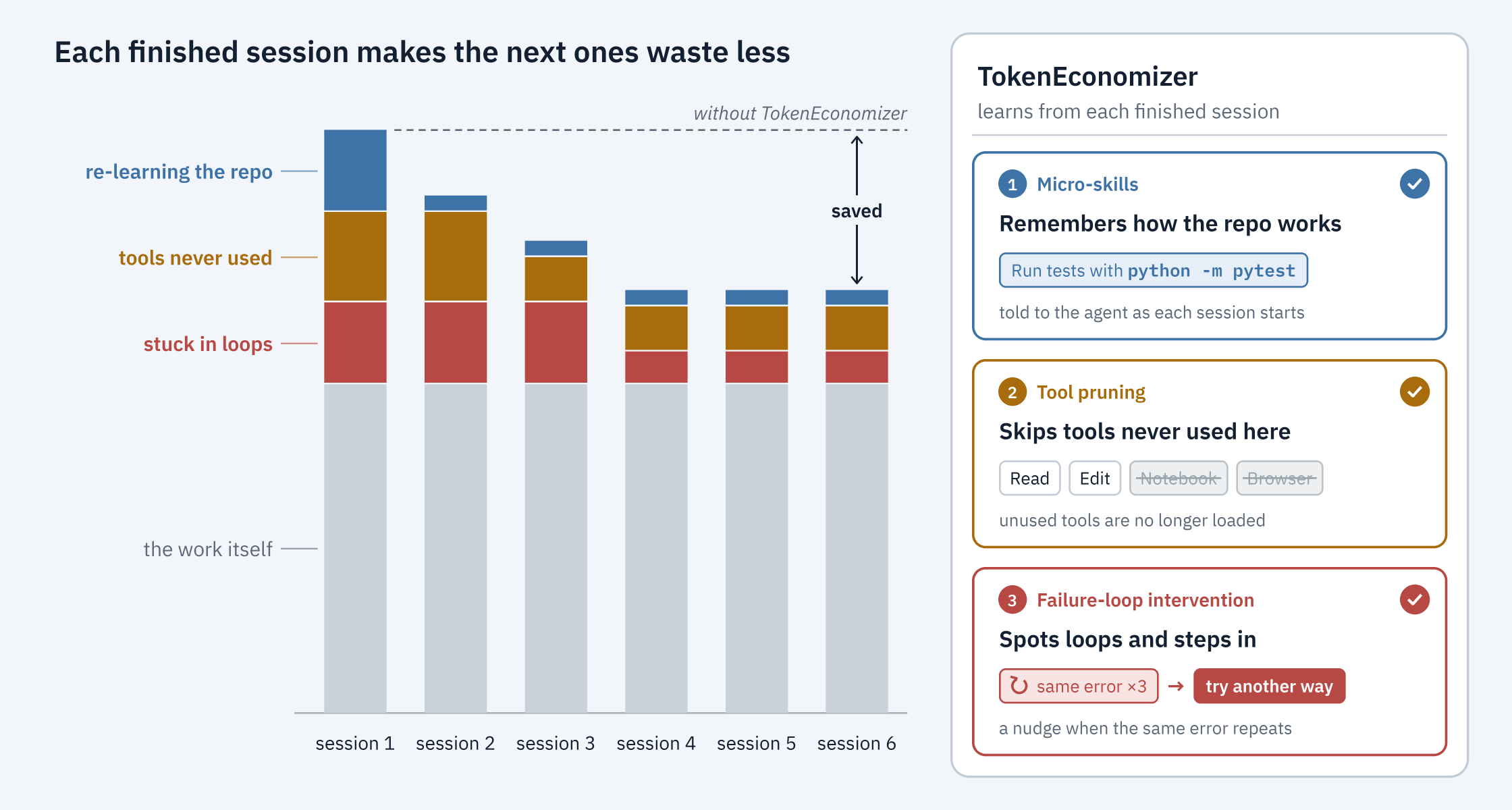
Microsoft Research and UC Berkeley open-source TokenEconomizer, a plugin that cuts Claude Code and Codex costs by 18.4–30.9% on SWE-Bench without changing the agent

Microsoft Research, Microsoft Security and UC Berkeley open-sourced TokenEconomizer on GitHub (Apache 2.0, v0.1.0 released October 26), a plugin for Claude Code, Codex, GitHub Copilot CLI and Pi, with experimental opencode support. It learns from earlier sessions in the same repository: micro-skills remember repo facts, tool pruning drops tool definitions that go unused, and a loop guard nudges an agent that is stuck. The paper reports 18.4–30.9% lower mean cost across five agent and model combinations on 277 SWE-Bench tasks (paper figures).

Microsoft Research and UC Berkeley open-source TokenEconomizer, a plugin that cuts Claude Code and Codex costs by 18.4–30.9% on SWE-Bench without changing the agent

Key Takeaways

  • Cost: on 277 SWE-Bench tasks across 6 repositories and 5 agent and model combinations, mean cost fell 18.4–30.9%, and all 30 repository-by-combination cells got cheaper (paper figures, including the plugin's own model calls)
  • Success rate: Pass@1 rose in 4 of 5 combinations, e.g. Copilot CLI with Sonnet 5 cost 18.4% less with Pass@1 +2.6, while Claude Code with Opus 4.8 cost 30.9% less with Pass@1 -1.0
  • Three mechanisms: micro-skills (repo facts stated only after three sessions confirm them), tool pruning (by default a tool unused over 10 prompts across 2 sessions is left out), and a failure-loop guard (one redirect when a judge is at least 0.7 confident, never stopping a turn itself)
  • Generalization: 16–21% lower cost on Web-Bench and 6–20% lower on two security-auditing benchmarks where every task is a new repository
  • Deployment: Apache 2.0, Python 3.10+, no API key of its own, and learned experience stays local in ~/.tokeneconomizer
Read full story

LM Studio Bionic 1.1.10 adds the oMLX engine, bringing RAM-plus-SSD KV caching and MLX speculative decoding to local models on Macs

LM Studio posted on X at 15:32 UTC on Oct 29 that users can now download a new oMLX engine inside LM Studio and run it with MLX models they already have. The official changelog lists it in Bionic 1.1.10, alongside speculative decoding for MLX models and an in-app terminal. oMLX is an open-source Apple Silicon inference server maintained by developer jundot (Apache 2.0, about 23,000 GitHub stars) built around continuous batching and a two-tier RAM and SSD KV cache. LM Studio has not published speed comparisons for the engine.

LM Studio Bionic 1.1.10 adds the oMLX engine, bringing RAM-plus-SSD KV caching and MLX speculative decoding to local models on Macs

Key Takeaways

  • LM Studio says the oMLX engine can now be downloaded inside the app and used with existing MLX models; the post has about 540 likes (post)
  • The Bionic 1.1.10 changelog (Oct 29) also lists speculative decoding for MLX models, a public in-app terminal and llama.cpp 2.66.0 extension packs (changelog)
  • oMLX is Apache 2.0 open source with about 23,000 GitHub stars and needs macOS 15+ on Apple Silicon M1 to M5 (GitHub)
  • Its core is a two-tier KV cache: hot blocks stay in RAM, overflow is written to SSD as safetensors, and matching prefixes are restored from disk even after a restart
  • LM Studio has published no speed comparison with its existing MLX engine; one user reported that restart-to-update failed after launch and LM Studio is investigating
Read full story
ADSponsored

OpenBMB open-sources the MiniCPM-OCR suite: a 1.3B parser scoring 93.68 on Real5-OmniDocBench, plus a 2B judge model that flags OCR errors

On Oct 27 OpenBMB (ModelBest) open-sourced the MiniCPM-OCR suite with two models: MiniCPM-OCR 1.0, a 1.3B-parameter document parser that scores 93.68 on Real5-OmniDocBench and 54.7 on OCRBench v2 (vendor-reported), and MiniCPM-OCR Jev, a 2B OCR quality judge that scores any parser's output region by region from 0 to 1 and flags content that needs human review. Code and weights are Apache 2.0, with day-one support for vLLM, SGLang, llama.cpp, Ollama and multiple chip platforms.

OpenBMB open-sources the MiniCPM-OCR suite: a 1.3B parser scoring 93.68 on Real5-OmniDocBench, plus a 2B judge model that flags OCR errors

Key Takeaways

  • MiniCPM-OCR 1.0 has just 1.3B parameters and scores 93.68 on Real5-OmniDocBench and 54.7 on OCRBench v2 (vendor-reported, both claimed SOTA)
  • The 2B MiniCPM-OCR Jev judge reaches 93.6 AUROC on JevOCRBench, above JEV-35B-A3B at 90.1 and close to Qwen3.5-397B-A17B at 93.8 (vendor-reported)
  • Jev is parser-agnostic: AUROC stays between 91.9 and 93.4 on outputs from MiniCPM-OCR, GLM-OCR, PaddleOCR-VL-1.6 and Xiaomi-OCR-0
  • Throughput is about 1.49x PaddleOCR-VL-1.6 and 3.62x MinerU2.5 Pro, reaching up to about 128 pages per minute with SDK concurrency (vendor-reported)
  • Code and weights on GitHub are all Apache 2.0, with GGUF/AWQ/GPTQ quantized builds and a SKILL.md for coding agents
Read full story
Linked Models & Agents:
⚡ MiniCPM-OCR 1.0⚡ MiniCPM-OCR Jev⚡ PaddleOCR-VL-1.6⚡ MinerU2.5 Pro⚡ Qwen3.5-397B-A17B🌐 OpenBMB🌐 ModelBest🌐 Intel🌐 NVIDIA🌐 Arm

DiffuSpace, founded by the HKU Dream team, open-sources Clover-35B-A3B, a diffusion LLM hitting 680 tokens/s on one GPU and 73.6 on SWE-bench Verified

On Oct 28 DiffuSpace, whose members come from the HKU NLP group behind Dream 7B, released its first model, Clover-35B-A3B-Preview: a mixture-of-experts diffusion language model initialized from Qwen3.6-35B-A3B, with 35B total and about 3B active parameters, a 128K context window and block-parallel denoising. Vendor-reported results include 73.6 on SWE-bench Verified, 51.7 on Terminal-Bench 2.1 and 83.8 on GPQA Diamond, with 680 tokens/s on a single GB300 in agent workloads. Weights are Apache 2.0 on Hugging Face, ModelScope and GitHub, with SGLang and llama.cpp support.

DiffuSpace, founded by the HKU Dream team, open-sources Clover-35B-A3B, a diffusion LLM hitting 680 tokens/s on one GPU and 73.6 on SWE-bench Verified

Key Takeaways

  • A 35B-total, roughly 3B-active MoE diffusion model initialized from Qwen3.6-35B-A3B, with 128K context and a thinking mode
  • DiffuSpace says it tops all six agent benchmarks it compared: SWE-bench Verified 73.6, Terminal-Bench 2.1 51.7 and tau3 Overall 65.3, ahead of LLaDA2.2 flash, Mercury 2.5 and Qwen3.6-35B-A3B
  • Speed (vendor-reported): 680 tokens/s on one GB300 at BF16 and batch size 1 in agent workloads, and 515 tokens/s on one H200 versus 365 tokens/s for Qwen with DFlash2
  • An INT4 build runs on a 16GB RTX 5070 Ti at 101.8 tokens/s on MATH-500
  • Weights on Hugging Face are Apache 2.0, about 69GB in BF16, and SGLang is the recommended serving path
Read full story
Linked Models & Agents:
⚡ Clover-35B-A3B-Preview⚡ Qwen3.6-35B-A3B⚡ Dream 7B⚡ LLaDA2.2 flash⚡ Mercury 2.5🌐 DiffuSpace🌐 HKU NLP🌐 Alibaba Qwen🌐 NVIDIA

BOSS Zhipin's Nanbeige lab open-sources Nanbeige4.3-33B, a 33B dense agent model with 512K context under Apache 2.0, reporting 80.9 on Terminal-Bench 2.1 vs 73.0 for Qwen3.8-27B

At 12:11 UTC on 2026-10-25, the Nanbeige LLM Lab of BOSS Zhipin (Kanzhun Limited) announced Nanbeige4.3-33B from its account @nanbeige (post), with the model and its Base version released as open weights on Hugging Face under Apache 2.0 (model card). It is a 33B dense model on a Llama-style architecture with a 512K context window, positioned as the teacher model of the Nanbeige4.3 series that will be distilled into smaller models such as Nanbeige4.3-3B. The official model card compares it with Qwen3.8-27B, Muse-Glimmer-30B and Gemma4-31B using the same harness at highest thinking effort: 80.9 on Terminal-Bench 2.1 (Qwen3.8-27B 73.0) and 65.5 on DeepSWE (42.5), but 60.3 on SWE-Bench Pro, slightly below Qwen's 61.7, and 84.8 on GDPval vs 86.4. All figures are self-reported and not yet independently reproduced.

Key Takeaways

  • Official sources: @nanbeige post on X and the Hugging Face model card; the post had about 616 likes, 79 reposts and 38K views when we pulled it
  • Specs: 33B dense, Llama-style architecture, 512K context, Apache 2.0, with a Base checkpoint released too
  • Self-reported coding scores: Terminal-Bench 2.1 80.9, Terminal-Bench 4.0 23.8, DeepSWE 65.5, SWE-Bench Pro 60.3 (Qwen3.8-27B: 73.0, 6.3, 42.5, 61.7)
  • Self-reported cowork scores: Automation Bench 54.2, JobBench 44.8, GDPval 84.8 (Qwen3.8-27B: 38.3, 34.5, 86.4)
  • Deployment: Transformers, SGLang and vLLM, with official examples using 4-way tensor parallelism; Nanbeige4.3-3B distillation is next
Read full story
Linked Models & Agents:
⚡ Nanbeige4.3-33B⚡ Qwen3.8-27B⚡ Gemma4-31B⚡ Muse-Glimmer-30B🌐 Nanbeige🌐 BOSS Zhipin🌐 Kanzhun

Google previews Gemini API CLI (gemini-api), a zero-dependency Go binary that lets Claude Code, Codex, Cursor and other coding agents generate media, transcribe and run managed agents from the shell

The Google AI Studio team released an experimental preview of the Gemini API CLI (command name gemini-api). It is a stateless, zero-dependency Go binary for macOS, Linux and Windows, open source under Apache 2.0. Any coding agent with shell access and a GEMINI_API_KEY can call text reasoning, image, video, music and speech generation, file and YouTube analysis, audio and video transcription, and managed agents such as Deep Research with one command. Media is written straight to disk and only the file path goes to stdout, so base64 payloads never land in the context window. Google labels it experimental and not a supported Google product.

Google previews Gemini API CLI (gemini-api), a zero-dependency Go binary that lets Claude Code, Codex, Cursor and other coding agents generate media, transcribe and run managed agents from the shell

Key Takeaways

  • Default models (official README): gemini-3.8-flash for generate, analyze and transcribe; gemini-nano-banana-2.1 for image; gemini-omni-1.1-flash for video; lyria-3.5 for music; gemini-3.8-flash-tts for speech
  • Install with a one-line curl script on macOS/Linux, a PowerShell script on Windows, or go install; the latest GitHub release is v0.4.3 (published 2026-10-19)
  • Built for agents: --usage prints the command tree as KDL, --schema prints JSON Schema, --dry-run validates offline with credentials redacted, plus --output-format json/toon and inline --jq
  • Exit codes separate 4 cases: 0 success, 1 runtime/API failure, 2 usage or validation error, 3 auth failure; --agent-mode emits structured JSON errors
  • It also manages sandbox environments, server-side credentials, webhooks and cron triggers for managed agents; files uploaded via the Files API are kept for 48 hours
Read full story
Linked Models & Agents:
⚡ Gemini 3.8 Flash⚡ Gemini Nano Banana 2.1⚡ Gemini Omni 1.1 Flash⚡ Lyria 3.5⚡ Gemini 3.8 Flash TTS🤖 Gemini API CLI🤖 Claude Code🤖 Codex🤖 Cursor🤖 Antigravity🤖 Deep Research🌐 Google

Ollama Natively Supports Recursive Flint 40B: 2.5B Active MoE Coding Agent Delivering 125+ tok/s on MacBook Pro

Recursive, founded by Richard Socher, has officially open-sourced Flint (RecursiveSI/flint), a 39.8B Mixture-of-Experts (MoE) coding agent model under Apache 2.0 with day-zero Ollama support (ollama run flint). Activating just 2.5B parameters per token across 47 MoE layers with a 262K context window, Flint hits 125+ tokens/sec on an M4 Pro MacBook Pro. It sets new benchmarks for sub-50B local models, scoring 74.2% on SWE-bench Verified and 89.7% on SWE-bench Pro v2.

Ollama Natively Supports Recursive Flint 40B: 2.5B Active MoE Coding Agent Delivering 125+ tok/s on MacBook Pro

Key Takeaways

  • Flint employs a 49-layer architecture (2 dense + 47 MoE layers) with 39.8B total and 2.5B active parameters per token
  • Native 262,144-token (256K) context window supports end-to-end repository indexing and cross-file debugging
  • Blazing local inference speed: 125+ tokens/sec on M4 Pro MacBook Pro and 150+ tokens/sec on RTX Spark
  • Scores 74.2% on SWE-bench Verified, 89.7% on SWE-bench Pro v2, and 80.3% on LiveCodeBench v6 with instant 'ollama run flint' execution
Read full story
Linked Models & Agents:

Recursive releases its first model, Flint: a 40B-total, 2.5B-active open-weights local coding model under Apache 2.0, running at 125+ tok/s on a MacBook

On Oct 21, Recursive, the startup founded by Richard Socher, released its first model, Flint: a 39.8B-total MoE coding model with about 2.5B active parameters per token, with weights on Hugging Face under Apache 2.0. Recursive says it leads sub-50B MoE models on SWE-Bench Pro v2, Terminal-Bench 2.1 and SWE-Bench Verified, runs at 125+ tok/s on an M4 Pro MacBook Pro, and was built from scratch in under four months with its automated research system, the Eureka Machine, contributing to nearly every part of the stack.

Recursive releases its first model, Flint: a 40B-total, 2.5B-active open-weights local coding model under Apache 2.0, running at 125+ tok/s on a MacBook

Key Takeaways

  • Scale: 39.8B total, ~2.5B active incl. output head; 256 routed experts pick 6 plus 1 shared expert; Apache 2.0 (model card)
  • Benchmarks (vendor-reported): Terminal-Bench 2.1 54.9%, SWE-bench Verified 74.2%; the card lists SWE-bench Pro v2 at 89.7%
  • Speed (vendor-reported): 125+ tok/s on M4 Pro MacBook Pro, 150+ tok/s on 64GB RTX Spark at short contexts, up to 2x comparable models
  • Context: 262,144 tokens in the model card config; the blog says up to 512K, best within 256K
  • Ecosystem: day-one llama.cpp, Ollama, LM Studio, vLLM, SGLang, plus the open-source rec local engine; free to try on OpenCode and Pi
Read full story
ADSponsored

NVIDIA launches OpenShell Reference Architecture at GTC Berlin: Vera Rubin, Vera CPUs and BlueField-4 Sentry for hardware-enforced safe AI agents

At GTC Berlin on Oct 21, NVIDIA announced the OpenShell Reference Architecture: building on the open-source OpenShell secure runtime, it pairs Vera Rubin for inference, Vera CPUs for agent harnesses, and BlueField-4 DPUs running NVIDIA Sentry for in-silicon policy enforcement, so enterprises can build, contain, observe and govern agents on-prem and at the edge. NVIDIA says it is available now; partners named include Anthropic, OpenAI, Meta, Microsoft and ServiceNow. The software is Apache 2.0.

NVIDIA launches OpenShell Reference Architecture at GTC Berlin: Vera Rubin, Vera CPUs and BlueField-4 Sentry for hardware-enforced safe AI agents

Key Takeaways

  • Full stack: Vera Rubin for model inference, Vera CPUs for agent harnesses/tool use, BlueField-4 + Sentry for in-silicon policy and quarantine (vendor claims)
  • Vendor claims: Vera Rubin NVL72 about 30x throughput per megawatt on agentic workloads; Sentry can quarantine a boundary-breaking agent in milliseconds and boost agent capacity by up to 20%
  • Runtime: deny-by-default, enforcement outside the agent process; sandboxes have no direct network, syscalls are filtered in-kernel, credentials are injected only onto allowed requests
  • Stated agent paths include Claude Code, Codex, GitHub Copilot CLI, OpenCode, OpenClaw, LangChain Deep Agents; deploy with Docker, Podman or Kubernetes via Helm
  • Start: curl install script then openshell sandbox create; docs at docs.nvidia.com/openshell; GitHub NVIDIA/OpenShell (Apache 2.0) and PyPI package openshell
Read full story

Krafton AI Open-Sources Raon-1 Mini: A 30B MoE with 4B Active Parameters Matching Muse Glimmer on Coding Autonomy

Krafton AI, the research division of global gaming giant Krafton, officially announced the open-weights release of Raon-1 mini under Apache 2.0. Pretrained from scratch, Raon-1 mini features a sparse Mixture-of-Experts (MoE) architecture with 30 billion total parameters and only 4 billion active parameters per token. The release is accompanied by a dedicated DFlash speculative drafting model and a live interactive playground. Internal evaluations reveal that Raon-1 mini matches Meta's Muse Glimmer across agentic tool-use and coding benchmarks while requiring substantially lower VRAM and sustaining lower generation latency.

Krafton AI Open-Sources Raon-1 Mini: A 30B MoE with 4B Active Parameters Matching Muse Glimmer on Coding Autonomy

Key Takeaways

  • Krafton AI released Raon-1 mini under Apache 2.0, architecting a 30B total / 4B active parameter sparse MoE model
  • Trained entirely from scratch, matching Meta's Muse Glimmer across agentic coding and multi-turn tool orchestration
  • Bundled with a dedicated DFlash draft model for high-throughput speculative decoding on consumer-grade workstations
  • Accompanied by a live public evaluation playground, providing a viable open backbone for local gaming and coding copilots
Read full story
Linked Models & Agents:
⚡ Raon-1 mini⚡ Muse Glimmer🌐 Krafton AI

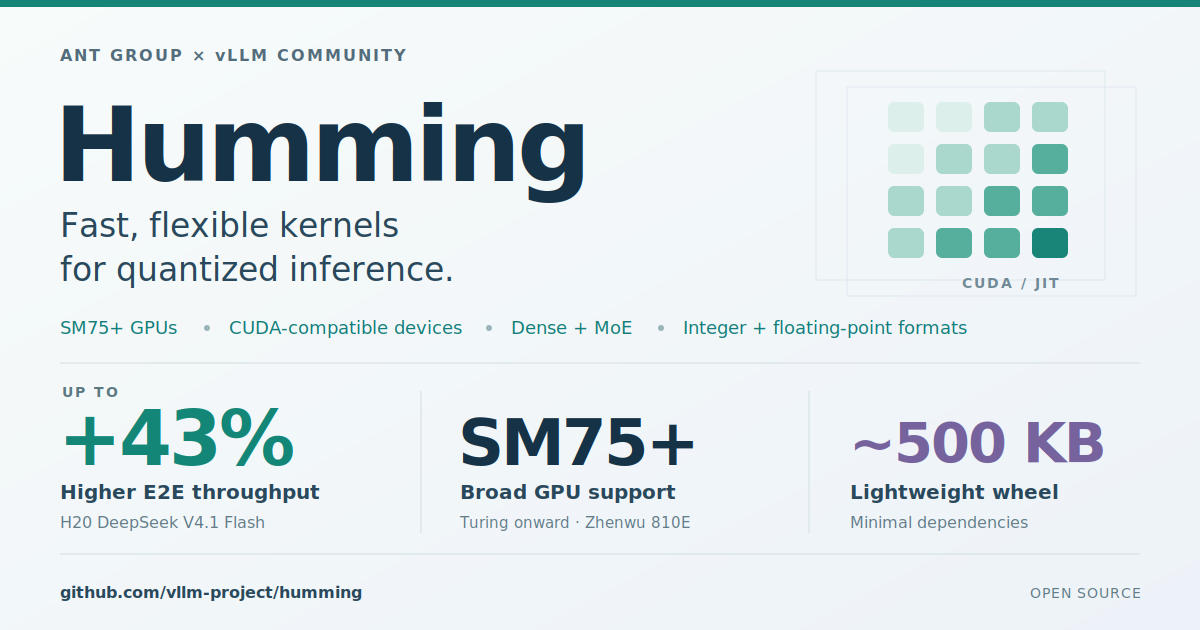
vLLM and Ant Group open-source Humming, one quantized-inference kernel library for many formats and every NVIDIA GPU since Turing, lifting DeepSeek-V4.1-Flash end-to-end throughput by 14-43%

On Oct 21 the vLLM community and Ant Group open-sourced Humming (Apache 2.0), a quantized-inference library that JIT-compiles GEMM kernels on demand. It supports every NVIDIA architecture from Turing on plus T-Head's Zhenwu 810E, and covers weight and activation combinations from INT1-INT8 and FP4-FP8 for dense and MoE workloads. In vLLM's microbenchmarks it runs 2-5x faster than vLLM Marlin, FlashInfer or DeepGEMM in some cases; on 8 H20 GPUs, switching DeepSeek-V4.1-Flash MoE from Marlin W4A16 to Humming W4A8 raised throughput 14-43%. vLLM 0.29.0 ships it built in.

vLLM and Ant Group open-source Humming, one quantized-inference kernel library for many formats and every NVIDIA GPU since Turing, lifting DeepSeek-V4.1-Flash end-to-end throughput by 14-43%

Key Takeaways

  • One JIT kernel framework instead of a hand-written kernel per format: WNA16, W8A8, W4A8, W4A4, INT1-INT8 and FP4-FP8 weights, dense and MoE
  • Hardware: every NVIDIA GPU from Turing (SM75) on, including Blackwell SM100/103/120/121, plus T-Head Zhenwu 810E
  • End to end: DeepSeek-V4.1-Flash on 8x H20 at TP=8, Humming W4A8 beats Marlin W4A16 by 14-43% in throughput and cuts mean TTFT 25-32%; at concurrency 64 output goes from 442 to 634 tok/s
  • Microbenchmarks run by the vLLM community: W4A8-MXFP4 on H200 is about 4.5x DeepGEMM W8A8, and the B300 MoE Grouped path is about 5x Marlin; one W4A16 kernel compiles in 1.82 s versus 23.35 s for CUTLASS
  • Use: pip install humming-kernels (about a 500 KB wheel); built into vLLM 0.29.0+, enable with --linear-backend humming --moe-backend humming
Read full story

Vercel open-sources durable-harness: Claude Code, Codex, OpenCode and Pi agents resume from a durable log after crashes instead of starting over

On Oct 20, Vercel released durable-harness, an open-source package (Apache 2.0, npm 0.0.1-beta.6, marked experimental). It adds durability from the outside to existing coding-agent harnesses such as Pi, OpenCode, Codex and Claude Code: every model and tool call is logged before and after it runs in a Workflow SDK World, and if a function times out or crashes, a queue hands the turn to a new function that resumes from the log, so finished model calls are not billed twice. It runs on Vercel, on local files, or on self-hosted Postgres and other backends.

Vercel open-sources durable-harness: Claude Code, Codex, OpenCode and Pi agents resume from a durable log after crashes instead of starting over

Key Takeaways

  • Supports 5 harnesses: Pi, OpenCode, Codex, Claude Code and libfx's fx (eve and fx are already durable on their own)
  • Mechanism: an intent is recorded before each model or tool call and the outcome after it; each turn is backstopped by a queue message so a new function resumes from the log
  • Finished model calls are read back from the log, so Vercel says you never pay twice for the same call's tokens; only tools marked replay: 'safe' are rerun
  • Swappable backends: Vercel World, local files, Postgres, plus MongoDB, Redis and Turso; two environment variables move it to Postgres
  • Status: Apache 2.0, npm 0.0.1-beta.6, and the README marks it experimental with an API that may change
Read full story

Gradium open-sources Phonon on-device TTS: a 31M-parameter, 64 MB model that starts speaking in 7 ms on a laptop CPU, with the English version under Apache 2.0

On Oct 20, French voice AI company Gradium open-sourced Phonon, a family of on-device text-to-speech models: the English Phonon 31m (64 MB q8 weights, Apache 2.0) and Phonon 40m (single-language English, French, German, Spanish and Portuguese variants plus a five-language model, CC BY-NC non-commercial). Built on Kyutai's Pocket TTS and the Mimi codec, it ships its own runtime for CPU, Metal, CUDA, Vulkan, WebGPU, Core ML and Snapdragon, running offline on phones, browsers and a Raspberry Pi. Gradium reports 7 ms to first audio on a MacBook Air M5 CPU versus 517 ms for Kokoro.

Gradium open-sources Phonon on-device TTS: a 31M-parameter, 64 MB model that starts speaking in 7 ms on a laptop CPU, with the English version under Apache 2.0

Key Takeaways

  • Check the license: only the English Phonon 31m is Apache 2.0 for commercial use; every Phonon 40m variant, including multilingual, is CC BY-NC 4.0 and needs a deal with Gradium for commercial use
  • Size (official): 64 MB q8 weights for 31m and 74.6 MB for 40m; 37 built-in English voices, 102 in the multilingual model, plus voices cloned or designed with Gradium
  • Speed (vendor-measured): 6.9 ms to first audio and 29.9x real time on a MacBook Air M5 CPU with 4 threads, versus 517 ms for Kokoro (which does not stream); 38 ms and 3.7x real time on a Raspberry Pi 5; 7.5 ms on Snapdragon 8 Elite Gen 5
  • Accuracy (vendor-built hard-sentence set, 500 per language, public on HF): English WER of 1.70% for 31m and 2.22% for 40m versus 3.50% for Kokoro and 8.71% for NeuTTS Nano, with text normalization for numbers, dates and version strings
  • Get started with uvx ptts or pip install ptts, the phonon-tts npm package for browsers, or the gradium-ai/xn-ptts runtime on GitHub
Read full story
Linked Models & Agents:
⚡ Phonon 31m⚡ Phonon 40m⚡ Phonon 40m multilingual⚡ Pocket TTS⚡ Kokoro🤖 Pipecat🌐 Gradium🌐 Kyutai🌐 Arm🌐 Qualcomm🌐 Hugging Face