AI Coding Live News

X discussion: Pieter Levels posts a 13-minute video on "what is left when AI can build everything", saying his businesses are shrinking, the sense of achievement is gone, and moats shift to community and content

Indie developer Pieter Levels (@levelsio) posted a roughly 13.5-minute walk-and-talk video on X on November 1, following up his October 11 "software is dead" post. He says AI has finally hit programmers themselves, and the identity and sense of achievement that came from building paid products is fading; his own businesses and many friends' are flat or shrinking, and competition has exploded because anyone can now ship a landing page or app. He sees the remaining moats as community, audience, content and slower-moving enterprise B2B, and has already made Nomad List free as nomads.com. The post had about 2,478 likes and 205K views. These are personal views, not industry data.

X discussion: Pieter Levels posts a 13-minute video on "what is left when AI can build everything", saying his businesses are shrinking, the sense of achievement is gone, and moats shift to community and content

Key Takeaways

  • Original post: @levelsio video, Nov 1, 10:44 UTC, about 2,478 likes, 2,441 bookmarks, 204 replies and 205K views at fetch time
  • It quotes his October 11 "Software is dead" post (about 5,747 likes, 1.94M views); the video expands on what is left to do when AI can build everything
  • His GTA cheat-code analogy: every new model makes building faster and easier, but "where's the achievement?"; he says he is not pessimistic, just looking for a new source of achievement
  • His own observations: his and many friends' businesses are flat or shrinking, the ones still growing often rely on AI or VC sponsorships, and big labs building legal and medical products will absorb many small businesses
  • Nomad List is now free as nomads.com; he says sign-ups went from about 200 when paid to about 3,000 (period not stated), with revenue now from sponsorship and a $1 anti-spam membership
Read full story
O
OpenAIhelp.openai.com·
👀63
🔥83

OpenAI will pool ChatGPT and Codex into one token-based usage allowance starting in December for Plus, Pro, and Business; Instant chat is excluded

On Oct 31, OpenAI's Help Center added a page titled "Understanding ChatGPT and Codex usage limits": starting in December, the usage allowance on Plus, Pro, and Business plans will be shared across ChatGPT and Codex as OpenAI brings the agentic capabilities of Work into the main ChatGPT experience. Usage will be measured in tokens, so stronger models and more complex tasks use more; Instant chat will not draw from the allowance. Users will see combined remaining usage and reset times in Settings > Usage, and can wait for a reset, upgrade, or buy credits when they run out. OpenAI says it expects most users will not need to wait for resets more often than they do now, but it has not given an exact start date or per-plan allowances. The news drew strong concern from Plus users on X.

Key Takeaways

  • Timing: takes effect in December, exact date not announced; covers Plus, Pro, and Business plans (OpenAI Help Center)
  • Metering: everything is measured in tokens and Instant chat is excluded; the Business pricing page now also notes that plan usage will have a shared limit across ChatGPT and Codex starting in December (Business pricing)
  • Today's baseline: only Work and Codex share an allowance now; Plus is estimated at 5-45 local messages per 5 hours on GPT-6 Astra, 15-160 on GPT-6.1 Sol, and 350-3,000 on GPT-6 Luna (official estimates, help article)
  • Pro 100/200/500 currently have no 5-hour limit in Work and Codex; per-plan allowances after the merge have not been published
  • OpenAI's position: most users should not wait for resets more often than today; when out, wait, upgrade, or buy credits
Read full story

OpenAI rolls out GPT-6 Rosalind Research, a GPT-6 generation life sciences model for approved research orgs in Work, Codex and the API at $15/$75 per million tokens

In its October 30 ChatGPT Business release notes, OpenAI said GPT-6 Rosalind Research is rolling out to a limited set of customers with Research approval. It shows up in the model picker in ChatGPT Work and Codex, not in the Chat tab, and separately approved organizations can call it through the API as gpt-6-rosalind. OpenAI's token-based Enterprise rate card lists it at $15 per million input tokens, $1.50 cached input and $75 output, three times the price of GPT-5.5 Rosalind Research.

Key Takeaways

  • Approved orgs only: both the organization and the user need Rosalind Research approval, and Discovery approval does not include it
  • Where to use it: the model picker in ChatGPT Work and Codex, not the Chat tab; in Codex it pairs with the Life Sciences Research plugin
  • API model name gpt-6-rosalind needs separate approval and is limited to internal research tools, not customer-facing products
  • Priced at $15 input, $1.50 cached input and $75 output per million tokens, versus $5/$0.50/$25 for GPT-5.5 Rosalind Research
  • Enterprise workspaces start with a two-week Admin Preview that is off by default until an admin enables it for approved users
Read full story
Linked Models & Agents:
⚡ GPT-6 Rosalind Research⚡ GPT-5.5 Rosalind Research⚡ GPT-6 Astra🤖 Codex🤖 ChatGPT Work🌐 OpenAI

OpenAI launches Private Intelligence for enterprises: Zero Data Retention, Private Inference preview and agent approval controls

On Oct 30 OpenAI introduced Private Intelligence, a business privacy offering that bundles Zero Data Retention, a Private Inference confidential-computing preview for the API, agent access and approval controls, encryption and compliance certifications across ChatGPT, Codex and the API, built with some of its largest customers.

OpenAI launches Private Intelligence for enterprises: Zero Data Retention, Private Inference preview and agent approval controls

Key Takeaways

  • Covers three product lines, ChatGPT, Codex and the API, with per-product controls documented by OpenAI
  • Private Inference ships as an API preview that OpenAI describes as confidential computing with strict, verifiable controls
  • Businesses set agent data access, available tools, permitted actions and required approvals before agents act
  • OpenAI lists SOC 2 Type 2, ISO certifications, HIPAA BAAs and FedRAMP support; no benchmarks or pricing were published
Read full story
ADSponsored

OpenAI raises Work and Codex usage on ChatGPT Pro and Business Premium: Pro 100 and Pro 500 doubled, Pro 200 cut canceled

On Oct 29, OpenAI's Codex and ChatGPT lead Tibo announced on X that usage for Pro 100/200/500 and Business Premium doubles effective today. OpenAI's Help Center confirms that Pro 100 and Pro 500 now get twice their previous Work and Codex allowance, the Pro 200 reduction announced in a Sept 29 email is canceled, and Pro 200 subscribers on the lower allowance are doubled up to the higher one. Plus is unchanged.

Key Takeaways

  • Pro 100 ($100/mo) and Pro 500 ($500/mo) now get twice their previous Work and Codex allowance, applied automatically to existing subscriptions without waiting for renewal (Help Center)
  • The Pro 200 reduction announced in a Sept 29 email is canceled; Pro 200 users on the lower allowance are doubled to the higher one, still at $200/mo
  • Weekly GPT-6 Pro chat message limits stay the same on Pro 100 and Pro 500; Pro 200's lower weekly limit is raised to the higher one
  • Business Premium Work and Codex usage also goes up (the official release notes give no multiplier; Tibo's post says doubled); Plus is unchanged
  • Tibo says extended limits for dots continue and stay separate from default usage
Read full story

Mistral releases the open weights of Mistral Large 4 "Le Chonk": a 1T-total, ~52B-active multimodal MoE that Mistral says leads open models on FrontierCode 2.0

On Oct 29 Mistral released an improved Mistral Large 4 (Le Chonk) with open weights on Hugging Face (plus an NVFP4 quantized checkpoint), served on its API as mistral-large-4. After about three more weeks of reinforcement learning since the early-October preview, Mistral reports 19.7% on FrontierCode 2.0, Terminal-Bench 4.0 up from 28% to 41%, and new low/medium/high reasoning modes. The license is a modified MIT that allows commercial use, but running a model-as-a-service business needs a separate commercial license.

Mistral releases the open weights of Mistral Large 4 "Le Chonk": a 1T-total, ~52B-active multimodal MoE that Mistral says leads open models on FrontierCode 2.0

Key Takeaways

  • Specs: about 1T total parameters with 49B active per token (about 52B including embeddings and output layers), 128 routed experts with 4 active plus 1 shared expert, 1M context, text and image input
  • Per Mistral: 19.7% on Cognition's FrontierCode 2.0, ahead of DeepSeek V4.1 Flash at 19.3% and GLM-5.3 at 17.8%, first among open models
  • 48% on the Artificial Analysis Coding Agent Index, roughly tied with GLM-5.3 while using 47% fewer tokens per task on average; Terminal-Bench 4.0 rose from 28% in preview to 41%
  • 51% on the Artificial Analysis Cyber Index, and a 96.6% average refusal rate on malicious cyber requests, which Mistral says is the highest among open models
  • Trained from scratch on 3,800 NVIDIA Grace Blackwell GPUs in Mistral's own European datacenters; in Surge Code blind pairwise tests it ranked behind only Claude Opus 5.5
Read full story
Linked Models & Agents:

GitHub Enterprise now includes Copilot: $0 seat charge for Enterprise Cloud users, $10 a month Copilot Standalone for others, with AI usage metered from the first request

At Universe 2026 on Oct 28, GitHub announced a new Copilot access billing model: users with a GitHub Enterprise Cloud license pay no Copilot seat charge, and users without one can get Copilot Standalone at $10 per user per month. Both get the same features and models as Copilot Enterprise but no monthly per-seat AI credits; all usage is metered against the enterprise budget from the first request. It is available now only to Enterprise Cloud customers working with a GitHub or Microsoft account team, opens to self-serve customers in stages, and Copilot Business and Enterprise stay on sale.

Key Takeaways

  • Seat charge: $0 for users with a GitHub Enterprise Cloud license; users without one get Copilot Standalone at $10 per user per month
  • Versus the old plans: Copilot Business is $19 per user per month with 1,900 pooled AI credits and Copilot Enterprise is $39 with 3,900; the new model includes no credits and meters usage from the first request
  • When the budget runs out: code completion and next edit suggestions keep working, while Copilot Chat, Copilot code review and Copilot in the cloud need available budget
  • Availability: from Oct 28 only for Enterprise Cloud customers working with a GitHub or Microsoft account team; self-serve opens in stages, and GitHub Free and Team are not eligible
  • Switching is voluntary, but the billing model applies to the whole enterprise, cannot be mixed with Copilot Business or Enterprise seats, and admins still have to assign seats
Read full story

OpenAI gives ChatGPT Pro and Business subscribers up to $500 a month in API credits to build apps and agents

On Oct 28, OpenAI Developers announced on X that eligible ChatGPT Pro and Business subscriptions can now claim up to $500 a month in API credits. Pro tiers get $100, $200 or $500 per month; Business workspaces get $20 per paid Standard seat and $100 per paid Premium seat, pooled and capped at $500 per workspace. Credits go to one linked API organization, expire at the end of each billing cycle, and do not add to ChatGPT or Codex usage limits.

Key Takeaways

  • Amounts: Pro $100, $200 and $500 tiers get $100, $200 and $500 per month; Business gets $20 per paid Standard seat and $100 per paid Premium seat, capped at $500 per workspace per month
  • Plus, free trials and complimentary subscriptions do not qualify; Enterprise, Edu and legacy Codex seats are not eligible for this offer; the paid subscription must be at least 7 days old
  • One subscription or workspace links to one API organization, and the person claiming must own both the subscription or workspace and the API organization, using the same email on both
  • The first grant is prorated, unused credits expire at the end of the billing cycle with no rollover, and no API payment method is needed while free credits are active
  • Business workspaces billed annually upfront receive the full year at once, capped at $6,000
Read full story

GitLab brings Claude Mythos 5.1 into its Business Logic Security Analyzer and offers free-credit security sprints

On Oct 28, GitLab CEO Bill Staples announced in a blog post and on X that new and existing customers can request free credits to run a security sprint with Claude Mythos alongside GitLab Orbit, Secrets Manager and Duo Agent Platform. The core capability is the Business Logic Security Analyzer, the first GitLab feature to support Anthropic's Claude Mythos 5.1. It reads the whole repository, infers what each endpoint should enforce, and flags authorization and mass-assignment flaws that pattern-based SAST misses. The analyzer has been in early access for a small group of GitLab.com Ultimate customers since Oct 20.

GitLab brings Claude Mythos 5.1 into its Business Logic Security Analyzer and offers free-credit security sprints

Key Takeaways

  • The Business Logic Security Analyzer is the first GitLab feature to support Claude Mythos 5.1; it also supports Claude Opus 5.5, Sonnet 5.5, Sonnet 5 and Sonnet 4.6, all as GitLab-managed models via GitLab's AI gateway
  • It starts with three flaw classes: broken object-level authorization (BOLA), missing or improper authorization, and mass assignment
  • Scans can run on the whole repository from Duo Chat or the API, or automatically on each merge request after its pipeline passes; findings land in the Vulnerability Report and MR security widget as SAST results
  • Early access is limited to a small group of GitLab.com Ultimate customers; each scan consumes GitLab Credits, with cost scaling with the application's attack surface
  • New on Oct 28: a security sprint offer where qualifying teams can request free credits for Ultimate, Duo Agent Platform, Orbit and Secrets Manager
Read full story

ChatGPT dots add texting: US Pro users can message their dot over iMessage or RCS, and the dot texts back with proactive updates

On Oct 28 OpenAI announced through @ChatGPT that users can now text their dot, the always-on agent inside ChatGPT. You can hand it a task or something to watch using text, photos or voice notes, and it texts you proactively when there is a relevant update. Texting runs over iMessage or RCS, not plain SMS; only you can text your dot and it can only text you. It is rolling out in beta to a limited number of US Pro users and is not supported in Business or Enterprise workspaces. Texts pass through the third-party provider Linq, and OpenAI says the conversation is not end-to-end encrypted.

ChatGPT dots add texting: US Pro users can message their dot over iMessage or RCS, and the dot texts back with proactive updates

Key Takeaways

  • Scope: a limited beta for US Pro users; not supported in Business or Enterprise workspaces (OpenAI Help Center)
  • Channels: iMessage on iPhone and RCS on Android only; a plain SMS gets an automatic reply asking you to use iMessage, RCS or the app
  • Setup in 3 steps: open the dot's profile and choose Texting, enter your number to get a confirmation text, then enter the code
  • Privacy: texts route through third-party provider Linq, so they are not end-to-end encrypted; Linq keeps no message content after delivery, only metadata such as timestamps and delivery status
  • Context: texting shares the same memory and plugins as the dot in the app; reply STOP or turn it off under Texting to stop
Read full story
ADSponsored

Google releases Gemini 4 Carbon two weeks after Argon: 59 and first place on the Artificial Analysis Intelligence Index v5, state-of-the-art cybersecurity and long-horizon coding, with early access for cyber defenders in the Fairwind program

Google DeepMind announced Gemini 4 Carbon on Oct 28, calling it its strongest model, just two weeks after Gemini 4 Argon. The official blog says it ranks first on v5.0 of the Artificial Analysis Intelligence Index at 59 and leads three cybersecurity evaluations: 88.2% on SEC-bench Pro for finding vulnerabilities, 54.8% on ExploitGym for exploitation and 71.0% on CWE-bench for patching; it also gains 89 points to rank fourth on WebDev Arena at 1769. Access starts this week for a subset of cyber defenders in the Fairwind program, with developers, businesses and consumers to follow. Introductory pricing matches Argon at $2 per million input tokens and $10 per million output tokens, rising to $4 and $20 afterwards.

Google releases Gemini 4 Carbon two weeks after Argon: 59 and first place on the Artificial Analysis Intelligence Index v5, state-of-the-art cybersecurity and long-horizon coding, with early access for cyber defenders in the Fairwind program

Key Takeaways

  • Positioning: Google calls it its strongest model, aimed at cybersecurity and long-horizon agentic work; internal teams saw it run for days to root-cause and patch subtle bugs across large codebases and low-level systems
  • Official scores (evaluated without guardrails): 88.2% on SEC-bench Pro, 54.8% on ExploitGym and 71.0% on Collinear's CWE-bench; 59 and first place on the Artificial Analysis Intelligence Index v5.0; +89 to fourth place on WebDev Arena at 1769
  • Safety and alignment: successful cheating on Terminal-Bench 4.0 fell to 0.0% with a 0.4% attempt rate, high-severity misalignment alerts in internal live coding dropped by almost 80%, unsupported claims are about half of Argon's, and the Gray Swan indirect prompt injection attack success rate fell from Argon's 0.7% to 0.0%
  • Internal examples: more than 2x Argon's success rate at generating secure code, and the Chrome team reports more than 10x better high-quality patches than another lab's large frontier model
  • Rollout: a subset of cyber defenders in the Fairwind program first, alongside the U.S. government's voluntary pre-release testing; no developer API yet; introductory pricing of $2 / $10 per million tokens with cached input 95% off, then $4 / $20
Read full story

Replit launches Replit for Business, pitching an "Agent Habitat" where agents work inside company permissions, approvals and audit logs

In an Oct 26 post on Replit's blog, "The Rise of the Self-Driving Company," CEO Amjad Masad introduced Replit for Business. Its central idea is an Agent Habitat: a company-controlled environment where agents use the company's knowledge and systems and coordinate with people and other agents, while the company decides what they can access, when human approval is required, and how far mistakes can spread. The enterprise page lists SSO, SCIM, role-based access, bring-your-own-cloud, audit logs, isolated execution, security scanning, model controls and 510+ connectors. Masad says Replit engineers nearly tripled code output in the first half of 2026 while review times, reversions and incidents stayed flat (vendor figures).

Replit launches Replit for Business, pitching an "Agent Habitat" where agents work inside company permissions, approvals and audit logs

Key Takeaways

  • Internal numbers (per Replit): engineers nearly tripled code output in the first half of 2026 while review times, reversions and production incidents stayed flat
  • Customer case (vendor-reported): Sumitomo Mitsui Finance and Leasing (SMFL) says a process that needed six people for six months was done by one person in one week, and a project estimated at about JPY 3 billion is now expected to cost under JPY 1 billion
  • Enterprise controls: SAML SSO, SCIM, role-based access, BYOC, searchable audit logs, execution in isolated cloud environments, required security scans, Security Center and Auto-Protect, plus admin controls over which models are available
  • Ecosystem: the enterprise page lists 510+ connectors, Microsoft Fabric and Databricks Lakebase/Apps integration, and Microsoft Execution Containers to sandbox local builds in the Windows desktop app
  • Masad's view (opinion): by the end of 2030 every Fortune 500 company will be a "self-driving company"; a16z's Marc Andreessen endorsed the launch in a post the same day
Read full story
Linked Models & Agents:

Grok Bot can now phone people and businesses for you: Elon Musk says it makes the request, takes notes and sends a call summary (0.77 prerelease)

On Oct 25 SpaceXSI CEO Elon Musk (@elonmusk) posted on X that Grok Bot can now call someone or a business for you, make a request on your behalf, take notes on the response and send you a summary of the conversation. The post quoted a third-party rundown of the Grok Bot 0.77 prerelease: it dials, sits on hold, presses keys, gets transferred and shows a live transcript. As of Oct 25 SpaceXSI had not published release notes or docs for the feature, and supported regions, plans and AI disclosure to the callee are not announced.

Key Takeaways

  • Source: Elon Musk's own X post (post), Oct 25 14:35 UTC
  • Capability: calls a person or business for you, makes the request, takes notes and sends a call summary
  • Prerelease rundown (third-party @alexmichaelio): dialing, waiting on hold, key presses, transfers and a live transcript
  • Per CellCog and The Tech Signal, the official changelog and docs did not cover the feature as of Oct 25
  • At capture the post had about 14.4K likes, 1,399 reposts, 3,332 bookmarks and 2.31M views
Read full story
Linked Models & Agents:

Technical University of Munich Introduces TabWM: Relational World Modeling for Enterprise Database Decision Agents

Researchers from the Technical University of Munich (TUM) introduced TabWM (Tabular World Model) and the WorldRel benchmark generator in arXiv:2610.16763. Moving beyond traditional relational learning that only performs static prediction on database rows, TabWM formulates operational database environments as relational world models capable of simulating state transitions and downstream consequences under arbitrary business actions, unlocking offline reinforcement learning for enterprise decision agents.

Technical University of Munich Introduces TabWM: Relational World Modeling for Enterprise Database Decision Agents

Key Takeaways

  • Technical University of Munich introduced TabWM and WorldRel (arXiv:2610.16763), formalizing relational databases as dynamic world models
  • Expands relational learning beyond static predictions to counterfactual simulations of state deltas under business actions
  • Achieves >0.84 correlation on state transition prediction from only 10-20 observed traces, improving decision-making utility by 28.4%
  • Provides enterprise teams with a differentiable simulation sandbox to train autonomous database and ERP agents via offline RL
Read full story
Linked Models & Agents:

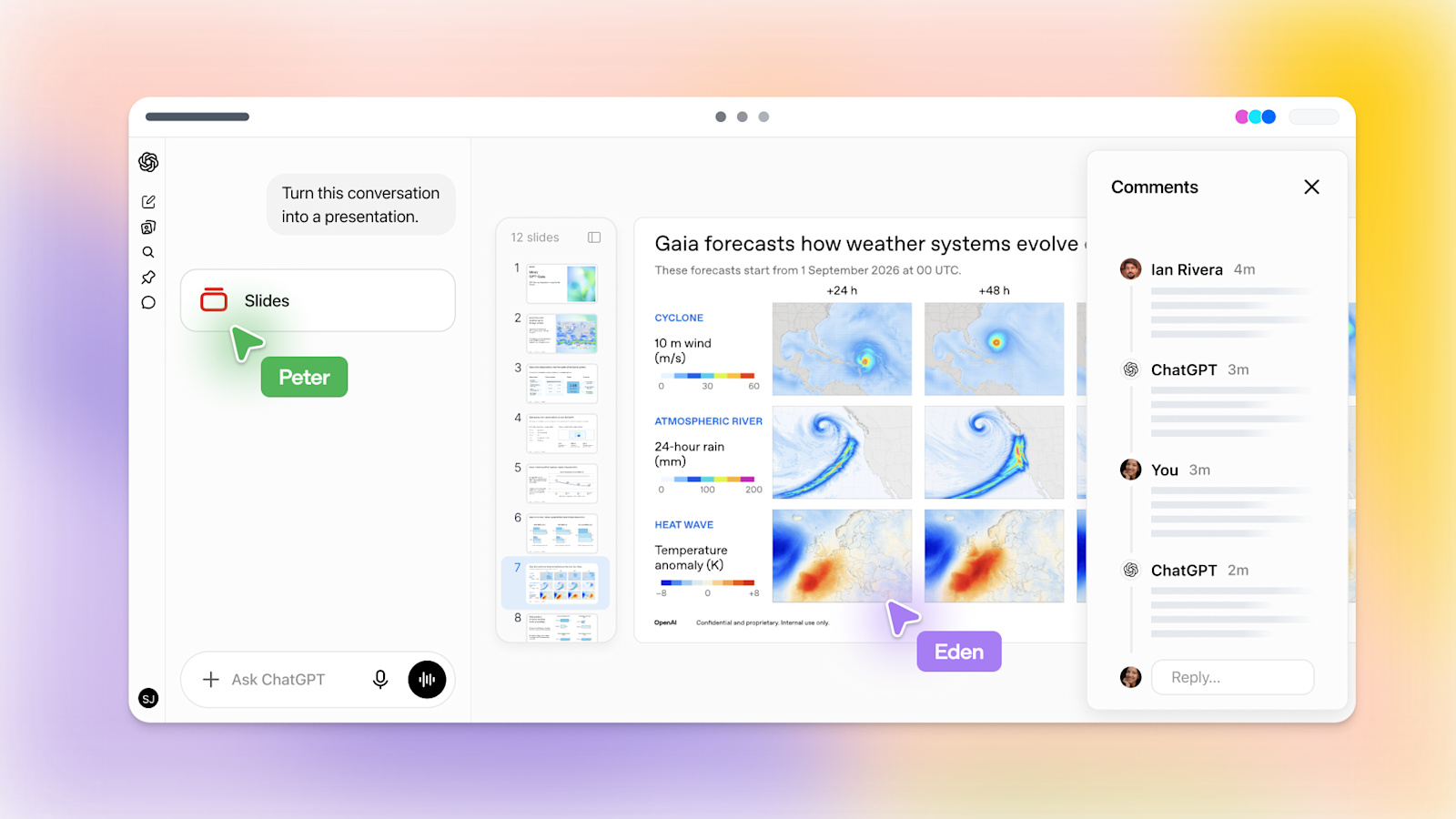
OpenAI rolls out ChatGPT Slides: real-time collaborative decks in Space, exportable to PowerPoint, PDF and Google Slides

Starting Oct 16, OpenAI is rolling out ChatGPT Slides on web and desktop to Pro, Business and Enterprise users with Space access. Ask ChatGPT in Work to turn a conversation, files or an outline into an editable deck, or share an example deck to set the style; teammates co-edit in real time, leave shared comments and @mention ChatGPT for edits. The web app exports to PowerPoint, PDF and Google Slides, and the desktop app can open decks in PowerPoint or Keynote.

OpenAI rolls out ChatGPT Slides: real-time collaborative decks in Space, exportable to PowerPoint, PDF and Google Slides

Key Takeaways

  • Rolling out from Oct 16 to 3 plans (Pro, Business, Enterprise) with Space access; Plus and Free are not in this wave
  • 3 web export targets: PowerPoint (.pptx), PDF and Google Slides; desktop opens decks in PowerPoint or Keynote
  • Share an example deck to guide layout, build templates with template-creator and share them via team Plugins
  • Real-time co-editing and shared comments; @mention ChatGPT or your dot to have the agent edit. Help Center says comment-only access is not available at launch
  • On Windows without the MXC component (unsupported on Windows 10) local desktop editing falls back to .pptx files; no official quality benchmarks
Read full story