
AI Coding Live News

GitHub Universe 2026: Copilot Fusion is generally available, routing and orchestrating models automatically, with Fusion Max scoring 60 on the Artificial Analysis Coding Agent Index at about half the cost of Claude Code with Opus 5.5 Max

At GitHub Universe 2026 on Oct 28, GitHub made Copilot Fusion generally available. It merges the multi-model orchestration of the Project HydraFusion research preview with Copilot auto model selection: users pick Copilot Fusion and an effort level (Standard, High or Max) in the model picker, and the system decides which models to use and whether to run a Single, Cascade or Critique workflow. GitHub says Fusion Max scored 60 on the Artificial Analysis Coding Agent Index, two points below Claude Code with Opus 5.5 Max, at about half the API cost per task, about half the tokens and about 40% less time. Each underlying model is billed at its standard rate, and paid plans get 30% off through Nov 30.
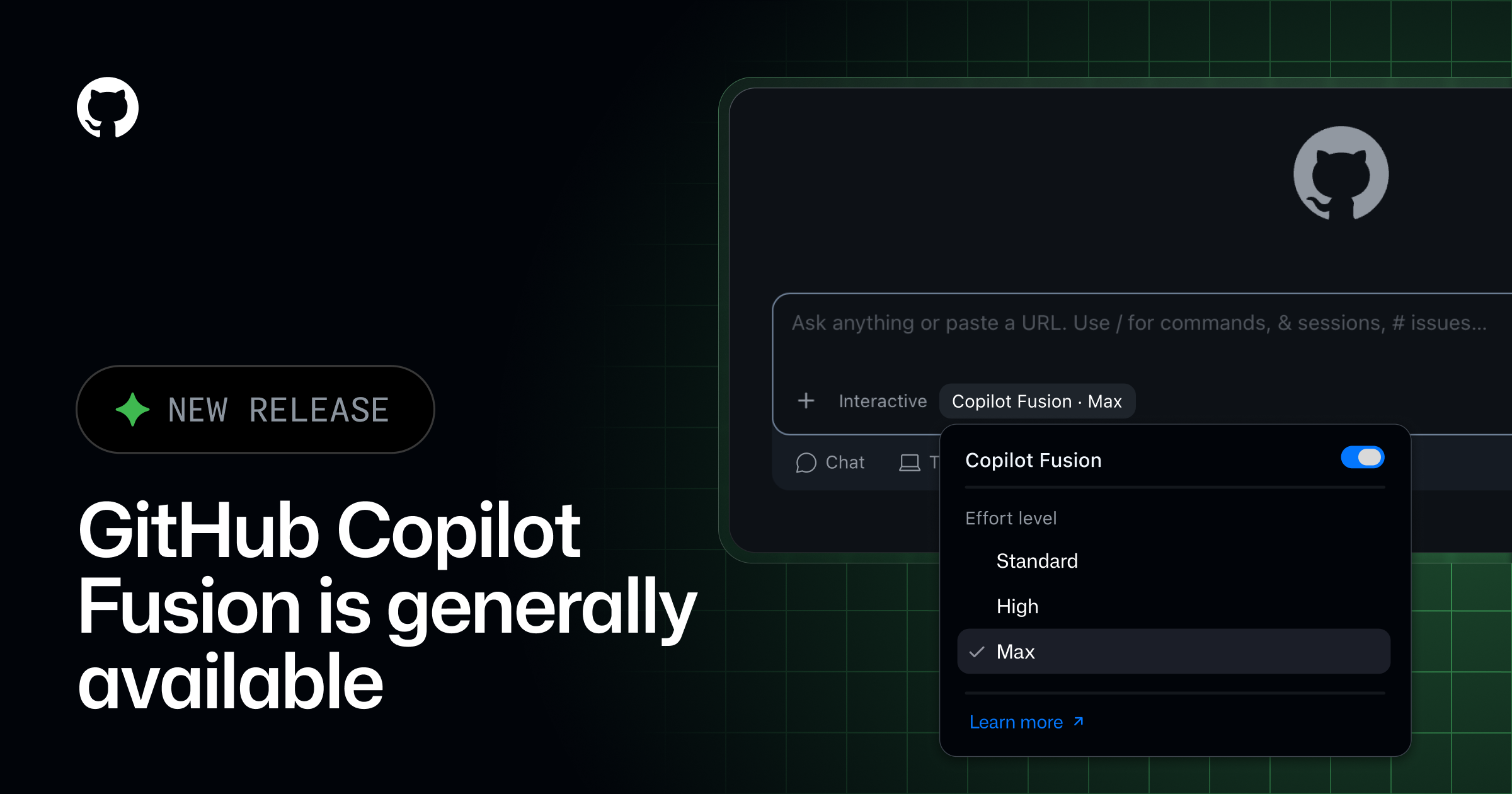
GitHub Universe 2026: Copilot Fusion is generally available, routing and orchestrating models automatically, with Fusion Max scoring 60 on the Artificial Analysis Coding Agent Index at about half the cost of Claude Code with Opus 5.5 Max

Key Takeaways

  • Scores (Artificial Analysis Coding Agent Index v2.0): Fusion Max 60 versus 62 for Claude Code with Opus 5.5 Max; $5.59 per task versus $11.42, while the Devin Fusion pairing scores 62 at $8.00
  • Breakdown: a slight lead on Terminal-Bench 4.0 at 71, third on FrontierCode at 51 (Claude Code 56, Devin Fusion 54), and a weaker 57 on SWE-Atlas-QnA-AA
  • Efficiency: about 7.2M tokens per task, roughly half of Claude Code with Opus 5.5 and 30% fewer than Devin Fusion; GitHub reports about 40% less time per task
  • The pool includes Claude Opus 5.5, Claude Sonnet 5.5, GPT-6 Astra and GPT-6 Sol; admins can disable individual models for Fusion only and set Fusion as the default
  • Availability: all Copilot plans in VS Code, the Copilot app, Copilot CLI and JetBrains IDEs; existing auto, HydraFusion and HydraFusion Max selections migrate to matching effort levels
Read full story

Cloudflare launches Clairic, a System One extraction model that returns typed values, dates and forecasts with confidence in one forward pass, in preview on Workers AI at $0.10 per million input tokens

On October 19 Cloudflare released a preview of Clairic, a "System One extraction model". Instead of generating tokens, it uses one parallel forward pass to extract, compute, estimate and forecast typed values from text or up to 4 images, with confidence, character spans and a null probability for each answer, returning null when a value is missing. It is live on Workers AI as @cf/cloudflare/clairic; the docs list a 64K context, vision support and $0.10 per million input tokens with no output charge. In Cloudflare's example, a Clairic+Clef+GLM-5.3 cascade ran about 3.2x faster and about 49% cheaper than GLM-5.3 alone (company figures). Open weights are planned later.

Cloudflare launches Clairic, a System One extraction model that returns typed values, dates and forecasts with confidence in one forward pass, in preview on Workers AI at $0.10 per million input tokens

Key Takeaways

  • Pricing and specs: $0.10 per million input tokens, no output charge, 65,536-token context, text plus up to 4 images (official docs).
  • Output types: text, number, date/time, duration, list, estimate, forecast; each answer carries confidence and p_null, and missing values return null.
  • Cascade test: Clairic to Clef to GLM-5.3 took 19.3 s vs 61.7 s, about 3.2x faster; $6,032 vs $11,740 per million claims, about 49% cheaper (company figures).
  • Forecast example: 21-day TSA checkpoint forecast averaged 3.3% error, with 17 of 21 days inside the 80% interval.
  • Limits: long arithmetic chains and multi-row aggregation are not reliable yet; it is a preview checkpoint with no date for open weights.
Read full story
Linked Models & Agents:
⚡ clairic⚡ clef⚡ GLM-5.3🌐 cloudflare

GitHub Copilot updates HydraFusion and adds HydraFusion Max, with Claude Opus 5.5 and the GPT-6 family in its model pool

On 2026-10-14 GitHub updated HydraFusion, Copilot's multi-model orchestration feature, and added HydraFusion Max for harder tasks. The pool now includes Claude Opus 5.5, GPT-6 Astra, GPT-6.1 Sol and GPT-6 Luna; effort is tuned per stage (medium for drafts, high for review), Cascade gains a judging step, and Critique now inspects the workspace with tools using parallel critics. Both remain in research preview across VS Code, the Copilot app and Copilot CLI.

Key Takeaways

  • Pool: Claude Opus 5.5, GPT-6 Astra, GPT-6.1 Sol, GPT-6 Luna, chosen per workflow (GitHub Changelog)
  • Per-stage effort: medium for drafts, high for review (previously each model's default)
  • Cascade adds a judge that requests repair only when needed; Critique uses tools on the workspace plus parallel critics
  • Two tiers: HydraFusion (balanced) and HydraFusion Max (deepest reasoning, orchestration still minds tokens)
  • Available in VS Code, Copilot app and Copilot CLI on Pro, Pro+, Business and Enterprise with preview features enabled
Read full story

Omni-Embed-Mini Binds 6 Modalities Without Forgetting: MBZUAI Opens 0.9B Dense Distillation Model Outperforming Gemini

Expanding text embedding models to multimodal domains typically triggers catastrophic forgetting in text retrieval, with existing omni-modal embedders ballooning past multi-billion parameters to compensate. MBZUAI researchers introduce Omni-Embed-Mini, a compact 0.9B architecture mapping text, speech, audio, image, video, and rich documents into a single shared cosine space. Crucially, text-side weights remain bit-identical to the base model, guaranteeing zero regression on text retrieval (49.57 nDCG@10 on MTEB-v2 BEIR-8). Powered by dense cascaded caption distillation, Matryoshka SigLIP loss, and online hybrid hard-negative mining, Omni-Embed-Mini is 2.7x to 9.5x smaller than competing open models, while its 2.3B variant surpasses proprietary gemini-embedding-2 on cross-modality averages.

Omni-Embed-Mini Binds 6 Modalities Without Forgetting: MBZUAI Opens 0.9B Dense Distillation Model Outperforming Gemini

Key Takeaways

  • Unifies text, speech, audio, image, video, and rich documents into a single shared space at only 0.9B parameters
  • Guarantees zero text forgetting via bit-identical frozen text weights (49.57 nDCG@10 on MTEB-v2 BEIR-8)
  • 2.3B model variant outperforms proprietary Google gemini-embedding-2 on cross-modality retrieval averages
Read full story
Linked Models & Agents:
ADSponsored

Amazon Open-Sources Rufus-Air: 8-Stage Post-Training RL Recipe on GLM-4.5-Air MoE Surpassing Official Checkpoints

Amazon's AI Research division has open-sourced 'Rufus-Air: An Open LLM Post-Training Recipe' (arXiv: 2609.29421), an entirely reproducible eight-stage post-training pipeline built atop GLM-4.5-Air-Base (a 106B total / 12B active parameter Mixture-of-Experts model). Dispensing with proprietary teacher distillation and private human annotation, Rufus-Air cascades through eight distinct stages—SFT, Reasoning RL, Coding RL, Instruction-Following RL, General Agent, Coding Agent, Search Agent, and RLHF—leveraging solely public data and open tooling to beat the official GLM-4.5-Air checkpoint across standard benchmarks.

Amazon Open-Sources Rufus-Air: 8-Stage Post-Training RL Recipe on GLM-4.5-Air MoE Surpassing Official Checkpoints

Key Takeaways

  • Delivers the first fully reproducible 8-stage post-training recipe for 100B+ MoE architectures (106B-A12B GLM-4.5-Air).
  • Relies entirely on publicly available datasets and verifiable programmatic reward models without proprietary teacher distillation.
  • Validates the 'Reward Reliability Ordering' heuristic, sequencing stages from deterministic unit tests to soft LLM judge signals.
  • Outperforms the official GLM-4.5-Air checkpoint across core evaluation suites, registering a 21.8% boost on multi-turn coding agent tasks.
  • Full stage ordering configs, reward architectures, and distributed training recipes published openly on arXiv and Hugging Face.
Read full story

FLEET Framework Open-Sourced: Guiding LLM Generation via Logits Entropy, Slashing Code Hallucinations

Researchers have open-sourced the FLEET framework (arXiv: 2609.27657). Tackling error compounding in long-form code generation and mathematical deduction, FLEET computes real-time logits entropy during forward passes to dynamically guide decoding trajectories and beam search, reducing hallucination cascades by 38% and boosting code pass@1 accuracy by 14.8%.

FLEET Framework Open-Sourced: Guiding LLM Generation via Logits Entropy, Slashing Code Hallucinations

Key Takeaways

  • Employs native logits entropy as an intrinsic token-level uncertainty estimator without auxiliary discriminator models.
  • Dynamically modulates temperature and prunes search branches in real time to prevent hallucination cascades.
  • Improves HumanEval-X multilingual code generation and GSM8K mathematical reasoning pass@1 by 14.8%.
  • Fully open-sourced on GitHub with turnkey decoding extensions for Hugging Face Transformers and vLLM.
Read full story
Linked Models & Agents:

Google introduces Gemini 3.8 Live and Live Extended Thinking

Google for Developers introduced Gemini 3.8 Live and Gemini 3.8 Live Extended Thinking. The audio models improve turn-taking and near real-time reasoning, replacing cascaded speech-to-text, reasoning, and text-to-speech stacks with one multimodal API call. They are available through the Gemini API in Google AI Studio.

Key Takeaways

  • Google for Developers introduced Gemini 3.8 Live and Gemini 3.8 Live Extended Thinking. The audio models improve turn-taking and near real-time reasoning, replacing cascaded speech-to-text, reasoning, and text-to-speech stacks with one multimodal API call. They are available through the Gemini API in Google AI Studio.
Read full story
Linked Models & Agents:

Google introduces Gemini 3.8 Live and Live Extended Thinking

Google for Developers introduced Gemini 3.8 Live and Gemini 3.8 Live Extended Thinking. These audio models improve turn-taking and near real-time reasoning, replacing cascaded speech-to-text, reasoning, and text-to-speech stacks with one multimodal API call to reduce latency and cost. They are available in the Gemini API via Google AI Studio and coming soon to the Gemini Enterprise Agent Platform.

Key Takeaways

  • Google for Developers introduced Gemini 3.8 Live and Gemini 3.8 Live Extended Thinking. These audio models improve turn-taking and near real-time reasoning, replacing cascaded speech-to-text, reasoning, and text-to-speech stacks with one multimodal API call to reduce latency and cost. They are available in the Gemini API via Google AI Studio and coming soon to the Gemini Enterprise Agent Platform.
Read full story
Linked Models & Agents:

Together: GLM-5.3 Flash cascade hits 80.9% on DeepSWE at $1.70/task

Together ran about 900 DeepSWE rollouts of GLM-5.3 vs GLM-5.3 Flash: 69.0% pass@1 at ~$3.99 per task versus 63.4% at ~$0.24, a 17x cost gap. Distillation mostly removed first-try reliability, not coverage—the pass@4 gap shrinks to 2.6 points. A Flash-then-escalate cascade reached 80.9% at about $1.70 per task, beating the full model alone at less than half the price. Coding agents should default to Flash and promote on test failure, but Flash broke an already-passing baseline in 6.9% of rollouts versus 4.4%, so diffs still need a regression gate.

Key Takeaways

  • On DeepSWE, GLM-5.3 is 69.0% pass@1 at ~$3.99; Flash is 63.4% at ~$0.24, about 17x cheaper.
  • A Flash-first cascade that escalates on test failure hits 80.9% at ~$1.70 per task.
  • Flash breaks passing baselines more often (6.9% vs 4.4%), so accept diffs only behind regression tests.
Read full story
Linked Models & Agents:

xAI brings Grok Voice to LiveKit: STT, Grok 4.3, and TTS in one ZDR AgentSession

SpaceXAI said Grok Voice models can now be used in LiveKit to build voice agents with full zero-data-retention support. LiveKit showed a patient-intake agent that cascades Grok STT, Grok 4.3, and Grok TTS through LiveKit Inference in a single AgentSession, with one set of credentials and billing. For developers, that is a three-string voice stack instead of a glued-together ASR, LLM, and TTS bill.

Key Takeaways

  • Grok Voice is available in LiveKit with zero-data-retention on every hop.
  • STT, Grok 4.3, and TTS cascade in one AgentSession with unified credentials and billing.
  • The reference build is a patient-intake agent for real-time, tool-using voice workflows.
Read full story
Linked Models & Agents:
ADSponsored

Codeium Windsurf introduces Cascade Hybrid Orchestration with adaptive routing between DeepSeek-R1 and Claude 3.7

Codeium rolled out Cascade Hybrid Orchestration for its Windsurf IDE. The engine routes architectural planning and algorithmic decomposition to DeepSeek-R1 while switching to Claude 3.7 Sonnet for rapid code writing and patch application, boosting composite task completion rates by 28%.

Key Takeaways

  • Dual-engine workflow: DeepSeek-R1 for architectural planning and Claude 3.7 for code generation.
  • Boosts complex multi-step debugging resolution rates by 28% while reducing rollback retries.
  • Available by default for Pro and Team subscribers in the latest Windsurf IDE update.
Read full story

Codeium Windsurf Cascade introduces persistent workflow memory graphs to retain project architectural conventions

Codeium launched Cascade Memories for its Windsurf IDE. The agent automatically distills team conventions, API paradigms, deprecated methods, and architectural patterns into a persistent knowledge graph, applying learned rules across sessions and branches without manual prompting.

Key Takeaways

  • Automatically extracts team coding standards and design constraints from interactions.
  • Memories exportable as team config files (.windsurf/rules) shared across Git repos.
  • Prevents repeated mistakes by preserving architectural invariants across sessions.
Read full story
Linked Models & Agents:

Codeium Unveils Windsurf Enterprise: Self-Hosted Cloud Clusters & SOC2 / HIPAA Compliance

Codeium released Windsurf Enterprise Edition supporting air-gapped on-premise VPC clusters and SOC2 compliance.

Key Takeaways

  • Air-gapped on-premise deployment with enterprise SSO integration (Okta, Azure AD, SAML)
  • Centralized administrative console for managing team-wide Rules Hub and model routing policies
  • Native bidirectional integration with internal self-hosted GitLab, Bitbucket, and Jira
Read full story