AI Coding Live News

Vercel Security Review Enters Public Beta: Vulnerability Review on Every GitHub Push, One-Click Fixes with Vercel Agent

On November 3 (US Pacific time), Vercel launched Security Review in public beta. It is a new Vercel Agent capability alongside Code Review and Investigation: once enabled, every push to connected GitHub repositories triggers a diff-only vulnerability review that finishes in seconds. Findings land in the Security dashboard, PR comments and the CLI, and can be fixed with one click by Vercel Agent or pulled into your own coding agent via vercel security vulnerabilities. It is available to Pro and Enterprise teams, and reviews are free until November 10.

Vercel Security Review Enters Public Beta: Vulnerability Review on Every GitHub Push, One-Click Fixes with Vercel Agent

Key Takeaways

  • Trigger: every GitHub push (including direct pushes to production) is reviewed automatically; only the diff is scanned, which Vercel says finishes in seconds, so it can run on every preview and production deployment
  • Beyond pattern matching: the agent traces how changed code is reached, checks existing protections and rechecks each finding, which Vercel says catches logic flaws such as missing authorization checks
  • Teams can write security policies in plain language, scoped to projects or the whole team, and manage them with vercel security policy
  • Pricing: Vercel Agent rate, model tokens at provider cost with no markup, plus $0.25 per million tokens; reviews are free until November 10, 2026, while Agent fixes are billed
  • Availability: public beta for Pro and Enterprise teams; Vercel has not published detection-rate or false-positive benchmarks
Read full story

X Discussion: Grok Bot Engineer poteto Calls Adversarial Agent Code Reviews "Mostly a Waste of Tokens" and Argues for Empirical Plus Formal Verification Instead

On November 3, @poteto (lauren), whose bio says she works on Grok @bot at SpaceXSI, is on the React Compiler core team, and previously worked at Cursor, Meta and Netflix, posted what she called "maybe a hot take": she now considers adversarial reviews mostly a waste of tokens and thinks those tokens are far better spent on empirical combined with formal verification. She says she has updated her agent skill pack pstack to use its interrogate (multi-model adversarial review) skill less and may eventually remove it. She adds that she has found very little value in code review in the abstract, because agents tend to get lost in nitpicks and YAGNIs. The post drew about 906K views, 9,227 likes and 5,538 bookmarks. It is a personal opinion that sparked debate over the value of AI code review.

Key Takeaways

  • Opinion (personal, not an official finding): adversarial reviews are "mostly a waste of tokens"; empirical plus formal verification is the better use of them
  • Action: the author says she has made pstack use the interrogate skill less and may remove it; at fetch time the public pstack folder in GitHub cursor/plugins had no commits after October 27, so the change is not visible there yet
  • What interrogate is: per its public SKILL.md, it spawns one read-only reviewer per configured model (defaults Claude Opus 5.5 xhigh and Grok 4.7 xhigh fast) to attack the diff, then sorts findings into Act on, Consider, Noted and Dismissed without auto-applying fixes
  • Author (per her X and GitHub bios): engineer on Grok Bot at SpaceXSI, React Compiler core team, previously at Cursor, Meta and Netflix
  • Reach: about 906K views, 9,227 likes, 5,538 bookmarks, 668 replies, 356 reposts and 210 quotes
Read full story

Anthropic Claude Code Review generally available for Team/Enterprise: ~3x faster reviews (about 20 min → 6–10 min), Quick/Standard/Deep per repo

On 2026-10-15 Anthropic moved Claude Code’s Code Review out of research preview to general availability for Team and Enterprise organizations. Most reviews finish about 3x faster (roughly 20 minutes down to 6–10). Admins pick Quick, Standard, or Deep per repository; the Claude GitHub App auto-reviews new PRs, or anyone with write access can comment @claude review. Eligible Enterprise orgs can claim at least $10,000 in Code Review credits by January 15, 2027 (credits expire 30 days after claim).

Key Takeaways

  • Scope: Code Review leaves research preview for Claude Team and Enterprise; enable via Claude GitHub App and selected repos (GA announcement)
  • Speed: Anthropic says most reviews finish ~3x faster than preview — about 20 minutes down to 6–10 minutes
  • Tunable depth: admins set Quick / Standard / Deep per repo (Standard default); triggers: once on PR open, every push, or @claude review only
  • Pipeline: multi-agent Find → Verify → Rank → Post; inline comments + check run; never approves or blocks the PR (docs)
  • Billing & credits: billed on token usage credits (no flat per-review price); eligible Enterprise orgs can claim ≥$10,000 Code Review credits by Jan 15, 2027 (expire 30 days after claim)
Read full story

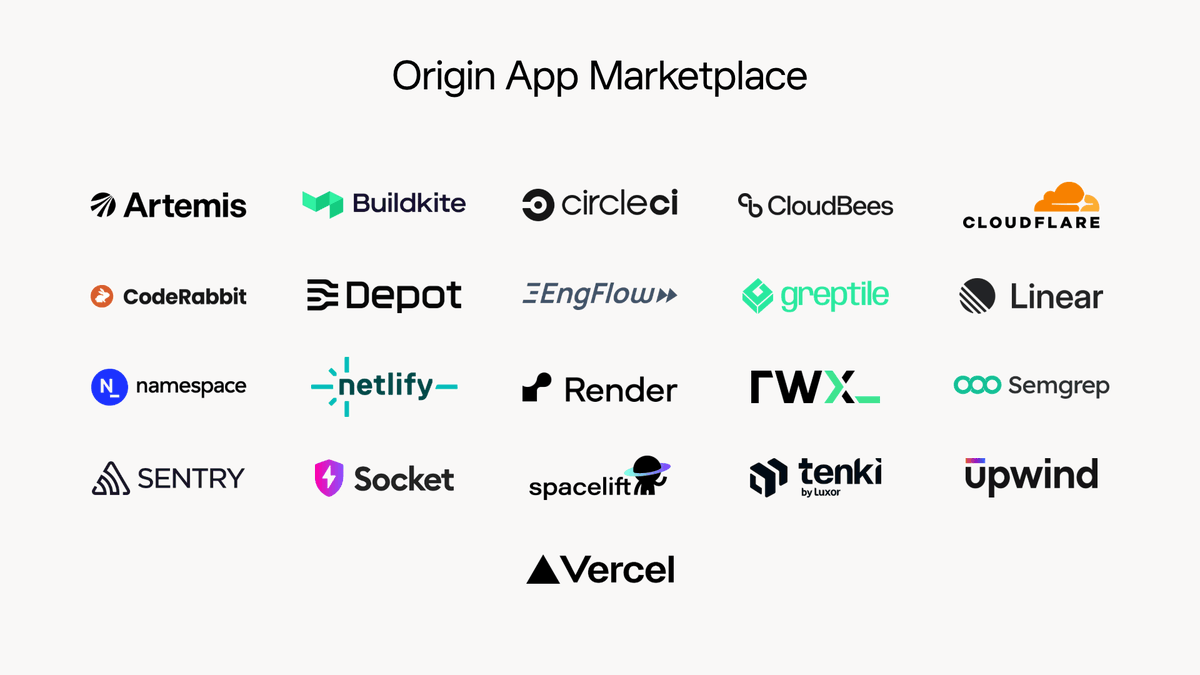
Cursor launches the Origin App Marketplace with 20+ CI, deploy, code-review and security integrations, open to public submissions

On Oct 13 Cursor launched the Origin App Marketplace: its code hosting platform Origin now connects to 20+ apps across deployments (Cloudflare, Vercel and more), CI (CircleCI, Buildkite and more), code review (CodeRabbit, Greptile, Tenki), security (Semgrep, Socket and more), monitoring (Sentry) and project management (Linear), and the marketplace is open to public submissions from any developer-tool team.

Cursor launches the Origin App Marketplace with 20+ CI, deploy, code-review and security integrations, open to public submissions

Key Takeaways

  • 21 launch apps in 6 categories: deploy (5), CI (7), code review (3), security (4), monitoring (1), project management (1)
  • Public submissions: build privately in your namespace, make it public, submit with slug, tags and a demo video, then Cursor reviews and lists it
  • Apps authenticate with an app JWT plus installation access tokens, receive webhooks, and write back check runs, PR comments and reviews
  • The official origin-apps plugin answers questions from live Origin API docs and plans ports of existing apps
  • Launch post: ~1,356 likes and ~68K views as of Oct 14 morning
Read full story
ADSponsored

JetBrains Unveils SWE-TaskFlow: Aligning Coding Agent Benchmarks with Real Developer IDE Workflows

Mainstream coding agent benchmarks like SWE-bench frame evaluation around issue-derived tasks: feeding an agent a bug description and expecting an end-to-end patch. But does this reflect genuine developer practices? JetBrains Research analyzes 4,782 production sessions of professional software engineers inside JetBrains IDEs (arXiv:2610.09633). For long interactive sessions (>=3 turns, comprising 33% of production traffic), user requests span a diverse mix of intent types—project codebase Q&A, strategic planning, code review, refactoring, and test execution—with users frequently transitioning between types mid-session. To align benchmarks with real developer task flows, JetBrains introduces SWE-TaskFlow, an approach that transforms issue-based benchmarks via prompt-splitting and verifiable repository QA into calibrated multi-stage workflows guided by a TaskFlow Alignment Score (TFAS). A pilot study across 700 SWE-Bench Pro tasks demonstrates that sequential multi-step interaction protocols nearly double agent inference expenditure without stable improvements in resolve rates, proving that the interaction protocol itself is a critical, previously unmeasured dimension of agent evaluation.

JetBrains Unveils SWE-TaskFlow: Aligning Coding Agent Benchmarks with Real Developer IDE Workflows

Key Takeaways

  • JetBrains analyzes 4,782 production IDE sessions, proving real software engineers navigate dynamic multi-intent task flows
  • Introduces SWE-TaskFlow and TFAS to transform issue benchmarks into realistic multi-turn developer interaction protocols
  • Pilot across 700 SWE-Bench Pro tasks reveals multi-turn protocols double token costs without stable success gains
Read full story
Linked Models & Agents:

GitHub open-sources ReviewBench, a 219-PR benchmark for AI code review: Copilot, Devin and Qodo lead; Cursor's grounded recall is 9.6%

GitHub's blog post ReviewBench (Oct 5, 2026) launches an offline AI code-review benchmark as a research preview. It has 219 PRs from 187 open-source repos in 19 languages, sampled to match the distribution of 103.9M GitHub PRs. The golden set combines human reviewers, several frontier LLMs and static analysis. Claude Sonnet 5 is the judge, and senior engineers agreed with its labels 96.6% of the time. On the leaderboard, grounded recall is 26.0% for Copilot Code Review (Balanced), 23.8% for Devin, 22.1% for Qodo and 9.6% for Cursor. The dataset, judge prompt and runner are MIT-licensed on GitHub.

GitHub open-sources ReviewBench, a 219-PR benchmark for AI code review: Copilot, Devin and Qodo lead; Cursor's grounded recall is 9.6%

Key Takeaways

  • Scale: 219 PRs from 187 open-source repos in 19 languages, sampled to match the distribution of 103.9M GitHub PRs (blog)
  • Trust: senior engineers independently re-labeled every golden finding and agreed with the benchmark 96.6% of the time; Claude Sonnet 5 is the judge
  • Leaderboard grounded recall: Copilot Balanced 26.0% (87.8% precision) > Devin 23.8% > Qodo 22.1% > Codex GPT-5.6 Sol Ultra 19.9% > Cursor 9.6%
  • Offline matched online: in a multi-model ensemble experiment, the online A/B showed +8.0% precision, +13.6% recall and −8.0% cost per review; critical comments were predicted at +227% offline and measured at +262% online
  • To submit: bring your own container image and model key, run the 25-PR test set, then the full 219 PRs over 3 rounds. The repo review-bench/ReviewBench is MIT-licensed
Read full story

Anthropic opens multi-agent Code Review to Claude Code Team/Enterprise: substantive comments 16%→54%

Anthropic blog Code Review (Last-Modified 2026-10-02) and docs: multi-agent Code Review research preview for Claude Code Team/Enterprise. Parallel find→verify→rank; overview + inline comments; never approves/blocks. Vendor stats: substantive comments 16%→54%; large PRs 84% with findings; ~$15–25/review, ~20 min. Local /code-review remains for other plans.

Key Takeaways

  • Sources: claude.com/blog/code-review + code.claude.com docs; Last-Modified 2026-10-02
  • Team/Enterprise research preview; not for ZDR orgs; others keep local /code-review
  • Multi-agent find→verify→rank; CLAUDE.md/REVIEW.md; @claude review triggers
  • Vendor: substantive comments 16%→54%; large PRs 84% with findings; ~$15–25/review
  • Setup: GitHub App, per-repo triggers, spend caps; forks need explicit @claude review
Read full story
Linked Models & Agents:

GitHub Copilot Code Review Major Upgrade: Custom Team Policy Rules and Granular PR Filters

GitHub (@github) announced a major update to Copilot Code Review via its official Changelog. Enterprise teams can now establish custom team policy rules, granular path filters, and risk thresholds to catch security defects and architecture violations while significantly reducing noise on non-critical files.

GitHub Copilot Code Review Major Upgrade: Custom Team Policy Rules and Granular PR Filters

Key Takeaways

  • Supports glob file path and branch matching rules to exclude documentation, mocks, and vendor assets.
  • Introduces custom architectural rules (e.g., banning direct raw SQL queries in controller layers).
  • Tight integration with PR Status Checks to automatically block merging non-compliant pull requests.
  • Comprehensive configuration guides published on GitHub Docs for immediate enterprise adoption.
Read full story

Mira open-sources a self-hosted AI code reviewer with full-repo indexing

@DanKornas highlighted miracodeai/mira, a self-hosted AI code reviewer for teams that keep diffs, indexes, review history, and CVE data in their own SQLite or Postgres. It supports OpenRouter and OpenAI-compatible endpoints including vLLM/Ollama, applies per-repo rules via .mira.yaml, and auto-reviews PRs on GitHub, GitLab, and Forgejo/Codeberg. Apache-2.0.

Key Takeaways

  • Self-hosted by default: code and review data stay on your infrastructure.
  • Full-repo indexing plus custom rules go beyond a single diff.
  • Supports GitHub, GitLab, and Forgejo; models via OpenRouter or local OpenAI-compatible endpoints.
Read full story

OpenAI Renews Codex for OSS with 10,000 Pro Grants

OpenAI engineer Charlie Marsh announced a renewal of Codex for OSS, offering open-source maintainers $100 Pro plans and doubling the grant pool from 5,000 to 10,000. The program includes AI code review and security tooling for critical projects, expanding agent-assisted engineering across open source.

Key Takeaways

  • The Pro grant pool doubles from 5,000 to 10,000 places, and previous recipients may re-apply
  • The $100 Pro plans target open-source maintainers building and maintaining critical projects
  • The program includes AI code review and security tooling for practical software engineering
Read full story
Linked Models & Agents:
ADSponsored

gentle-ai v2.9.0: RTK community tool, Claude Code telemetry, OpenCode reviewer relay

Gentleman Programming shipped gentle-ai v2.8.1–v2.9.0 and gentle-pi v2.6.1–v2.6.3. Highlights include Claude Code runtime telemetry that attributes models by public family patterns, OpenCode SDD/reviewer relay semantic decoding, and opt-in RTK as a community tool (attested install to ~/.local/bin/rtk, configures only selected agents, telemetry off by default; Windows unavailable). gentle-pi adds subagent_reconcile so a parent can reconcile uncertain acquire/settle remediations without launching an actor or exposing tokens.

Key Takeaways

  • gentle-ai v2.9.0 adds opt-in RTK community tool with attested install and selected-agent-only config.
  • Claude Code Stop usage telemetry is idempotent and attributes models by public family patterns.
  • OpenCode reviewer relay decodes Task wrappers semantically; gentle-pi adds subagent_reconcile for uncertain remediations.
Read full story

Alibaba open-sources Open Code Review: line-level AI review CLI; higher precision/F1 than Claude Code at ~1/9 tokens

Community coverage notes Alibaba open-sourced its internal AI code-review assistant as Open Code Review (github.com/alibaba/open-code-review; npm @alibaba-group/open-code-review at 1.12.0). The CLI reads Git diffs, uses a tool-using agent for line-level structured comments, supports ocr scan for whole-file audits, and plugs into Claude Code, Codex, and Cursor. Official bench: 50 repos / 200 PRs / 10 languages with 1,505 annotated issues; same base model yields higher Precision and F1 than general-purpose Claude Code at ~1/9 the tokens, trading some recall for less noise.

Key Takeaways

  • Alibaba open-sourced Open Code Review (alibaba/open-code-review); npm @alibaba-group/open-code-review at 1.12.0.
  • Line-level diff review plus ocr scan; works with Claude Code, Codex, and Cursor.
  • AACR-Bench: higher Precision/F1 vs Claude Code at ~1/9 tokens (recall traded for precision).
Read full story

Warp adds built-in Grok Build CLI support: rich prompts, /remote-control sessions, code review panels

Warp now has built-in support for the Grok Build CLI—rich input for longer pasted prompts and multi-cursor, /remote-control to share an agent session to another device, plus file explorer and code review panels.

Key Takeaways

  • Native Grok Build CLI support inside Warp.
  • Longer prompts, multi-cursor, and /remote-control cross-device sessions.
  • File explorer and code review panels available in-session.
Read full story
Linked Models & Agents:

Zed Unveils Delta and DeltaDB: Binding Every Code Edit with Its Generating Agent Conversation Trace

Zed launched early access for Delta and DeltaDB, capturing ordered code deltas paired with human and agent conversation histories on top of git for granular review provenance.

Key Takeaways

  • Re-architects code provenance by binding ordered file deltas directly to conversation transcripts;
  • Reviewers receive shareable thread links containing the complete conversational context behind changes;
  • Private beta expanding with instant terminal invocation directly within the Delta interface.
Read full story