AI Coding Live News

Suhail launches Particle and its first model, Particle-1: a DeepSeek V4.1 Flash post-train that uses about 45% fewer tokens on coding tasks

On Oct 28, Mixpanel founder Suhail Doshi announced his new company Particle on X, with its first model, Particle-1, live now. Particle's blog says it is a reinforcement-learning post-train of DeepSeek V4.1 Flash that uses 28.4% to 52.2% fewer output tokens and costs 34.4% to 51.6% less per task across four coding and data engineering benchmarks, with pass rates inside the base model's confidence intervals. It is available through the Particle API, OpenRouter and Vercel AI Gateway; Particle's docs list $0.25 input and $1.00 output per million tokens with a 1,048,576-token context window.

Suhail launches Particle and its first model, Particle-1: a DeepSeek V4.1 Flash post-train that uses about 45% fewer tokens on coding tasks

Key Takeaways

  • Across four benchmarks (Terminal-Bench 2.1, ReactBench, ADE Bench, DeepSWE 1.1), 28.4% to 52.2% fewer output tokens and 34.4% to 51.6% lower cost per task (vendor-reported)
  • Particle's summary table: $0.2211 per task versus $0.3368 for DeepSeek V4.1 Flash and $0.6523 for GLM 5.3 Flash; 59,580 mean output tokens versus 83,246 and 98,155
  • Task pass rate 72.57% versus 71.15% for the base model and 66.82% for GLM 5.3 Flash; GPQA Diamond 90.40% (base 90.91%), MMLU 86.08% (base 85.98%)
  • Training: a rank-64 LoRA on the experts in all layers, about 1.25% of the model's parameters, trained with sequence-level GSPO in two RL stages
  • Pricing: Particle docs currently list $0.25 input, $0.03 cached input and $1.00 output per million tokens, a 1,048,576-token context and a 131,072-token output ceiling
Read full story

DiffuSpace, founded by the HKU Dream team, open-sources Clover-35B-A3B, a diffusion LLM hitting 680 tokens/s on one GPU and 73.6 on SWE-bench Verified

On Oct 28 DiffuSpace, whose members come from the HKU NLP group behind Dream 7B, released its first model, Clover-35B-A3B-Preview: a mixture-of-experts diffusion language model initialized from Qwen3.6-35B-A3B, with 35B total and about 3B active parameters, a 128K context window and block-parallel denoising. Vendor-reported results include 73.6 on SWE-bench Verified, 51.7 on Terminal-Bench 2.1 and 83.8 on GPQA Diamond, with 680 tokens/s on a single GB300 in agent workloads. Weights are Apache 2.0 on Hugging Face, ModelScope and GitHub, with SGLang and llama.cpp support.

DiffuSpace, founded by the HKU Dream team, open-sources Clover-35B-A3B, a diffusion LLM hitting 680 tokens/s on one GPU and 73.6 on SWE-bench Verified

Key Takeaways

  • A 35B-total, roughly 3B-active MoE diffusion model initialized from Qwen3.6-35B-A3B, with 128K context and a thinking mode
  • DiffuSpace says it tops all six agent benchmarks it compared: SWE-bench Verified 73.6, Terminal-Bench 2.1 51.7 and tau3 Overall 65.3, ahead of LLaDA2.2 flash, Mercury 2.5 and Qwen3.6-35B-A3B
  • Speed (vendor-reported): 680 tokens/s on one GB300 at BF16 and batch size 1 in agent workloads, and 515 tokens/s on one H200 versus 365 tokens/s for Qwen with DFlash2
  • An INT4 build runs on a 16GB RTX 5070 Ti at 101.8 tokens/s on MATH-500
  • Weights on Hugging Face are Apache 2.0, about 69GB in BF16, and SGLang is the recommended serving path
Read full story
Linked Models & Agents:
⚡ Clover-35B-A3B-Preview⚡ Qwen3.6-35B-A3B⚡ Dream 7B⚡ LLaDA2.2 flash⚡ Mercury 2.5🌐 DiffuSpace🌐 HKU NLP🌐 Alibaba Qwen🌐 NVIDIA

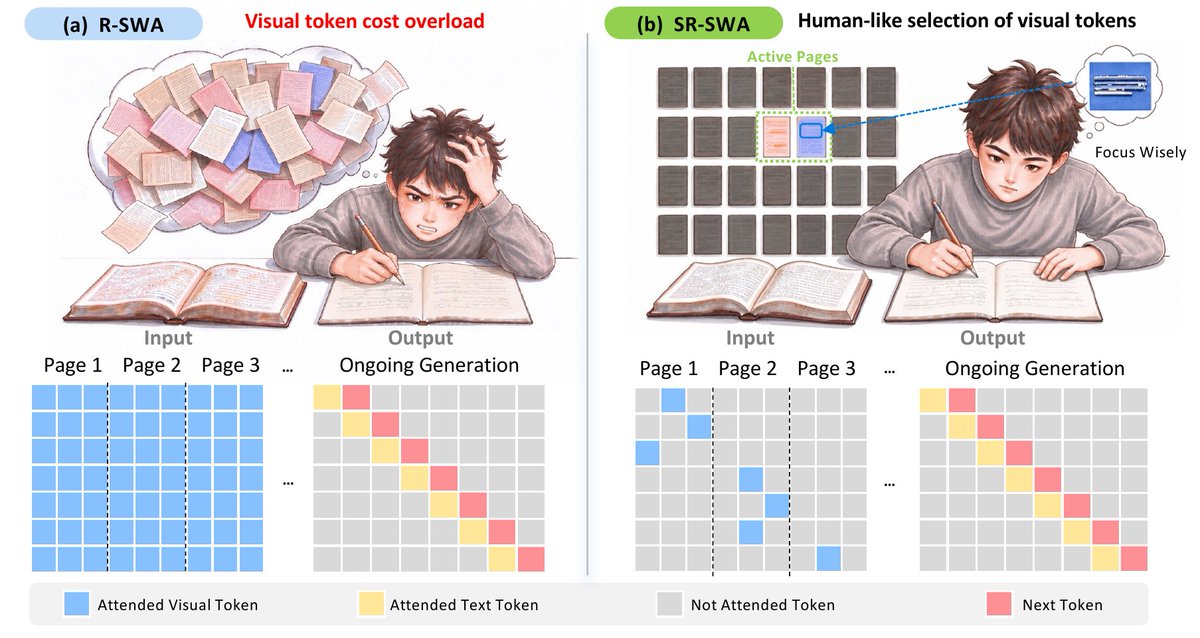
Baidu open-sources Unlimited OCR 2: SR-SWA keeps memory and latency nearly flat on very long documents, scoring 77.1 on MarathonDocBench per Baidu

On Oct 27, Baidu's official @Baidu_Inc account announced the open-source release of Unlimited OCR 2 on Hugging Face under the MIT license. Its new SR-SWA attention compresses text-visual interactions into a fixed-size reference set, which Baidu says lets it parse documents of any length within a finite context window. Baidu reports 84.6 on MPDocBench (dozens of pages) and 77.1 on MarathonDocBench (hundreds of pages), both self-reported.

Baidu open-sources Unlimited OCR 2: SR-SWA keeps memory and latency nearly flat on very long documents, scoring 77.1 on MarathonDocBench per Baidu

Key Takeaways

  • SR-SWA compresses text-visual attention over very long sequences into a fixed-size reference set (e.g. 512 tokens), which Baidu says keeps per-step decode latency and memory nearly flat as page count grows
  • Per Baidu: 84.6 overall on MPDocBench, 6.3 points above the next best, Qwen3.8-Max (78.3)
  • Per Baidu: 77.1 overall on MarathonDocBench, 43.3 points above the next best, Kimi-K3 (33.7); the first Unlimited-OCR scores 0 there
  • Weights are on Hugging Face under MIT, about 3.3B parameters by the HF weight count, with Transformers and a customized SGLang build for serving
  • All scores are Baidu's own measurements with no third-party reproduction yet
Read full story
Linked Models & Agents:
⚡ Unlimited OCR 2⚡ Unlimited-OCR⚡ DeepSeek-OCR🌐 Baidu

Cloudflare discloses a cross-request KV cache leak in GLM-5.3 on Workers AI: a config mismatch plus an SGLang bug let 155 responses carry other users' data over 13 days

In an Oct 26 incident report on its blog, Cloudflare said that between Aug 27 and Sep 9, 155 responses from GLM-5.3 on Workers AI (@cf/zai-org/glm-5.3) to prompts longer than 681,280 tokens contained data from other customers' recent requests, all returned with HTTP 200. The cause was a prefill KV cache pool smaller than the 1,048,576-token context window, combined with an SGLang bug in disaggregated prefill/decode mode. Cloudflare found no evidence of deliberate exploitation, has fixed it, and recommends operators upgrade to SGLang v0.5.22 or later.

Cloudflare discloses a cross-request KV cache leak in GLM-5.3 on Workers AI: a config mismatch plus an SGLang bug let 155 responses carry other users' data over 13 days

Key Takeaways

  • Scope: 155 responses between 2026-08-27 and 09-09, all to prompts over 681,280 tokens; Cloudflare confirmed no other Workers AI model was affected
  • Cause 1: GLM-5.3 advertised a 1,048,576-token context but the prefill KV pool held only 681,280 tokens; after the fix the pool holds about 2.04 million tokens, roughly twice the context
  • Cause 2: SGLang marked over-length requests as rejected and swapped in a one-token placeholder without aborting, so the decode node read stale cache pages from earlier requests
  • Response: report from Gadi Evron of Knostic via HackerOne on Sep 8; model taken offline within 40 minutes of declaring the incident on Sep 9 and restored at 19:40 UTC that day
  • Action: teams running SGLang should upgrade to v0.5.22 or later and check KV pool size against context length directly
Read full story
Linked Models & Agents:
⚡ Z.ai GLM 5.3🌐 cloudflare🌐 zai
ADSponsored

OpenAI launches GPT-6.1 Terra: fast, low-cost computer use at $1/$5 per million tokens, half the price of GPT-5.6 Terra and GPT-6.1 Sol

On Oct 26 OpenAI released GPT-6.1 Terra, an efficient model for visual reasoning, precise computer use and natural writing. It is rolling out today to Plus, Pro, Enterprise and Edu users in ChatGPT Work and Codex, and in the API as gpt-6.1-terra. Standard API pricing is $1 input, $0.05 cached input and $5 output per million tokens, which OpenAI says is 50% lower than GPT-5.6 Terra and GPT-6.1 Sol, with a 1,050,000-token context window. By OpenAI's figures it scores 15 points higher than GPT-5.6 Terra on Agents' Last Exam at medium effort for about a third of the cost, and solves 50.3% of Terminal-Bench 4.0 at max effort.

OpenAI launches GPT-6.1 Terra: fast, low-cost computer use at $1/$5 per million tokens, half the price of GPT-5.6 Terra and GPT-6.1 Sol

Key Takeaways

  • Pricing (official docs): $1 input, $0.05 cached input, $1.25 for 30-minute cache writes and $5 output per million tokens; requests over 272K input tokens are billed at 2x input and 1.5x output; Batch/Flex are half price and Fast mode is 2x
  • Specs: 1,050,000-token context, 922,000 max input and 128,000 max output tokens, Jun 1 2026 knowledge cutoff; reasoning.effort from none to max, and tool calling requires the Responses API
  • Computer use (OpenAI figures): on Agents' Last Exam at medium effort it beats GPT-5.6 Terra by 15 points at about one-third the cost, and matches GPT-6 Astra at one-tenth the price per token; it finishes tasks over 3x faster than GPT-6 Astra and GPT-6.1 Sol
  • Coding and factuality (OpenAI figures): 50.3% on Terminal-Bench 4.0 at max effort, more than double GPT-5.6 Terra's published 21.5%; error rate on an internal error-inducing prompt set fell from 53.6% to 16.7% at low effort
  • Safety: OpenAI says it meets the Critical cybersecurity threshold under its Preparedness Framework and keeps the safeguards built for GPT-6 Astra
Read full story

Mirendil, founded by ex-Anthropic researchers, unveils Fern: its first from-scratch model with up to 10M tokens of context

On Oct 26 Mirendil unveiled Fern, its first model, pretrained from scratch on its own Mirendil-Base (0.1-0.5T params) with a context window of up to ~10M tokens, about 0.5M lines of code or days of agent traces. Fern 0.1 got only a short round of post-training and targets AI R&D work such as auditing training data, debugging runs from logs and reading agent traces end to end. Vendor-reported: 73.4% on SWE-Bench Verified and 100% single-needle RULER retrieval at 10M, while multi-hop QA drops to 45% at 10M. Access is early-access only; no price or weights yet.

Mirendil, founded by ex-Anthropic researchers, unveils Fern: its first from-scratch model with up to 10M tokens of context

Key Takeaways

  • Scale and context (vendor-reported): Mirendil-Base has 0.1-0.5T params; Fern reads up to ~10.2M tokens (about 23 MB or ~0.5M lines of code, roughly Megatron-LM scale), per the official blog
  • Coding scores (run by Mirendil, OpenCode, 1 attempt): SWE-Bench Verified 73.4, SWE-Bench Pro v2-Hard 76.5, SWE Atlas QnA 53.2, DeepSWE v1.1 44.2, Terminal-Bench 4.0 just 6.1; Claude Opus 5.5 in the same table scores 98.2/100.0/66.4/74.2/66.4
  • RULER long context (vendor-reported): single-needle retrieval is 100% from 32K to 10M; multi-hop HotpotQA falls from 65% at 32K to 45% at 10M, with only 20 samples per 10M cell
  • Cost (vendor-reported): one researcher plus agents built Mirendil-Base in 3.5 months for under $10M of compute, with agents writing over 99% of the code, per the pretraining write-up
  • Availability: Fern is the smallest of three models; Base-Large (0.5-2T) and Base-XL (2-10T) are still pretraining; access is via early-access requests only, with no price or weights announced
Read full story
Linked Models & Agents:
⚡ Fern 0.1⚡ Mirendil-Base🌐 Mirendil

BOSS Zhipin's Nanbeige lab open-sources Nanbeige4.3-33B, a 33B dense agent model with 512K context under Apache 2.0, reporting 80.9 on Terminal-Bench 2.1 vs 73.0 for Qwen3.8-27B

At 12:11 UTC on 2026-10-25, the Nanbeige LLM Lab of BOSS Zhipin (Kanzhun Limited) announced Nanbeige4.3-33B from its account @nanbeige (post), with the model and its Base version released as open weights on Hugging Face under Apache 2.0 (model card). It is a 33B dense model on a Llama-style architecture with a 512K context window, positioned as the teacher model of the Nanbeige4.3 series that will be distilled into smaller models such as Nanbeige4.3-3B. The official model card compares it with Qwen3.8-27B, Muse-Glimmer-30B and Gemma4-31B using the same harness at highest thinking effort: 80.9 on Terminal-Bench 2.1 (Qwen3.8-27B 73.0) and 65.5 on DeepSWE (42.5), but 60.3 on SWE-Bench Pro, slightly below Qwen's 61.7, and 84.8 on GDPval vs 86.4. All figures are self-reported and not yet independently reproduced.

Key Takeaways

  • Official sources: @nanbeige post on X and the Hugging Face model card; the post had about 616 likes, 79 reposts and 38K views when we pulled it
  • Specs: 33B dense, Llama-style architecture, 512K context, Apache 2.0, with a Base checkpoint released too
  • Self-reported coding scores: Terminal-Bench 2.1 80.9, Terminal-Bench 4.0 23.8, DeepSWE 65.5, SWE-Bench Pro 60.3 (Qwen3.8-27B: 73.0, 6.3, 42.5, 61.7)
  • Self-reported cowork scores: Automation Bench 54.2, JobBench 44.8, GDPval 84.8 (Qwen3.8-27B: 38.3, 34.5, 86.4)
  • Deployment: Transformers, SGLang and vLLM, with official examples using 4-way tensor parallelism; Nanbeige4.3-3B distillation is next
Read full story
Linked Models & Agents:
⚡ Nanbeige4.3-33B⚡ Qwen3.8-27B⚡ Gemma4-31B⚡ Muse-Glimmer-30B🌐 Nanbeige🌐 BOSS Zhipin🌐 Kanzhun

Google previews Gemini API CLI (gemini-api), a zero-dependency Go binary that lets Claude Code, Codex, Cursor and other coding agents generate media, transcribe and run managed agents from the shell

The Google AI Studio team released an experimental preview of the Gemini API CLI (command name gemini-api). It is a stateless, zero-dependency Go binary for macOS, Linux and Windows, open source under Apache 2.0. Any coding agent with shell access and a GEMINI_API_KEY can call text reasoning, image, video, music and speech generation, file and YouTube analysis, audio and video transcription, and managed agents such as Deep Research with one command. Media is written straight to disk and only the file path goes to stdout, so base64 payloads never land in the context window. Google labels it experimental and not a supported Google product.

Google previews Gemini API CLI (gemini-api), a zero-dependency Go binary that lets Claude Code, Codex, Cursor and other coding agents generate media, transcribe and run managed agents from the shell

Key Takeaways

  • Default models (official README): gemini-3.8-flash for generate, analyze and transcribe; gemini-nano-banana-2.1 for image; gemini-omni-1.1-flash for video; lyria-3.5 for music; gemini-3.8-flash-tts for speech
  • Install with a one-line curl script on macOS/Linux, a PowerShell script on Windows, or go install; the latest GitHub release is v0.4.3 (published 2026-10-19)
  • Built for agents: --usage prints the command tree as KDL, --schema prints JSON Schema, --dry-run validates offline with credentials redacted, plus --output-format json/toon and inline --jq
  • Exit codes separate 4 cases: 0 success, 1 runtime/API failure, 2 usage or validation error, 3 auth failure; --agent-mode emits structured JSON errors
  • It also manages sandbox environments, server-side credentials, webhooks and cron triggers for managed agents; files uploaded via the Files API are kept for 48 hours
Read full story
Linked Models & Agents:
⚡ Gemini 3.8 Flash⚡ Gemini Nano Banana 2.1⚡ Gemini Omni 1.1 Flash⚡ Lyria 3.5⚡ Gemini 3.8 Flash TTS🤖 Gemini API CLI🤖 Claude Code🤖 Codex🤖 Cursor🤖 Antigravity🤖 Deep Research🌐 Google

Ollama Natively Supports Recursive Flint 40B: 2.5B Active MoE Coding Agent Delivering 125+ tok/s on MacBook Pro

Recursive, founded by Richard Socher, has officially open-sourced Flint (RecursiveSI/flint), a 39.8B Mixture-of-Experts (MoE) coding agent model under Apache 2.0 with day-zero Ollama support (ollama run flint). Activating just 2.5B parameters per token across 47 MoE layers with a 262K context window, Flint hits 125+ tokens/sec on an M4 Pro MacBook Pro. It sets new benchmarks for sub-50B local models, scoring 74.2% on SWE-bench Verified and 89.7% on SWE-bench Pro v2.

Ollama Natively Supports Recursive Flint 40B: 2.5B Active MoE Coding Agent Delivering 125+ tok/s on MacBook Pro

Key Takeaways

  • Flint employs a 49-layer architecture (2 dense + 47 MoE layers) with 39.8B total and 2.5B active parameters per token
  • Native 262,144-token (256K) context window supports end-to-end repository indexing and cross-file debugging
  • Blazing local inference speed: 125+ tokens/sec on M4 Pro MacBook Pro and 150+ tokens/sec on RTX Spark
  • Scores 74.2% on SWE-bench Verified, 89.7% on SWE-bench Pro v2, and 80.3% on LiveCodeBench v6 with instant 'ollama run flint' execution
Read full story
Linked Models & Agents:

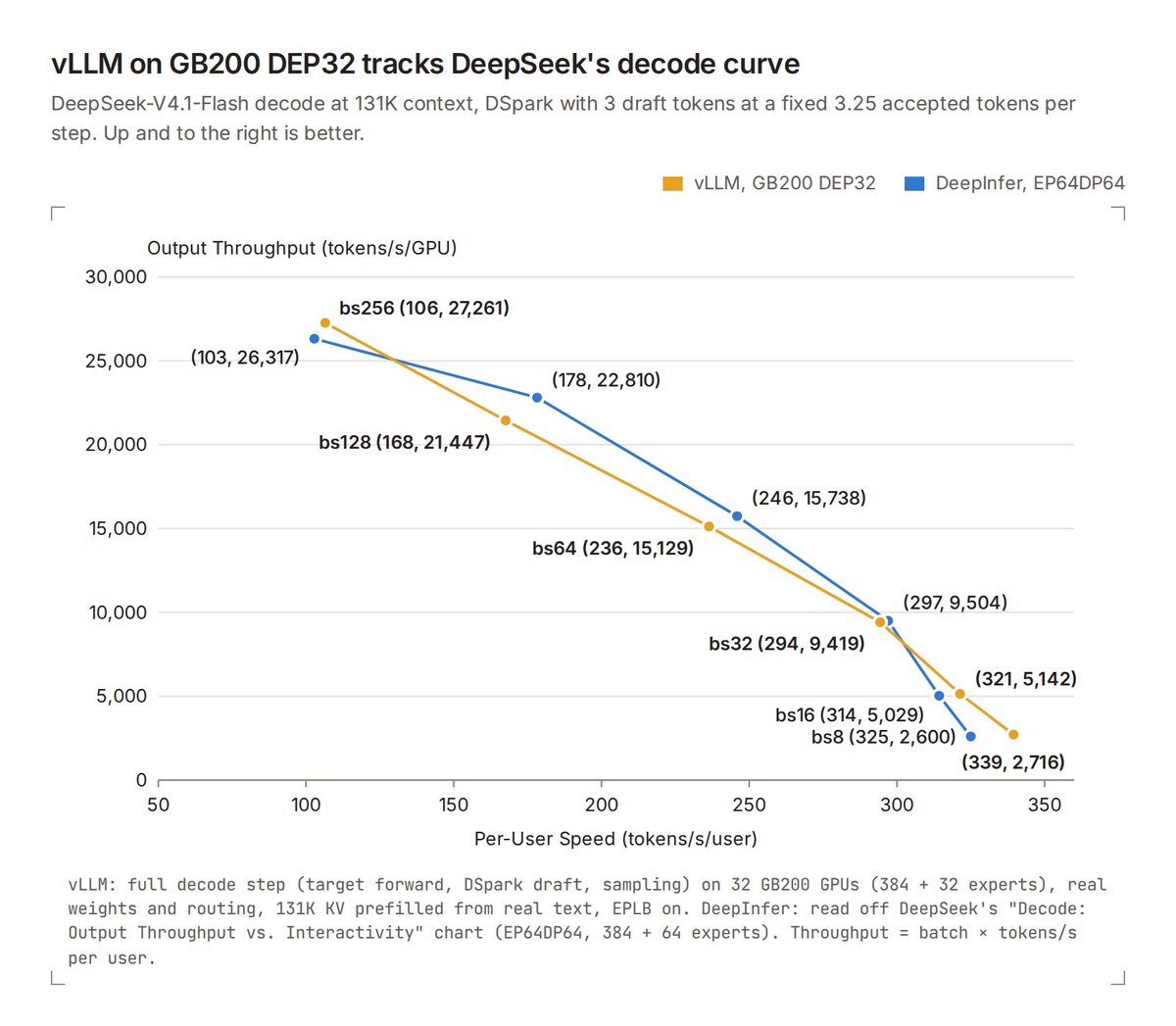
vLLM Narrows Gap with DeepInfer to 6% on NVIDIA GB200, Reaching 1M Tokens/s per GPU on GB300

Hours after DeepSeek open-sourced DeepInfer, the vLLM project team released official benchmark parity data serving DeepSeek-V4.1-Flash. Utilizing DeepSeek's identical decoding setup (131K context window, nextn=3 speculative decoding), vLLM closed its throughput performance delta to within 6% of DeepInfer across batch sizes 8 through 256 on NVIDIA GB200 systems. On GB300 hardware, vLLM attained up to 1,000,000 tokens/second per GPU and 826 tokens/second per user, generating $38.96 in hourly GPU revenue at DeepSeek off-peak rates. vLLM simultaneously shipped day-0 runtime support for FastH3-Omni and Spark-X2.6-4B.

vLLM Narrows Gap with DeepInfer to 6% on NVIDIA GB200, Reaching 1M Tokens/s per GPU on GB300

Key Takeaways

  • vLLM published direct benchmark comparisons, demonstrating that its serving throughput on NVIDIA GB200 is within 6% of DeepInfer
  • Achieves unprecedented scaling on NVIDIA GB300: up to 1,000,000 tokens/second per GPU and 826 tokens/second per active user stream
  • Generates up to $38.96 per GPU-hour in revenue when mapped to DeepSeek's production off-peak API pricing schedule
  • Delivers immediate Day-0 support for the FastH3-Omni video model and the 1M-token Apache 2.0 model Spark-X2.6-4B
Read full story
Linked Models & Agents:
ADSponsored

Inception Unveils Mercury 3: Diffusion-Based LLM Breaks 1,000+ Tok/s with 1M Context Window

Inception co-founder Stefano Ermon officially unveiled Mercury 3, the company's next-generation diffusion-based large language model. Delivering an astonishing 1,068 tokens per second inference speed on NVIDIA GPUs, Mercury 3 scales to 40x the size of Mercury 1 with a native 1M context window. Benchmarked on IFBench, GPQA Diamond, and SWE-Bench Atlas, it matches frontier closed baselines with standard API pricing of $0.20 / $0.70 per 1M input/output tokens (with 50% promotional pricing of $0.10 / $0.35).

Inception Unveils Mercury 3: Diffusion-Based LLM Breaks 1,000+ Tok/s with 1M Context Window

Key Takeaways

  • Inception co-founder Stefano Ermon officially launched Mercury 3, a diffusion LLM generating 1,068 tokens per second on NVIDIA GPUs
  • Scales model size by 40x over Mercury 1 with a native 1M context window; priced at $0.20 / $0.70 per 1M tokens ($0.10/$0.35 promotional)
  • Triples baseline intelligence on IFBench, GPQA Diamond, and SWE-Bench Atlas, with live availability via OpenRouter
  • Bypasses autoregressive sequential bottlenecks via parallel diffusion denoising, accelerating multi-step agent workflows
Read full story
Linked Models & Agents:

MiniMax Releases M3.1 Flash: 1M Context Window, $0.15/M Token Pricing, Surging +106 Points in WebDev Code Arena

MiniMax officially announced M3.1 Flash, its next-generation lightweight frontier model (previously dominating leaderboards as the secret model Space Bunny across 200T+ tokens). Featuring a native 1M context window, flat-rate API pricing of $0.15 / $0.60 per 1M input/output tokens ($0.015 cache reads), and 3x faster inference at 1/3 the cost of M3. It surged +106 points to 1588 on LMSYS Code Arena: WebDev (#12 among open models), with full weights set for open release on October 23.

MiniMax Releases M3.1 Flash: 1M Context Window, $0.15/M Token Pricing, Surging +106 Points in WebDev Code Arena

Key Takeaways

  • MiniMax officially launched M3.1 Flash, unveiling that it was the mystery model Space Bunny evaluated across 200T+ tokens
  • Features native 1M context with flat-rate API pricing of $0.15/$0.60 per 1M tokens ($0.015 cache reads), offering 3x speed at 1/3 cost of M3
  • Debuts on LMSYS Code Arena: WebDev at 1588 Elo (+106 pts over M3), ranking #12 among open models with major leaps in Gaming (+179) and Reference Design (+155)
  • Artificial Analysis benchmark confirms Intelligence Index of 42 and HLE of 48% at half the token consumption of rivals; weights release on Oct 23
Read full story
Linked Models & Agents:

OpenCode Makes GLM 5.3 Flash and 1M-Context Reflection Beam Free in Its Open-Source Coding Agent, Drawing 1.92M+ Views

OpenCode (@opencode), the wildly popular open-source terminal coding agent, announced free access to both Zhipu AI's high-speed GLM 5.3 Flash and Reflection AI's newly released 501B/23B MoE model Beam with a full 1M-token context window. The GLM 5.3 Flash announcement alone surged past 1.92 million views and 17,500 likes on X within hours.

OpenCode Makes GLM 5.3 Flash and 1M-Context Reflection Beam Free in Its Open-Source Coding Agent, Drawing 1.92M+ Views

Key Takeaways

  • Viral 1.92M-view developer launch: OpenCode's free GLM 5.3 Flash rollout drew 1.92M+ views and 17.5K likes on X
  • 1M-context Reflection Beam added for free: integrates the 501B/23B MoE model (80.1% on Terminal-Bench 2.1) with a full 1M-token context window
  • Zero-cost dual coding workflow: pairs ultra-fast GLM 5.3 Flash tool loops with 1M-context whole-repo reasoning inside the open-source OpenCode CLI
Read full story

RunningTab: KAIST Overcomes Coding Agent Context Drift via Environment-Side Tabs for Direct Workspace Interaction

In software engineering and knowledge-work tasks, autonomous coding agents operate via Direct Workspace Interaction (DWI)—issuing shell commands to navigate, inspect, and modify files within local repositories without external vector indexing. However, during extended interaction horizons, agents suffer severe context degradation: initial task requirements are purged from context windows by voluminous file dumps, read file provenances vanish, and listed but unopened candidate files are permanently forgotten, leading to premature task terminations and unfulfilled requirements. Researchers from KAIST introduce RunningTab (arXiv:2610.10444), an innovative agent interaction framework that replaces unreliable internal agent scratchpads with an environment-maintained 'running tab'. The tab persists three critical streams: dynamic requirement trackers, verified file excerpts with provenance links, and unopened candidate file stacks. When an agent attempts to finalize a deliverable, the environment triggers a mandatory 'Finish Check' barrier that blocks completion if unsatisfied criteria persist. Evaluated across Workspace-Bench, TheAgentCompany, and OfficeQA Pro benchmarks using frontier LLMs, RunningTab decisively outperforms vanilla DWI and self-refine baselines, establishing substantial gains in rubric satisfaction (TCR@70).

RunningTab: KAIST Overcomes Coding Agent Context Drift via Environment-Side Tabs for Direct Workspace Interaction

Key Takeaways

  • KAIST introduces RunningTab, pioneering environment-side tabs to eliminate long-horizon context drift in coding agents
  • Tracks Requirements, Provenances, and Candidate files externally, reinforced with a strict Finish Check barrier
  • Sweeps Workspace-Bench and TheAgentCompany, elevating TCR@70 to 25.67 and proving the superiority of environment-managed memory
Read full story
Linked Models & Agents:
⚡ RunningTab⚡ Direct Workspace Interaction⚡ Workspace-Bench🤖 RunningTab-Agent🤖 Finish-Checker🌐 KAIST🌐 Hugging Face🌐 TheAgentCompany

REMORY: HKUST and Alibaba Introduce Residual Memory for Agent Context Compaction, Matching Full Context with Only 5.2% Token Overhead

As autonomous agents execute complex multi-step workflows across terminal consoles and web browsers, context window expansion and escalating token costs impose severe operational bottlenecks. Conventional compaction methods rely on text summarization or token pruning, both of which discard crucial state variables and induce semantic drift over extended sessions. Researchers from HKUST and Alibaba present REMORY (arXiv:2610.11287), introducing a residual memory paradigm designed for sequence-level context compaction. REMORY combines lossy natural language summaries with bounded sets of learned soft memory tokens, effectively forming a residual connection in the sequence dimension. While text summaries convey high-level narrative continuity, the soft memory tokens reconstruct lost fine-grained execution artifacts, API arguments, and intermediate environment states. On challenging benchmarks including BrowseComp and Terminal-Bench 2.1, REMORY retains 97% of full-context task performance while occupying only 5.2% of the original input token footprint, slashing redundant tool retries and loops by more than 40%.

Key Takeaways

  • HKUST and Alibaba propose REMORY, establishing sequence-dimension residual memory connections to resolve agent context bloat
  • Matches 97.2% of full-context capability using only 5.2% of token positions, slashing repetitive tool errors by 41.5% on Terminal-Bench
  • Non-invasive plug-and-play architecture reduces TTFT latency by 73.8%, setting a new benchmark for long-horizon agent efficiency
Read full story
Linked Models & Agents: