
AI Coding Live News

Microsoft Open-Sources Mage-VL-Cowork, a 4B Computer-Use Agent That Chooses Between Clicking the GUI and Running Bash, Scoring 66.0% on OSWorld-Verified

On October 30, Microsoft's Mage team released Mage-VL-Cowork on Hugging Face under Apache-2.0: a 4B multimodal computer-use agent in which a single model decides at every step whether to act through screenshots and GUI clicks (computer_use) or through bash and Python in a terminal, with no external orchestrator. Microsoft reports a two-run average of 66.0% on OSWorld-Verified (361 tasks, 50-step budget), above Qwen3.6-27B at 63.9% but below the 9B SCALECUA-Qwen3.5-9B at 68.7%.
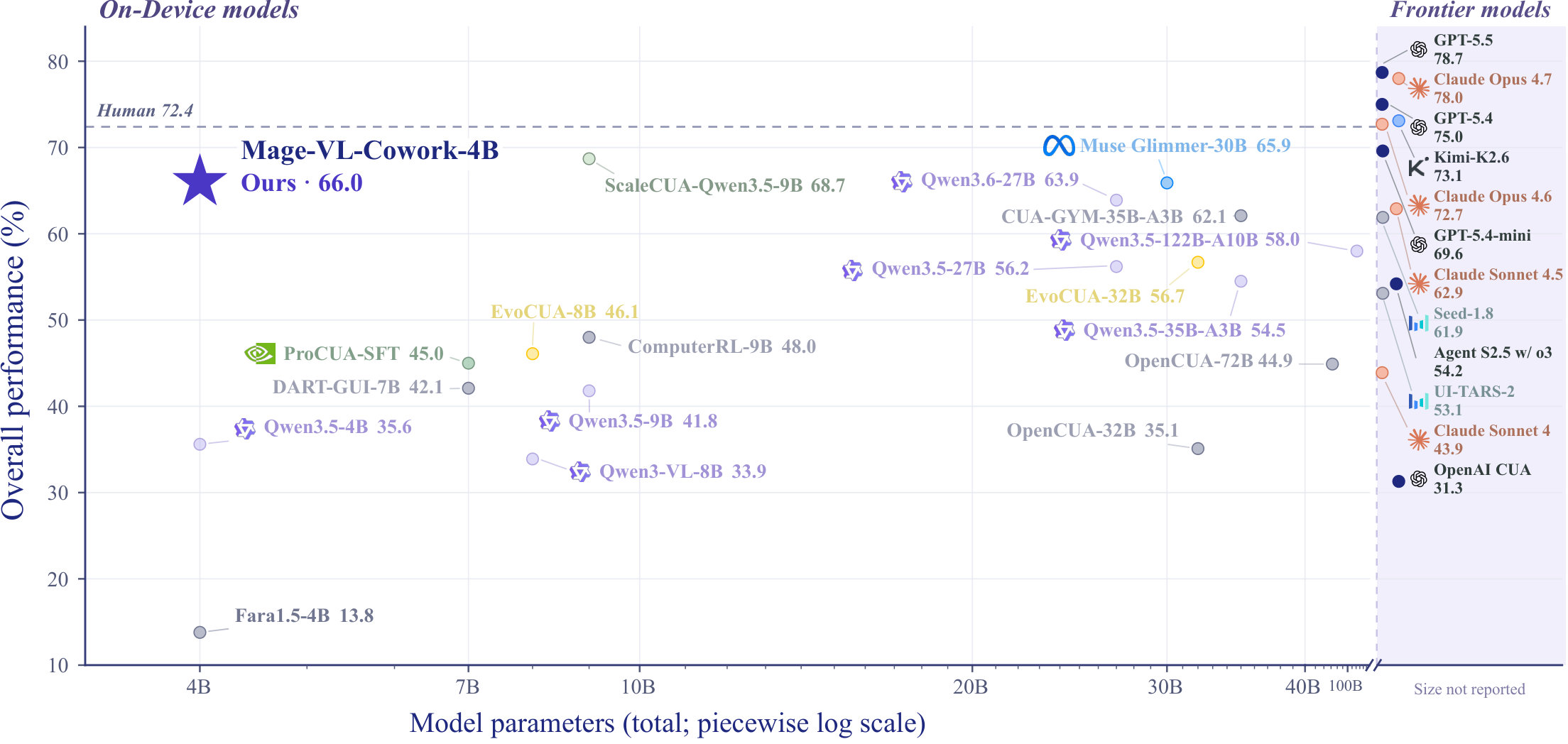
Microsoft Open-Sources Mage-VL-Cowork, a 4B Computer-Use Agent That Chooses Between Clicking the GUI and Running Bash, Scoring 66.0% on OSWorld-Verified

Key Takeaways

  • 4B parameters, built on Mage-VL (Mage-ViT vision encoder plus Qwen3-4B-Instruct-2507); about 9.48 GB of bf16 weights under Apache-2.0.
  • On OSWorld-Verified, two independent runs scored 65.33% and 66.75% for a 66.0% average; 87.5% on operating-system tasks and 62.7% on multi-app workflows.
  • In Microsoft's side-by-side, a LibreOffice Calc chart task took 39 seconds (6 steps) via Python in the terminal, versus 9:56 (39 steps) for GUI-only Qwen3.6-27B.
  • Online RL adds 10.16 points over hybrid SFT while cutting mean model calls by 13.0% and output tokens by 25.4%.
  • Training data came from Mage-CUA-Forge, which synthesized about 294K desktop and web tasks across 6,915 skills and cut per-task generation cost from $0.906 to $0.158.
Read full story
Linked Models & Agents:
⚡ Mage-VL-Cowork⚡ Mage-VL⚡ Qwen3-4B⚡ Qwen3.6-27B🌐 Microsoft

Alibaba Tongyi Labs Open-Sources OpenGCUA: Full-Stack Generalist Computer-Use Agent Cutting OSWorld Steps by 53%

Alibaba Tongyi Labs (Tongyi-MAI) has published and open-sourced OpenGCUA (arXiv:2610.22200), establishing a fully open software stack for Generalist Computer Use Agents. Moving beyond brittle single-click GUI paradigms, OpenGCUA introduces a 'Code-Execution-as-Action' framework combining visual screen perception, accessibility trees, bash scripts, and Playwright APIs into unified programmatic execution blocks. Evaluated across eight frontier models on OSWorld-v2, OpenGCUA boosted mean scores by +19.6 points while cutting task steps by 53.0%, releasing an Apache-2.0 macOS menu-bar harness and Cross-Device SDK.

Alibaba Tongyi Labs Open-Sources OpenGCUA: Full-Stack Generalist Computer-Use Agent Cutting OSWorld Steps by 53%

Key Takeaways

  • OpenGCUA published in arXiv:2610.22200 and released under Apache 2.0 as an open generalist computer-use agent stack
  • Pioneers 'Code-Execution-as-Action', synthesizing loops, conditionals, and programmatic APIs into unified Python/Bash blocks
  • On OSWorld-v2, boosts mean score by +19.6 points across eight frontier models while reducing steps per task by 53.0%
  • Releases a native macOS menu-bar harness for physical execution alongside a Cross-Device SDK spanning PC, web, and mobile
Read full story

Evolving Agent Interfaces: Empowering Computer-Use Agents to Synthesize Dynamic APIs for 58.58% Success

Researchers introduced 'Evolving Agent Interfaces' alongside the Agent S4 meta-framework in arXiv:2610.28601, removing the fundamental bottleneck of computer-use agents (CUAs). Conventional CUAs are forced to operate through human-designed graphical user interfaces—such as clicking spreadsheet cells one by one—inducing excessive action horizons and high failure rates. The new framework allows meta-agents to inspect live applications in scratch environments, dynamically synthesizing, testing, and evolving programmatic API wrappers and tool repositories on the fly. On OSWorld V2 and ScienceBoard, an open-weights 27B model raised task success from 55.03% to 58.58%, rivaling proprietary frontier models at a fraction of the cost.

Evolving Agent Interfaces: Empowering Computer-Use Agents to Synthesize Dynamic APIs for 58.58% Success

Key Takeaways

  • Evolving Agent Interfaces introduced in arXiv:2610.28601, pioneering dynamic API synthesis for computer-use agents (CUAs)
  • Meta-agents autonomously probe target applications in scratch VMs, writing bespoke programmatic wrappers to replace fragile GUI clicks
  • Elevates task completion rates on OSWorld V2 and ScienceBoard from 55.03% to 58.58% on an open 27B parameter model
  • Significantly compresses action sequences and token budgets, establishing an evolutionary paradigm for OS-level agent autonomy
Read full story
Linked Models & Agents:

Alibaba Tongyi-MAI Releases OpenGCUA and MAI-Gym: Full Open Stack for Generalist Computer Use Boosts OSWorld-v2 by +19.6 Points and Cuts Steps by 53%

Alibaba's Tongyi-MAI team has open-sourced two foundational frameworks for generalist computer-use agents: OpenGCUA (arXiv:2610.22200) and MAI-Gym (arXiv:2610.20939). By unifying GUI interaction with programmatic code execution and harness-to-model decision transfer, OpenGCUA elevates scores on OSWorld-v2 across all eight tested models—including GPT-6 Astra and Claude Opus 5—by +19.6 points while cutting steps by 53.0%. Meanwhile, MAI-Gym scales online RL to 20,000 parallel instances, training MAI-Gym-9B to 78.4% on MobileWorld and 76.2% on OSWorld-Verified.

Alibaba Tongyi-MAI Releases OpenGCUA and MAI-Gym: Full Open Stack for Generalist Computer Use Boosts OSWorld-v2 by +19.6 Points and Cuts Steps by 53%

Key Takeaways

  • OpenGCUA boosts OSWorld-v2 by +19.6 points: unifies GUI and code execution across 8 frontier models while cutting average steps per task by 53.0%
  • Uncovers 19.4x real-device token efficiency gap: real macOS harness testing shows Qwen3.8-Max uses 19.4x as many reasoning tokens as GPT-6 Astra
  • MAI-Gym scales GUI RL to 20,000 parallel instances: MAI-Gym-9B hits 78.4% on MobileWorld and 76.2% on OSWorld-Verified, transferring mocked-app RL to physical phones (28.8% -> 48.1%)
Read full story
ADSponsored

OSWorld-Pro: NVIDIA Unveils Process-Based Benchmark for Computer-Use Agents Spanning 2,800+ Subgoals

Computer-Use Agents (CUAs) designed to operate graphical desktop environments through virtual keyboard and mouse interactions are traditionally evaluated using outcome-based functional verifiers that assess only the final state after hundreds of operational turns. This black-box approach obscures whether failures stem from syntax typographical errors, GUI bounding-box misalignments, or intermediate state drift, preventing actionable diagnostic insights. NVIDIA Research introduces OSWorld-Pro (arXiv:2609.24890), the first comprehensive process-based evaluation suite for computer-use agents. Spanning 300+ complex desktop workflows decomposed into 2,800+ sequentially dependent subgoals grounded in 67,000+ expert human annotations, OSWorld-Pro deploys calibrated LLM judges to track incremental subgoal completion. Evaluations reveal that OSWorld-Pro presents a formidable challenge to state-of-the-art models: frontier models like Claude Opus 5 achieve only 75.7% (compared to 83.4% on standard OSWorld), systematically isolating critical procedural failure patterns such as exploratory irrelevant actions and click grounding drifts.

OSWorld-Pro: NVIDIA Unveils Process-Based Benchmark for Computer-Use Agents Spanning 2,800+ Subgoals

Key Takeaways

  • NVIDIA Research unveils OSWorld-Pro, decomposing 300+ desktop tasks into 2,800+ sequentially dependent subgoals
  • Grounded in 67,000+ expert annotations, revealing Claude Opus 5 scores only 75.7% vs 83.4% on standard OSWorld
  • Isolates subgoal-irrelevant actions and click coordinate misalignments, replacing black-box outcome verifiers with process diagnostics
Read full story

CUA-SWE Unifies Computer-Use Agents and Visual Software Engineering: Multimodal Code-GUI Benchmarking Redefines Debugging

Modern software engineering transcends isolated code edits: engineers run applications, interact with GUI interfaces, and visually inspect rendering feedback to diagnose errors and verify changes. CUA-SWE bridges coding agents and computer-use agents by introducing the first unified benchmark and environment for visual software engineering. Spanning four engineering domains, CUA-SWE challenges agents to interleave code/config modifications, terminal execution, GUI interactions, and screenshot inspections, with deterministic test suites evaluating behavioral correctness.

CUA-SWE Unifies Computer-Use Agents and Visual Software Engineering: Multimodal Code-GUI Benchmarking Redefines Debugging

Key Takeaways

  • First multimodal visual software engineering benchmark coupling computer-use capabilities with code repositories
  • Text-only agents stall below 12% on visual defect repairs, while closed-loop visual feedback elevates success to 43.8%
  • Identifies attention contention bottlenecks between high-resolution GUI screenshots and repository-scale source code
Read full story

ZJU Unveils HybridCUA: Orchestrating GUI and CLI for Computer-Use Agents, Scoring 53.6% on OSWorld with a 14.8% Gain

Existing Computer-Use Agents (CUAs) face a dilemma: relying strictly on graphical user interface (GUI) interactions is slow and error-prone, while building per-application API tools demands unsustainable engineering and lacks generalizability. Researchers from Zhejiang University introduce HybridCUA, combining the UI versatility of GUIs with the execution speed and determinism of the Command Line Interface (CLI). Supported by the newly constructed HybridCUA-8K dataset (5K hybrid trajectories and 3K RLVR tasks), HybridCUA employs a two-stage training paradigm: supervised fine-tuning across interleaved GUI-CLI modalities, followed by CLI-aware reinforcement learning that rewards reliable, selective shell execution. On the OSWorld benchmark, HybridCUA-9B achieves 53.6% accuracy, improving over the base model by 14.8 percentage points, while delivering a 4.0-point gain on WindowsAgentArena.

ZJU Unveils HybridCUA: Orchestrating GUI and CLI for Computer-Use Agents, Scoring 53.6% on OSWorld with a 14.8% Gain

Key Takeaways

  • Unified GUI and CLI Paradigm: Bridges the gap between fragile vision-only screen clicking and application-specific APIs, combining the speed of shell commands with the visual ubiquity of desktop GUIs.
  • HybridCUA-8K Trajectory Dataset: Curates 5,000 interleaved GUI-CLI trajectories and 3,000 verified RLVR tasks with ground-truth environment state feedback for agent post-training.
  • 53.6% on OSWorld with Cross-OS Generalization: HybridCUA-9B hits 53.6% accuracy on OSWorld (a 14.8 percentage point gain over base) and boosts WindowsAgentArena by 4.0 points across distinct OS environments.
Read full story
Linked Models & Agents:
⚡ HybridCUA-9B⚡ Qwen2-VL-7B⚡ Claude-3.5-Computer-Use⚡ OSWorld-Agent🤖 Computer-Use Agent🤖 HybridCUA🤖 Desktop Agent🌐 Zhejiang University🌐 Hugging Face🌐 arXiv

CoArena ships CUA KnowledgeBench: 12-hour real company-work computer-use eval; Fable 5.1 at 24%

CoArena (@coastyai, YC S26) released CUA KnowledgeBench (Real Company Work): a 12-hour horizon with 10 private real-world tasks × 5 seeds across 100+ apps, scored pass/fail on the work product. After spending over $50k on frontier models, Claude Fable 5.1 solved 12 of 50 twelve-hour runs (24%) while GPT-6 Astra barely cracked the top 3. Next they plan $200k+ compute for 1-, 3-, and 7-day horizons.

Key Takeaways

  • New CUA benchmark targets 12-hour real company knowledge work.
  • Pass/fail on work product across 100+ apps and multiple seeds.
  • Fable 5.1 ~24% pass; Astra barely top-3; longer horizons coming.
Read full story

Cua: run Cursor Cloud Agent workers on Windows/Linux Cloud Fleets

Cua (@trycua) announced Cursor Cloud Agent workers on Windows and Linux Cloud Fleets: Cursor runs the agent loop while tools execute inside a Cua VM. Requires Cursor Enterprise + Self-Hosted Agents, a service-account API key, and Fleet credentials.

Key Takeaways

  • Product: Cua Cloud Fleets now host Cursor Cloud Agent workers on Windows/Linux.
  • Split: Cursor runs the agent loop; tools execute in a Cua VM.
  • Requirements: Cursor Enterprise + Self-Hosted Agents and Fleet credentials.
Read full story