AI Coding Live News

Together AI Launches Together Compiler: Agents Continually Optimize Production Inference, Up to 2.6x Higher TPS

On November 4 Together AI launched Together Compiler (TKCC), which pairs a swarm of AI agents with a persistent inference engine to keep rewriting inference kernels for real traffic, models and hardware, as part of what it calls Polymorphic Inference. The company says that within 24 hours it reached up to 2.6x higher TPS on models such as Kimi K3, GLM 5.3, MiniMax M3.1-Flash and DeepSeek v4.1-Flash, up to 50% faster on customer workloads, and it already serves trillions of tokens a day in production.

Key Takeaways

  • Together Compiler recasts inference optimization from a classic compiler problem into an agentic search: agents propose kernel changes, a persistent engine checks speed and correctness, and only verified changes reach production
  • Together says that within 24 hours it reached up to 2.6x higher TPS on Kimi K3, GLM 5.3, MiniMax M3.1-Flash and DeepSeek v4.1-Flash, and up to 50% faster on customer workloads
  • On InferenceX low-latency batch size 1 it reports 1,111 TPS on MiniMax M3.1-Flash and 1,205 TPS on DeepSeek v4.1-Flash (company-reported); SemiAnalysis said it validated one of the results
  • The persistent engine hot-reloads candidate forward passes, cutting time to serving to 9 seconds versus 467 seconds for restarting an engine, with 252x higher experiment throughput than baseline agentic optimization systems
  • It already serves trillions of tokens a day in Together's production stack, where 40+ models are now optimized by agents
Read full story

Fireworks Forge Launches: Ultra-fast Inference Preview Hits 1,500 Tokens/s, Half-Price Background Mode, Nexus Desktop for Codex and Claude Desktop, Sovereign Private Preview

At its first Forge conference on November 3, open-model inference platform Fireworks launched a batch of products. Ultra-fast, powered by NVIDIA Blackwell, is in public preview at up to 1,500 tokens per second on DeepSeek V4.1 Flash, cutting a 30-turn agent task from 1 minute to 8 seconds. Background Mode runs deferrable work at half price, alongside multi-day prompt caching and higher rate limits. Nexus Desktop brings open-model routing into the Codex app, Claude Desktop and OpenCode, with Pro plans from $8 per month. Fireworks also announced No Eval, serverless LoRA inference, the Fireworks Sovereign private preview and a 60+ partner Frontier Ecosystem.

Fireworks Forge Launches: Ultra-fast Inference Preview Hits 1,500 Tokens/s, Half-Price Background Mode, Nexus Desktop for Codex and Claude Desktop, Sovereign Private Preview

Key Takeaways

  • Ultra-fast public preview: on NVIDIA Blackwell, up to 1,500 tokens per second on DeepSeek V4.1 Flash; in Fireworks' benchmark a 30-turn agent task fell from 1 minute to 8 seconds (Fireworks blog)
  • Cost options: Background Mode runs deferrable work at half price; multi-day prompt caching cuts the cost of resuming long context; higher serverless rate limits and Elastic Burst are generally available
  • Nexus Desktop launches: personalized routing across open and closed models inside the Codex app, Claude Desktop and OpenCode; Pro from $8 per month, Teams from $10 per seat per month
  • Training: No Eval (private preview) turns production traces into task evals; serverless LoRA inference (public preview) starts with GLM 5.3 Flash at per-token pricing with no idle charge; free training on Muse Glimmer 30B through November 30
  • Enterprise: Fireworks Sovereign (private preview) runs the inference engine in a customer's own cloud or data center; Fireworks says it already manages over 25,000 GPUs in customer environments; plus a 60+ partner Frontier Ecosystem
Read full story

Suhail launches Particle and its first model, Particle-1: a DeepSeek V4.1 Flash post-train that uses about 45% fewer tokens on coding tasks

On Oct 28, Mixpanel founder Suhail Doshi announced his new company Particle on X, with its first model, Particle-1, live now. Particle's blog says it is a reinforcement-learning post-train of DeepSeek V4.1 Flash that uses 28.4% to 52.2% fewer output tokens and costs 34.4% to 51.6% less per task across four coding and data engineering benchmarks, with pass rates inside the base model's confidence intervals. It is available through the Particle API, OpenRouter and Vercel AI Gateway; Particle's docs list $0.25 input and $1.00 output per million tokens with a 1,048,576-token context window.

Suhail launches Particle and its first model, Particle-1: a DeepSeek V4.1 Flash post-train that uses about 45% fewer tokens on coding tasks

Key Takeaways

  • Across four benchmarks (Terminal-Bench 2.1, ReactBench, ADE Bench, DeepSWE 1.1), 28.4% to 52.2% fewer output tokens and 34.4% to 51.6% lower cost per task (vendor-reported)
  • Particle's summary table: $0.2211 per task versus $0.3368 for DeepSeek V4.1 Flash and $0.6523 for GLM 5.3 Flash; 59,580 mean output tokens versus 83,246 and 98,155
  • Task pass rate 72.57% versus 71.15% for the base model and 66.82% for GLM 5.3 Flash; GPQA Diamond 90.40% (base 90.91%), MMLU 86.08% (base 85.98%)
  • Training: a rank-64 LoRA on the experts in all layers, about 1.25% of the model's parameters, trained with sequence-level GSPO in two RL stages
  • Pricing: Particle docs currently list $0.25 input, $0.03 cached input and $1.00 output per million tokens, a 1,048,576-token context and a 131,072-token output ceiling
Read full story

Mistral launches its Responses API in public preview: OpenAI Responses-compatible, returning the answer, reasoning and tool calls as separate items for building agents

Mistral AI announced on X on Oct 28 that its Responses API is in public preview, positioned as the interface for building agents on Mistral. The official docs say it uses the OpenAI Responses format, and each response's output array carries the models messages, its reasoning and its function calls as separate items, which is easier to handle step by step than Chat Completions. The preview is stateless, so the app keeps the conversation history and sends it back; it supports text, image and file input, JSON Schema structured output, streaming events, client-executed function calls, reasoning.effort, and token counting via POST /v1/responses/input_tokens. It is served in the EU and US on Mistral AI Cloud Inference. The same thread says Mistral now also serves DeepSeek V4.1 Flash (public preview) and GLM 5.3 Flash (generally available).

Key Takeaways

  • The Responses API is in public preview and uses the OpenAI Responses format, so existing Responses integrations can move to Mistral more easily
  • Each response splits the answer, reasoning and function calls into separate output items, which suits step-by-step agent loops
  • The preview is stateless: the app keeps the history and sends earlier output items back along with function_call_output results
  • It supports image and file input, JSON Schema structured output, streaming, function calling (including namespaces), reasoning.effort and token counting via /v1/responses/input_tokens
  • It is served in the EU and US on Mistral AI Cloud Inference; Mistral also added DeepSeek V4.1 Flash (preview) and GLM 5.3 Flash (GA)
Read full story
ADSponsored

Cursor adds DeepSeek V4.1 Flash: all four effort levels sit on the CursorBench 4.0 cost frontier, with Max scoring 47.7% at $0.98 per task

Cursor announced on Oct 26 (UTC) that DeepSeek V4.1 Flash is now available in Cursor and can be turned on under Cursor Settings > Models. Cursor says every effort level sits on the CursorBench cost frontier, from $0.60 to $0.98 per task, with no model scoring higher at those prices. The official CursorBench 4.0 leaderboard lists DeepSeek V4.1 Flash 1017 at 47.7% on Max ($0.98 per task), 46.3% on Medium ($0.80), 45.6% on High ($0.77) and 44.9% on Low ($0.60). The top score on the board, Opus 5.5 Max, is 57.8% but costs $13.43 per task.

Cursor adds DeepSeek V4.1 Flash: all four effort levels sit on the CursorBench 4.0 cost frontier, with Max scoring 47.7% at $0.98 per task

Key Takeaways

  • Four effort levels on the official CursorBench 4.0 board: Max 47.7% at $0.98, Medium 46.3% at $0.80, High 45.6% at $0.77, Low 44.9% at $0.60; Max ranks 17th overall
  • Value: Max at 47.7% nearly ties Sonnet 5.5 High (47.8%, $1.20) for about 18% less; Opus 5.5 Max scores about 10 points higher but costs $13.43 per task, roughly 13.7x more
  • Nearest rivals on price: Haiku 5.5 Max at 48.4% for $1.12 and Haiku 5.5 Extra High at 44.3% for $0.56, bracketing DeepSeek's price range
  • The trade-off is tokens and steps: Max averages about 537K tokens and 187 steps per task, versus about 37K tokens and 41 steps for Sonnet 5.5 High, so expect longer runs
  • Turn it on under Cursor Settings > Models; a counterintuitive detail is that Medium (46.3%) scores slightly above High (45.6%) for only $0.03 more
Read full story

Artificial Analysis launches HealthBench and HealthBench Professional leaderboards: GPT-6 Astra leads clinician conversations at 66.0%, while Claude Opus 5.5 tops the raw score but falls to sixth after the length penalty

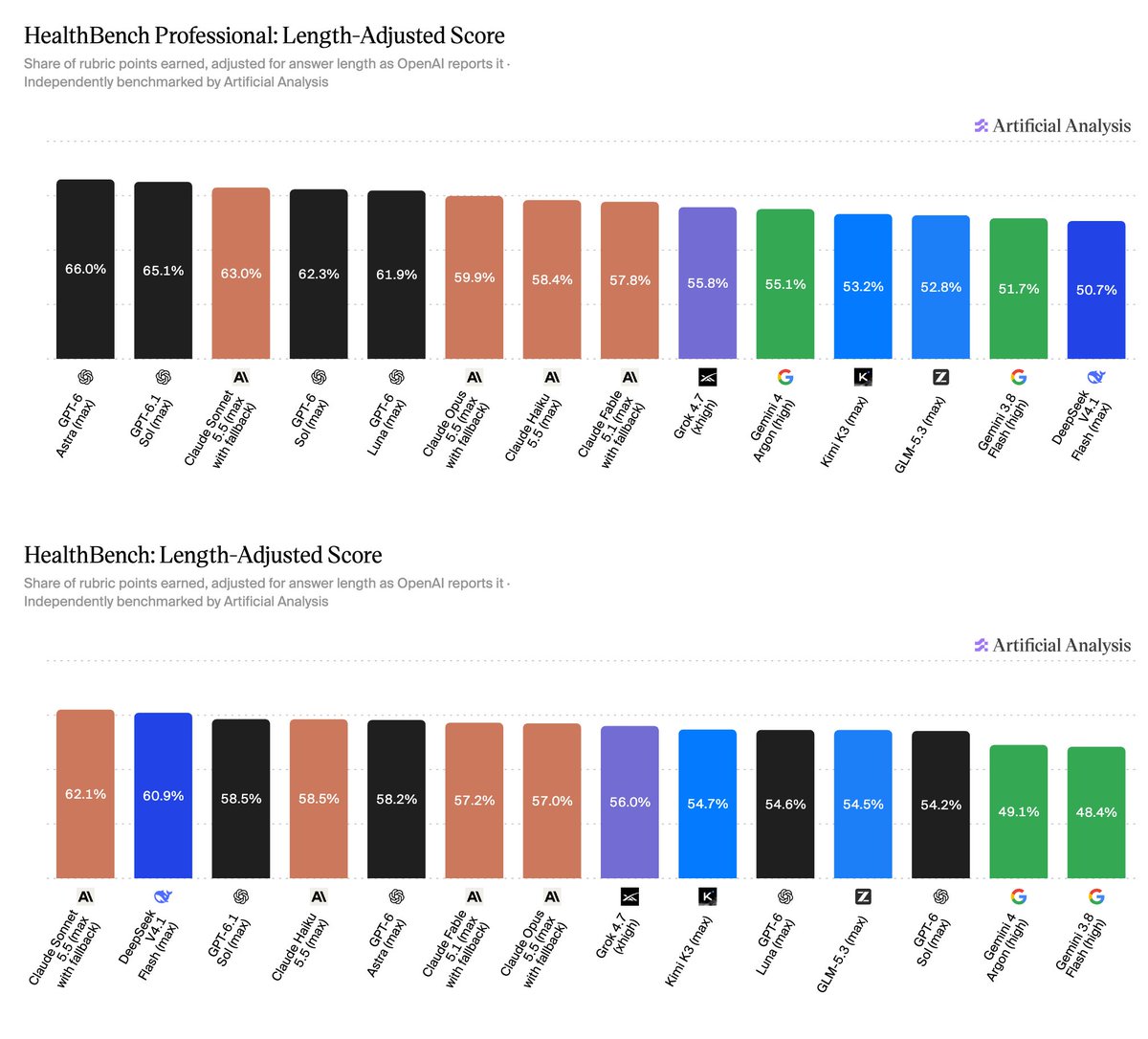
On October 19 independent evaluator Artificial Analysis launched two health-conversation leaderboards built on OpenAI's HealthBench (5,000 realistic health conversations) and HealthBench Professional (525 clinician conversations), graded against physician-written rubrics and reported as both raw and OpenAI-style length-adjusted scores. On Professional, GPT-6 Astra (max) leads at 66.0% length-adjusted, ahead of GPT-6.1 Sol (65.1%) and Claude Sonnet 5.5 (63.0%); Claude Opus 5.5 has the top raw score (71.4%) but drops to sixth (59.9%) because its ~5,900-character answers are penalized. On HealthBench, Claude Sonnet 5.5 leads at 62.1%, with DeepSeek V4.1 Flash close behind at 60.9% for about 1/16 of the cost per task.

Artificial Analysis launches HealthBench and HealthBench Professional leaderboards: GPT-6 Astra leads clinician conversations at 66.0%, while Claude Opus 5.5 tops the raw score but falls to sixth after the length penalty

Key Takeaways

  • HealthBench Professional (length-adjusted): GPT-6 Astra (max) 66.0%, GPT-6.1 Sol (max) 65.1%, Claude Sonnet 5.5 63.0%.
  • Claude Opus 5.5 posts the highest raw score (71.4%) but averages ~5,900 characters per answer, nearly 3x the 2,000-character threshold, and falls to sixth at 59.9%; Claude Fable 5.1 also loses over 11 points.
  • The Professional score-vs-cost Pareto frontier is all OpenAI: GPT-6 Luna (max) scores 61.9% at $0.004 per task, under 2% of GPT-6 Astra's $0.27.
  • HealthBench: Claude Sonnet 5.5 leads at 62.1%, DeepSeek V4.1 Flash 60.9% at $0.005 per task, GPT-6.1 Sol 58.5%.
  • Grading follows OpenAI's original setup: GPT-5.4 (low) grades Professional and GPT-4.1 grades HealthBench.
Read full story

CrowdStrike: attacker used open-source AI pentest agent ARTEX plus Claude Code to breach South Korean financial firms

CrowdStrike Intelligence found Claude Code session histories, ARTEX configs and a CLAUDE.md in attacker open directories, showing a likely Chinese-speaking, financially motivated actor used the China-built open-source agentic pentest framework ARTEX (DeepSeek v4.1-flash primary, plus GLM-5.3 and Grok 4.6) to breach loan-inquiry and employee mobile systems at South Korean financial institutions from late September to early October 2026.

Key Takeaways

  • Window: late Sep to early Oct 2026; CrowdStrike attribution is moderate confidence, no named adversary
  • Model stack: DeepSeek v4.1-flash as ARTEX primary backend via likely reseller xcai[.]pro; GLM-5.3 and Grok 4.6 in Claude Code sessions
  • IOCs: 1 actor-controlled IP (38.244.50[.]120) plus 9 proxy IPs, with MITRE ATT&CK mapping
  • Reported impact: Shinhan 25,729 customers, Hana 89, Yegaram ~40,000 (press reports)
  • The upstream Autumn-27/ARTEX GitHub repo now returns 404
Read full story
A
AgentField / Santosh Radha@Agent-Field·
👀83
🔥95

AgentField open-sources CodeAF v0.6: one Go binary software factory for open models; vendor DeepSWE 54.9% #1 same-model

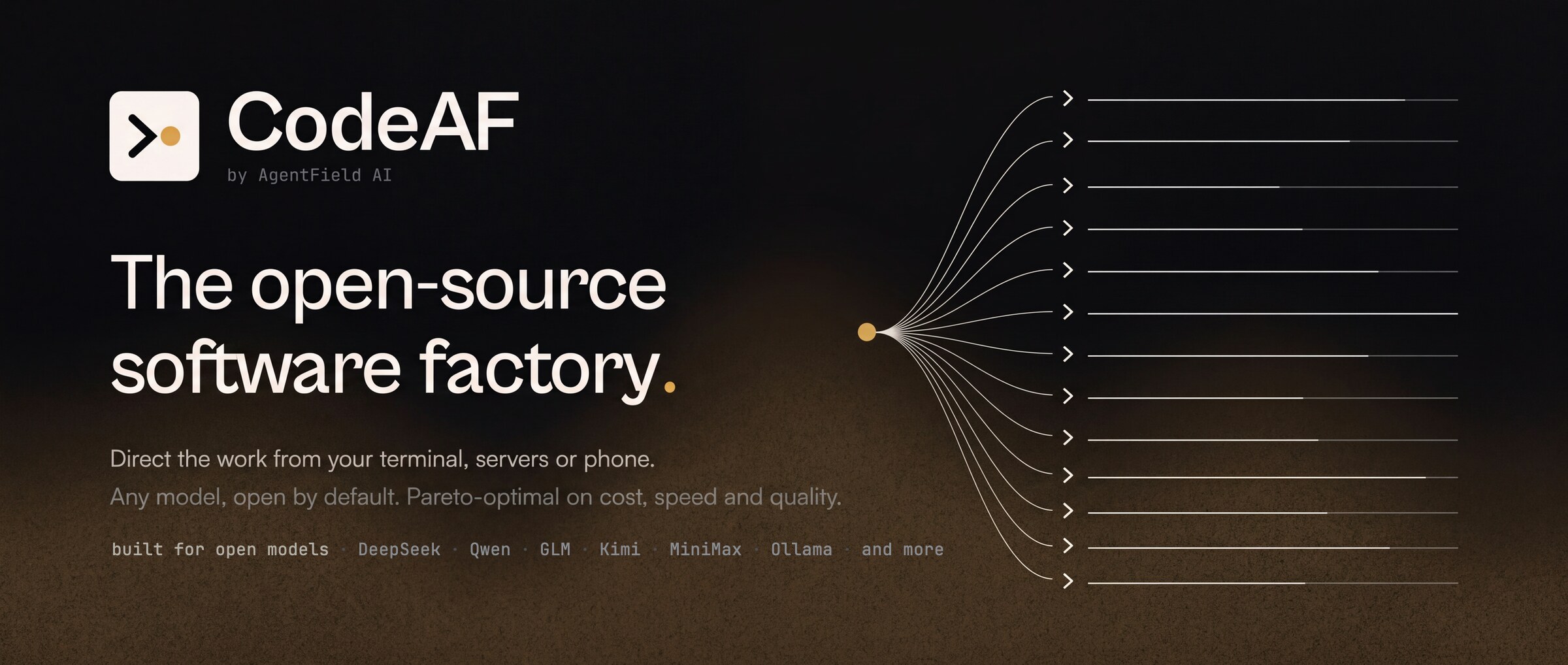
CodeAF is an Apache-2.0 Go binary that runs open-weight models as a local software factory with task fan-out and Pareto crewing. v0.6.0 shipped 2026-10-01; ★259 now. Vendor DeepSWE doc: /senior-dev solved 62/113 (54.9%) on DeepSeek V4 Flash vs nine other harnesses—with stated one-seed and sampling caveats.

AgentField open-sources CodeAF v0.6: one Go binary software factory for open models; vendor DeepSWE 54.9% #1 same-model

Key Takeaways

  • Agent-Field/CodeAF Apache-2.0; ★259 / 34 forks; install via agentfield.ai/get/codeaf
  • v0.6.0 published 2026-10-01T18:59:00Z; README still says early preview
  • Vendor DeepSWE same-model table: senior-dev 62/113 (54.9%) at ~22¢/task vs nine harnesses—one seed; sampling-contract caveat documented
  • Later same 113 tasks: 88/113 (77.9%) on DeepSeek V4.1 Flash; 78/113 (69.0%) on Kimi K3 (senior-dev only)
  • Built-in providers include OpenRouter, DeepSeek, GLM, Kimi, MiniMax, Qwen, Codex, Ollama; default worker/planner/checker crew
Read full story

Freebuff launches $8/mo Starter: ad-supported high-usage coding plan centered on DeepSeek V4.1 Flash / GLM Flash

@jahooma (Freebuff/Codebuff) announced an $8/mo Starter tier: the post claims ~15 hours/day of DeepSeek V4.1 Flash with unlimited messages because ads subsidize usage. freebuff.com/plans currently lists Starter at $8/mo with about 10 hrs/day DeepSeek V4.1 Flash or 30 hrs/day GLM 5.3 Flash across Web, Desktop, and CLI.

Freebuff launches $8/mo Starter: ad-supported high-usage coding plan centered on DeepSeek V4.1 Flash / GLM Flash

Key Takeaways

  • Founder announced $8/mo Starter: ad-supported, claiming ~15h/day DeepSeek V4.1 Flash with unlimited messages.
  • Plans page lists Starter at $8/mo with ~10h/day DeepSeek V4.1 Flash or ~30h/day GLM 5.3 Flash.
  • Works across Web, Desktop, and CLI as a low-cost alternative tier to Claude Code / Cursor / Codex.
Read full story
Linked Models & Agents:

Dev distills DeepSeek V4 Flash decisions into a 4B local model: 26h on DGX Spark, ~22ms per call

Developer Taro L. Saito (@taroleo) followed a TypeSafe Jev-style approach—dropping full text/JSON generation and specializing on decisions—to distill DeepSeek V4 Flash judgments (~157GB weights) into a 4B model with about 26 hours of training on a DGX Spark. The student is roughly 1/20 the size, beats the teacher’s instant-answer mode, and runs about 22ms per decision, showing a fast local-LLM decision engine is practical.

Key Takeaways

  • Jev-style decision-only specialization distills DeepSeek V4 Flash judgments into a 4B model.
  • About 26 hours on a DGX Spark; roughly 1/20 the teacher size and ~22ms per decision.
  • Claims to beat the teacher's instant-answer mode—useful for local routing/gating agents.
Read full story
Linked Models & Agents:
ADSponsored

Bolt Forge adds DeepSeek V4.1 Flash with about 10x the usage of V4 Pro

boltdotnew announced another Bolt Forge addition after its open-model week: DeepSeek V4.1 Flash, with about 10x the usage of DeepSeek V4 Pro. The team says beta users report it builds the best-looking sites, pushing a faster open-weight option further into frontend generation workflows.

Key Takeaways

  • DeepSeek V4.1 Flash is now available in the Bolt Forge model picker.
  • Bolt says it sees about 10x the usage of DeepSeek V4 Pro.
  • Aimed at Forge users building sites with open weights; try via bolt.new/lite.
Read full story

Bolt Forge launches on bolt.new: open-weight coding agent free with up to 50x usage until Oct 14

bolt.new introduced Bolt Forge, an open-weight coding agent now live in the bolt.new model picker. Free until Oct 14 with up to ~50x usage and zero usage charges; lineup includes GLM 5.3 / GLM 5.3 Flash, Kimi K3, and DeepSeek v4 Pro. Opt-in builds help train a trillion-parameter-class model with Arcee; also announced $9/mo Bolt Lite (Forge included; join by Oct 14 to lock $9). Partners include Arcee, Microsoft, Vercel, Fireworks, and DigitalOcean.

Key Takeaways

  • Bolt Forge is live in bolt.new’s model picker as an open-weight coding agent.
  • Free through Oct 14 with up to ~50x usage and zero usage charges; GLM 5.3, Kimi, DeepSeek included.
  • Also ships $9/mo Bolt Lite with Forge; opt-in builds train a trillion-param model with Arcee.
Read full story

OpenRouter: DeepSeek V4.1 Flash hits 1T tokens in 24h; ~90% cache reads at ~$0.006/M

OpenRouter reported DeepSeek V4.1 Flash processed ~1T tokens in 24 hours and is on pace for ~2.8T in 48 hours—potentially its biggest paid-model launch window. About 90% of those tokens were cache reads, priced by the market at ~$0.006/M, roughly 5x cheaper than comparable models like GLM-5.3 Flash.

Key Takeaways

  • ~1T tokens in 24h on OpenRouter; ~2.8T pace at 48h.
  • ~90% cache reads at ~$0.006/M market price.
  • About 5x cheaper cache pricing vs peers like GLM-5.3 Flash.
Read full story

Cerebras launches Qwen3.8-27B: open dense model scores 34 on AA Index, near GPT-5.6 Luna / DeepSeek V4 Pro tier

Cerebras said Alibaba's open-weight dense Qwen3.8-27B is live at Cerebras speed. It scores 34 on the Artificial Analysis Intelligence Index—comparable to models such as GPT-5.6 Luna, DeepSeek V4 Pro, and Claude Sonnet 4.6. Qwen also confirmed rapid inference on Cerebras.

Key Takeaways

  • Qwen3.8-27B live with Cerebras-speed inference.
  • AA Intelligence Index 34—near Luna / DeepSeek V4 Pro / Sonnet 4.6 tier.
  • Open dense weights; Qwen confirms Cerebras availability.
Read full story
Linked Models & Agents:

Fable Orchestrator Codex skill routes work to Luna, DeepSeek V4 Flash, and Fable 5.1

Open-source Codex skill Fable Orchestrator (k2s1/Fable-Orechester-) routes one task across specialized models: GPT-5.6 Luna for implementation, DeepSeek V4 Flash for loops, and Claude Fable 5.1 for planning and final adjudication. After install, run /fable orchestrator [task].

Key Takeaways

  • Shape: Codex skill at k2s1/Fable-Orechester-.
  • Routing: Luna implement, DeepSeek V4 Flash loops, Fable 5.1 plan/adjudicate.
  • Usage: install then /fable orchestrator [task].
Read full story
Linked Models & Agents: