AI Coding Live News

X Debate: Ethan Mollick Says the Anti-AI Backlash in Games Mostly Hurts Indie Studios, After Indie Hit Big Walk Disclosed AI Use in Under 0.1% of Its Code and Split IGF Jurors

Wharton professor Ethan Mollick posted on X on November 11 that the anti-AI backlash in games is "mostly hurting indie studios": in a world where nearly all coding will involve AI, insisting on zero AI code is an impossible standard, and fans who care about human work should reward games that center human artists and designers rather than police AI use. He was quoting Kotaku's coverage of Big Walk, the indie game from House House, which disclosed that "well under 0.1%" of its code had anything to do with AI and that generative AI was used nowhere else; the studio said it had not disclosed this because Steam does not ask about code or chatbot use. The episode split jurors for the 2027 Independent Games Festival (IGF). The post drew about 12.7K views, 335 likes and 77 replies; a follow-up calling GTA 6 "The Last Human Game" passed 600 likes. This is a debate, not a settled finding.

X Debate: Ethan Mollick Says the Anti-AI Backlash in Games Mostly Hurts Indie Studios, After Indie Hit Big Walk Disclosed AI Use in Under 0.1% of Its Code and Split IGF Jurors

Key Takeaways

  • House House says well under 0.1% of Big Walk's code had anything to do with AI and generative AI was used nowhere else, per Kotaku quoting the studio
  • Its reason for not disclosing: Steam does not ask about code or chatbot use
  • 2027 IGF jurors split: some signed a public no-exceptions statement, others felt such limited use should not disqualify the game
  • Mollick's post drew about 12.7K views, 335 likes and 77 replies; his "Last Human Game" follow-up passed 600 likes and 22K views

Read full story

X Discussion: Ethan Mollick had Claude build a 3D "Portals" site on its own; about 25,000 agent runs made 471 worlds, and the agents grew a 204-section, 87,500-word rule book

Wharton professor Ethan Mollick shared an experiment on X on November 9: from a one-paragraph description, Claude built a site that flies endlessly through 3D worlds linked by portals. Twenty hours in there were 204 worlds; the open-source repo now holds 471 worlds and about 1.4 million lines of JavaScript. On his blog he says the agent teams later built their own review bureaucracy, with a rule book that grew to 204 sections, slowing output from hundreds of worlds a day to about a dozen. The post drew 1,262 likes and 158 replies in about 10 hours.

X Discussion: Ethan Mollick had Claude build a 3D "Portals" site on its own; about 25,000 agent runs made 471 worlds, and the agents grew a 204-section, 87,500-word rule book

Key Takeaways

  • From one paragraph to 204 live worlds in 20 hours; the README lists 471 worlds and about 1.4 million lines of JavaScript as of November 9 (GitHub)
  • Claude's own estimate is about 25,000 agent runs, most doing a single task such as judging an image; by day 10 there was 1 lead agent and 28 parallel teams (One Useful Thing)
  • The agents built their own review system: a new version had to win a blind vote on 12 test screenshots, and the rule book grew from 84 to 204 sections and 87,500 words in 12 days, so launching a world took about a day
  • After an outside "consultant" team of agents reviewed the process, output recovered to 30+ worlds a day (per Mollick's blog)
  • The post drew 1,262 likes, 108 reposts, 158 replies and about 62K views in about 10 hours; replies focused on agents inventing middle management and on token cost
Read full story

X Discussion: MIT Team Says GPT-6 Astra Can Read and Write Neural Network Weights, Editing 0.016% of Qwen3.5-0.8B to Lift MATH-500 From 7.9% to 48.1%

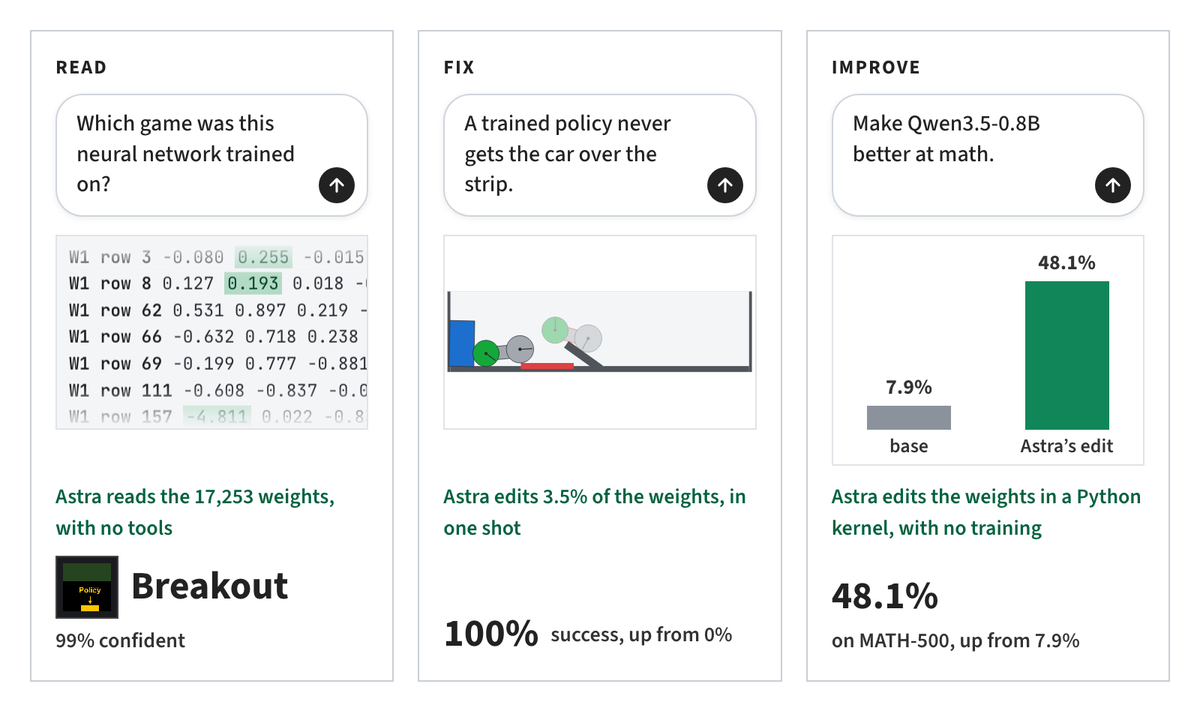
On November 2, MIT CSAIL PhD student Rikiya Takehi posted "Weight-Space Programming" on X: a team (Takehi, Jayden Teoh, Alex Zhang, Omar Khattab) had GPT-6 Astra read and edit neural network weights directly, with no gradients or training. Their blog says Astra changed only 131,072 weights (0.016%) of Qwen3.5-0.8B, fixed its thinking loops and raised MATH-500 from 7.9% to 48.1%. The post drew about 24K likes and 1.77M views, and Ethan Mollick quoted it saying it is a big deal pending replication. All results are self-reported by the authors and not yet independently reproduced.

X Discussion: MIT Team Says GPT-6 Astra Can Read and Write Neural Network Weights, Editing 0.016% of Qwen3.5-0.8B to Lift MATH-500 From 7.9% to 48.1%

Key Takeaways

  • The original post (2026-11-02 17:51 UTC) had about 24,320 likes, 2,697 reposts, 2,284 quotes, 1.77M views and 15K bookmarks at fetch time; Wharton professor Ethan Mollick quoted it saying it is a pretty big deal pending replication (about 880 likes).
  • Experiment 8 (authors' figures): with a 50 forward-pass budget, Astra edited 131,072 weights (0.016%) of Qwen3.5-0.8B, raising MATH-500 from 7.9% to 48.1% and IFEval from 21.0% to 62.3%, while answers hitting the token limit fell from 93.0% to 33.1%.
  • Experiment 5 (authors' figures): with no data, gradients or tools, Astra wrote MinAtar policy networks in one shot that scored 517.4 on Breakout versus 15.8 for PPO at 100M steps and 25.3 at 500M steps; on Seaquest it scored 53.1, below the 88.9 of 500M-step PPO.
  • Limits the authors report: on Gemma 3 270M, which rarely loops, Astra's edits moved MATH-500 by no more than about a point; they conclude weight edits can remove an obstacle hiding an ability but cannot add one the model lacks.
  • Full experiment logs are public at RikiyaT/lm_understand-logs; so far there is only a blog post, with no peer-reviewed paper and no third-party replication.
Read full story
Linked Models & Agents:

X discussion: a new paper from Harvard's Gary King says AI article reviews beat top human peer reviews "by every measure we could construct", and Ethan Mollick urges academia to adapt fast

At 00:27 UTC on 2026-10-23, Harvard social scientist Gary King (@kinggary) posted a new paper with Steven Worthington, "AI Article Reviews Dominate Human Peer Reviews at Their Best: Evidence and Policy Choices". Its abstract says AI-generated reviews are now better, by every measure the authors could construct, than reviews by well-compensated human experts that editors and authors judged to be unusually good. Wharton professor Ethan Mollick (@emollick) then wrote that the study covers 124 Harvard social science papers and used Claude Opus 4.8, and that academics need to figure out how to adapt science to AI fast; his post had about 1,675 likes and 97K views. The topic was still on X's trending news list over the past 12 hours. This is an X discussion of a single paper, not a conclusion from any journal or from Anthropic.

Key Takeaways

  • The paper is by Harvard's Gary King and Steven Worthington; its page says it was last updated on 2026-10-22 (paper page; King's post, about 472 likes, 121K views and 371 bookmarks when we pulled it)
  • In the abstract's words, AI reviews are better "by every measure we could construct" than reviews by "well-compensated" human experts judged to be of "unusually high quality"; the paper also discusses journal policy choices and their "concerning downsides"
  • Ethan Mollick's post (post) says the study used Claude Opus 4.8 on 124 papers; it had about 1,675 likes, 97K views and 249 replies when we pulled it
  • Many reposts on X also cite figures such as "former journal editors picked the AI review 87% of the time" and "5.5% vs 15.9% wrong claims"; we have not checked each of these against the paper itself, so treat the paper as the source of record
Read full story
Linked Models & Agents:
ADSponsored