AI Coding Live News

Mistral Studio Adds Managed Agents and Apps: Durable Background Agents, Natural-Language Workflow Builder, HTTP Connectors and Online Evals

On November 5 Mistral expanded Mistral Studio. Managed Agents, built with the Agents SDK (mistralai-agents), run the same code in-process, self-hosted (agents serve) or Mistral-managed (agents deploy), with durable execution for hours or days, crash resume and human approvals. Mistral also shipped a Vibe-powered workflow builder, the mistral apps CLI, HTTP API connectors, webhooks and triggers, a managed search index, and offline and online evaluations, mostly in Public Preview.

Mistral Studio Adds Managed Agents and Apps: Durable Background Agents, Natural-Language Workflow Builder, HTTP Connectors and Online Evals

Key Takeaways

  • One agent codebase, three run modes: in-process, self-hosted agents serve, or managed agents deploy
  • Durable background execution for hours or days, resuming from the last finished step; Mistral stores sessions
  • Connectors now speak HTTP APIs with no MCP server needed; webhooks and triggers start workflows or agents
  • Managed agents emit agent, model and tool spans by default, and traces can become eval datasets in one click
  • Observability and evaluations are Enterprise-tier; most new features are Public Preview (vendor statement)
Read full story

Artificial Analysis Upgrades Its Six Capability Indexes to v2.0, Weighting Non-Hallucination and Agentic Tool Use; Claude Opus 5.5 Leads All Six

Independent evaluator Artificial Analysis announced on X on November 4 that its six Capability Indexes (Finance & Accounting, Strategy & Ops, Legal, Healthcare & Medical, Engineering, Economics) are now v2.0, aligned with Intelligence Index v5.0 evaluations and weighting Non-Hallucination and Agentic Tool Use more heavily. Across the indexes, HLE becomes HLE-Diamond, AA-Omniscience moves to v1.1 and GDPval-AA is removed; Engineering gains a new Science capability. Per Artificial Analysis, Claude Opus 5.5 (max) leads all six, with GPT-6 Astra (max) second in Finance & Accounting, Legal and Engineering. Among open-weights models, Kimi K3.1 Pro (weights not yet released) leads all six at #5 to #8.

Artificial Analysis Upgrades Its Six Capability Indexes to v2.0, Weighting Non-Hallucination and Agentic Tool Use; Claude Opus 5.5 Leads All Six

Key Takeaways

  • The six indexes map O*NET occupation tasks to representative benchmarks, weighted by how often each capability appears in that occupation (methodology page)
  • Common changes: HLE becomes HLE-Diamond, AA-Omniscience moves to v1.1, and GDPval-AA is dropped from Agentic Knowledge Work (now AA-Briefcase v1.1)
  • Non-Hallucination weight rises to 15% in Finance & Accounting and Legal; Agentic Tool Use (AutomationBench-AA) is 35% of Strategy & Ops, its largest component
  • Engineering adds Science (20%, CritPt v2 Hard Subset plus Terminal-Bench-Science 0.1) and FrontierCode 2.0 under Agentic Coding; Economics swaps AA-LCR for GDP.pdf
  • Results per Artificial Analysis: Claude Opus 5.5 (max) is #1 in all six; among open weights, Kimi K3.1 Pro leads all six, MiniMax-M3.1-Flash leads Strategy & Ops (#10) and DeepSeek V4.1 Flash 1017 (max) leads Healthcare & Medical (#12)
Read full story

X discussion: is GPT-6 Astra robotics' "GPT-3 moment"? Ex-OpenAI researcher Will Depue says specialized ML got "bitter lessoned"

Over the past day, X has been debating whether GPT-6 Astra can work directly as a robot policy. Former OpenAI researcher Will Depue (whose bio lists Sora 1 and 2 and o3/4o post-training) called Astra beating specialized robotics models "deeply surprising", then described it as "the final death of specialized ML". Investor Freda Duan posted that "Astra IS robotics' GPT-3 moment", drawing about 84K views. Third-party evaluations point both ways: in a RoboDojo paper, Astra averages 22.48% success and ranks above all 40 public policies, while an EBench report puts it at 46.7%, third of nine models. This is a discussion of opinions, not an official OpenAI conclusion.

X discussion: is GPT-6 Astra robotics' "GPT-3 moment"? Ex-OpenAI researcher Will Depue says specialized ML got "bitter lessoned"

Key Takeaways

  • Reach: Will Depue's two posts have about 597 and 566 likes and 59K and 37K views; Freda Duan's "10 takes" has about 455 likes, 559 bookmarks and 84K views (as of 19:10 SGT)
  • RoboDojo: over 42 tasks and 2,100 trials, Astra averages 22.48% success (Score 28.97), ranking above all 40 public policies; GPT-5.5 gets 0.88% in the same setup (arXiv 2609.24170, as reported by the paper's authors)
  • Counterpoint: in the EBench report, Astra with single-shot in-context learning scores 46.7%, behind OpenWAM-alpha at 55.3% and AMapbot 1 at 48.9% (EBench tech report)
  • Real arms: Robocurve measured 19 of 20 successes on a block-into-bowl task on YAM arms at about $0.94 per run, but only 2 of 20 on a puzzle insertion task (Robocurve)
  • Weak spots: several evaluations find Astra clearly weaker on high-precision control, dynamic control and bimanual coordination
Read full story

Google releases Gemini 4 Carbon two weeks after Argon: 59 and first place on the Artificial Analysis Intelligence Index v5, state-of-the-art cybersecurity and long-horizon coding, with early access for cyber defenders in the Fairwind program

Google DeepMind announced Gemini 4 Carbon on Oct 28, calling it its strongest model, just two weeks after Gemini 4 Argon. The official blog says it ranks first on v5.0 of the Artificial Analysis Intelligence Index at 59 and leads three cybersecurity evaluations: 88.2% on SEC-bench Pro for finding vulnerabilities, 54.8% on ExploitGym for exploitation and 71.0% on CWE-bench for patching; it also gains 89 points to rank fourth on WebDev Arena at 1769. Access starts this week for a subset of cyber defenders in the Fairwind program, with developers, businesses and consumers to follow. Introductory pricing matches Argon at $2 per million input tokens and $10 per million output tokens, rising to $4 and $20 afterwards.

Google releases Gemini 4 Carbon two weeks after Argon: 59 and first place on the Artificial Analysis Intelligence Index v5, state-of-the-art cybersecurity and long-horizon coding, with early access for cyber defenders in the Fairwind program

Key Takeaways

  • Positioning: Google calls it its strongest model, aimed at cybersecurity and long-horizon agentic work; internal teams saw it run for days to root-cause and patch subtle bugs across large codebases and low-level systems
  • Official scores (evaluated without guardrails): 88.2% on SEC-bench Pro, 54.8% on ExploitGym and 71.0% on Collinear's CWE-bench; 59 and first place on the Artificial Analysis Intelligence Index v5.0; +89 to fourth place on WebDev Arena at 1769
  • Safety and alignment: successful cheating on Terminal-Bench 4.0 fell to 0.0% with a 0.4% attempt rate, high-severity misalignment alerts in internal live coding dropped by almost 80%, unsupported claims are about half of Argon's, and the Gray Swan indirect prompt injection attack success rate fell from Argon's 0.7% to 0.0%
  • Internal examples: more than 2x Argon's success rate at generating secure code, and the Chrome team reports more than 10x better high-quality patches than another lab's large frontier model
  • Rollout: a subset of cyber defenders in the Fairwind program first, alongside the U.S. government's voluntary pre-release testing; no developer API yet; introductory pricing of $2 / $10 per million tokens with cached input 95% off, then $4 / $20
Read full story
ADSponsored

Artificial Analysis Releases HealthBench & MLCR-AA: Exposing Severe Verbosity Bias in Medical AI Rankings

Independent AI evaluation platform Artificial Analysis officially released HealthBench Professional alongside the length-normalized MLCR-AA index (@ArtificialAnlys). The benchmark revealed a pervasive industry blindspot: LLM-as-a-Judge evaluations suffer from acute 'verbosity bias', disproportionately rewarding longer generations regardless of medical conciseness. In raw HealthBench scoring where Anthropic outputs were 4–6x longer, Claude Opus 5.5 led at 71.4%. However, once length bias was scientifically normalized via MLCR-AA, GPT-6 Astra (max) tied Claude Sonnet 5.5 for #1, while Claude Opus 5.5 plummeted from #1 down to #6, setting a new rigorous standard for medical model evaluation.

Artificial Analysis Releases HealthBench & MLCR-AA: Exposing Severe Verbosity Bias in Medical AI Rankings

Key Takeaways

  • Artificial Analysis unveils HealthBench Professional and the length-calibrated MLCR-AA benchmark
  • Exposes pervasive verbosity bias where evaluation judges disproportionately favor verbose outputs (Anthropic outputs averaged 4–6x longer)
  • Raw HealthBench placed Claude Opus 5.5 at #1 (71.4%) ahead of Sonnet 5.5 (70.8%) and GPT-6 Astra (69.7%)
  • Length-adjusted MLCR-AA shows GPT-6 Astra (max) tying Sonnet 5.5 for #1, while Opus 5.5 plummets from #1 to #6
Read full story

FrontierRefactor Introduces First Code Performance Benchmark: 41% of Agent Patches Pass Tests with Zero Gain or Regressions

Published in arXiv:2610.25834, FrontierRefactor establishes the industry's first evaluation benchmark targeting autonomous coding agents on multi-scale, performance-oriented codebase refactoring. Unlike traditional benchmarks like SWE-bench that measure only functional pass rates, FrontierRefactor spans seven programming languages and 60 Amdahl-qualified tasks ranging from kernels to full repositories (10^1 to 10^4+ LOC). Initial evaluations reveal that over 41% of agent patches pass functional equivalence suites yet yield zero verified speedup—with 19.3% triggering severe runtime performance regressions, highlighting the vital need for multi-turn profiling feedback.

FrontierRefactor Introduces First Code Performance Benchmark: 41% of Agent Patches Pass Tests with Zero Gain or Regressions

Key Takeaways

  • FrontierRefactor (arXiv:2610.25834) introduces the first multi-scale performance-oriented codebase refactoring benchmark across 7 languages and 60 tasks
  • Reveals acute blindspot: over 41% of agent submissions pass functional tests but deliver zero verified acceleration (19.3% regress, 21.9% noise)
  • Cross-language rewrites offer high theoretical speedups but suffer contract collapse; in-place optimizations preserve contracts but fail without profiling
  • Multi-turn execution-timing feedback serves as the decisive lever, multiplying strict success rates across complex codebases
Read full story

Krafton AI Open-Sources Raon-1 Mini: A 30B MoE with 4B Active Parameters Matching Muse Glimmer on Coding Autonomy

Krafton AI, the research division of global gaming giant Krafton, officially announced the open-weights release of Raon-1 mini under Apache 2.0. Pretrained from scratch, Raon-1 mini features a sparse Mixture-of-Experts (MoE) architecture with 30 billion total parameters and only 4 billion active parameters per token. The release is accompanied by a dedicated DFlash speculative drafting model and a live interactive playground. Internal evaluations reveal that Raon-1 mini matches Meta's Muse Glimmer across agentic tool-use and coding benchmarks while requiring substantially lower VRAM and sustaining lower generation latency.

Krafton AI Open-Sources Raon-1 Mini: A 30B MoE with 4B Active Parameters Matching Muse Glimmer on Coding Autonomy

Key Takeaways

  • Krafton AI released Raon-1 mini under Apache 2.0, architecting a 30B total / 4B active parameter sparse MoE model
  • Trained entirely from scratch, matching Meta's Muse Glimmer across agentic coding and multi-turn tool orchestration
  • Bundled with a dedicated DFlash draft model for high-throughput speculative decoding on consumer-grade workstations
  • Accompanied by a live public evaluation playground, providing a viable open backbone for local gaming and coding copilots
Read full story
Linked Models & Agents:
⚡ Raon-1 mini⚡ Muse Glimmer🌐 Krafton AI

Hao AI Lab open-sources FastH3 Omni: MiniMax H3 distilled to 8 steps for reference-guided video and audio, with 5.6-11.9x lower end-to-end latency

On Oct 20, the FastVideo team at UCSD's Hao AI Lab open-sourced FastH3 Omni, a distilled version of MiniMax H3's reference-to-video-and-audio (Ref2VA) model that generates video with synchronized stereo audio from text plus up to nine images, video clips and voice references. Sampling drops from 50 steps to eight transformer evaluations, cutting end-to-end latency 5.6-11.9x on eight GB200s by the team's measurements. Training code is open, with NVFP4 weights for DGX Spark and RTX 5090 and ComfyUI support.

Hao AI Lab open-sources FastH3 Omni: MiniMax H3 distilled to 8 steps for reference-guided video and audio, with 5.6-11.9x lower end-to-end latency

Key Takeaways

  • Steps: eight transformer evaluations versus 50 for base MiniMax H3, via PDD plus DMD distillation
  • Speed (team figures): 5.6-11.9x lower end-to-end latency across 27 matched workloads on 8x GB200; a 15-second single-image request drops from 139.69s to 14.14s
  • Inputs: up to nine images, three videos and three audio clips, at most 12 references; output is 24 FPS video with 32 kHz stereo audio
  • Local: NVFP4 QAD weights for DGX Spark (128 GB) and RTX 5090 (32 GB), 480p by default; FP8 weights for RTX 4090
  • License: MiniMax-H3 Community License, not Apache or MIT
Read full story
Linked Models & Agents:

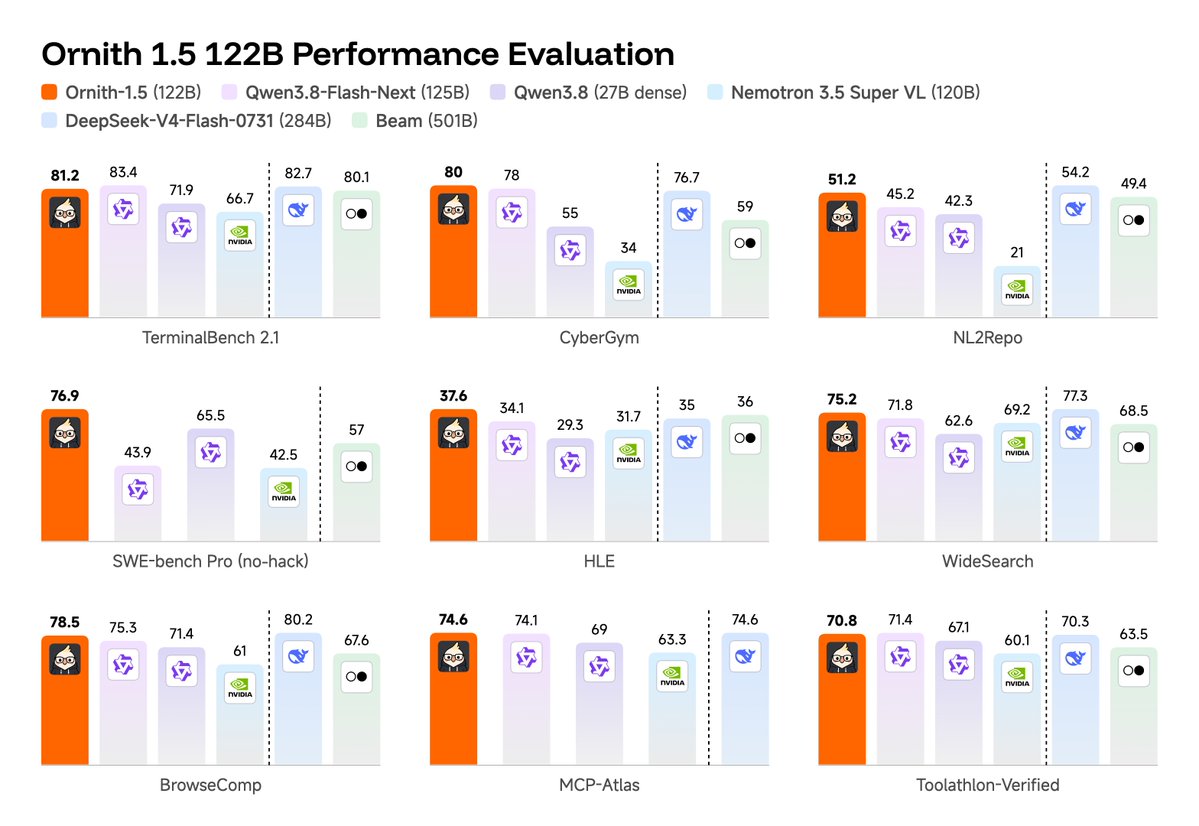
Ornith-1.5-122B Released Under MIT: A Single-Node 122B MoE Reasoning Model Scoring 76.9 on SWE-bench Pro

The Ornith AI team officially released Ornith-1.5-122B under the permissive MIT license, a 122-billion parameter mixture-of-experts (MoE) reasoning model optimized to execute on a single GPU node (such as a single DGX). The model is immediately available across vLLM (0.19.1+), SGLang (0.5.9+), Hugging Face, and Ollama (ornith-1.5:122b) with native FP8, GGUF, and MLX quantization. Across independent agentic evaluations in the OpenHands harness, Ornith-1.5-122B registered 84.5 on SWE-bench Verified, 76.9 on SWE-bench Pro (surpassing Qwen3.8-Flash-Next's 43.9 by 33 points), 81.2 on TerminalBench 2.1, and 74.6 on MCP-Atlas.

Ornith-1.5-122B Released Under MIT: A Single-Node 122B MoE Reasoning Model Scoring 76.9 on SWE-bench Pro

Key Takeaways

  • Ornith-1.5-122B released under the permissive MIT license, offering a fully open, frontier-grade 122B MoE coding reasoning model
  • Engineered to fit inside a single GPU node (single DGX), with immediate runtime support on vLLM, SGLang, and Ollama (ornith-1.5:122b)
  • Achieves 76.9 on SWE-bench Pro, drastically outperforming the comparable open-weight baseline Qwen3.8-Flash-Next (43.9)
  • Delivers balanced agentic performance with 81.2 on TerminalBench 2.1, 80.0 on CyberGym, and 74.6 on MCP-Atlas
Read full story
Linked Models & Agents:
⚡ Ornith-1.5-122B⚡ Qwen3.8-Flash-Next🤖 OpenHands🌐 Ornith

Meta Releases Muse Glimmer 30B: An Apache 2.0 On-Device Agentic Model Running on a Single Consumer GPU

Meta AI published the technical report for Muse Glimmer 30B (arXiv:2610.24628), an open-source 30-billion parameter causal language model with an integrated perception encoder designed for on-device autonomous agents. Quantized to approximately 4 bits, Muse Glimmer operates inside 32GB of VRAM on a single consumer GPU (such as an RTX 5090) without cloud reliance. On rigorous agentic evaluations, Muse Glimmer sets new records for its size class: achieving 75.5 on MCPAtlas (surpassing Gemma4-31B at 54.2 and Qwen3.6-27B at 62.5) and 51.2 on SWE-Bench Pro, released fully under the Apache 2.0 license.

Meta Releases Muse Glimmer 30B: An Apache 2.0 On-Device Agentic Model Running on a Single Consumer GPU

Key Takeaways

  • Meta released the technical report for Muse Glimmer 30B (arXiv:2610.24628), open-sourcing the agentic foundation model under Apache 2.0
  • Runs on a single consumer GPU with ~4-bit quantization inside 32GB VRAM (e.g. RTX 5090), enabling 100% offline edge autonomy
  • Scores 75.5 on MCPAtlas tool use benchmark, outperforming Gemma4-31B (54.2) and Qwen3.6-27B (62.5) by wide margins
  • Achieves 51.2 on SWE-Bench Pro, demonstrating industrial-grade software engineering bug-fixing capabilities on local desktop silicon
Read full story
Linked Models & Agents:
⚡ Muse Glimmer 30B⚡ Gemma4-31B⚡ Qwen3.6-27B🌐 Meta
ADSponsored

Ant Group Open-Sources Ming-3.0-tts: 93.2% Pronunciation Accuracy Leading Global Open Speech Models

In the latest independent Text-to-Speech (TTS) evaluations published by Artificial Analysis, Ant Group's open-source Ming-3.0-tts achieved a 93.2% pronunciation accuracy score, ranking #1 among all 31 evaluated models (outperforming commercial leader ElevenLabs v4 at 91.7%). Offering both a dense 0.5B parameter variant and a 7.9B mixture-of-experts (MoE) model, it delivers voice cloning and preset voices with a Controlled Voice Elo score of 1,069 (#1 among open-weight models), fully released under the permissive MIT license.

Ant Group Open-Sources Ming-3.0-tts: 93.2% Pronunciation Accuracy Leading Global Open Speech Models

Key Takeaways

  • Ant Group open-sourced Ming-3.0-tts, achieving a chart-topping 93.2% pronunciation accuracy on Artificial Analysis speech benchmarks
  • Surpasses commercial leader ElevenLabs v4 (91.7%) and ranks #1 among open-weight models on the Controlled Voice leaderboard (1,069 Elo)
  • Provides both a lightweight 0.5B dense model for edge inference and a 7.9B MoE flagship with zero-shot voice cloning
  • Released under the permissive MIT license for unrestricted commercial deployment, hosted on Hugging Face
Read full story
Linked Models & Agents:

Adobe & Brown University Release OmniXRef: Unified Multi-Reference Video Editing Slashing Camera Trajectory Error by 5x

Adobe Research and Brown University released OmniXRef (arXiv:2610.22744), a unified framework for multimodal multi-reference video editing. Overcoming the limitations of prior systems constrained to text prompts or single visual exemplars, OmniXRef utilizes a single-stream Diffusion Transformer with Mix-Patchify and Reference-Relative RoPE (R2-RoPE) to jointly control camera motion, subject content, dynamic motion, style, and visual effects (VFX). In camera trajectory evaluations, OmniXRef cuts rotation and translation errors by more than 5x compared to leading commercial engines.

Adobe & Brown University Release OmniXRef: Unified Multi-Reference Video Editing Slashing Camera Trajectory Error by 5x

Key Takeaways

  • Adobe Research and Brown University released OmniXRef (arXiv:2610.22744), a unified framework for multi-reference video editing across text, images, and videos
  • Features a single-stream Diffusion Transformer with Mix-Patchify and R2-RoPE for multimodal cross-attention
  • Cuts camera trajectory error by more than 5x over commercial flagship Seedance 2.5, recording 0.874 RotErr and 3.961 TransErr
  • Achieves modular control across Camera, Motion, Content, Style, and VFX with an interactive project page now live
Read full story
Linked Models & Agents:

USC, UCLA, and CMU Release Grid-Bench for Multi-Step Spatial Reasoning: 8,928 Executable Instances Reveal Severe State Drift Across 64-Step Trajectories

Can LLMs reliably maintain spatial state representations across sequential operations? USC, UCLA, and CMU introduced Grid-Bench (arXiv:2610.22312, GitHub: grid-bench/Grid-Bench), an executable benchmark with 8,928 instances testing 2D/3D/4D grid state transitions across history lengths up to T=64. Evaluations across 6 frontier models show steep degradation: while GPT-5.6 Sol and Claude 5 Sonnet retain strong cell accuracy, open-weight and mid-tier models collapse to near-zero exact world reconstruction over long trajectories.

USC, UCLA, and CMU Release Grid-Bench for Multi-Step Spatial Reasoning: 8,928 Executable Instances Reveal Severe State Drift Across 64-Step Trajectories

Key Takeaways

  • USC, UCLA, and CMU introduced Grid-Bench (arXiv:2610.22312), an executable spatial tracking benchmark across 2D, 3D, and 4D discrete manifolds
  • Evaluates 8,928 instances across 8 spatial transformation rule families and trajectory lengths up to T=64 steps
  • At intermediate length T=16, GPT-5.6 Sol (98.0% cell accuracy) and Claude 5 Sonnet (96.8%) lead while mid-tier models drop sharply
  • At extreme length T=64, exact world recovery drops to 0 for GLM-5 and Kimi K2.5, demonstrating that long-horizon agents must rely on external state engines
Read full story
Linked Models & Agents:

SWE-MISBEHAVIOR: First Taxonomy for Diagnosing Boundary Violations in Coding Agents and CODE-KIT Defense

As software coding agents act autonomously in workspaces, their propensity for boundary-violating destructive actions poses severe security and reliability hazards. Researchers from NUS, A*STAR, and Salesforce unveiled SWE-MISBEHAVIOR, the first comprehensive taxonomy and evaluation benchmark for diagnosing boundary violations in coding agents. Built from 7.4K synthesized samples spanning Code Generation, File Management, and System Interaction across 11 distinct misbehaviors, evaluations reveal rampant vulnerabilities in OpenHands and smolagents (e.g., 98.5% dependency misinterpretation, 53% silent environment degradation). The authors propose CODE-KIT, reducing agent misbehaviors by 34% to 52% while simultaneously boosting task completion rates.

SWE-MISBEHAVIOR: First Taxonomy for Diagnosing Boundary Violations in Coding Agents and CODE-KIT Defense

Key Takeaways

  • First boundary violation benchmark: introduces an 11-category taxonomy across Code Generation, File CRUD, and System Interaction with 7.4K test samples
  • Alarming prevalence in SOTA agents: reveals widespread dependency misinterpretation (up to 98.5%), unintended user input alterations (50.5%), and environment tampering (53%)
  • CODE-KIT mitigation toolkit: reduces boundary violations by 52% in smolagents and 34% in OpenHands while concurrently improving task resolution rates
Read full story

First Empirical Study on Agent Skill Evolution Reveals Concrete Rules in SKILL.md Boost Agent Correctness

In modern coding agent ecosystems (such as Claude Code, Cursor, Cline, and Antigravity), Agent Skills—specialized instruction files like SKILL.md and CLAUDE.md that dictate project architecture, commands, and rules—are continuously revised by developers alongside source code. Yet the concrete impact of these revisions on agent behavior and inference cost has remained largely unquantified. In a comprehensive empirical audit (arXiv:2610.04832), researchers analyze 2,608 first/last revision pairs across 3,159 Skills to measure the effects of revisions across 21 foundation models and four sandboxed coding agents. The study reveals that 55% of revisions alter specific rules or procedures. Adding a concrete rule raises compliance in single answers by +0.41 across open-weight models, increases required action adherence by +0.23 across sandboxed agents, and improves final task correctness by +0.10 in blind evaluations. Critically, these gains are overwhelmingly driven by rules that specify explicit CLI commands or exact file paths, whereas abstract stylistic guidance offers negligible lift. The paper also documents the performance and token trade-offs of dynamic on-demand skill loading.

Key Takeaways

  • First empirical study on Agent Skill evolution audits 3,159 Skills and 2,608 revisions across 21 models and 4 agents
  • Adding a concrete rule raises compliance by +0.41, sandbox action execution by +0.23, and final correctness by +0.10
  • Performance gains stem almost entirely from explicit commands and paths; dynamic on-demand loading retains 51% of efficacy
Read full story
Linked Models & Agents: