AI Coding Live News

Flower Labs Releases Endeavor 1.1: Multimodal, EU-Only Inference and Private Deployment With Readable Thinking Traces, Claims Parity With OpenAI and Anthropic

Flower Labs, the company behind the Flower federated learning framework, released Endeavor 1.1 on November 3, its third model this year after the UK sovereign 7B model Lizzy in April and Endeavor 1.0 in September. The update adds image input, an optional EU-only GPU inference tier, and Flower-managed, private-cloud or on-premises deployment, and promises readable thinking traces plus ownership of outputs that customers may use to train their own models. Vendor-reported scores are GPQA 94.4, HumanEval 99.9, AIME 2026 99.9 and MMMU-Pro 81.1, but the comparison uses GPT-5.6 Sol and Claude Fable 5 rather than either lab's newest models, and access is request-only for now.
Flower Labs Releases Endeavor 1.1: Multimodal, EU-Only Inference and Private Deployment With Readable Thinking Traces, Claims Parity With OpenAI and Anthropic

Key Takeaways

  • Vendor-reported: GPQA rose from 92.0 in 1.0 to 94.4 (about 30% fewer errors), HumanEval from 98.2 to 99.9; IFEval is 94.5 and MMMU-Pro 81.1.
  • In the vendor table, GPT-5.6 Sol scores GPQA 94.1, IFEval 95.9 and MMMU-Pro 83.0, and Claude Fable 5 scores GPQA 92.6; Endeavor does not lead on IFEval or MMMU-Pro.
  • New EU-only GPU inference with SLAs, with UK, Middle East, Asia and Africa regions planned.
  • The pitch is control: raw thinking traces, ownership of outputs and traces, and the right to fine-tune or train your own models on them.
  • Flower says the model builds on mature open-weight models via continual pre-training, targeted post-training and model integration, without naming the base or parameter count; access is request-only.
Read full story
Linked Models & Agents:
⚡ Endeavor 1.1⚡ Endeavor 1.0⚡ GPT-5.6 Sol⚡ Claude Fable 5⚡ Kimi K3⚡ Nemotron 3 Ultra🌐 Flower Labs

Artificial Analysis releases AA-Omniscience v1.1: 3,000 refreshed questions and a calibrated 300-question public set, with Gemini 4 Carbon leading at a Net Score of 54

On October 31, independent evaluator Artificial Analysis released AA-Omniscience v1.1, its knowledge and hallucination benchmark and part of Intelligence Index v5. The question set shrinks from 6,000 to 3,000, dropping previously public and saturated questions, fixing errors and ambiguities, and adding new ones, and a new 300-question public set on Hugging Face is calibrated to the private set's difficulty, with 0.99 Pearson and Spearman correlation on Net Score. Gemini 4 Carbon (high) leads with a Net Score of 54, ahead of Claude Opus 5.5 at 48 and Claude Fable 5.1 at 46; Fable 5.1 has the highest accuracy (68%) and Gemini 4 Argon the lowest hallucination rate (4%). Models score about 1.9 points lower than on v1 on average, and MiniMax M3.1 Flash drops 22 points. All figures are as reported by Artificial Analysis.

Artificial Analysis releases AA-Omniscience v1.1: 3,000 refreshed questions and a calibrated 300-question public set, with Gemini 4 Carbon leading at a Net Score of 54

Key Takeaways

  • The question set shrinks from 6,000 to 3,000 across 6 domains and 42 topics: 600 each for science/engineering/math and software engineering, 450 each for finance, health, humanities/social sciences and law
  • A new 300-question public set is on Hugging Face, with 0.99 correlation to private-set Net Score and a median difference of 0.0 points
  • Net Score ranking: Gemini 4 Carbon (high) 54, Claude Opus 5.5 48, Claude Fable 5.1 46; the best open-weights model, Muse Spark Open, trails Gemini 4 Carbon by 28 points
  • Claude Fable 5.1 has the highest accuracy (68%), followed by Claude Opus 5.5 (66%); Gemini 4 Argon has the lowest hallucination rate (4%)
  • Rank order keeps a 0.98 Spearman correlation with v1, but scores are 1.9 points lower on average; MiniMax M3.1 Flash falls from 16 to -6 and MiMo V2.6 Pro from 8 to -5 (vendor-reported)
Read full story
g
guregodevo (Memdoor author)github.com·
👀16
🔥81

Memdoor reproduces GVS5H: a team of five Qwen3.8-27B agents averages 9.8/10 on the first 10 LiveCodeBench Hard problems, against 8.0 for a single Fable 5 call

On Oct 31 the open-source coding agent Memdoor (GitHub guregodevo/memdoor, Apache 2.0) published its team-solve workflow: using the GVS5H paper authors' exact prompts and loop, five Qwen3.8-27B instances act as planner, two ideators, solver and manager, talk only through files on disk, and a script that runs the tests decides success. Over five passes on the first 10 LiveCodeBench Hard problems from the GVS5H list it averaged 9.8/10, against 9.6 for the authors' own harness and 8.0 for a single Fable 5 call; 49 of 50 runs solved the problem for $35.79 in total, and every request and reply is public. The Hacker News post has about 200 points. This is a community reproduction on only 10 problems, and the author notes that training-data contamination cannot be ruled out.

Key Takeaways

  • Score: a mean of 9.8/10 over five passes (10, 10, 10, 10, 9), against 9.6 for the GVS5H authors' own harness and 8.0 for a single Fable 5 call (team-solve README, project-reported)
  • Cost: 49 of 50 runs solved, $35.79 and 15.3M output tokens in total; a median run took about 40 minutes of model time and $0.39, the longest 4 hours
  • Method: five roles (planner, two ideators, solver, manager) plus a repair worker each start from a fresh context, talk only through files on disk, and a shell script that runs the tests decides success instead of a model
  • Limits: only 10 problems rather than the paper's 100; the contests date from March and April 2025 and may be in training data; Fable 5's column comes from the GVS5H authors' result files and was not rerun in this harness
  • Reach: the HN post has about 200 points as of Nov 1, 16:10 SGT; the original GVS5H paper is arXiv 2608.26480, which reached #1 on HN on Oct 25
Read full story

Anthropic details Claude self-assessment for misuse detection: 78% recall at 1% false positives for under 2% extra compute

On Oct 29 Anthropic introduced self-assessment on X: after each response, Claude produces a structured preliminary safety assessment of the whole conversation for offline review. Anthropic's Safeguards blog says that on Claude Fable 5, at a 1% false-positive rate, it flags 78% of the conversations a stronger prompted classifier flags and 94% of high-priority ones. Because the conversation is already in the KV cache, it adds about 10 output tokens on average and an estimated under 2% of inference compute. It has run in production since June, but Anthropic says it is not robust against an attacker who targets it directly and is only one layer of defense in depth.

Anthropic details Claude self-assessment for misuse detection: 78% recall at 1% false positives for under 2% extra compute

Key Takeaways

  • On Claude Fable 5, at a 1% false-positive rate it recalls 78% of what the prompted classifier flags and 94% of high-priority (7+) conversations (vendor figures, Safeguards blog)
  • It reuses the KV cache, adding about 10 output tokens per assessment on average; Anthropic estimates under 2% extra inference compute and does not bill customers for it
  • Across four model sizes, recall at 1% false positives rises from about 16% to about 96% and AUC from 0.862 to 0.995
  • As a real-time blocker it is weak: attack success on 24 cyber tasks only drops from 79% to 54%, versus 25% with a prompted classifier
  • In August it raised over 100k child sexual abuse flags from a single API customer, reported to NCMEC; about a third of flags fall outside the existing taxonomy
Read full story
Linked Models & Agents:
ADSponsored

Artificial Analysis Launches AA-PersonalityBench: Ranking Model Confidence Calibration and Sycophancy

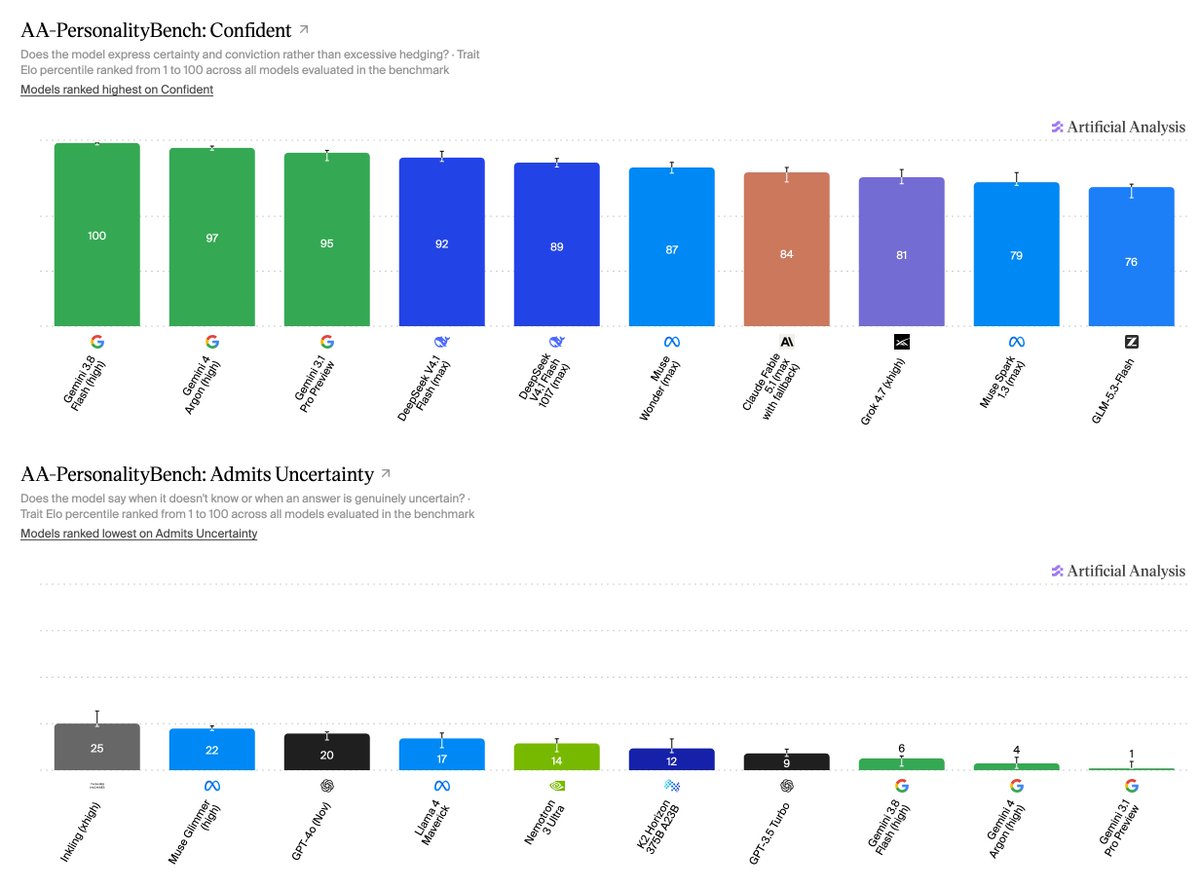
Artificial Analysis launched AA-PersonalityBench (@ArtificialAnlys), an innovative behavioral benchmark quantifying psychological traits in frontier LLMs, with initial rankings focusing on Confidence (uncertainty calibration) and Sycophancy (tendency to agree with user misconceptions). The data revealed that Google's Gemini 3.8 Flash (100) and Gemini 4 Argon (97) displayed the highest assertiveness while being the least likely to admit uncertainty. Conversely, on sycophancy tests, Llama 4 Maverick scored 97 (frequently validating flawed user prompts), whereas Claude Fable 5.1 scored a near-flawless 4, refusing to flatter and rigorously holding factual ground.

Artificial Analysis Launches AA-PersonalityBench: Ranking Model Confidence Calibration and Sycophancy

Key Takeaways

  • Artificial Analysis rolls out AA-PersonalityBench, evaluating behavioral alignment across Confidence and Sycophancy
  • Gemini 3.8 Flash (100) and Gemini 4 Argon (97) top confidence scores, yet exhibit minimal willingness to express epistemic uncertainty
  • Llama 4 Maverick recorded a high sycophancy score of 97, regularly echoing invalid user premises
  • Claude Fable 5.1 (4) and Claude Opus 5.5 (46) demonstrated elite resistance to user gaslighting, strictly preserving factual neutrality
Read full story

Breken launches a "production before production": synthetic users and agents run your real software to find bugs, and its own ESCAPES benchmark says it caught 76 of 235 shipped bugs, twice what Claude Code found

On October 21 the startup Breken launched its product of the same name as "production engineering". It rebuilds the whole application in an isolated environment, grows production data at 4,000x speed, lets synthetic users and agents with intent and limited patience use it, and varies one condition at a time, such as a retry, a lost response or a clock jump. When a failure reproduces every time it hands back the state, a trace and a draft fix PR. It also published an open benchmark, ESCAPES: 327 bugs from 33 open-source products that reached users. Scanning each product once on its July 1 code, Breken caught 76 of the 235 bugs already present (32%), against 37 (16%) for Claude Fable 5.1 in Claude Code. These are vendor-run results.

Breken launches a "production before production": synthetic users and agents run your real software to find bugs, and its own ESCAPES benchmark says it caught 76 of 235 shipped bugs, twice what Claude Code found

Key Takeaways

  • ESCAPES benchmark (vendor-run): 327 real user-reported bugs from 33 open-source products, one scan on the 2026-07-01 code, scored on the 235 bugs already present
  • Bugs caught: Breken 76 (32%, 61 proven by a reproduction), Claude Fable 5.1 in Claude Code 37 (16%), Claude Opus 5.5 in Claude Code 33 (14%), GPT-6 Astra in Codex CLI 28 (12%), Semgrep 9 (4%)
  • False alarms: Breken 20, Claude Fable 5.1 59, GPT-6 Astra 86; precision 85% vs 46%; weighted score +23.8% vs -9.4%
  • 71% of these bugs only show up when the product runs with real data, a second user, an outside failure or time passing; they sat in the code for a median 152 days
  • Billing is prepaid usage with a $25 minimum top-up and $50, $100 and $250 presets; you sign in with GitHub and pick repositories
Read full story

Artificial Analysis launches AA-Robotics v0.1: coding agents drive a real robot arm, GPT-6 Astra leads at 69.4

Artificial Analysis released AA-Robotics v0.1 on 2026-10-14, a research preview in which frontier models running inside coding-agent harnesses (Codex, Claude Code, Antigravity) control a 6-axis robot arm over an HTTP API across eight tabletop tasks. GPT-6 Astra scores 69.4, ahead of GPT-6.1 Sol (64.6), Gemini 4 Argon (55.3), Claude Opus 5.5 (48.8) and Claude Fable 5.1 (46.3). Models take about 30 minutes per task versus roughly 20 seconds for a human.

Artificial Analysis launches AA-Robotics v0.1: coding agents drive a real robot arm, GPT-6 Astra leads at 69.4

Key Takeaways

  • Scores (out of 100): GPT-6 Astra 69.4, GPT-6.1 Sol 64.6, Gemini 4 Argon 55.3, Claude Opus 5.5 48.8, Claude Fable 5.1 46.3 (AA article)
  • Speed: ~30 min per task for models (Argon ~52 min) vs ~20 s for a human
  • Cost: GPT-6.1 Sol cheapest at $1.93/task, GPT-6 Astra $16.36/task; ~70% of spend is input context
  • Grasp success: Astra 45%, Fable 5.1 44%, Opus 5.5 40%, Argon 36%, Sol 28%
  • Measure-the-box (within 2 mm) tops out at 17/100 across all five models
Read full story

Paper Instruments releases Ultramarine 1 Flash: non-verifiable-RL knowledge-work model on GLM-5.3 Flash, $0.13/task on its own suite, API live, weights promised

San Francisco lab Paper Instruments launched Ultramarine 1 Flash on 2026-10-14 16:02 UTC: GLM-5.3 Flash post-trained with large-scale non-verifiable RL (per-task rubric rewards) for finance, legal, consulting and operations work. Its report claims +4.1 points on average over the base across six knowledge-work benchmarks with 6.5% fewer output tokens, and 59.3 at $0.13/task on its internal PI Knowledge Work suite vs Claude Fable 5 at 57.8 / $8.19. An OpenAI-compatible API (ultramarine-1-flash) is live; the CEO says weights follow in about two weeks and post-training cost ~$300k. The headline cost comparison rests on an internal benchmark and has not been independently reproduced.

Paper Instruments releases Ultramarine 1 Flash: non-verifiable-RL knowledge-work model on GLM-5.3 Flash, $0.13/task on its own suite, API live, weights promised

Key Takeaways

  • GLM-5.3 Flash base + modified CISPO RL (LoRA rank 64, 131K context, up to 250 turns); +4.1 avg over base on 6 knowledge-work benchmarks with 6.5% fewer tokens
  • JobBench 62.9 (#1, Gemini 3.8 Flash 60.6); FrontierFinance 53.3 (#1); APEX-Agents 1.1 57.0 vs Gemini 3.8 Flash 64.3
  • Internal PI Knowledge Work: 59.3 at $0.13/task vs Claude Fable 5 57.8 / $8.19 and GPT-6 Sol 61.3 / $1.26
  • Trade-off: slight coding regression — Terminal-Bench 2.1 83.2 (base 84.3), DeepSWE 1.1 61.5 (base 63.4)
  • Curriculum: 4 domains, 19 practice areas, 88 synthetic environment types, fully synthetic tasks graded by rubrics
Read full story

Last Secure Code Benchmark: Vibe Coding Under Fire as Top Agents Produce Secure Code on Only 25.1% of Tasks

While AI coding agents and 'vibe coding' workflows synthesize an unprecedented volume of production software, code security remains highly fragile. Researchers from NUS and Monash University introduced the Last Secure Code Benchmark, evaluating 450 tasks derived from 150 real CVE vulnerabilities across 7 languages (Java, C, C++, JS, Python, PHP, Go) and 24 CWE categories (including 21 of the 2025 CWE Top 25 and 8 of the Top 10 KEVs). While frontier agents achieve 73.6% to 91.3% functional completion rates, even the strongest model (Claude Fable 5) produces code that is both functional and secure on only 25.1% of tasks, exposing acute supply-chain risks in autonomous vibe coding.

Last Secure Code Benchmark: Vibe Coding Under Fire as Top Agents Produce Secure Code on Only 25.1% of Tasks

Key Takeaways

  • First comprehensive vibe-coding security benchmark: 450 tasks based on 150 CVEs spanning 7 languages, covering 21 of the 2025 CWE Top 25 and 8 Top 10 KEVs
  • The functionality illusion: while agents pass functional specs at 73.6%–91.3%, dual functional-and-secure pass rates collapse to 16.4%–25.1%
  • Vulnerability defense crisis: across full-repository and file generation scenarios, top models resolve only 12% of vulnerability environments securely
Read full story

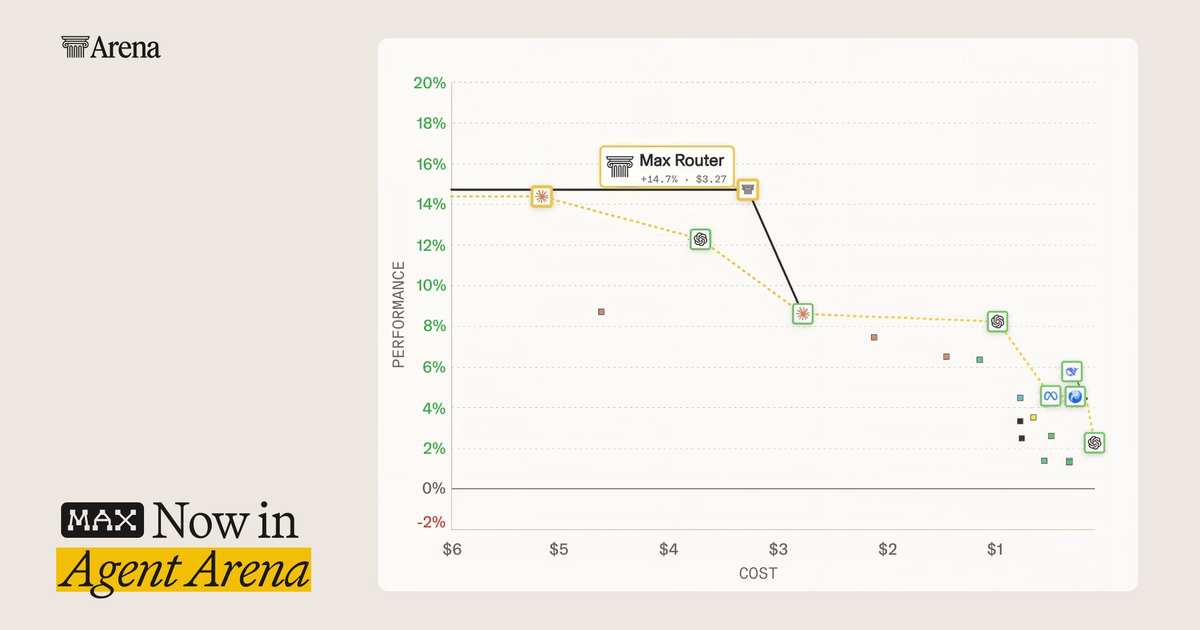
Arena's agentic Max router, trained on 2.5M Agent Arena sessions, tops Agent Arena at a $3.27 median task cost — 37.5% below Fable 5.1 (Max)

Arena released an agentic version of its Max router. Trained on 2.5M+ real Agent Arena sessions, it picks between Fable 5.1 (Max), Astra (Max) and Astra (Medium) per task based on complexity, task type and cost. In a live test it ranked #1 in Agent Arena with a +14.7% score at a $3.27 median cost per task — 0.3% better than the top public model, Fable 5.1 (Max), at 37.5% lower cost — and sent 67% of coding sessions to the cheaper Astra (Medium). It is free to try in Agent Mode for a limited time; API access is via a signup form.

Arena's agentic Max router, trained on 2.5M Agent Arena sessions, tops Agent Arena at a $3.27 median task cost — 37.5% below Fable 5.1 (Max)

Key Takeaways

  • Training data: 2.5M+ real Agent Arena sessions; Arena tested 60+ agentic models over the past 4 months
  • Live test: #1 in Agent Arena with +14.7% score and a $3.27 median cost per task — 0.3% above Fable 5.1 (Max) at 37.5% lower cost
  • Routing mix: code 67% → Astra (Medium); chat Astra (Max) 49% / Fable 5.1 (Max) 42%; work Fable 5.1 (Max) 49% / Astra (Medium) 43%
  • Model-agnostic: an earlier Fable 5 + Kimi K3 router hit +10.7% net at a $1.06 median cost, 0.6 pp above Fable 5 (High) at 54% lower cost
  • Caveats: trained on data collected before Sept 17 (pre-Opus 5.5); Agent Mode only for now, API via signup
Read full story
ADSponsored

Anthropic makes Claude Opus 5.5 available

Anthropic announced Claude Opus 5.5 is available today. It is the first model in the Claude 5.5 family, performs at the level of Claude Fable 5.1 for most tasks, and costs 40% less to run than Opus 5.

Key Takeaways

  • Anthropic announced Claude Opus 5.5 is available today. It is the first model in the Claude 5.5 family, performs at the level of Claude Fable 5.1 for most tasks, and costs 40% less to run than Opus 5.
Read full story
Linked Models & Agents:

Anthropic launches Claude Opus 5.5: kicks off 5.5 family with 40% cost reduction and 30%+ speedup

Anthropic officially launched Claude Opus 5.5 as the frontier pioneer of the new Claude 5.5 family. Benchmark audits show Opus 5.5 matches previous flagship Claude Fable 5.1 on core agentic coding and reasoning tasks while slicing operating costs by 40% compared to Opus 5. API pricing is set at $4/M input and $20/M output with $0.20/M prompt cache reads.

Key Takeaways

  • Flagship launch kicking off Claude 5.5 family, matching Claude Fable 5.1 performance on primary workflows.
  • Operating costs slashed by ~40% with over 30% faster token output speed.
  • API pricing at $4/M input, $20/M output, and $0.20/M prompt cache reads ($5/M cache write).
  • Highest automated behavioral safety audit score recorded by Anthropic to date.
Read full story
Linked Models & Agents:

Anthropic ships Claude Opus 5.5: Fable 5.1-level on most tasks, ~40% cheaper than Opus 5

Anthropic / Claude (@claudeai; confirmed by @AnthropicAI) launched Claude Opus 5.5 today, the first model in the new Claude 5.5 family. Officially it matches Claude Fable 5.1 on most tasks, and is a major step up from Opus 5 on agentic coding, computer use, and knowledge work. At default settings typical workloads cost about 40% less than Opus 5. Pro, Max, and Team five-hour usage limits are increased, with a bankable rate-limit reset for subscribers.

Anthropic ships Claude Opus 5.5: Fable 5.1-level on most tasks, ~40% cheaper than Opus 5

Key Takeaways

  • Opus 5.5 opens the Claude 5.5 family and is available today; most tasks match Claude Fable 5.1.
  • Leads Opus 5 on agentic coding, computer use, and knowledge work; ~40% cheaper on typical default workloads.
  • Higher Pro/Max/Team five-hour usage caps plus a bankable rate-limit reset for subscribers.
Read full story

Anthropic says Claude Opus 5.5 is available today

Anthropic (@AnthropicAI) confirmed Claude Opus 5.5 is available today; see the same-day @claudeai launch thread. First Claude 5.5 model, Fable 5.1-level on most tasks, ~40% cheaper than Opus 5 on typical workloads.

Anthropic says Claude Opus 5.5 is available today

Key Takeaways

  • @AnthropicAI confirms Opus 5.5 is available today.
  • First model in the Claude 5.5 family; Fable 5.1-level on most tasks.
  • About 40% cheaper than Opus 5 on typical workloads.
Read full story

LMArena: MiMo-V2.6-Pro enters Code Arena WebDev top 10 at AutoEval 1628

@arena reports Xiaomi MiMo-V2.6-Pro debuted on Code Arena: WebDev around #10 overall and about #3 among MIT-licensed open-weights models, scoring 1628 AutoEval points—tying Claude Fable 5 (High) and just ahead of Hy4-preview (1624). That is a +153 jump from MiMo-V2.5-Pro (1475). Live human votes are still coming in.

LMArena: MiMo-V2.6-Pro enters Code Arena WebDev top 10 at AutoEval 1628

Key Takeaways

  • Code Arena WebDev: MiMo-V2.6-Pro ~#10 overall, ~#3 among MIT open-weights.
  • AutoEval 1628, tying Claude Fable 5 (High), just ahead of Hy4-preview (1624).
  • +153 vs MiMo-V2.5-Pro (1475); human votes still open.
Read full story
Linked Models & Agents:
⚡ Xiaomi Mimo V2 6 Pro