AI Coding Live News

Fish Audio Launches Live 3 Full-Duplex Voice Model: Listens While Speaking, Backchannels "Mm-hmm" and Knows When to Yield, Decides to Respond in as Little as 186 ms, Voice Agents at $0.035 per Minute

On November 10 (02:02 on November 11 Singapore time) Fish Audio released Live 3, a full-duplex voice model that keeps listening while it speaks. It can acknowledge with short cues such as "mm-hmm" or "okay" while leaving the floor to the user, tell a backchannel apart from a real interruption, and wait while a caller corrects themselves. Fish Audio says these behaviors were learned from real human conversations rather than hand-written rules and thresholds, and that Live 3 can decide to respond in as little as 186 milliseconds. Live 3 speaks English only for now, is available on the Fish Agent Platform and via API, and can be deployed on-premises by enterprises; voice agents are priced at a limited-time $0.035 per minute (list $0.07, offer ends December 31, 2026). No standardized benchmark has been published.

Fish Audio Launches Live 3 Full-Duplex Voice Model: Listens While Speaking, Backchannels "Mm-hmm" and Knows When to Yield, Decides to Respond in as Little as 186 ms, Voice Agents at $0.035 per Minute

Key Takeaways

  • Full duplex: Live 3 keeps listening while it speaks, moving turn-taking into the speech model itself instead of rules in an ASR, LLM and TTS pipeline
  • Latency (vendor figure): decides to respond in as little as 186 ms, using short replies like "mm-hmm" or "okay" while the full answer is prepared
  • Pricing: voice agents at $0.035/min (list $0.07, 50% off until 2026-12-31), with speech recognition, LLM and voice billed together; phone calls add $0.01/min and sign-up includes $5 credit
  • Limits: English only for now; no standardized benchmark published, only 3 excerpts from real test calls
  • Deployment: Fish Agent Platform, API, or enterprise on-premises, supporting both full-duplex and cascaded modes
Read full story
Linked Models & Agents:

OpenAI Will Retire ChatGPT's Advanced and Standard Voice on December 11: Everyone Moves to Full-Duplex GPT-Live, While Live Video and Screen Sharing Stay on Advanced for Now

On November 10 the OpenAI Newsroom announced that Advanced voice and Standard voice in ChatGPT Voice will be retired on December 11, 2026. OpenAI says voice usage has nearly doubled since it introduced GPT-Live in July and that virtually all voice users are already on GPT-Live, so dropping the older modes lets it simplify the experience and focus on improving GPT-Live. According to the official Help Center article, users can keep using the old modes during the transition; from December 11 the two older voices can no longer be selected in settings, and anyone who had chosen them will be defaulted to Live voice. Live video and screen sharing will stay on Advanced voice until GPT-Live gains that capability, and voice in custom GPTs keeps using Advanced until custom GPTs themselves are retired on the same date.

Key Takeaways

  • Timeline: users were notified on November 10, the old modes keep working during the transition, and from December 11 Advanced and Standard can no longer be selected in Settings > Voice, with users defaulted to Live voice
  • Official figures: since GPT-Live launched in July, ChatGPT voice usage has nearly doubled, and virtually all voice users are already on GPT-Live (no absolute numbers given)
  • Three generations: Standard chained 3 models (speech-to-text, an LLM, and text-to-speech), Advanced was a turn-based native audio model, and GPT-Live is a full-duplex model that listens while it speaks
  • Exceptions: live video and screen sharing stay on Advanced until GPT-Live supports them; voice in custom GPTs keeps using Advanced until custom GPTs retire on December 11 (February 11, 2027 for FedRAMP and approved-deferral Enterprise workspaces)
  • Past conversations stay in ChatGPT history and can be continued by text or voice; the announcement includes no new benchmarks and does not mention any API endpoint changes
Read full story
Linked Models & Agents:

Nuance Labs, Founded by Ex-Apple Researchers, Launches Nuplex 1.0 Full-Duplex Audiovisual Model and Emma Persona: Reacts With Her Face While You Talk, Matches Human Reply Timing 89% of the Time per the Company, Beta API Opens

Seattle startup Nuance Labs released Nuplex 1.0 (Nuance Full-duplex) on November 9, a full-duplex audiovisual foundation model that listens and speaks at the same time, along with Emma, the first AI persona built on it. Emma nods, smiles and uses gaze to signal turn-taking while the user is still speaking instead of waiting for them to finish. On 1,785 questions drawn from recordings of real conversations, the company says Nuplex reply timing overlaps the original human speaker 89% of the time, versus 35% for the next closest system. Emma can be tried in a browser with no sign-up, and the Nuplex Beta API is open, though deliberately restricted: no cloning of real people, watermarked video, English only, adults only, and no healthcare or under-18 use for now.

Nuance Labs, Founded by Ex-Apple Researchers, Launches Nuplex 1.0 Full-Duplex Audiovisual Model and Emma Persona: Reacts With Her Face While You Talk, Matches Human Reply Timing 89% of the Time per the Company, Beta API Opens

Key Takeaways

  • Company figures: on 1,785 real-conversation questions, Nuplex reply timing overlaps the human speaker 89% of the time vs 35% for the next closest system; compared systems include PersonaPlex, Moshi, GPT-Live and Gemini Live
  • 18 months of research; Emma's face and voice are licensed from a real actress who helped capture how she actually listens, reacts and speaks, rather than an averaged face
  • The Nuplex Beta API lets developers brief a persona with their own prompt and hand longer tasks to their tools in the background mid-call; during the beta the language model is served by Nuance
  • Limits: no uploading faces or voices and no cloning real people, API video carries a visible watermark; English only, 18+ only, and no healthcare or under-18 use yet
  • Availability: the US (except Colorado, Connecticut, Illinois and Texas), the EU, the UK, and Canada (except Quebec)
Read full story
Linked Models & Agents:

Adventists AI Open-Sources Sophon-Realtime v1 Full-Duplex Voice Models: One 32B Brain, Three Voice Builds, VoiceBench 82.8 Level With GPT-4o-mini-Audio, Runs on One 80 GB GPU, Apache 2.0

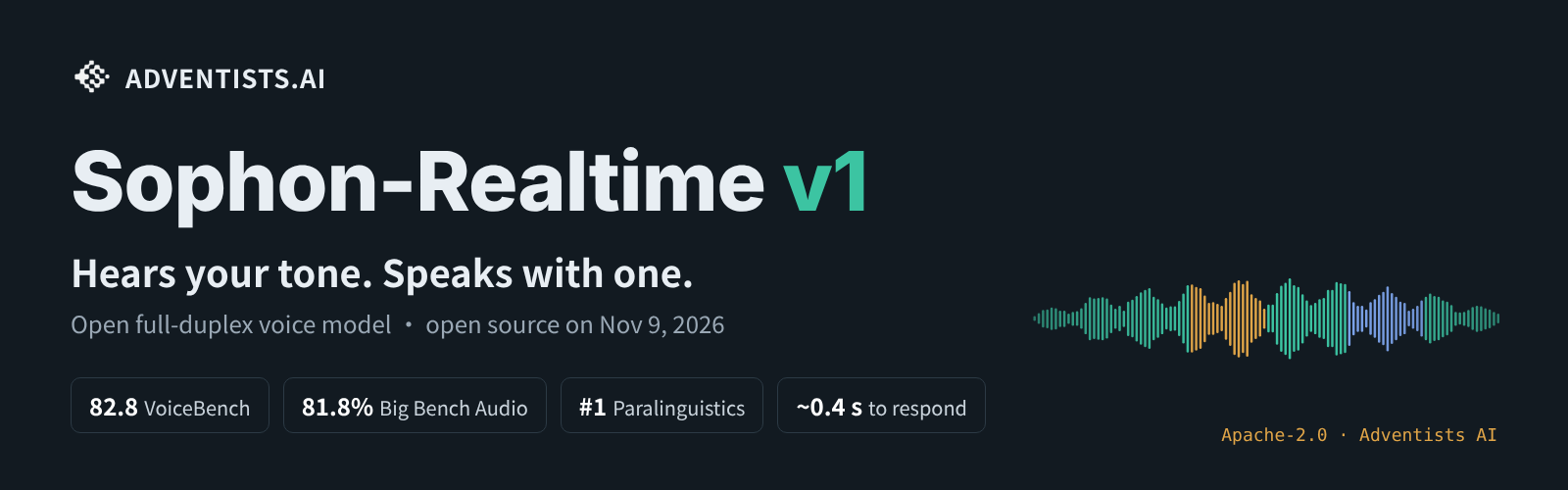
On November 8, Adventists AI released the Sophon-Realtime v1 family of full-duplex voice models on GitHub, Hugging Face, ModelScope and PyPI, with Apache 2.0 code and weights that allow commercial use. All three builds share one 32B brain, adapted from Qwen3-VL-32B-Instruct, that listens continuously, decides turns and writes the reply; they differ only in how the reply becomes sound. The recommended Tag build is the most expressive, Flash reaches first audio in 0.31 s with up to 40 concurrent users per GPU, and E2E is a research preview that needs two 80 GB GPUs. Vendor-reported scores are VoiceBench 82.8 and Big Bench Audio 81.8%, first among open full-duplex models; all benchmarks are self-run by the team.

Adventists AI Open-Sources Sophon-Realtime v1 Full-Duplex Voice Models: One 32B Brain, Three Voice Builds, VoiceBench 82.8 Level With GPT-4o-mini-Audio, Runs on One 80 GB GPU, Apache 2.0

Key Takeaways

  • Scores (vendor-reported, self-run; see the GitHub README): VoiceBench 82.8 and Big Bench Audio 81.8%, first among open full-duplex models and level with GPT-4o-mini-Audio on VoiceBench
  • Tone understanding: paralinguistic score 48.6, ahead of Gemini 3.8 Flash (46.9) and Qwen3-Omni (44.6); Full-Duplex-Bench v3 tool calling Pass@1 48% versus 43% for Grok
  • Three builds: Tag about 0.6 s to first audio and 16 users per GPU; Flash 0.31 s and 40 users per GPU; E2E about 1 s on two 80 GB GPUs (measured on one H100, vendor-reported)
  • Quick start: pip install sophon-realtime then sophon-realtime serve downloads the ~42 GB Tag weights on first run and serves an OpenAI Realtime-style WebSocket on port 8000 (see PyPI)
  • License and bases: Apache 2.0 code and weights; the Tag thinker derives from Qwen3-VL-32B-Instruct quantized to FP8, and the voice derives from Fun-CosyVoice3-0.5B (see Hugging Face)
Read full story
Linked Models & Agents:
⚡ Sophon-Realtime-32B-Tag⚡ Sophon-Realtime-32B-Flash⚡ Sophon-Realtime-32B-E2E⚡ Qwen3-VL-32B-Instruct⚡ GPT-4o-mini-Audio🌐 Adventists AI
ADSponsored

Boson AI Unveils Higgs Realtime Duplex: A 45B MoE Full-Duplex Omni Model That Listens, Watches, Talks, and Calls Tools in the Background; API Waitlist Open

On 2026-11-05 Boson AI (the team of Mu Li and Alex Smola) released a research preview of Higgs Realtime Duplex: a 45B MoE front model that slices voice, video, and tool results into 160 ms chunks so it can listen, watch, speak, and render its own face at once, while thinking, calling tools, or delegating hard questions to a larger backend model without pausing. Vendor-reported scores include Big Bench Audio 98.9, tau-Voice 69.8, and Full-Duplex-Bench v1.5 75.5. The API is waitlist-only for now; the earlier Higgs Realtime is available today.

Boson AI Unveils Higgs Realtime Duplex: A 45B MoE Full-Duplex Omni Model That Listens, Watches, Talks, and Calls Tools in the Background; API Waitlist Open

Key Takeaways

  • Shape: a 45B MoE front model, further trained on about 2T tokens of text, audio, and video; every stream is cut into 160 ms chunks, silence included
  • Background work: it thinks and calls tools asynchronously while talking, and delegates hard tasks with full context to a larger backend model (a frontier model is recommended)
  • Vendor-reported scores: Big Bench Audio 98.9 (top of the table), IFEval 94.1, tau-Voice 69.8 (GPT-Live-1 about 74.5), Full-Duplex-Bench v1.5 75.5 (GPT-Live-1 80.1, TML 77.8)
  • Cost design: audio and video use about 2.6K tokens per minute, about 2.6K-5K with thinking and tools; the target is an hour of talk costing at most one-tenth of an hour of human time
  • Availability: the Duplex API is waitlist-only; voice and face swap zero-shot from a reference clip or a single image
Read full story
Linked Models & Agents:
⚡ Higgs Realtime Duplex⚡ Higgs Realtime⚡ GPT-Live-1⚡ TML Interaction Small🌐 Boson AI

Block unveils Dessa: a full-duplex speech model trained from scratch only on human conversation audio, running locally on a MacBook Pro M4 Max

On 2026-10-23 (16:53 UTC) the official @blocks account unveiled Dessa, and Jack Dorsey called it the most authentic full-duplex speech model ever built. The official page block.xyz/dessa says Dessa is a true speech-to-speech model trained only on recordings of human conversation, with no text and no pretrained models. It is full-duplex, so it listens and talks at the same time, cuts in and backchannels naturally, runs faster than real time, and runs locally on a MacBook Pro M4 Max or better. Block says it was trained on a single NVIDIA GB200 NVL72 and learned language from hundreds of times fewer words than LLMs. There is no public API or weights yet; a small group of AI safety researchers is getting early access.

Block unveils Dessa: a full-duplex speech model trained from scratch only on human conversation audio, running locally on a MacBook Pro M4 Max

Key Takeaways

  • Trained only on human conversation audio, from scratch, with no text and no pretrained models (official page)
  • Full-duplex speech-to-speech: listens while talking, cuts in and backchannels, and natively hears and expresses emotion, sarcasm and laughter
  • Inference runs faster than real time and runs locally on a MacBook Pro M4 Max or better
  • Block says training used a single NVIDIA GB200 NVL72 and needed hundreds of times fewer words than LLMs
  • No public API, weights or third-party benchmarks yet; early access is limited to a small group of AI safety researchers
Read full story
Linked Models & Agents:
⚡ Dessa🌐 Block

OpenAI ships GPT-Live-1.1 and GPT-Live-1.1 Quip as the new voice models in ChatGPT, Codex and dots; API coming soon

On Oct 15 OpenAI rolled out GPT-Live-1.1 (successor to GPT-Live-1) and GPT-Live-1.1 Quip (successor to GPT-Live-1 mini), full-duplex voice models that become the default voice for Plus-and-up users in ChatGPT Voice, Codex and dots. New voices cover French, German, Hindi, Japanese, Korean and Mexican Spanish, accents are more natural and the constant 'checking...' filler is reduced. Rolling out to all users; API coming soon. The system card reports statistically significant regressions in four synthetic safety categories.

OpenAI ships GPT-Live-1.1 and GPT-Live-1.1 Quip as the new voice models in ChatGPT, Codex and dots; API coming soon

Key Takeaways

  • Two tiers: GPT-Live-1.1 replaces GPT-Live-1 and GPT-Live-1.1 Quip replaces GPT-Live-1 mini; 1.1 is default for Plus+ including Codex and dots, Quip for everyone else
  • New Live voices in 6 languages (French, German, Hindi, Japanese, Korean, Mexican Spanish) plus Bubbie in English; fewer repetitive 'checking...' fillers while searching
  • Full-duplex: listens and speaks continuously, handling pauses, interruptions and pace changes; the system card describes GPT-Live as a two-model system that delegates hard work to thinking models
  • System card: parity on production voice evals; statistically significant regressions on sexual, mental health, emotional reliance and gore synthetic evals vs GPT-Live-1
  • Rolling out to all users today; API 'coming soon' with no published price, model ID, latency or WER figures yet
Read full story
Linked Models & Agents:
⚡ GPT-Live-1.1⚡ GPT-Live-1.1 Quip⚡ GPT-Live-1🤖 Codex🤖 ChatGPT dots🌐 OpenAI

LLMs are General Asynchronous Agents: Non-Blocking Coroutine Runtimes Enable Concurrent Execution on Qwen 3.x Without Retraining

Mainstream LLM agents strictly follow sequential interaction loops: read, think, reply, call tools, and block until completion. Real-world applications—including full-duplex voice assistants, robotic manipulation, and continuous infrastructure monitoring—are inherently asynchronous, receiving incoming observations while the agent is actively deliberating or waiting on tool I/O. Researchers introduce a general asynchronous LLM framework that abstracts model inference into non-blocking coroutines with overlapping memory states. Without requiring task-specific fine-tuning or architectural alterations, foundation models like Qwen 3.x exhibit native asynchronous competency, effortlessly handling live video feeds, real-time gaming, and continuous systems monitoring.

LLMs are General Asynchronous Agents: Non-Blocking Coroutine Runtimes Enable Concurrent Execution on Qwen 3.x Without Retraining

Key Takeaways

  • Transition from Sequential Blocking to Asynchronous Coroutines: Establishes an inference runtime treating LLM reasoning as concurrent coroutines with overlapping memory states, breaking sequential execution limits.
  • Zero-Finetuning Asynchronous Competency: Empirical evaluations demonstrate that off-the-shelf Qwen 3.x models natively handle concurrent state synchronization and interrupts without bespoke fine-tuning.
  • Versatile Streaming & Real-Time Performance: Proves robust non-blocking adaptability across live video analysis, real-time game control, and concurrent infrastructure monitoring.
Read full story

Artificial Analysis: GPT-Live-1 (Astra) tops Speech to Speech Index at 81.5

Artificial Analysis (@ArtificialAnlys) published its Speech to Speech Index: OpenAI GPT-Live-1 with Astra (medium) as the delegated backend debuts at #1 with 81.5, while Sol (low) scores 80.1 at #3, with Grok Voice Think Fast 2.0 High between them at 81.3. GPT-Live-1 is a full-duplex speech model that can delegate reasoning and tool use to a backend text model mid-conversation. The same drop covers Speech Agent Arena, Tau Voice, Big Bench Audio, plus cost and time-to-first-audio.

Key Takeaways

  • GPT-Live-1 (Astra medium) leads Speech to Speech Index at 81.5; Sol low is #3 at 80.1.
  • On Tau Voice, Astra medium (67.9%) and Sol low (59.3%) take the top two agentic spots.
  • Cost is about $5.83/$4.47 per hour of input audio incl. backend; TTFA about 1.34s/1.24s vs Grok Voice 0.70s.
Read full story
Linked Models & Agents:

OpenAI: GPT-Live-1 live in the API—full-duplex voice agents that listen while speaking

OpenAI Developers said GPT-Live-1 is available in the API: bring ChatGPT’s natural back-and-forth into your app with voice agents that listen while they speak, using the models and harness you choose. OpenAI’s Tibo also noted builders can use the same full-duplex voice stack shipped to ~1B ChatGPT users, with solid tool calling.

Key Takeaways

  • GPT-Live-1 is live in the OpenAI API for full-duplex voice agents.
  • Agents can listen while speaking and pick model + harness.
  • Same voice stack as ChatGPT; strong fit for tool-calling voice apps.
Read full story
Linked Models & Agents:
⚡ GPT Live 1🌐 OpenAI
ADSponsored