AI Coding Live News

Flower Labs Releases Endeavor 1.1: Multimodal, EU-Only Inference and Private Deployment With Readable Thinking Traces, Claims Parity With OpenAI and Anthropic

Flower Labs, the company behind the Flower federated learning framework, released Endeavor 1.1 on November 3, its third model this year after the UK sovereign 7B model Lizzy in April and Endeavor 1.0 in September. The update adds image input, an optional EU-only GPU inference tier, and Flower-managed, private-cloud or on-premises deployment, and promises readable thinking traces plus ownership of outputs that customers may use to train their own models. Vendor-reported scores are GPQA 94.4, HumanEval 99.9, AIME 2026 99.9 and MMMU-Pro 81.1, but the comparison uses GPT-5.6 Sol and Claude Fable 5 rather than either lab's newest models, and access is request-only for now.
Flower Labs Releases Endeavor 1.1: Multimodal, EU-Only Inference and Private Deployment With Readable Thinking Traces, Claims Parity With OpenAI and Anthropic

Key Takeaways

  • Vendor-reported: GPQA rose from 92.0 in 1.0 to 94.4 (about 30% fewer errors), HumanEval from 98.2 to 99.9; IFEval is 94.5 and MMMU-Pro 81.1.
  • In the vendor table, GPT-5.6 Sol scores GPQA 94.1, IFEval 95.9 and MMMU-Pro 83.0, and Claude Fable 5 scores GPQA 92.6; Endeavor does not lead on IFEval or MMMU-Pro.
  • New EU-only GPU inference with SLAs, with UK, Middle East, Asia and Africa regions planned.
  • The pitch is control: raw thinking traces, ownership of outputs and traces, and the right to fine-tune or train your own models on them.
  • Flower says the model builds on mature open-weight models via continual pre-training, targeted post-training and model integration, without naming the base or parameter count; access is request-only.
Read full story
Linked Models & Agents:
⚡ Endeavor 1.1⚡ Endeavor 1.0⚡ GPT-5.6 Sol⚡ Claude Fable 5⚡ Kimi K3⚡ Nemotron 3 Ultra🌐 Flower Labs

OpenAI Daybreak Red (GPT-5.6 Cyber) arrives on Amazon Bedrock in AWS GovCloud (US-East) for vetted defenders, at $16.875 input and $101.25 output per 1M tokens

On Oct 30, AWS announced that Daybreak Red (GPT-5.6 Cyber, model ID openai.gpt-5.6-cyber), the OpenAI security model built for vulnerability research, is now on Amazon Bedrock in AWS GovCloud (US-East), after previously being offered only in US East (Ohio). Access still requires passing OpenAI Daybreak eligibility. GovCloud short-context pricing is $16.875 input and $101.25 output per 1M tokens, about 23% above Ohio at $13.75 and $82.50.

Key Takeaways

  • Regions: Daybreak Red can now be called In-Region in us-east-2 (Ohio) and us-gov-east-1 (GovCloud US-East); Geo and Global cross-Region inference are not supported (AWS announcement)
  • Eligibility: customers must first enroll in OpenAI Daybreak / Trusted Access for Cyber, then have their AWS account team enable access
  • Pricing: GovCloud short context (272K input tokens or fewer) is $16.875 input, $21.09375 for 30-minute cache writes, $1.6875 cache reads and $101.25 output per 1M tokens
  • Data: AWS says inference data is not used for training and Daybreak Red data does not need to be shared with OpenAI; it runs on an inference engine with zero-operator access enforced at the chip
  • API: served through the bedrock-mantle endpoint with OpenAI Responses and Chat Completions, and a 1,050,000-token context window
Read full story

OpenAI launches GPT-6.1 Terra: fast, low-cost computer use at $1/$5 per million tokens, half the price of GPT-5.6 Terra and GPT-6.1 Sol

On Oct 26 OpenAI released GPT-6.1 Terra, an efficient model for visual reasoning, precise computer use and natural writing. It is rolling out today to Plus, Pro, Enterprise and Edu users in ChatGPT Work and Codex, and in the API as gpt-6.1-terra. Standard API pricing is $1 input, $0.05 cached input and $5 output per million tokens, which OpenAI says is 50% lower than GPT-5.6 Terra and GPT-6.1 Sol, with a 1,050,000-token context window. By OpenAI's figures it scores 15 points higher than GPT-5.6 Terra on Agents' Last Exam at medium effort for about a third of the cost, and solves 50.3% of Terminal-Bench 4.0 at max effort.

OpenAI launches GPT-6.1 Terra: fast, low-cost computer use at $1/$5 per million tokens, half the price of GPT-5.6 Terra and GPT-6.1 Sol

Key Takeaways

  • Pricing (official docs): $1 input, $0.05 cached input, $1.25 for 30-minute cache writes and $5 output per million tokens; requests over 272K input tokens are billed at 2x input and 1.5x output; Batch/Flex are half price and Fast mode is 2x
  • Specs: 1,050,000-token context, 922,000 max input and 128,000 max output tokens, Jun 1 2026 knowledge cutoff; reasoning.effort from none to max, and tool calling requires the Responses API
  • Computer use (OpenAI figures): on Agents' Last Exam at medium effort it beats GPT-5.6 Terra by 15 points at about one-third the cost, and matches GPT-6 Astra at one-tenth the price per token; it finishes tasks over 3x faster than GPT-6 Astra and GPT-6.1 Sol
  • Coding and factuality (OpenAI figures): 50.3% on Terminal-Bench 4.0 at max effort, more than double GPT-5.6 Terra's published 21.5%; error rate on an internal error-inducing prompt set fell from 53.6% to 16.7% at low effort
  • Safety: OpenAI says it meets the Critical cybersecurity threshold under its Preparedness Framework and keeps the safeguards built for GPT-6 Astra
Read full story

OpenAI Discloses PHP Zero-Day Critical Flaws Found via GPT-5.6 Sol, Open-Sources Scanner and Pledges $1B Defense Fund

OpenAI announced a critical coordinated vulnerability disclosure in the core PHP runtime discovered by cybersecurity firm Calif utilizing GPT-5.6 Sol, alongside independent verification by Wiz. Because PHP powers roughly 70% of all websites globally, the vulnerability represented an existential risk to internet infrastructure. Following coordinated patching, OpenAI committed $1B in subsidized Daybreak security access and open-sourced openai/php2shell-checker, an automated Codex inspection tool enabling site administrators worldwide to audit their deployments.

OpenAI Discloses PHP Zero-Day Critical Flaws Found via GPT-5.6 Sol, Open-Sources Scanner and Pledges $1B Defense Fund

Key Takeaways

  • Cybersecurity firm Calif used GPT-5.6 Sol to identify critical remote code execution (RCE) vulnerabilities in the core PHP interpreter
  • PHP powers an estimated 70% of active web properties globally; patches have been coordinated and safely distributed
  • OpenAI commits $1 billion in subsidized Daybreak program access to support security research across foundational open-source projects
  • Open-sources openai/php2shell-checker on GitHub, providing an automated Codex-powered scanner for site vulnerability assessments
Read full story
ADSponsored

OpenAI Patch the Planet: GPT-5.6 Sol helped find two critical PHP RCE flaws, fixed in PHP 8.5.12, 8.4.27, 8.3.36 and 8.2.35

On Oct 21, PHP published a security advisory fixing two critical unauthenticated remote code execution flaws (CVE-2026-109618, CVE-2026-109619) affecting every PHP install serving web requests, with mod_php at highest risk. OpenAI disclosed the same day that Calif found a flaw using GPT-5.6 Sol under its Patch the Planet initiative, with Wiz independently finding and reporting both; OpenAI coordinated a two-month disclosure and committed $1B in subsidized Daybreak access for under-resourced defenders.

OpenAI Patch the Planet: GPT-5.6 Sol helped find two critical PHP RCE flaws, fixed in PHP 8.5.12, 8.4.27, 8.3.36 and 8.2.35

Key Takeaways

  • Flaws: CVE-2026-109618 (memory corruption via OOM handling) and CVE-2026-109619 (stale global state across requests), both unauthenticated RCE (PHP official)
  • Fix: upgrade to PHP 8.5.12, 8.4.27, 8.3.36 or 8.2.35; PHP says there are no complete mitigations and updating is the only safe choice
  • Scope: PHP-FPM, Apache mod_php, php-cgi, FrankenPHP and LiteSpeed are affected, with a demonstrated exploit on mod_php
  • AI role: Calif found a flaw with GPT-5.6 Sol, Wiz reported both independently; OpenAI coordinated a ~2-month disclosure (vendor account)
  • Investment: OpenAI committed $1B in subsidized Daybreak access and will ship a Codex skill to check PHP versions
Read full story

OpenAI API adds 12-hour prompt caching: GPT-5.6+ models can keep shared context cached for half a day, with writes at 2.5x input and reads still at 0.1x

On Oct 20 OpenAI added 12-hour prompt caching to the Responses API: GPT-5.6 and later models can set prompt_cache_options.ttl to "12h" so instructions, tool definitions and reference material stay billed at the cached rate even when requests are hours apart. 12-hour writes cost 2.5x the ordinary input price versus 1.25x for the default 30 minutes; read rates are unchanged at 0.1x on most models and 0.05x on GPT-6.1 Sol. One request can mix 12-hour and 30-minute breakpoints.

Key Takeaways

  • New option: prompt_cache_options.ttl in the Responses API accepts "30m" (default) or "12h", and prompt_cache_breakpoint.ttl overrides it per breakpoint, for GPT-5.6 and later models
  • Rates (vendor-stated): 30-minute writes at 1.25x and 12-hour writes at 2.5x ordinary input; reads at 0.1x on most models and 0.05x on GPT-6.1 Sol, same for both lifetimes
  • Our estimate from the documented rates: reusing one prefix 6 times an hour apart costs about 6x1.25=7.5x input with 30-minute caching (rewritten each time) versus about 2.5+5x0.1=3.0x with 12-hour caching
  • Up to 4 cache writes per request and a 1,024 visible-token minimum prefix; usage now splits writes into ttl_30m_tokens and ttl_12h_tokens
  • "12h" is a minimum lifetime, not a deletion deadline, and does not guarantee a hit or lower latency; GPT-5.5 and earlier keep using prompt_cache_retention
Read full story
Linked Models & Agents:

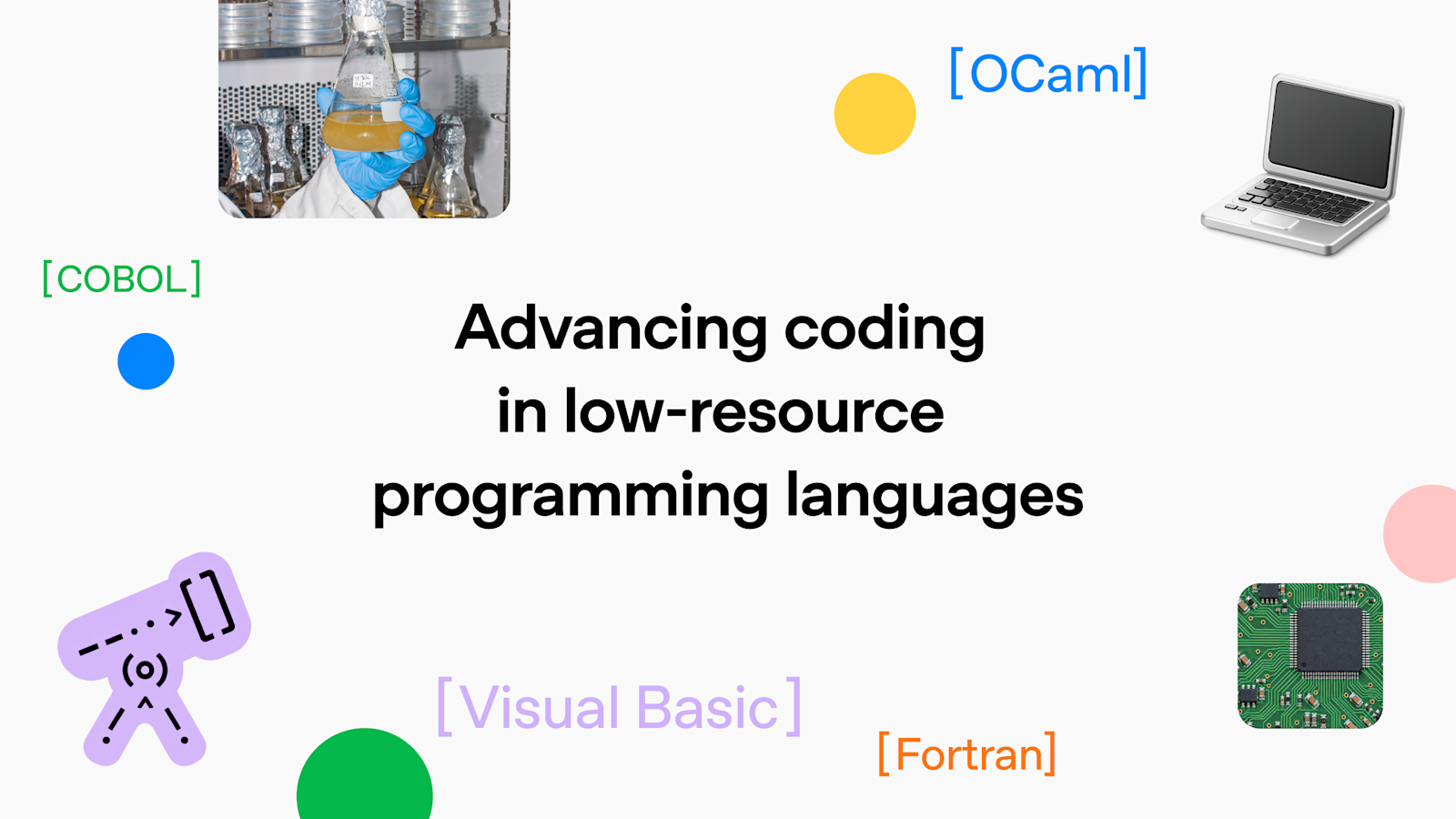
OpenAI open-sources MultiLangBench and reports low-resource language gains: GPT-6 Astra averages 87.4% building SQLite across 20 languages, GPT-6.1 Sol reaches up to 97.9% on COBOL migration

On October 19 OpenAI said its latest models are much better at low-resource languages such as COBOL, Fortran, Visual Basic and OCaml, and open-sourced MultiLangBench, which asks a model to build a SQLite-compatible database engine from scratch in each of 20 languages. GPT-6 Astra averages an 87.4% test pass rate (GPT-5.6 Sol: 26.8%), above 83% in 19 of 20 languages, with COBOL hardest at 72.1%. On a separate COBOL migration eval requiring byte-for-byte output parity after porting to C++, Java, Kotlin, Python or Rust, GPT-6.1 Sol scores 86.6% at low effort (GPT-5.6 Sol: 5.4%) and 97.9% at higher effort. All figures are OpenAI's own.

OpenAI open-sources MultiLangBench and reports low-resource language gains: GPT-6 Astra averages 87.4% building SQLite across 20 languages, GPT-6.1 Sol reaches up to 97.9% on COBOL migration

Key Takeaways

  • MultiLangBench: GPT-6 Astra (max) averages 87.4% across 20 languages vs 26.8% for GPT-5.6 Sol, above 83% in 19 of them (OpenAI-reported).
  • Per language: COBOL 10.9% to 72.1%, OCaml 25.6% to 85.8%, Fortran 21.4% to 83.5%, Visual Basic 27.5% to 89.4%.
  • Budget tier: GPT-6 Luna averages 40.3% at about $0.77 per sample vs $3.48 for GPT-5.6 Sol, roughly 78% cheaper.
  • COBOL migration: GPT-6.1 Sol scores 86.6% at low effort (GPT-5.6 Sol 5.4%) at about 61% of the API cost; 97.9% at higher effort, near saturation.
  • The eval setup, test suite and per-language results are on GitHub openai/multilangbench; the COBOL migration eval is not public.
Read full story

USC, UCLA, and CMU Release Grid-Bench for Multi-Step Spatial Reasoning: 8,928 Executable Instances Reveal Severe State Drift Across 64-Step Trajectories

Can LLMs reliably maintain spatial state representations across sequential operations? USC, UCLA, and CMU introduced Grid-Bench (arXiv:2610.22312, GitHub: grid-bench/Grid-Bench), an executable benchmark with 8,928 instances testing 2D/3D/4D grid state transitions across history lengths up to T=64. Evaluations across 6 frontier models show steep degradation: while GPT-5.6 Sol and Claude 5 Sonnet retain strong cell accuracy, open-weight and mid-tier models collapse to near-zero exact world reconstruction over long trajectories.

USC, UCLA, and CMU Release Grid-Bench for Multi-Step Spatial Reasoning: 8,928 Executable Instances Reveal Severe State Drift Across 64-Step Trajectories

Key Takeaways

  • USC, UCLA, and CMU introduced Grid-Bench (arXiv:2610.22312), an executable spatial tracking benchmark across 2D, 3D, and 4D discrete manifolds
  • Evaluates 8,928 instances across 8 spatial transformation rule families and trajectory lengths up to T=64 steps
  • At intermediate length T=16, GPT-5.6 Sol (98.0% cell accuracy) and Claude 5 Sonnet (96.8%) lead while mid-tier models drop sharply
  • At extreme length T=64, exact world recovery drops to 0 for GLM-5 and Kimi K2.5, demonstrating that long-horizon agents must rely on external state engines
Read full story
Linked Models & Agents:

SemiAnalysis Breaks Down 1.3B Tokens/$ AgentX Record: vLLM + Inferact Disaggregated Serving Beats Aggregated B300 by 4x, While Cline Highlights Multi-Harness RL

SemiAnalysis published the architectural breakdown behind the 1.3B tokens per dollar TCO record on AgentX: vLLM and Inferact utilized Prefill/Decode disaggregated serving at hyperscaler volume pricing to achieve 4x better cost-efficiency than an aggregated NVIDIA B300 configuration. Concurrently, open-source coding agent Cline reported that DeepSeek-V4.1-Flash-1017 beats GPT-5.6-Sol on Terminal-Bench at ~17x lower cost (+35% over prior V4.1-Flash) purely by scaling RL training across multiple coding agent harnesses.

SemiAnalysis Breaks Down 1.3B Tokens/$ AgentX Record: vLLM + Inferact Disaggregated Serving Beats Aggregated B300 by 4x, While Cline Highlights Multi-Harness RL

Key Takeaways

  • SemiAnalysis confirms vLLM and Inferact achieve 1.3B tokens per dollar TCO on AgentX via disaggregated serving—4x better than an aggregated NVIDIA B300 configuration
  • Cline reports that DeepSeek-V4.1-Flash-1017 improves prior V4.1-Flash Terminal-Bench performance by 35%, beating GPT-5.6-Sol at ~17x lower cost
  • The 35% agentic coding leap was achieved without base algorithmic changes by scaling reinforcement learning directly across multiple coding agent harnesses
Read full story
Linked Models & Agents:

Humans Score 100% While GPT-5.6-Sol Hits Only 17%: RoTA-Bench Exposes 3D Interactive Control Gaps, and OpenSAE Pairwise Steering Lifts Fidelity to 0.779

Two top-trending Hugging Face papers dissect the limits of VLM 3D interactive reasoning and LLM mechanistic interpretability: Xiamen University's RoTA-Bench (arXiv:2610.17665, 200 upvotes) evaluates closed-loop 3D-to-2D projection alignment across 674 tasks, finding that humans achieve 100% success while GPT-5.6-Sol reaches only 17%. Meanwhile, UW-Madison's OpenSAE study (arXiv:2610.21261, 104 upvotes) introduces SAE Additivity Residuals (SAR) across 18 model/behavior settings, showing that modeling pairwise feature interactions boosts multi-feature steering rank fidelity from 0.5874 to 0.7790 and cuts ordering error from 0.1444 to 0.0606.

Humans Score 100% While GPT-5.6-Sol Hits Only 17%: RoTA-Bench Exposes 3D Interactive Control Gaps, and OpenSAE Pairwise Steering Lifts Fidelity to 0.779

Key Takeaways

  • On RoTA-Bench's 3D-to-2D interactive projection alignment tasks, human participants achieve a 100% success rate whereas GPT-5.6-Sol succeeds on only 17%, worsening 3D pose while improving 2D overlap 19.4% of the time
  • Removing interaction history causes 96.8% of VLM rotation actions to degenerate into coarse 30-degree steps, underscoring the necessity of multi-turn visual feedback
  • UW-Madison's OpenSAE framework introduces SAE Additivity Residuals (SAR) across 18 settings, showing pairwise feature interaction modeling raises multi-feature steering rank fidelity from 0.5874 to 0.7790 and cuts ordering error from 0.1444 to 0.0606
Read full story
Linked Models & Agents:
ADSponsored

PreciseCoder: Augmenting Unit-Test RL with Localized Semantic Rewards Cuts Code Edits from 7–15 Lines to 3 and Boosts GPT-5.6 Sol Precision

While reinforcement learning from unit tests raises code pass rates, researchers discover it inadvertently teaches models to over-edit and hallucinate bugs in already-correct code. PreciseCoder augments unit-test rewards with a semantically verified localized edit signal. Across 4B, 9B, and 27B models, PreciseCoder slashes average edit lines from 7–15 down to 3 at equal pass rates, generalizes from single-line training to repository-level repair, and transfers 9B reasoning traces to boost GPT-5.6 Sol and Qwen3.8-Max edit precision by 4.6–12.4 points without retraining.

PreciseCoder: Augmenting Unit-Test RL with Localized Semantic Rewards Cuts Code Edits from 7–15 Lines to 3 and Boosts GPT-5.6 Sol Precision

Key Takeaways

  • Exposes unit-test RL side effects: shows unit-test-only rewards teach coding models to over-edit and hallucinate bugs in working code
  • Slashes edit footprint from 7–15 lines to 3: augments unit tests with semantically verified localized edit rewards across 4B, 9B, and 27B models
  • Weak-to-strong trace transfer: conditioning GPT-5.6 Sol and Qwen3.8-Max on 9B PreciseCoder reasoning traces boosts edit precision by 4.6–12.4 points zero-shot
Read full story
Linked Models & Agents:

MMPostTrainBench & MMResearch: Benchmarking Autonomous Agents in Multimodal Post-Training and Mitigating Capability Regressions

Autonomous research agents hold the promise of sustaining AI self-improvement by iteratively proposing hypotheses, tuning models, and refining post-training pipelines. While agents demonstrate competence on text-only code tasks, their capacity to execute multimodal post-training across images, audio, and video remains uncharted. Researchers introduce MMPostTrainBench (arXiv:2610.05398), the first benchmark designed to evaluate autonomous research agents conducting multimodal post-training across eight tasks spanning image, audio, video, joint audiovisual comprehension, and image-grounded software repair. Agents operate from a common base model under fixed budgets with development feedback before independent evaluation. The audit reveals sobering realities: across all tasks, 52.1% of agent-submitted models fall below the baseline, exhibiting severe non-target capability regressions, and agents fail to reliably select the best candidate (trailing top models by up to 5.38 percentage points). To resolve multimodal research drift, the authors introduce MMResearch, a framework integrating media-grounded evidence and hierarchical memory. Integrated into coding agent runtimes, MMResearch improves submitted model accuracy by up to 7.75 percentage points for Claude Code (Claude Opus 4.8) and 2.33 points for Codex (GPT-5.6).

Key Takeaways

  • MMPostTrainBench benchmarks autonomous research agents conducting multimodal post-training across eight core tasks
  • Reveals that 52.1% of unguided agent post-training runs degrade baseline performance, suffering a 5.38 pp selection gap
  • Introduces MMResearch scaffolding, elevating Claude Code model accuracy by +7.75 pp and slashing regressions by 64%
Read full story
Linked Models & Agents:

OpenAI API shuts down 12 legacy models on Oct 23: o4-mini, o3-mini, gpt-4o-2024-05-13 and gpt-image-1 included, 12 days left to migrate

Per OpenAI's official Deprecations page, a batch of legacy snapshots deprecated on Apr 22 stops serving in the API on Oct 23, 2026: 12 snapshots and their aliases including gpt-3.5-turbo-0125, gpt-4-0613, gpt-4-turbo, gpt-4.1-nano, gpt-4o-2024-05-13, gpt-image-1, o1, o1-pro, o3-mini and o4-mini, plus five fine-tuned model families. Official substitutes are gpt-5.6-sol/terra/luna and gpt-image-2.5. The #keep4o campaign to preserve GPT-4o snapshots resurfaced on X today.

Key Takeaways

  • 12 snapshots plus aliases go dark together: o4-mini, o3-mini, o1, o1-pro, gpt-4-turbo, gpt-4, gpt-3.5-turbo aliases stop resolving (OpenAI Deprecations)
  • Shutdown date Oct 23, 2026 — 12 days away; announced Apr 22, meeting OpenAI's 6-month minimum for GA models
  • Substitutes: o4-mini / gpt-3.5 → gpt-5.6-terra; gpt-4 family / o1 / o3-mini / gpt-4o-2024-05-13 → gpt-5.6-sol; o1-pro → gpt-5.6-sol with reasoning.mode: pro; gpt-4.1-nano → gpt-5.6-luna
  • gpt-image-1 → gpt-image-2.5-sunburst or -flare; five fine-tuned families (ft-gpt-4, ft-gpt-3.5-turbo, ft-o4-mini, etc.) also shut down and must be retrained on new bases
  • Next wave: Dec 1 (gpt-image-1.5 / 1-mini) and Dec 11 (first-gen gpt-5 snapshots, o3, o3-pro)
Read full story
Linked Models & Agents:

Pine Computer launches a cloud computer built for AI agents: event-driven perception instead of screenshot polling; GPT-5.6 Luna hits 78.3% SaaS-Bench v1.1 checkpoint score vs 74.3% for Opus 5 + Claude Code at ~$1.02 model cost per task

On Oct 9 Pine AI released Pine Computer in private beta: cloud virtual computers plus a harness and runtime built for AI, driven by an API across browser, files and shell. Instead of repeated screenshots, the OS, browser and apps push change notifications to the model ("epoll for AI perception"). On SaaS-Bench v1.1 (106 tasks, 23 apps) GPT-5.6 Luna on Pine scored 78.3% on checkpoints vs 74.3% for Opus 5 + Claude Code, though its fully-resolved rate (27.4%) trails the latter (31.1%).

Pine Computer launches a cloud computer built for AI agents: event-driven perception instead of screenshot polling; GPT-5.6 Luna hits 78.3% SaaS-Bench v1.1 checkpoint score vs 74.3% for Opus 5 + Claude Code at ~$1.02 model cost per task

Key Takeaways

  • SaaS-Bench v1.1 checkpoint score: Pine + GPT-5.6 Luna 78.3% vs Opus 5 + Claude Code 74.3% vs GPT-5.6 Sol + Codex 71.1%
  • Fully resolved rate trails: 27.4% vs 31.1% (Claude Code) / 29.2% (Codex)
  • Model token cost per task: ~$1.02 vs $26.50 (Opus 5 + Claude Code) / $20.50 (GPT-5.6 Sol + Codex), excluding infrastructure
  • New computer boots in seconds, heavy state restores in ~15 s, paused ones resume in <1 s
  • Launch post: ~99.8K impressions, 250+ likes, 120 reposts; private beta waitlist only
Read full story

Theo open-sources tsc-rs: Opus 5.5 ported the TypeScript 7 compiler to Rust in two weeks for ~$24K, type-checking ~1.6x faster than the Go version

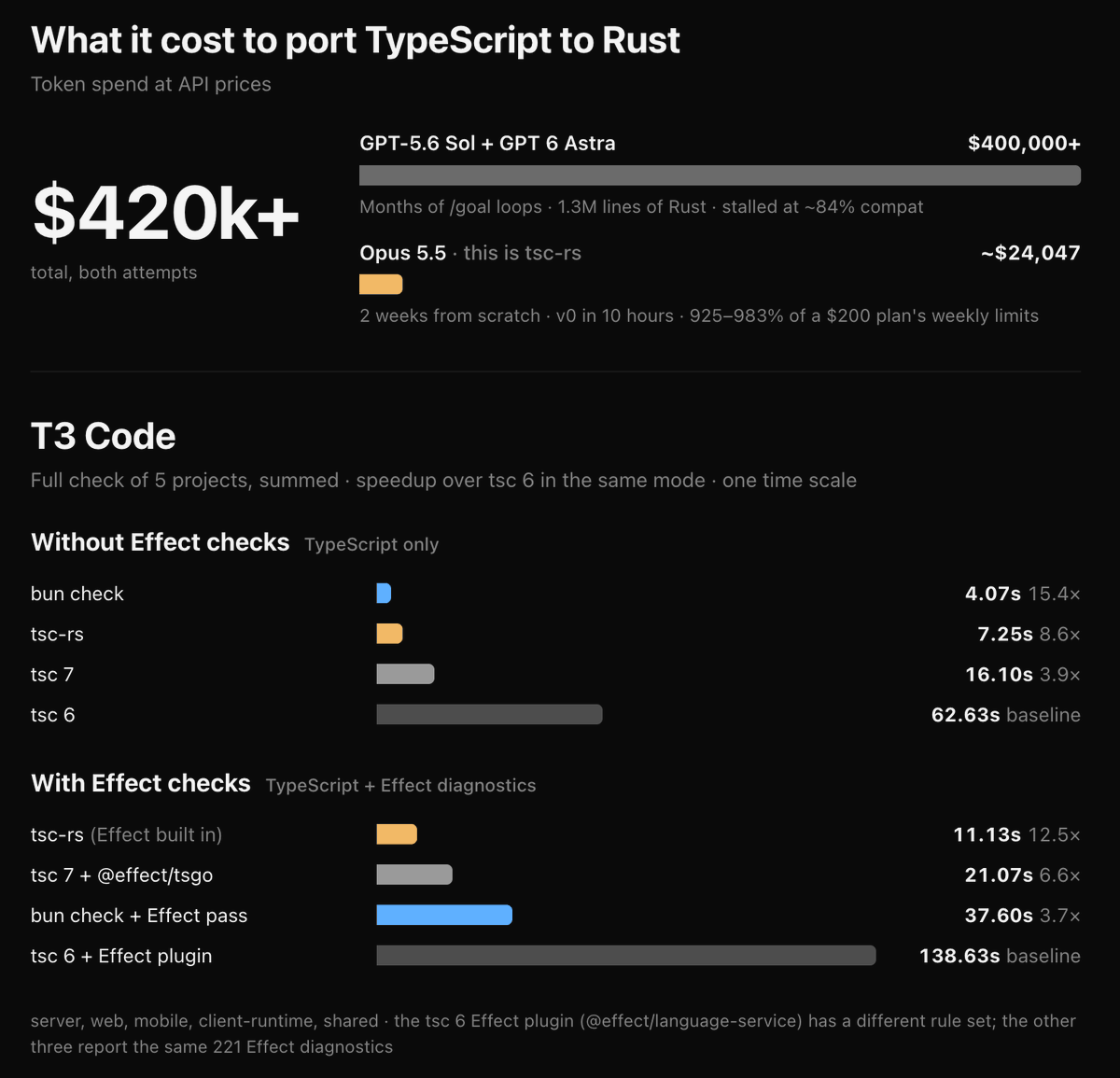
Theo (T3) open-sourced ts-rust (npm: tsc-rs), a Rust port of Microsoft's Go-native TypeScript compiler, checker and language server. Months of GPT-5.6 Sol / GPT 6 Astra runs cost over $400K in API-priced tokens and stalled near 84% compatibility; Claude Opus 5.5 restarted from scratch, reached a working v0 in 10 hours and finished in two weeks for about $24,047. All 181,711 ported Go tests pass, it type-checks 1.61x faster than tsc 7 (geometric mean over six open-source apps), ships Effect diagnostics built in and has a WASM build.

Theo open-sources tsc-rs: Opus 5.5 ported the TypeScript 7 compiler to Rust in two weeks for ~$24K, type-checking ~1.6x faster than the Go version

Key Takeaways

  • Cost: GPT-5.6 Sol / GPT 6 Astra burned $400K+ and stalled near 84% compat; Opus 5.5 finished in 2 weeks for ~$24,047 (README)
  • Correctness: all 181,711 ported Go tests pass; TanStack Query core and Hono diagnostics match Go exactly
  • Speed: geometric mean 11.4x over tsc 6 and 1.61x over tsc 7 on six apps; VS Code (3.75M lines) 4.20s vs 6.84s for tsc 7; bun check is still fastest (20.9x)
  • T3 Code: 7.25s vs 16.10s for tsc 7 without Effect (2.22x); 11.13s vs 21.07s with Effect diagnostics (1.89x)
  • Early release: Linux x64 and macOS arm64 only; known monorepo TS6059 and tsc -b stale-output issues
Read full story