AI Coding Live News

Flower Labs Releases Endeavor 1.1: Multimodal, EU-Only Inference and Private Deployment With Readable Thinking Traces, Claims Parity With OpenAI and Anthropic

Flower Labs, the company behind the Flower federated learning framework, released Endeavor 1.1 on November 3, its third model this year after the UK sovereign 7B model Lizzy in April and Endeavor 1.0 in September. The update adds image input, an optional EU-only GPU inference tier, and Flower-managed, private-cloud or on-premises deployment, and promises readable thinking traces plus ownership of outputs that customers may use to train their own models. Vendor-reported scores are GPQA 94.4, HumanEval 99.9, AIME 2026 99.9 and MMMU-Pro 81.1, but the comparison uses GPT-5.6 Sol and Claude Fable 5 rather than either lab's newest models, and access is request-only for now.
Flower Labs Releases Endeavor 1.1: Multimodal, EU-Only Inference and Private Deployment With Readable Thinking Traces, Claims Parity With OpenAI and Anthropic

Key Takeaways

  • Vendor-reported: GPQA rose from 92.0 in 1.0 to 94.4 (about 30% fewer errors), HumanEval from 98.2 to 99.9; IFEval is 94.5 and MMMU-Pro 81.1.
  • In the vendor table, GPT-5.6 Sol scores GPQA 94.1, IFEval 95.9 and MMMU-Pro 83.0, and Claude Fable 5 scores GPQA 92.6; Endeavor does not lead on IFEval or MMMU-Pro.
  • New EU-only GPU inference with SLAs, with UK, Middle East, Asia and Africa regions planned.
  • The pitch is control: raw thinking traces, ownership of outputs and traces, and the right to fine-tune or train your own models on them.
  • Flower says the model builds on mature open-weight models via continual pre-training, targeted post-training and model integration, without naming the base or parameter count; access is request-only.
Read full story
Linked Models & Agents:
⚡ Endeavor 1.1⚡ Endeavor 1.0⚡ GPT-5.6 Sol⚡ Claude Fable 5⚡ Kimi K3⚡ Nemotron 3 Ultra🌐 Flower Labs

OpenAI Discloses PHP Zero-Day Critical Flaws Found via GPT-5.6 Sol, Open-Sources Scanner and Pledges $1B Defense Fund

OpenAI announced a critical coordinated vulnerability disclosure in the core PHP runtime discovered by cybersecurity firm Calif utilizing GPT-5.6 Sol, alongside independent verification by Wiz. Because PHP powers roughly 70% of all websites globally, the vulnerability represented an existential risk to internet infrastructure. Following coordinated patching, OpenAI committed $1B in subsidized Daybreak security access and open-sourced openai/php2shell-checker, an automated Codex inspection tool enabling site administrators worldwide to audit their deployments.

OpenAI Discloses PHP Zero-Day Critical Flaws Found via GPT-5.6 Sol, Open-Sources Scanner and Pledges $1B Defense Fund

Key Takeaways

  • Cybersecurity firm Calif used GPT-5.6 Sol to identify critical remote code execution (RCE) vulnerabilities in the core PHP interpreter
  • PHP powers an estimated 70% of active web properties globally; patches have been coordinated and safely distributed
  • OpenAI commits $1 billion in subsidized Daybreak program access to support security research across foundational open-source projects
  • Open-sources openai/php2shell-checker on GitHub, providing an automated Codex-powered scanner for site vulnerability assessments
Read full story

OpenAI Patch the Planet: GPT-5.6 Sol helped find two critical PHP RCE flaws, fixed in PHP 8.5.12, 8.4.27, 8.3.36 and 8.2.35

On Oct 21, PHP published a security advisory fixing two critical unauthenticated remote code execution flaws (CVE-2026-109618, CVE-2026-109619) affecting every PHP install serving web requests, with mod_php at highest risk. OpenAI disclosed the same day that Calif found a flaw using GPT-5.6 Sol under its Patch the Planet initiative, with Wiz independently finding and reporting both; OpenAI coordinated a two-month disclosure and committed $1B in subsidized Daybreak access for under-resourced defenders.

OpenAI Patch the Planet: GPT-5.6 Sol helped find two critical PHP RCE flaws, fixed in PHP 8.5.12, 8.4.27, 8.3.36 and 8.2.35

Key Takeaways

  • Flaws: CVE-2026-109618 (memory corruption via OOM handling) and CVE-2026-109619 (stale global state across requests), both unauthenticated RCE (PHP official)
  • Fix: upgrade to PHP 8.5.12, 8.4.27, 8.3.36 or 8.2.35; PHP says there are no complete mitigations and updating is the only safe choice
  • Scope: PHP-FPM, Apache mod_php, php-cgi, FrankenPHP and LiteSpeed are affected, with a demonstrated exploit on mod_php
  • AI role: Calif found a flaw with GPT-5.6 Sol, Wiz reported both independently; OpenAI coordinated a ~2-month disclosure (vendor account)
  • Investment: OpenAI committed $1B in subsidized Daybreak access and will ship a Codex skill to check PHP versions
Read full story

OpenAI open-sources MultiLangBench and reports low-resource language gains: GPT-6 Astra averages 87.4% building SQLite across 20 languages, GPT-6.1 Sol reaches up to 97.9% on COBOL migration

On October 19 OpenAI said its latest models are much better at low-resource languages such as COBOL, Fortran, Visual Basic and OCaml, and open-sourced MultiLangBench, which asks a model to build a SQLite-compatible database engine from scratch in each of 20 languages. GPT-6 Astra averages an 87.4% test pass rate (GPT-5.6 Sol: 26.8%), above 83% in 19 of 20 languages, with COBOL hardest at 72.1%. On a separate COBOL migration eval requiring byte-for-byte output parity after porting to C++, Java, Kotlin, Python or Rust, GPT-6.1 Sol scores 86.6% at low effort (GPT-5.6 Sol: 5.4%) and 97.9% at higher effort. All figures are OpenAI's own.

OpenAI open-sources MultiLangBench and reports low-resource language gains: GPT-6 Astra averages 87.4% building SQLite across 20 languages, GPT-6.1 Sol reaches up to 97.9% on COBOL migration

Key Takeaways

  • MultiLangBench: GPT-6 Astra (max) averages 87.4% across 20 languages vs 26.8% for GPT-5.6 Sol, above 83% in 19 of them (OpenAI-reported).
  • Per language: COBOL 10.9% to 72.1%, OCaml 25.6% to 85.8%, Fortran 21.4% to 83.5%, Visual Basic 27.5% to 89.4%.
  • Budget tier: GPT-6 Luna averages 40.3% at about $0.77 per sample vs $3.48 for GPT-5.6 Sol, roughly 78% cheaper.
  • COBOL migration: GPT-6.1 Sol scores 86.6% at low effort (GPT-5.6 Sol 5.4%) at about 61% of the API cost; 97.9% at higher effort, near saturation.
  • The eval setup, test suite and per-language results are on GitHub openai/multilangbench; the COBOL migration eval is not public.
Read full story
ADSponsored

USC, UCLA, and CMU Release Grid-Bench for Multi-Step Spatial Reasoning: 8,928 Executable Instances Reveal Severe State Drift Across 64-Step Trajectories

Can LLMs reliably maintain spatial state representations across sequential operations? USC, UCLA, and CMU introduced Grid-Bench (arXiv:2610.22312, GitHub: grid-bench/Grid-Bench), an executable benchmark with 8,928 instances testing 2D/3D/4D grid state transitions across history lengths up to T=64. Evaluations across 6 frontier models show steep degradation: while GPT-5.6 Sol and Claude 5 Sonnet retain strong cell accuracy, open-weight and mid-tier models collapse to near-zero exact world reconstruction over long trajectories.

USC, UCLA, and CMU Release Grid-Bench for Multi-Step Spatial Reasoning: 8,928 Executable Instances Reveal Severe State Drift Across 64-Step Trajectories

Key Takeaways

  • USC, UCLA, and CMU introduced Grid-Bench (arXiv:2610.22312), an executable spatial tracking benchmark across 2D, 3D, and 4D discrete manifolds
  • Evaluates 8,928 instances across 8 spatial transformation rule families and trajectory lengths up to T=64 steps
  • At intermediate length T=16, GPT-5.6 Sol (98.0% cell accuracy) and Claude 5 Sonnet (96.8%) lead while mid-tier models drop sharply
  • At extreme length T=64, exact world recovery drops to 0 for GLM-5 and Kimi K2.5, demonstrating that long-horizon agents must rely on external state engines
Read full story
Linked Models & Agents:

PreciseCoder: Augmenting Unit-Test RL with Localized Semantic Rewards Cuts Code Edits from 7–15 Lines to 3 and Boosts GPT-5.6 Sol Precision

While reinforcement learning from unit tests raises code pass rates, researchers discover it inadvertently teaches models to over-edit and hallucinate bugs in already-correct code. PreciseCoder augments unit-test rewards with a semantically verified localized edit signal. Across 4B, 9B, and 27B models, PreciseCoder slashes average edit lines from 7–15 down to 3 at equal pass rates, generalizes from single-line training to repository-level repair, and transfers 9B reasoning traces to boost GPT-5.6 Sol and Qwen3.8-Max edit precision by 4.6–12.4 points without retraining.

PreciseCoder: Augmenting Unit-Test RL with Localized Semantic Rewards Cuts Code Edits from 7–15 Lines to 3 and Boosts GPT-5.6 Sol Precision

Key Takeaways

  • Exposes unit-test RL side effects: shows unit-test-only rewards teach coding models to over-edit and hallucinate bugs in working code
  • Slashes edit footprint from 7–15 lines to 3: augments unit tests with semantically verified localized edit rewards across 4B, 9B, and 27B models
  • Weak-to-strong trace transfer: conditioning GPT-5.6 Sol and Qwen3.8-Max on 9B PreciseCoder reasoning traces boosts edit precision by 4.6–12.4 points zero-shot
Read full story
Linked Models & Agents:

Theo open-sources tsc-rs: Opus 5.5 ported the TypeScript 7 compiler to Rust in two weeks for ~$24K, type-checking ~1.6x faster than the Go version

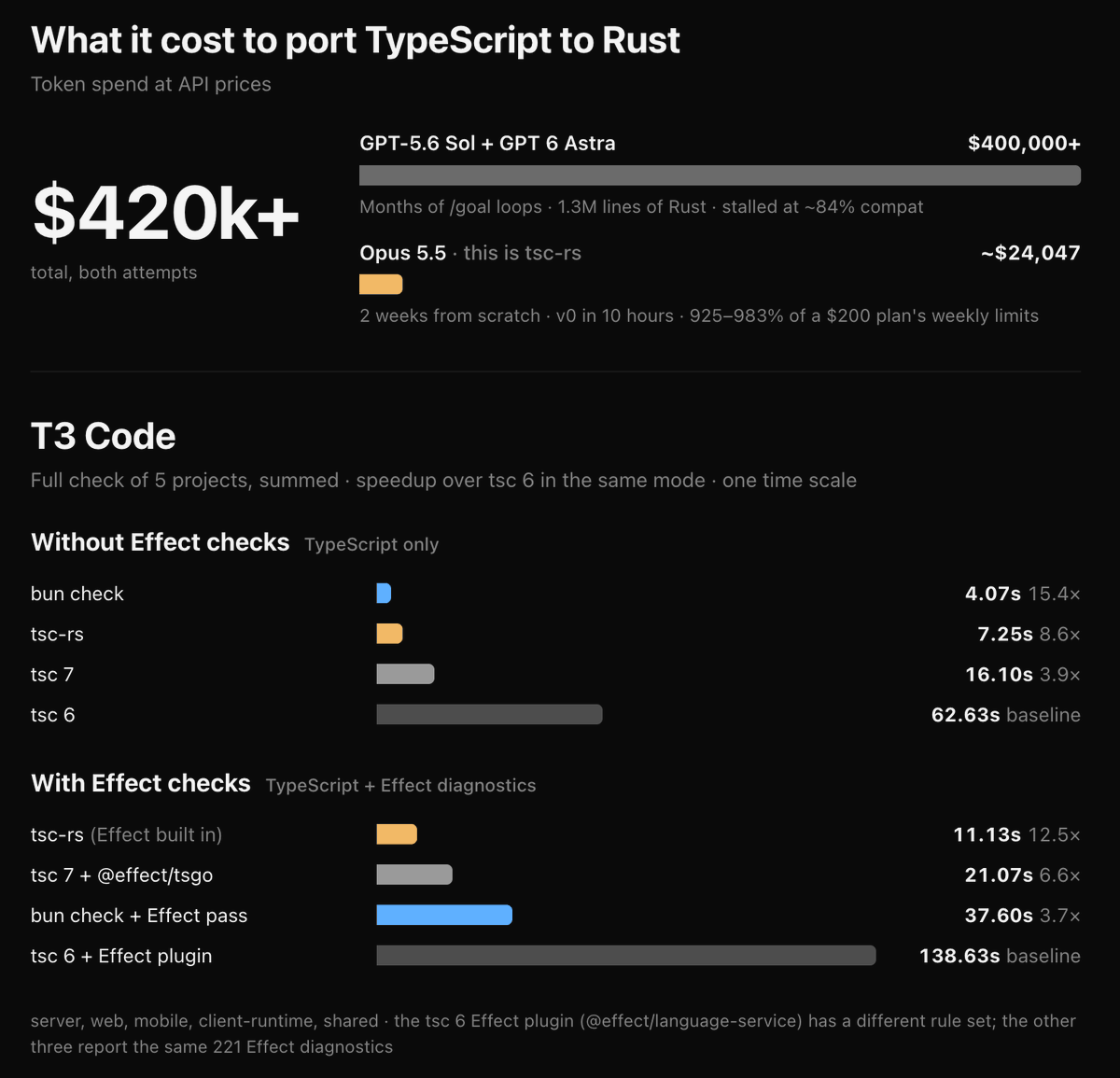
Theo (T3) open-sourced ts-rust (npm: tsc-rs), a Rust port of Microsoft's Go-native TypeScript compiler, checker and language server. Months of GPT-5.6 Sol / GPT 6 Astra runs cost over $400K in API-priced tokens and stalled near 84% compatibility; Claude Opus 5.5 restarted from scratch, reached a working v0 in 10 hours and finished in two weeks for about $24,047. All 181,711 ported Go tests pass, it type-checks 1.61x faster than tsc 7 (geometric mean over six open-source apps), ships Effect diagnostics built in and has a WASM build.

Theo open-sources tsc-rs: Opus 5.5 ported the TypeScript 7 compiler to Rust in two weeks for ~$24K, type-checking ~1.6x faster than the Go version

Key Takeaways

  • Cost: GPT-5.6 Sol / GPT 6 Astra burned $400K+ and stalled near 84% compat; Opus 5.5 finished in 2 weeks for ~$24,047 (README)
  • Correctness: all 181,711 ported Go tests pass; TanStack Query core and Hono diagnostics match Go exactly
  • Speed: geometric mean 11.4x over tsc 6 and 1.61x over tsc 7 on six apps; VS Code (3.75M lines) 4.20s vs 6.84s for tsc 7; bun check is still fastest (20.9x)
  • T3 Code: 7.25s vs 16.10s for tsc 7 without Effect (2.22x); 11.13s vs 21.07s with Effect diagnostics (1.89x)
  • Early release: Linux x64 and macOS arm64 only; known monorepo TS6059 and tsc -b stale-output issues
Read full story

HERMES: Harness Engineering via Modular Executable Dev-Primitives Empowers Software Engineering Agents to Match Frontier Models

Large Language Model (LLM) coding agents equipped with bash terminals frequently collapse when deployed across massive enterprise codebases. Centralized agents struggle to reconstruct project states fragmented across multi-language source trees, build configs, and test suites, precipitating context window exhaustion and catastrophic semantic drift. Researchers from UIUC introduce Dev-Primitives and the HERMES harness engineering framework (arXiv:2610.07832). Dev-Primitives transform passive software components into active agentic nodes by pairing each repository artifact with a resident LLM endowed with natural-language reasoning, inter-component communication channels, and localized self-modification primitives. Coordinated via a dependency-aware dynamic activation scheduler and execution-guided fault localization, HERMES boosts task performance across four standard software engineering benchmarks by 12.4% over baseline harnesses. Crucially, powering HERMES with lightweight Qwen3-8B Dev-Primitives brings performance within 4.5% of homogeneous GPT-5.6 Sol configurations while slashing inference token overhead by 26.2% on Terminal-Bench 4.0.

Key Takeaways

  • UIUC introduces Dev-Primitives and the HERMES framework, transforming passive software code artifacts into active LLM-powered nodes
  • Dependency-aware dynamic activation and execution-guided bug diagnosis eliminate context explosion across multi-thousand-file repositories
  • Outperforms baseline harnesses by 12.4% on average; lightweight Qwen3-8B primitives match GPT-5.6 Sol within 4.5% while cutting costs by 26.2%
Read full story

OpenAI and Ironclad train GPT-6 Astra on real contracting software: 55.0% vs GPT-5.6 Sol's 41.6% on 11 workflows, ~48% less time per attempt

OpenAI's first vertical-SaaS computer-use collaboration: with Ironclad it defined 11 legal, procurement and commercial tasks, let models practice in hosted Ironclad environments, and used RL on synthetic tasks. GPT-6 Astra scores 55.0% mean rubric vs 41.6% for GPT-5.6 Sol, with estimated time per attempt down from 37.0 to 19.2 minutes; an internal model reaches 63.7%. OpenAI is inviting more software companies to partner.

OpenAI and Ironclad train GPT-6 Astra on real contracting software: 55.0% vs GPT-5.6 Sol's 41.6% on 11 workflows, ~48% less time per attempt

Key Takeaways

  • 11 real contracting tasks, each graded on 8–50 criteria; ~30–40 min per task for an experienced human user
  • GPT-6 Astra (Max) 55.0% mean rubric vs GPT-5.6 Sol (High) 41.6%, ~32% relative gain
  • Estimated time per attempt 37.0 → 19.2 minutes (~48% lower) — simulated, not measured customer savings
  • Demo task: Astra ~94% of criteria in ~20 min vs Sol ~85% in ~32 min; an internal model hits 63.7%
  • Synthetic training tasks built from public SEC EDGAR contracts; no OpenAI or Ironclad customer data used
Read full story

Omni-IO Skills: Plug-and-Play Agent Harness Makes Existing Models Omni-Native Across 7 Modalities via Execution Graphs

While general-purpose agents exhibit strong long-horizon reasoning, enterprise workflows require manipulating seven distinct artifact modalities: text, images, audio, video, structured documents, 3D meshes, and code. Pretraining native omni-foundation models from scratch is economically prohibitive, while haphazard multi-tool integration triggers state desynchronization and intermediate asset sprawl across turns. Researchers from the National University of Singapore (NUS) and S-Lab introduce Omni-IO Skills (arXiv:2609.31847, ~300 upvotes on Hugging Face). As a modular agent harness, it organizes multimodal operations into Declarative Execution Graphs paired with a persistent Asset Registry, orchestrating 27 hierarchical skills across 38 tasks. Evaluated on UniM-90, the harness elevates input-support rates for GPT-5.6 Sol and Claude Sonnet 5 from ~40% to 100%, and lifts semantic quality scores from ~27 to over 77.

Omni-IO Skills: Plug-and-Play Agent Harness Makes Existing Models Omni-Native Across 7 Modalities via Execution Graphs

Key Takeaways

  • Pioneers Omni-IO Skills as a plug-and-play agent harness to make existing LLMs omni-native without parameter fine-tuning
  • Integrates 27 hierarchical skills across 7 artifact modalities, structured via Declarative Execution Graphs and persistent registries
  • Elevates GPT-5.6 Sol and Claude Sonnet 5 input-support rates from ~40% to 100%, nearly tripling semantic quality metrics
Read full story
ADSponsored

Mid-Harness Scales Actions at Model-Harness Boundary: Action Verification Lifts TerminalBench Pass@1 by 18%

Terminal agents operate through stochastic model generations, but a single errant command can irreversibly degrade sandbox environments. Mid-Harness introduces test-time compute scaling at the boundary between model and harness. By sampling and verifying candidate actions before terminal dispatch without modifying the underlying generator or harness, Mid-Harness boosts Pass@1 on TerminalBench-Lite from 50.00% to 68.03% under a GPT-5.6 Sol verifier, outperforming whole-trajectory scaling at lower token expenditure.

Mid-Harness Scales Actions at Model-Harness Boundary: Action Verification Lifts TerminalBench Pass@1 by 18%

Key Takeaways

  • Allocates test-time compute at model-harness boundary, lifting TerminalBench-Lite Pass@1 from 50.00% to 68.03%
  • Pairwise action verification and distillation enable compact local models to filter errant commands effectively
  • Reduces estimated token overhead by over 35% compared to whole-trajectory sampling while increasing task completion
Read full story

Omni-IO Skills: Plug-and-Play Multimodal Harness Unlocks 7 Modalities via Declare Execution Graphs, Elevating Support Rates to 100%

While general-purpose LLM agents exhibit strong long-horizon reasoning, their production utility remains heavily fragmented across seven heterogeneous artifact modalities: text, images, audio, video, documents, 3D assets, and code. Training unified native omni-modal foundation models incurs prohibitive compute, while naive tool chaining fails to coordinate asset dependencies and multi-turn revisions. Researchers from the National University of Singapore (NUS) introduce Omni-IO Skills, a plug-and-play agent harness transforming existing text/vision LLMs into omni-native agents. Using hierarchical skill abstractions, standardized I/O interfaces, a persistent Asset Registry, and Declare Execution Graphs, Omni-IO coordinates complex multi-asset workflows concurrently. Evaluated on the UniM-90 multimodal benchmark, Omni-IO boosts input-support rates for frontier models from ~40% to 100%, and nearly triples semantic quality coupling scores without modifying foundational model weights.

Omni-IO Skills: Plug-and-Play Multimodal Harness Unlocks 7 Modalities via Declare Execution Graphs, Elevating Support Rates to 100%

Key Takeaways

  • Plug-and-Play 7-Modality Runtime: Transforms existing LLM backbones into omni-native agents across text, image, audio, video, document, 3D, and code without modifying foundational model weights.
  • Declare Execution Graphs & Persistent Asset Registry: Coordinates concurrent multi-asset pipelines while persisting intermediate multimodal artifacts for robust cross-turn reuse.
  • 100% Modality Support on UniM-90: Propels input-modality support for GPT-5.6 Sol and Claude Sonnet 5 from ~40% to 100%, nearly tripling coupled semantic-quality scores.
Read full story

Code Arena WebDev: GPT-6 Astra (Max) Leads at 1800; Claude Fable 5.1 at 1758

LMSYS Arena updated Code Arena: WebDev rankings: OpenAI GPT-6 Astra (Max) leads at 1800 points, with Anthropic Claude Fable 5.1 (Max) second at 1758. Anonymous win-rate charts show Astra dominating most matchups, including about 72.5% against GPT-5.6 Sol (xHigh).

Key Takeaways

  • WebDev board: GPT-6 Astra (Max) #1 at 1800; Claude Fable 5.1 (Max) #2 at 1758
  • Anonymous win rates show Astra ahead of most rivals
  • About 72.5% win rate versus GPT-5.6 Sol (xHigh)
Read full story

Agent Arena Image-to-WebDev: GPT-6 Astra (Max) leads at 1733; Claude Fable 5.1 second

Arena updated the Image-to-WebDev leaderboard: GPT-6 Astra (Max) leads at 1733 points, 129 above GPT-5.6 Sol (xHigh); Claude Fable 5.1 (Max) is second at 1710. The board compares newly evaluated model releases on image-to-webdev delivery.

Key Takeaways

  • GPT-6 Astra (Max) leads Image-to-WebDev at 1733 points.
  • Claude Fable 5.1 (Max) ranks second at 1710.
  • Four newly evaluated model releases landed on the board.
Read full story

OpenAI: GPT-5.5 leaves ChatGPT, Work, and Codex plans on Oct 14; switch to GPT-5.6 Sol or GPT-6 Astra

ChatGPT announced that on October 14, 2026, GPT-5.5 will leave ChatGPT, ChatGPT Work, and Codex across all plans; Codex users should switch to GPT-5.6 Sol or GPT-6 Astra. OpenAI Developers clarified that GPT-5.5 remains available via the OpenAI API Platform and in Codex sessions authenticated with an API key.

Key Takeaways

  • Oct 14: GPT-5.5 exits ChatGPT, ChatGPT Work, and Codex across all plans.
  • Codex plan users should move to GPT-5.6 Sol or GPT-6 Astra.
  • GPT-5.5 stays on the API Platform and in API-key-authenticated Codex sessions.
Read full story