AI Coding Live News

Google DeepMind unveils Genie 4 world model: built on Gemini Omni, first with native real-time audio and dialogue, in research preview for trusted testers

Google DeepMind announced Genie 4 on Oct 27, calling it its most realistic and interactive world model yet. Built on Gemini Omni, it improves physics and human motion, natively generates ambient audio and interactive character dialogue for the first time, and uses Gemini 3.8 Flash in the loop to plan complex events. It is a research preview for trusted testers for now, coming soon to Google AI Ultra (Project Genie) and early access partners in the Gemini API and AI Studio; no quantitative benchmarks were published.

Google DeepMind unveils Genie 4 world model: built on Gemini Omni, first with native real-time audio and dialogue, in research preview for trusted testers

Key Takeaways

  • Per Google DeepMind, Genie 4 is its most realistic and interactive world model yet, with Gemini Omni anchoring real-world appearance and behavior
  • It is DeepMind's first real-time world model with native audio: ambient sound, music and character dialogue are generated with the world, and characters respond live
  • Gemini 3.8 Flash acts as a guiding agent in the loop, splitting goals into steps and checking frames; a demo pairs Gemini 4 Argon with Genie 4 to simulate an Apollo humanoid
  • Official limitations: only a few minutes of continuous interaction and drift over longer sessions; no quantitative benchmarks were published
  • Trusted testers only for now; coming soon to Google AI Ultra (Project Genie) and Gemini API / AI Studio early access partners, with SynthID on all outputs
Read full story
Linked Models & Agents:

Google previews Gemini API CLI (gemini-api), a zero-dependency Go binary that lets Claude Code, Codex, Cursor and other coding agents generate media, transcribe and run managed agents from the shell

The Google AI Studio team released an experimental preview of the Gemini API CLI (command name gemini-api). It is a stateless, zero-dependency Go binary for macOS, Linux and Windows, open source under Apache 2.0. Any coding agent with shell access and a GEMINI_API_KEY can call text reasoning, image, video, music and speech generation, file and YouTube analysis, audio and video transcription, and managed agents such as Deep Research with one command. Media is written straight to disk and only the file path goes to stdout, so base64 payloads never land in the context window. Google labels it experimental and not a supported Google product.

Google previews Gemini API CLI (gemini-api), a zero-dependency Go binary that lets Claude Code, Codex, Cursor and other coding agents generate media, transcribe and run managed agents from the shell

Key Takeaways

  • Default models (official README): gemini-3.8-flash for generate, analyze and transcribe; gemini-nano-banana-2.1 for image; gemini-omni-1.1-flash for video; lyria-3.5 for music; gemini-3.8-flash-tts for speech
  • Install with a one-line curl script on macOS/Linux, a PowerShell script on Windows, or go install; the latest GitHub release is v0.4.3 (published 2026-10-19)
  • Built for agents: --usage prints the command tree as KDL, --schema prints JSON Schema, --dry-run validates offline with credentials redacted, plus --output-format json/toon and inline --jq
  • Exit codes separate 4 cases: 0 success, 1 runtime/API failure, 2 usage or validation error, 3 auth failure; --agent-mode emits structured JSON errors
  • It also manages sandbox environments, server-side credentials, webhooks and cron triggers for managed agents; files uploaded via the Files API are kept for 48 hours
Read full story
Linked Models & Agents:
⚡ Gemini 3.8 Flash⚡ Gemini Nano Banana 2.1⚡ Gemini Omni 1.1 Flash⚡ Lyria 3.5⚡ Gemini 3.8 Flash TTS🤖 Gemini API CLI🤖 Claude Code🤖 Codex🤖 Cursor🤖 Antigravity🤖 Deep Research🌐 Google

Google Research launches Deep Review publicly: a four-stage agentic document verifier, piloted on 16,000+ conference papers, now on Gemini 4 Argon with an API

Google Research publicly released Deep Review on 2026-10-14. It grew out of the experimental Paper Assistant Tool (PAT), which gave opt-in pre-submission feedback on 16,000+ manuscripts at STOC 2026, ICML 2026, NeurIPS 2026 and ICLR 2027, and now covers design docs, presentations, and legal and financial documents. Users get two free reviews a week, can connect a Gemini API key for higher limits and the Deep Review API, and the system now supports Gemini 4 Argon.

Google Research launches Deep Review publicly: a four-stage agentic document verifier, piloted on 16,000+ conference papers, now on Gemini 4 Argon with an API

Key Takeaways

  • Pilot scale: 16,000+ opt-in manuscripts across STOC, ICML, NeurIPS and ICLR (Google Research blog)
  • Review load: over 74,000 submissions to ICLR, NeurIPS and ICML this year vs ~45,000 in 2025, 32,000 in 2024 and 23,000 in 2023 (Google-reported)
  • Two free reviews per user per week; a Gemini API key unlocks higher limits and the Deep Review API; PDF and plain text at launch, multi-file coming (Deep Review)
  • Uploaded documents are never used to train or fine-tune Google models and are stored one year for display only
  • Antigravity adds a Teamwork Deep Document Review pattern via /teamwork-preview; methodology in arXiv 2606.28277
Read full story

Gemini 4 Argon is generally available: gemini-4-argon ships in the Gemini API and AI Studio with a 1M unified window, long decode and $2/$10 intro pricing

On Oct 13 Google made Gemini 4 Argon globally available: the stable gemini-4-argon model is live on the Gemini API paid tier and AI Studio, in Antigravity for AI Ultra, and in the Gemini app and AI Mode for Pro and Ultra subscribers. Input, thinking and output share a 1,048,576-token window, and background execution lets one response run up to 1M tokens. Intro pricing is $2 input / $10 output per million tokens through Nov 30, then $4 / $20. There is no free tier, explicit caching is unsupported, and temperature/top_p/top_k are ignored.

Gemini 4 Argon is generally available: gemini-4-argon ships in the Gemini API and AI Studio with a 1M unified window, long decode and $2/$10 intro pricing

Key Takeaways

  • Model ID gemini-4-argon is marked GA (Stable) in the Gemini API changelog; text/image/video/audio/PDF in, a 1,048,576-token unified window, 65,536 default synchronous output
  • Pricing (official): $2 input / $10 output (incl. thinking) per 1M tokens through Nov 30, 2026, then $4 / $20; implicit cache hits at 95% off ($0.10); not on the Free tier or the Google AI Pro plan
  • Long decode: with background: true and max_output_tokens above 65,536 the server chains 64K hops up to ~1M tokens minus input (guide)
  • Vendor-reported: #1 on Vals Index, 87% on ERQA, 0.7% attack success on Gray Swan indirect prompt injection across 15 adaptive attempts; internally +35% agentic code submissions in Antigravity with roughly a third fewer rollbacks
  • Antigravity expands to AI Pro (official @antigravity, Oct 15): Pro gets a separate weekly-only Argon quota alongside the 3.8 Flash bucket, size not published; Google case studies: Gemma 4 E2B on vLLM/A100 went from ~37,900 to 108,000+ tokens/s (2.85x); ADK cut long-session prep time 40% and cold imports 21%
Read full story
ADSponsored

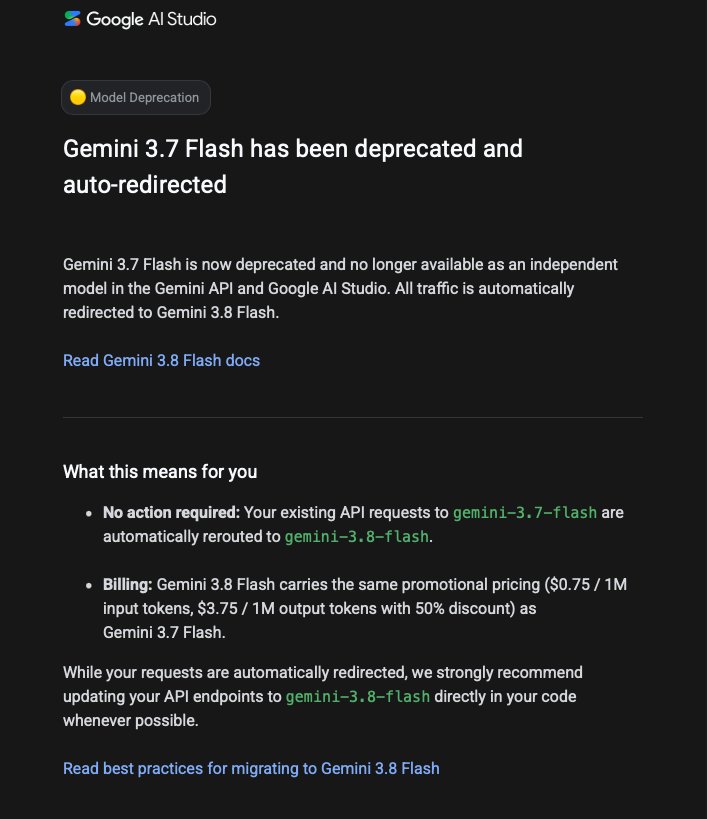
Gemini API deprecates 3.7 Flash and silently routes it to 3.8 Flash; 3.5 Flash moves to 3.6, old Deep Research agent shuts down Oct 23

Google's Gemini API release notes (Oct 8 entry) deprecate gemini-3.7-flash, with all requests now auto-routed to gemini-3.8-flash; gemini-3.5-flash is likewise routed to gemini-3.6-flash. The deep-research-pro-preview-12-2025 agent shuts down on Oct 23 and must migrate to the 04-2026 versions. Developers began receiving email notices on Oct 10.

Gemini API deprecates 3.7 Flash and silently routes it to 3.8 Flash; 3.5 Flash moves to 3.6, old Deep Research agent shuts down Oct 23

Key Takeaways

  • Two model IDs silently re-routed: gemini-3.7-flash → gemini-3.8-flash, gemini-3.5-flash → gemini-3.6-flash
  • Same price: 3.8 Flash paid tier $0.75 in / $3.75 out per 1M tokens through 2026-12-31, then $1.50 / $7.50 from 2027-01-01
  • deep-research-pro-preview-12-2025 shuts down 2026-10-23; migrate to deep-research-preview-04-2026 or deep-research-max-preview-04-2026
  • Deprecations page lists 3.6 Flash with no shutdown date, so 3.7 was replaced before its predecessor
Read full story

Google officially ships Nano Banana 2.1 (gemini-nano-banana-2.1) GA: 1K/2K images now half the price of Nano Banana 2, and human-eval Elo 1050 beats Nano Banana Pro

On 2026-10-06 Google officially launched Nano Banana 2.1 and marked it GA in the Gemini API changelog as gemini-nano-banana-2.1. It is based on Gemini 3.6 Flash and is rolling out across the Gemini app, AI Studio, Search AI Mode, Flow, Stitch, Google Ads and Gemini Enterprise Agent Platform. Image output is priced at $30 per 1M tokens (Nano Banana 2: $60), which works out to $0.0336 per 1K image and $0.0504 per 2K image, about half the old price. The model card's side-by-side human eval puts text-to-image Elo at 1050, ahead of Nano Banana 2 (990) and Nano Banana Pro (935). gemini-3.1-flash-image is now deprecated, with no shutdown date announced. This confirms the silent Flow rollout we reported earlier.

Google officially ships Nano Banana 2.1 (gemini-nano-banana-2.1) GA: 1K/2K images now half the price of Nano Banana 2, and human-eval Elo 1050 beats Nano Banana Pro

Key Takeaways

  • Per-image price: 1K $0.0336 (was $0.067, -50%), 2K $0.0504 (was $0.101, -50%), 4K $0.113 (was $0.151, -25%); Batch halves it again to $0.0168 per 1K image (pricing)
  • Text side got pricier: input $1.50/1M tokens (was $0.50), text+thinking output $7.50 (was $3), so re-check costs for long prompts and many reference images
  • Human-eval Elo (model card): T2I overall 1050 vs NB2 990 vs Pro 935; multi-character consistency 1106 vs 978 vs 1011; infographic factuality 0.521 vs 0.179 vs 0.265
  • Specs: up to 14 reference images (4 characters + 10 objects), fixed 2K/4K tiling artifacts at 1:8/8:1, Google Web + Image Search grounding, thinking levels minimal/medium/high
  • Migration: gemini-3.1-flash-image is deprecated (no shutdown date yet); 131,072-token input limit; no function calling, structured outputs or caching (model docs)
Read full story
Linked Models & Agents:
⚡ Nano Banana 2.1⚡ Nano Banana 2⚡ Nano Banana Pro⚡ Gemini 3.6 Flash🌐 Google🌐 Google DeepMind

Nano Banana 2.1 silent Flow sighting later confirmed by Google's official GA

On 2026-10-05 community screenshots and first-hand checks showed Nano Banana 2.1 already selectable in the Google Flow model picker — a silent product-side rollout with no Google announcement yet. Google then officially shipped it on 2026-10-06 and marked it GA in the Gemini API as gemini-nano-banana-2.1. Full specs, pricing (about half the prior 1K/2K per-image rates), and human-eval Elo 1050 are in our official GA brief: [Google officially ships Nano Banana 2.1](/news/news-20261007-google-nano-banana-2-1-ga-gemini-api-half-price).

Key Takeaways

  • Status update: the silent Flow picker sighting is now confirmed by Google GA — full write-up: [official GA brief](/news/news-20261007-google-nano-banana-2-1-ga-gemini-api-half-price) (API ID gemini-nano-banana-2.1)
  • Official highlights (from the GA brief/docs only — do not invent): ~half prior 1K/2K per-image price; human-eval T2I Elo 1050 (vs Nano Banana 2 at 990 and Pro at 935)
  • Where to try: Google Flow model dropdown still lists Nano Banana 2.1; API / AI Studio use gemini-nano-banana-2.1
  • Migration: old ID gemini-3.1-flash-image is deprecated (no shutdown date yet); see model docs
  • Early evidence: thtbee_ Flow screenshot showed Pro / 2 Lite / 2.1 side by side
Read full story
Linked Models & Agents:
⚡ gemini-nano-banana-2.1⚡ gemini-3.1-flash-image⚡ gemini-3.1-flash-lite-image⚡ Gemini 3 Pro Image🌐 Google DeepMind

yetone open-sources Magpie: one menu-bar picker for Claude Code/Codex/Gemini CLI; local gateway translates OpenAI/Anthropic/Gemini APIs (~4282★)

yetone/magpie (MIT, since ~2026-09-23) collapses per-agent model config into a menu bar + local gateway at 127.0.0.1:3425/v1 that speaks OpenAI Chat/Responses, Anthropic Messages, and Gemini—streaming, tools, and reasoning translated both ways. Add DeepSeek/Kimi/GLM/OpenRouter/Ollama or Claude/ChatGPT/Copilot logins once; pick models in Codex, Claude Code, Gemini CLI, OpenCode, etc. At ingest: 4282★ / 275 forks; site usemagpie.ai.

Key Takeaways

  • Repo yetone/magpie MIT; site usemagpie.ai; intent docs usemagpie.ai/docs/intent
  • At ingest: 4282★ / 275 forks; created 2026-09-23T16:22:35Z; latest binary tag v0.1.697 (2026-10-03T02:04:55Z)
  • Local gateway translates OpenAI/Anthropic/Gemini; routing groups smart/order/rotate/usage; optional intent classifier per turn
  • Claude/ChatGPT/Copilot sign-ins become providers; keys stay in Magpie
  • Install: curl usemagpie.ai/install.sh | sh or go install; then magpie provider add / magpie claude|codex|gemini
Read full story

No official date for a Gemini 4 Argon public drop: API docs still omit it

On 2026-10-02 Qwinah (@MaaSonder) said Argon could go public as soon as next week, or become a model nobody uses. The attached screenshot claims it is already in the Gemini API docs. Google’s Sep 30 post and Oct 2 recap give no calendar date; next access is paid API and AI Ultra. At ingest, public models and changelog pages did not contain Argon.

No official date for a Gemini 4 Argon public drop: API docs still omit it

Key Takeaways

  • Post: Qwinah (@MaaSonder), 2026-10-02 21:15 UTC, says public release could be next week or Argon becomes a null model; the image claims the API docs already list it. About 1.4k views
  • No date: the Sep 30 Argon post and the Oct 2 September recap still say Fairwind now, then paid API and Google AI Ultra, as soon as possible
  • Docs check: public models and changelog fetched ~07:32 SGT on 2026-10-03 contain no Argon string. Do not invent a model id
  • Official scores, not this post: DeepSWE v1.1 77.9%; AutomationBench 51.3%; LVBench 91.7%; CWE-bench v1 tied 68%. FrontierSWE v2 55.0% trails Astra 65.5%; Terminal-Bench 4.0 57.4% trails Opus 5.5 at 66.4%
  • Intro price $2/$10 per 1M in/out, cached input about 5% of input price, then $4/$20. Not orderable until the API lists it
Read full story

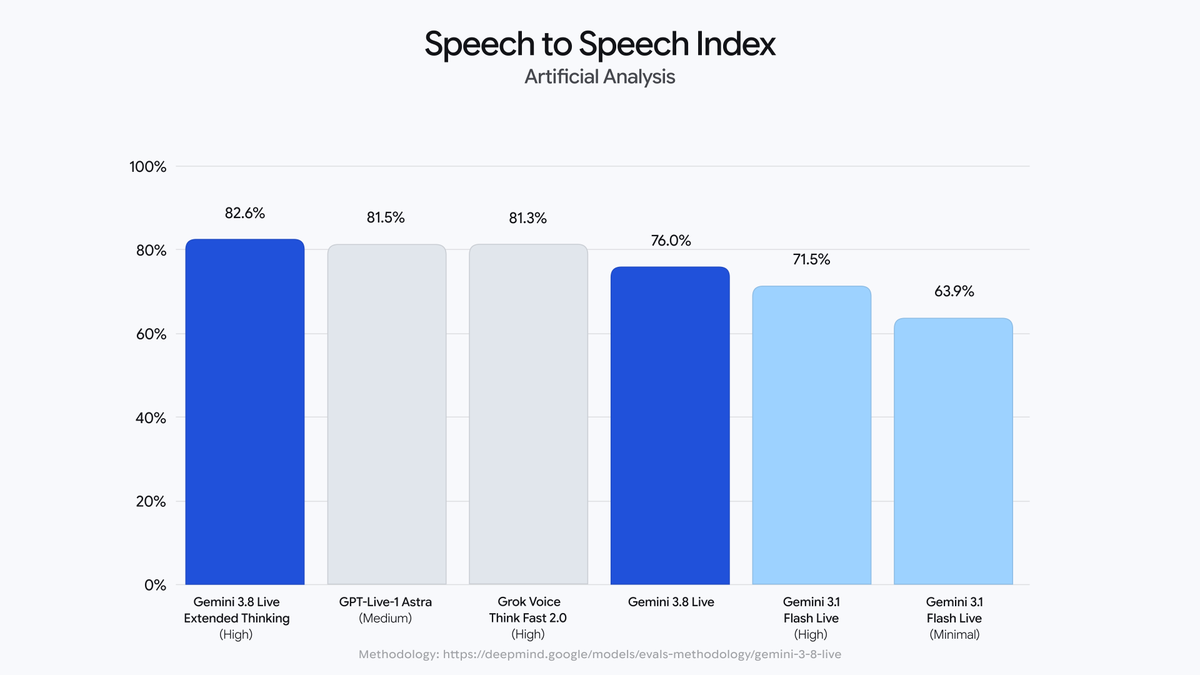
Google DeepMind Introduces Gemini 3.8 Live and Extended Thinking

Google DeepMind introduced Gemini 3.8 Live and 3.8 Live Extended Thinking, calling them its best conversational AI. Both models add upgraded reasoning, near real-time visual understanding, automatic detection for 97 languages, and background tool calling without interrupting chat. Extended Thinking narrates task progress for harder work. The models are available in Gemini Live in the Gemini app and via the Gemini API in Google AI Studio.

Google DeepMind Introduces Gemini 3.8 Live and Extended Thinking

Key Takeaways

  • Google DeepMind introduced Gemini 3.8 Live and 3.8 Live Extended Thinking, calling them its best conversational AI. Both models add upgraded reasoning, near real-time visual understanding, automatic detection for 97 languages, and background tool calling without interrupting chat. Extended Thinking narrates task progress for harder work. The models are available in Gemini Live in the Gemini app and via the Gemini API in Google AI Studio.
Read full story
Linked Models & Agents:
ADSponsored

Google introduces Gemini 3.8 Live and Live Extended Thinking

Google for Developers introduced Gemini 3.8 Live and Gemini 3.8 Live Extended Thinking. The audio models improve turn-taking and near real-time reasoning, replacing cascaded speech-to-text, reasoning, and text-to-speech stacks with one multimodal API call. They are available through the Gemini API in Google AI Studio.

Key Takeaways

  • Google for Developers introduced Gemini 3.8 Live and Gemini 3.8 Live Extended Thinking. The audio models improve turn-taking and near real-time reasoning, replacing cascaded speech-to-text, reasoning, and text-to-speech stacks with one multimodal API call. They are available through the Gemini API in Google AI Studio.
Read full story
Linked Models & Agents:

Google introduces Gemini 3.8 Live and Live Extended Thinking

Google for Developers introduced Gemini 3.8 Live and Gemini 3.8 Live Extended Thinking. These audio models improve turn-taking and near real-time reasoning, replacing cascaded speech-to-text, reasoning, and text-to-speech stacks with one multimodal API call to reduce latency and cost. They are available in the Gemini API via Google AI Studio and coming soon to the Gemini Enterprise Agent Platform.

Key Takeaways

  • Google for Developers introduced Gemini 3.8 Live and Gemini 3.8 Live Extended Thinking. These audio models improve turn-taking and near real-time reasoning, replacing cascaded speech-to-text, reasoning, and text-to-speech stacks with one multimodal API call to reduce latency and cost. They are available in the Gemini API via Google AI Studio and coming soon to the Gemini Enterprise Agent Platform.
Read full story
Linked Models & Agents:

Gemini 3.8 Live is available in the Gemini API

Google for Developers announced that Gemini 3.8 Live and 3.8 Live Extended Thinking are available today through the Gemini API in Google AI Studio for real-time voice apps, and are coming soon to the Gemini Enterprise Agent Platform.

Key Takeaways

  • Google for Developers announced that Gemini 3.8 Live and 3.8 Live Extended Thinking are available today through the Gemini API in Google AI Studio for real-time voice apps, and are coming soon to the Gemini Enterprise Agent Platform.
Read full story
Linked Models & Agents:

Google DeepMind introduces Gemini 3.8 Live and Extended Thinking, its best conversational AI

@GoogleDeepMind introduced Gemini 3.8 Live and 3.8 Live Extended Thinking—its best conversational AI. The models talk, think, and run background tools without breaking flow, with upgraded reasoning, near real-time visual understanding, and automatic detection for 97 languages. Try them in Gemini Live in the Gemini app or via the Gemini API in Google AI Studio.

Google DeepMind introduces Gemini 3.8 Live and Extended Thinking, its best conversational AI

Key Takeaways

  • @GoogleDeepMind introduced Gemini 3.8 Live and 3.8 Live Extended Thinking—its best conversational AI. The models talk, think, and run background tools without breaking flow, with upgraded reasoning, near real-time visual understanding, and automatic detection for 97 languages. Try them in Gemini Live in the Gemini app or via the Gemini API in Google AI Studio.
Read full story
Linked Models & Agents:

Google AI Studio introduces Managed Agents in the Gemini API with an updated harness, Files API, and managed credentials

Google AI Studio shared Managed Agents for the Gemini API, adding an updated agent harness, a Files API, and managed credentials. The combination brings long-running agent execution, file context, and credential handling into a managed path instead of forcing developers to assemble each control plane themselves.

Key Takeaways

  • The updated agent harness provides a more complete managed runtime for Gemini API agents.
  • The Files API adds a dedicated file-context surface for agent workflows.
  • Managed credentials reduce the operational burden of storing and rotating tool credentials in each app.
Read full story