AI Coding Live News

Google Turns Gemini and Search Off by Default for K-12 Student Accounts Until Admins Opt In, Launches Guided Learning in Classroom Globally

On November 3, Google VP and GM of Education Chris Phillips announced on the official Google blog that Gemini, Gemini Notebook, Gemini in Classroom and Google Search will be entirely off for K-12 student accounts until school administrators explicitly turn them on. Guided Learning is globally available in Google Classroom starting that day and is coming to Search for student accounts, with a pilot in select U.S. schools later this month. Because Search now includes AI Mode and AI Overviews, schools that want AI fully off also lose Search, which drew sharp backlash; Google later clarified on X that Search can be enabled on its own. EdWeek and AP report the change starts early next year; Google has given no exact date.

Google Turns Gemini and Search Off by Default for K-12 Student Accounts Until Admins Opt In, Launches Guided Learning in Classroom Globally

Key Takeaways

  • Off by default: Gemini, Gemini Notebook, Gemini in Classroom and Google Search are entirely off for K-12 student accounts until admins explicitly enable them (Google blog)
  • The controversy: Search now includes AI Mode and AI Overviews with no AI-free option, so student groups with AI fully off lose Search too (per EdWeek and NBC News)
  • Google clarified on X that schools can turn on Search without Gemini products, and that AI Mode and AI Overviews for students will guide them step by step instead of giving answers
  • Guided Learning is globally available in Google Classroom starting November 3; the Search version pilots in select U.S. schools later this month before wider expansion
  • Timeline: EdWeek and AP report the change starts early next year; Google only says it will share specifics in the coming months, with no exact date
Read full story
Linked Models & Agents:
⚡ Gemini🌐 Google

fal Announces $1.65B Across Series E and F for Generative Media Inference, Led by Sequoia and Bessemer with NVIDIA

fal, which hosts inference for image, video and audio models, announced on its official X account and blog on November 3 that it raised a combined $1.65B across Series E and Series F. Sequoia Capital led the Series E, closed earlier this year, and Bessemer Venture Partners led the Series F with continued investment from NVIDIA. fal did not disclose valuation or per-round amounts; Bloomberg reported the Series F at $1.3B at a $16B valuation, double the $8B from April. fal says the money funds inference capacity, hiring, and research and platform work in 2027.

fal Announces $1.65B Across Series E and F for Generative Media Inference, Led by Sequoia and Bessemer with NVIDIA

Key Takeaways

  • Confirmed by fal: $1.65B combined across Series E and F, Sequoia led E, Bessemer led F, NVIDIA continued investing (fal blog)
  • fal did not disclose valuation; Bloomberg reported the Series F at $1.3B at a $16B valuation and the Series E at $350M at $8B
  • Per Bloomberg, CEO Burkay Gur said demand spiked so much over the summer that fal had to rate limit customers, driving the large raise
  • Funds go to inference capacity, team growth and new research in 2027; fal hosts many third-party media models such as Seedance, Kling, Veo and FLUX
Read full story

X Discussion: Sam Altman Says People Should Always Control the Future and That This Should Ultimately Constrain AI Progress

At 01:40 UTC on November 4, OpenAI CEO Sam Altman (@sama) posted on X that "people should always be in control of the future," saying OpenAI is against the idea of people being relegated to doing things that "AI systems think makes sense to reward in humans," and that people should not cede control of the future to superintelligence, a requirement that "should ultimately constrain AI progress." Within about 25 minutes it drew roughly 1,360 likes, 337 replies and nearly 100K views; Francois Chollet and others voiced support while many replies pushed back. This is Altman's stated view, not a new OpenAI policy or product announcement.

Key Takeaways

  • Engagement: about 1,360 likes, 337 replies, 89 reposts, 74 quotes and roughly 99K views within about 25 minutes (per the X API); the high reply ratio signals a contested post
  • Three core lines: people should always be in control of the future; OpenAI rejects people being relegated to doing what "AI systems think makes sense to reward in humans"; people should not cede the future to superintelligence, and that requirement "should ultimately constrain AI progress"
  • Support: Francois Chollet (@fchollet) posted "Co-sign," saying the only future worth building is one where AI remains a tool in human hands; Matthew Berman said Altman made the same point in their interview last week
  • Pushback: replies asked "which people?", argued that AI systems "don't think anything," or contrasted the post with Altman's recent comments on RAM and concentrating compute in data centers
  • The post does not say where the quoted phrase comes from and names no concrete policy or timeline; online links to a GPT-6.2 Astra release date are speculation
Read full story
Linked Models & Agents:

X Discussion: Greg Isenberg Says He Talks to His Agents More Than His Human Teammates, Shares a Full Agent-Run Company Stack

On November 3, founder and Late Checkout CEO Greg Isenberg (@gregisenberg) posted a long thread on X saying his team has 50+ people in 12 countries, yet he "talks to my agents more than my human teammates." He listed an agent-driven stack covering ideation, design, build, user testing, bug fixing and data review. Within hours it drew about 1,050 likes, 2,300 bookmarks and 183 replies. This is a personal workflow and opinion, not verified productivity data.

Key Takeaways

  • Engagement: about 1,050 likes, 2,300 bookmarks, 183 replies and 75K views within hours (per the X API); bookmarks far exceed likes, so readers are saving it as a checklist
  • Coverage: ideation, design, build, user testing, bug fixing and data review are all handed to agents; humans handle "creative feedback, relationships and telling the agents what they got wrong"
  • Build: pingdotgg/t3code as the control surface and stablyai/orca to run parallel agents, each in its own git worktree
  • Quality control: every output is scored 1-10 by an LLM judge and anything under 8 goes back; every agent mistake becomes a new skill
  • All of this is self-reported; no verifiable productivity or cost figures were published
Read full story
ADSponsored

Vercel Security Review Enters Public Beta: Vulnerability Review on Every GitHub Push, One-Click Fixes with Vercel Agent

On November 3 (US Pacific time), Vercel launched Security Review in public beta. It is a new Vercel Agent capability alongside Code Review and Investigation: once enabled, every push to connected GitHub repositories triggers a diff-only vulnerability review that finishes in seconds. Findings land in the Security dashboard, PR comments and the CLI, and can be fixed with one click by Vercel Agent or pulled into your own coding agent via vercel security vulnerabilities. It is available to Pro and Enterprise teams, and reviews are free until November 10.

Vercel Security Review Enters Public Beta: Vulnerability Review on Every GitHub Push, One-Click Fixes with Vercel Agent

Key Takeaways

  • Trigger: every GitHub push (including direct pushes to production) is reviewed automatically; only the diff is scanned, which Vercel says finishes in seconds, so it can run on every preview and production deployment
  • Beyond pattern matching: the agent traces how changed code is reached, checks existing protections and rechecks each finding, which Vercel says catches logic flaws such as missing authorization checks
  • Teams can write security policies in plain language, scoped to projects or the whole team, and manage them with vercel security policy
  • Pricing: Vercel Agent rate, model tokens at provider cost with no markup, plus $0.25 per million tokens; reviews are free until November 10, 2026, while Agent fixes are billed
  • Availability: public beta for Pro and Enterprise teams; Vercel has not published detection-rate or false-positive benchmarks
Read full story

X Discussion: Grok Bot Engineer poteto Calls Adversarial Agent Code Reviews "Mostly a Waste of Tokens" and Argues for Empirical Plus Formal Verification Instead

On November 3, @poteto (lauren), whose bio says she works on Grok @bot at SpaceXSI, is on the React Compiler core team, and previously worked at Cursor, Meta and Netflix, posted what she called "maybe a hot take": she now considers adversarial reviews mostly a waste of tokens and thinks those tokens are far better spent on empirical combined with formal verification. She says she has updated her agent skill pack pstack to use its interrogate (multi-model adversarial review) skill less and may eventually remove it. She adds that she has found very little value in code review in the abstract, because agents tend to get lost in nitpicks and YAGNIs. The post drew about 906K views, 9,227 likes and 5,538 bookmarks. It is a personal opinion that sparked debate over the value of AI code review.

Key Takeaways

  • Opinion (personal, not an official finding): adversarial reviews are "mostly a waste of tokens"; empirical plus formal verification is the better use of them
  • Action: the author says she has made pstack use the interrogate skill less and may remove it; at fetch time the public pstack folder in GitHub cursor/plugins had no commits after October 27, so the change is not visible there yet
  • What interrogate is: per its public SKILL.md, it spawns one read-only reviewer per configured model (defaults Claude Opus 5.5 xhigh and Grok 4.7 xhigh fast) to attack the diff, then sorts findings into Act on, Consider, Noted and Dismissed without auto-applying fixes
  • Author (per her X and GitHub bios): engineer on Grok Bot at SpaceXSI, React Compiler core team, previously at Cursor, Meta and Netflix
  • Reach: about 906K views, 9,227 likes, 5,538 bookmarks, 668 replies, 356 reposts and 210 quotes
Read full story

Grok Bot Rolls Out a New Shopping Experience: Find the Best Deal, Compare Product Cards, and Track Orders After You Approve the Buy

On November 3, the official Grok Bot account @bot posted a video promoting a new shopping experience: have the Bot find the best deal, compare items, and track all your orders. The features come from the official changelog for version 0.78.1 (which includes 0.78.0), dated October 27: products appear as cards with photo, rating, price and store plus up to two badges, and three or four results scroll in a carousel. Product pages list in-stock options first, and Buy now starts an order you approve. After purchase the Bot tracks shipping and delivery, with shipment cards showing carrier and stage. Shop Pay can be connected in the Vault Payments tab and set as the preferred method.

Grok Bot Rolls Out a New Shopping Experience: Find the Best Deal, Compare Product Cards, and Track Orders After You Approve the Buy

Key Takeaways

  • The official post went out at 21:50 UTC on November 3 with a 17-second demo video; about 1,687 likes, 122 reposts, 292 replies and 112K views at fetch time
  • Source of the features: the official 0.78.1 changelog entry (October 27, includes 0.78.0), titled Shopping cards and subscription templates
  • Product cards: photo, rating, price and store, up to 2 badges such as Top rated, 3 or 4 results in a carousel; product pages list in-stock options first and disable options no store has
  • Ordering and tracking: orders started with Buy now need your approval; afterward the Bot reports shipping and arrival, and shipment cards show carrier and stage
  • Payments: the Vault has had a Payments tab since 0.77.0 (October 26); 0.78.1 lets you connect Shop Pay and make it the method Bots use first
Read full story
Linked Models & Agents:

Pruna Open-Sources P-H3-Image: MiniMax-H3 Video Model Turned Into an Image Generation and Editing Model, 8 Steps, 5x Faster, 7x Smaller

On November 3, model-compression company Pruna AI open-sourced P-H3-Image, which turns MiniMax-H3, the open-weights video model MiniMax released this summer, into a text-to-image and image-editing model. Per Pruna: sampling drops from 50 to 8 steps, a 4 MP image on one B200 goes from 12.4 s to 2.6 s, the 4-bit set is a 20 GB download (vs 143 GB for H3), and peak VRAM at 8 MP is about 21 GB. It renders 2 to 16 MP and edits with multiple reference images. Weights are on Hugging Face with native ComfyUI support. It keeps the MiniMax H3 Community License, which by default excludes the EU, UK, South Korea and the US.

Pruna Open-Sources P-H3-Image: MiniMax-H3 Video Model Turned Into an Image Generation and Editing Model, 8 Steps, 5x Faster, 7x Smaller

Key Takeaways

  • Speed (Pruna figures): 8 steps instead of 50; on one B200 a 4 MP image goes from 12.4 s to 2.6 s and 8 MP from 30.6 s to 5.8 s; the 4-bit set does 4 MP in about 6.3 s on an L40S
  • Size: the transformer shrinks from 33B to 20B parameters and the text encoder is distilled from 32B to 4B (67 GB to 9 GB); downloads are 55 GB in bf16 and 20 GB in 4-bit vs 143 GB for H3
  • Memory: peak VRAM at 8 MP is about 56 GB in bf16 and 21 GB in 4-bit; the bf16 diffusers pipeline with the prompt upsampler needs about 100 GB
  • Capabilities: renders 2 to 16 MP, strongest at photorealistic and documentary photography, film stills, anime and graphics with short text; supports multi-reference editing (8 images per the X post, 9 per the blog)
  • License: MiniMax H3 Community License; the EU, UK, South Korea and US need a separate license from MiniMax, and products must show "Powered by MiniMax H3"
Read full story
Linked Models & Agents:
⚡ P-H3-Image⚡ MiniMax-H3⚡ Qwen3.5-9B🌐 Pruna AI🌐 MiniMax🌐 Hugging Face🌐 ComfyUI

X Discussion: Paul Graham Pushes Back on an "AI Bubble" Post, Saying AI Cannot Be Both Fake and Destroying Jobs

On November 2, X user Fav (@favwontmiss) posted that "the AI bubble bursting is going to be one of the biggest reality checks in tech history," accusing AI companies of burning billions, destroying jobs, draining natural resources and forcing products nobody asked for into daily life. The post drew about 6,600 likes, 670 reposts and 370,000 views. On November 3, Y Combinator co-founder Paul Graham (@paulg) replied: "You can't claim both that AI is fake and that it's destroying jobs. If it were fake it wouldn't be able to." His reply drew about 1,600 likes and 44,000 views, and the debate reached X trending. These are opinions from both sides, not established facts.

Key Takeaways

  • The original post: Fav (@favwontmiss) called an AI bubble burst "one of the biggest reality checks in tech history," with about 6,600 likes, 670 reposts and 370,000 views; see the original post.
  • Paul Graham's rebuttal: the critiques "AI is fake" and "AI is destroying jobs" contradict each other; see his reply, with about 1,600 likes and 44,000 views.
  • Where the sides talk past each other: "bubble" is about valuations and whether spending pays back, while "replacing jobs" is about whether the capability is real. Both can hold at once (useful technology that is still overvalued), which is a recurring point in the replies.
  • Why it matters to developers: the argument does not change what the tools can do, but it shapes enterprise AI budgets, hiring narratives and public acceptance of AI coding products.
Read full story
Linked Models & Agents:

Stanford Retests 50 Well-Known LLM Findings on 20 Models: 44% Have Expired, Median Shelf Life About 15 Months

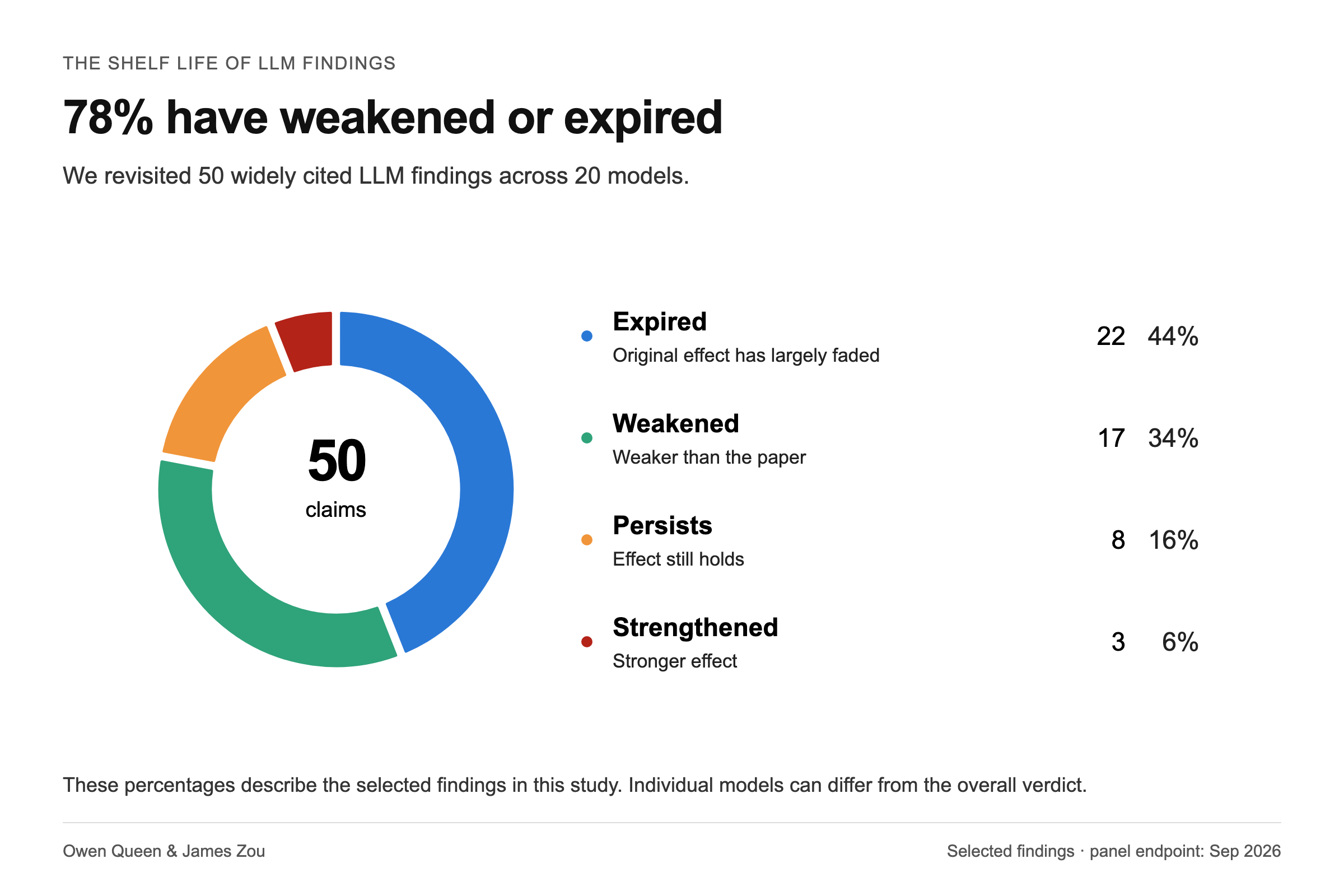
On November 2, Stanford researchers Owen Queen and James Zou published an interactive report, "The shelf life of LLM findings", retesting 50 widely cited claims about LLM behavior on 20 models released from July 2024 to September 2026 by eight developers. Verdict: 22 claims (44%) expired, 17 (34%) weakened, 8 (16%) persist and 3 (6%) strengthened; the median time from publication to expiration for expired claims was 14.7 months. Capability failures such as letter counting, lost-in-the-middle and fabricated citations have largely faded, while preference issues such as sycophancy and judges favoring their own answers persist.

Stanford Retests 50 Well-Known LLM Findings on 20 Models: 44% Have Expired, Median Shelf Life About 15 Months

Key Takeaways

  • 50 claims, 20 models, eight developers; verdicts reflect fitted effects as of September 30, 2026.
  • 44% expired, 34% weakened, 16% persist, 6% strengthened; expired claims had a median lifetime of 14.7 months (mean 15.7).
  • Kaplan-Meier estimates put the expired share at about 4%, 16% and 39% six months, one year and two years after publication.
  • Citation fabrication is expired overall, yet Qwen3.7-Flash still fabricated 69% of references in the same test (about 1% for Sonnet 5.5, 0% for GPT-6.1 Sol).
  • The pipelines were built with Claude Code and Codex; 43 of 48 reproduction checks matched the original papers within tolerance.
Read full story
ADSponsored

X Discussion: Addy Osmani of Claude Code Warns of "Cognitive Surrender" and Urges Developers to Keep Critical Thinking When Agents Do the Work

Addy Osmani (@addyosmani), whose X bio lists Claude Code at Anthropic, posted a long article on X on November 3 titled "Critical thinking when agents do the work." He describes a spectrum of working with AI: cognitive offloading (delegating a task but owning the result), deferral (the tool output becomes your new input), and "cognitive surrender" (the AI output quietly becomes your own and you feel no need to check it), a term he credits to Steven Shaw and Gideon Nave at Wharton. He offers self-check questions and verification habits. Within about three hours the post drew roughly 1,400 likes, 2,400 bookmarks and more than 72,000 views and reached X trending. These are the author's views, not an Anthropic announcement.

Key Takeaways

  • The spectrum: cognitive offloading (delegate but keep ownership, which the author says he does all day), deferral (the output stops being a hypothesis), and cognitive surrender (no more checking; it becomes your conclusion). Read the X article.
  • His argument: as models improve there are fewer obvious errors, so well-written, mostly correct output no longer demands a second look, and even with many agents running you still have only one pair of eyes on the results.
  • Self-check questions: write down your hypothesis before asking; know whether the AI is helping you think or thinking for you; ask what would make it wrong and test it; have several models argue the other side; ask whether you would bet on it in front of the person who maintains it.
  • Verification habits: define "verified" up front (a passing test, a screenshot, a log); a green check proves one property, so ask what it did not prove; have Claude Code critique its work with a fresh-context subagent, and finish by asking "Did I miss anything?"
  • Delegate fully where being wrong is cheap, but keep the reasoning for decisions whose consequences land on others, such as what to build and whether it is safe to ship.
Read full story
Linked Models & Agents:

Anthropic Open-Sources FlashProve: zkSNARK Proofs That a Reply Came From the Committed Model, About 110 Tokens/s for 400B Llama 4 Maverick on One H100

Anthropic's Frontier Red Team published a research post on November 2 and open-sourced FlashProve under Apache 2.0. A model provider commits to hidden weights once, then attaches a zero-knowledge proof to each reply, so a user without the weights can check on an ordinary CPU that the reply really came from that model. That targets routing services that quietly swap in cheaper models and tampered token streams. Anthropic reports about 110 tokens/s on one H100 for Llama 4 Maverick (400B MoE, 4-bit), proofs of about 19 MB per 1,024-token request, and roughly 70-95x the GPU time of vLLM inference. It is an unmaintained research prototype limited to 1,024-token contexts and greedy decoding of an integer version of the model. Anthropic engineer Steve Weis shared the release on X.

Anthropic Open-Sources FlashProve: zkSNARK Proofs That a Reply Came From the Committed Model, About 110 Tokens/s for 400B Llama 4 Maverick on One H100

Key Takeaways

  • Anthropic-reported: on Llama 4 Maverick (400B MoE, 4-bit) one H100 proves about 110 tokens/s (prefill, 24 requests per batch), with proofs of about 19 MB per 1,024-token request.
  • It is costly: roughly 70-95x the GPU time of vLLM inference; the performance page lists about 270 GB of host memory for serving and about 39 minutes to commit to a set of weights.
  • Verification needs no GPU: the C++ verifier checks a proof in about 21 seconds on one thread, and a slower Lean verifier plus Lean 4 proofs of the security theorem are included.
  • Against prior work: VerInf proved the same model at about 0.02 tokens/s; the commercial Attestable reached 53-77 tokens/s on Gemma 4 31B but has no open-source release.
  • Limits: v0.16.0 is an unmaintained research prototype with 1,024-token contexts, greedy decoding of an integer model only, and no architecture hiding.
Read full story
Linked Models & Agents:

DeepSeek Harness Launches Creator Mode: Describe a Plugin in Chat and the Agent Builds It, With 7 Official Demo Prompts

DeepSeek Harness, DeepSeek's open-source, MIT-licensed agent app, announced Creator Mode on its official X account on November 2: users describe the plugin they want in plain language, and the agent turns it into a plugin they can use. Demos include a 3D landmark gallery, a 3D Transformer visualizer, a video editing workbench and a paper reader. DeepSeek also published seven bilingual demo prompts on cdn.deepseek.com, cautioning that some plugins took several rounds of conversation, so a single prompt may not reproduce the video exactly. The post drew about 20,000 likes and 1.69 million views. No benchmarks were published.

DeepSeek Harness Launches Creator Mode: Describe a Plugin in Chat and the Agent Builds It, With 7 Official Demo Prompts

Key Takeaways

  • Creator Mode: describe the plugin you want in natural language and the agent turns it into a usable plugin, from a design workspace to a sandbox game or a 3D LLM visualizer.
  • DeepSeek published 7 demo prompts: a 3D landmark gallery, a 3D Transformer demo, a five-style app theme switcher, a poster workbench, a video editor, a paper reader and a token-usage statistics plugin.
  • The entry point shipped in v0.2.1-rc.5 (Oct 30 pre-release): plugin management gained a "Let Agent create a plugin" button that opens Creator mode and keeps the draft.
  • The GitHub repo has about 270,000 stars under the MIT license; Harness is still in preview.
  • No benchmarks or success rates were published; the announcement drew about 20,000 likes and 1.69 million views.
Read full story
Linked Models & Agents:

Anthropic Launches Message Threads in Public Beta on the Messages API: Server-Side Conversations Cut Claude Code TTFT About 35% on 500K-1M Token Requests

On November 2 (US time) Anthropic put message threads into public beta on the Messages API (beta header message-threads-2026-08-12). The API keeps the conversation on the server: the first request sends the full conversation and creates a thread, and each later request sends only new messages plus the previous response id. Anthropic says threads are on by default for most Claude Code users, cutting median time to first token by about 35% on 500K-1M token requests, while the median long-conversation request shrank from about 800 KB to 1.8 KB. Threads expire after 5 idle minutes; pricing and rate limits are unchanged.

Anthropic Launches Message Threads in Public Beta on the Messages API: Server-Side Conversations Cut Claude Code TTFT About 35% on 500K-1M Token Requests

Key Takeaways

  • Per Anthropic, median time to first token on 500K-1M token Claude Code requests is about 35% lower.
  • The median long-conversation request fell from about 800 KB to about 1.8 KB, since each turn uploads only new messages plus previous_message_id.
  • A thread expires 5 minutes after its last request and is deleted within 1 hour; an expired thread returns 404 thread_not_found and must be replayed in full.
  • Pricing and rate limits are unchanged; Message Batches, token counting and on-demand compaction are unsupported, and threads are not ZDR or HIPAA eligible.
  • Available on the Claude API, Claude Platform on AWS, Google Cloud (Anthropic managed) and Microsoft Foundry, with a thread helper in the SDKs.
Read full story
Linked Models & Agents:

OpenAI Plans Its Next Internal Security Sprint With Cathedral, More Than Quadruples Critical Bug Bounty Rewards to Up to $172,000

On November 2 (US time) OpenAI said it is planning its next internal security sprint and partnering with security firm Cathedral, whose researchers will use OpenAI models alongside OpenAI teams to challenge its defenses. It is also changing its Security Bug Bounty program, more than quadrupling rewards for critical findings; OpenAI's X post says exceptional findings can earn up to $172,000 including bonuses. Per OpenAI, the last sprint dedicated 25% of its product engineers to finding and fixing weaknesses, using Codex to reproduce vulnerabilities and prepare patches, and it has committed $1 billion in subsidized access over six months for frontline defenders.

OpenAI Plans Its Next Internal Security Sprint With Cathedral, More Than Quadruples Critical Bug Bounty Rewards to Up to $172,000

Key Takeaways

  • Critical bug bounty rewards are more than quadrupled; per OpenAI's X post, exceptional findings can earn up to $172,000 including bonuses.
  • Researchers from partner Cathedral will use OpenAI models alongside OpenAI teams to test its defenses.
  • Per OpenAI, the last sprint dedicated 25% of product engineers and used Codex to reproduce vulnerabilities in isolated environments and prepare patches.
  • OpenAI has committed $1 billion in subsidized access over six months for defenders of essential services and digital infrastructure.
  • Timing, scope and finding counts for the next sprint were not disclosed.
Read full story
Linked Models & Agents: