AI Coding Live News

Cartesia’s new H-Nets learn from raw bytes without a tokenizer, matching SmolLM3’s 11T-token result after about 1T tokens

On Oct 28 Cartesia chief scientist Albert Gu (co-author of Mamba) and team published two research posts on a new generation of hierarchical networks (H-Nets). In a controlled scaling ladder, swapping BPE tokenization for learned dynamic chunking alone gave up to 3-5x compute efficiency. A larger two-stage byte-level H-Net (3.67B parameters), compute-matched per byte against SmolLM3-3B, reached SmolLM3’s final average downstream score after about 1T tokens versus 11T (vendor-reported). The new architecture is not released yet; Cartesia says it plans to release it over time.
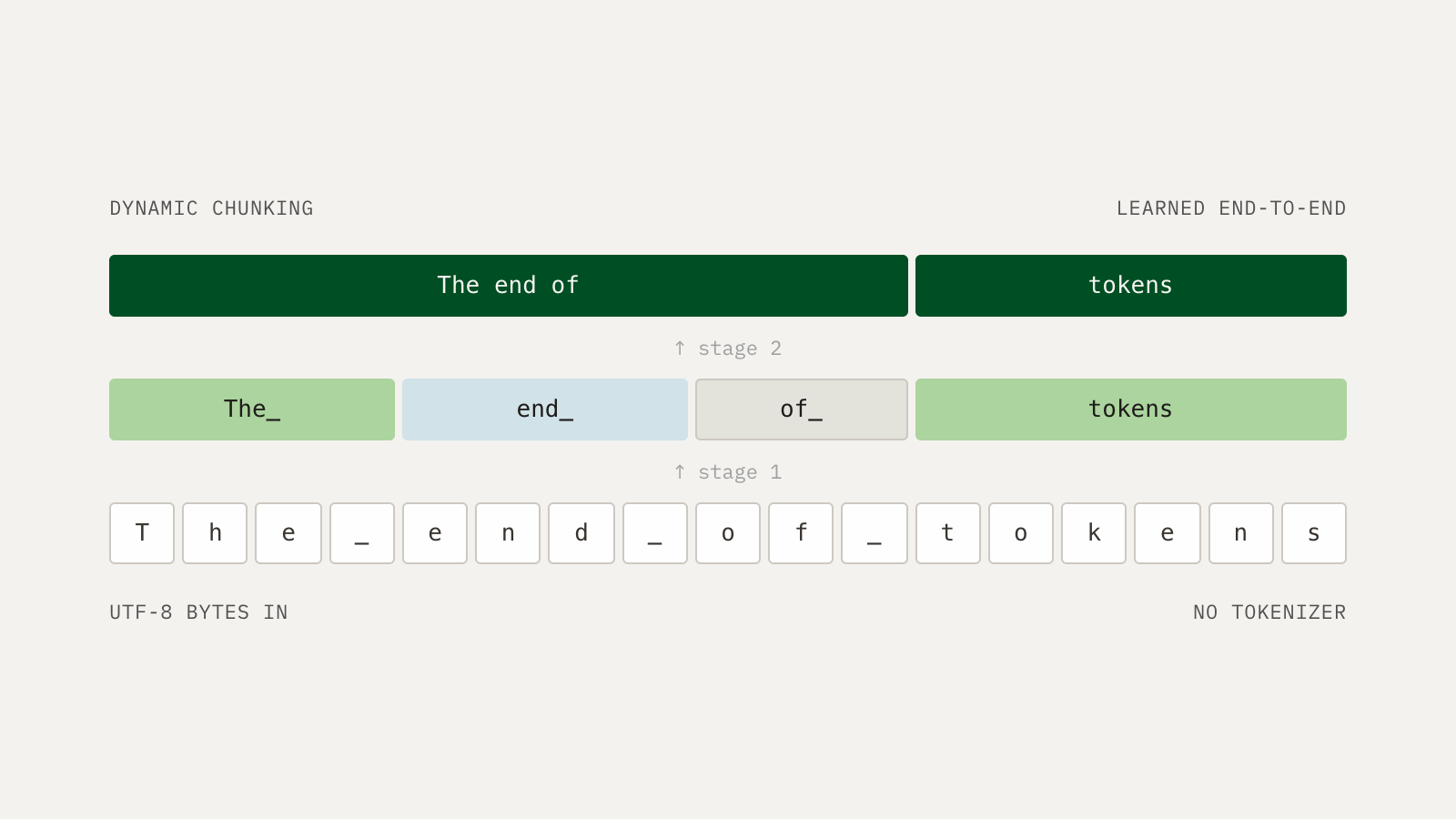
Cartesia’s new H-Nets learn from raw bytes without a tokenizer, matching SmolLM3’s 11T-token result after about 1T tokens

Key Takeaways

  • Controlled ladder (vendor-reported): a 1-stage H-Net as a drop-in replacement for BPE gave about 1.3x compute efficiency on validation loss, about 2x on code, and up to 3-5x overall
  • Larger run: a 3.67B two-stage byte H-Net vs 3.08B SmolLM3, compute-matched within 2% FLOPs per byte, matched SmolLM3’s six-task average after about 1T tokens instead of 11T
  • Code gains are larger: 1.49x-2.40x (median 2.04x) on 15 in-distribution languages, median 3.10x on 10 out-of-distribution languages, up to 5.37x on Prolog
  • Training mix is 70% English, 20% code, 5% math and 5% multilingual; the main network sees about one position per 7.6 bytes, and the outer encoder and decoder take about 43% of FLOPs
  • No weights or code yet; Cartesia says it will release some of these architectures over time; the original H-Net paper is arXiv 2507.07955
Read full story
Linked Models & Agents:
⚡ H-Net⚡ SmolLM3-3B⚡ Mamba-2🌐 Cartesia🌐 Hugging Face

HKU Introduces ReaDy for Hybrid Linear Attention: Recurrent States as Dynamic Context Accelerates B200 Decoding to 302 TPS

Traditional speculative decoding relies on static target hidden features that fail to supply varying contextual needs across draft positions. HKU researchers introduced ReaDy (arXiv:2610.20503). Designed specifically for Hybrid Linear Attention (HLA) architectures combining Transformers with recurrent linear attention states, ReaDy leverages compact recurrent states as dynamic context for drafting. On a single NVIDIA B200 GPU serving Qwen3.8-27B, ReaDy achieves an acceptance length of 4.53 and 302.78 TPS, accelerating inference by 2.4x over standard autoregressive decoding.

HKU Introduces ReaDy for Hybrid Linear Attention: Recurrent States as Dynamic Context Accelerates B200 Decoding to 302 TPS

Key Takeaways

  • HKU introduced ReaDy (arXiv:2610.20503), the first speculative decoding framework customized for Hybrid Linear Attention (HLA) LLMs
  • Reuses compact recurrent states as dynamic context for drafting, overcoming the static context bottleneck of feature-based drafters
  • Achieves 302.78 TPS for Qwen3.8-27B on a single NVIDIA B200 GPU (2.40x over AR and +7.97% over SOTA DSpark)
  • Reaches an acceptance length of 4.53 tokens using an ultra-lightweight Rank-8 reader
Read full story
Linked Models & Agents:

NVIDIA open-sources Nemotron 3.5 Super VL (120B-A12B multimodal agent model, 1M context) and the 24GB 2-bit local Bolt 74B-A9B

On 2026-10-15 NVIDIA released Nemotron 3.5 Super VL, an open multimodal agent model with 120B total / 12B active parameters: a Mamba-2–Transformer hybrid MoE with a C-RADIO vision encoder, text/image/document/video input, up to 1M context, and built-in MTP plus LiLiCorr speculative decoding. Weights, datasets and recipes ship under OpenMDW-1.1 on Hugging Face, OpenRouter, ModelScope and NIM. Alongside it, NVIDIA published Bolt 74B-A9B 24GB, a natively 2-bit (QAT) local agent model for RTX/DGX Spark; the 4GB Bolt E4B follows on Oct 23.

NVIDIA open-sources Nemotron 3.5 Super VL (120B-A12B multimodal agent model, 1M context) and the 24GB 2-bit local Bolt 74B-A9B

Key Takeaways

  • Scale: Super VL is 120B total / 12B active with up to 1M context; BF16 reference serving needs 4×H100 or 2×GB200, with an NVFP4 build for smaller footprints (model card)
  • Coding (vendor-reported): SWE-bench Verified 71.10, Terminal-Bench 2.1 66.70, LiveCodeBench v6 88.22; in the same table Qwen3.5-122B-A10B scores 71.9 / 48.70 / 76.7 and GLM-5.3-Flash 79.10 / 82.70 / 80.6
  • Agent evals: Hermes Bench 63.44% (Nemotron 3 Ultra 56.33%), LangChain Evals 87.05% (Ultra 84.3%); NVIDIA claims up to 5x single-GPU throughput vs open peers and 600+ TPS on Baseten (tech blog)
  • Bolt 74B-A9B 24GB: native 2-bit (IQ2 + QAT), 256K context; Terminal-Bench 2.1 50.98 and BrowseComp 66.75 vs 44.38 / 48.74 for Qwen3.6-35B-A3B; PinchBench 87.82 is slightly below Qwen3.6's 88.07 (Bolt card)
  • Serving: LiLiCorr speculative decoding gives up to 2.3x faster generation on DGX Spark; the Dynamo recipe serves 8x more users with 85% lower TTFT on 16×B200 at 50 tok/s/user
Read full story
Linked Models & Agents:
⚡ nemotron-3.5-super-vl⚡ nemotron-3.5-bolt-74b-a9b⚡ nemotron-3.5-bolt-e4b⚡ Nemotron 3 Ultra🤖 hermes-agent🤖 opencode🤖 OpenHands (All-Hands AI)🤖 Cline (VS Code Agent)🌐 Nvidia (NIM)

CacheBack: Receiver-Conditioned Latent Communication Slashes Multi-Agent KV Cache by Up to 94% with 3.2x Lower Latency

Multi-agent systems solving long-context distributed tasks face a fundamental trade-off: textual communication is compact but introduces autoregressive decoding latency and token-level information loss, whereas latent communication transferring raw KV caches avoids token generation but causes explosive linear memory scaling across agents and context tokens. Researchers from Columbia University introduce CacheBack (arXiv:2609.32046), a robust, training-free realization of receiver-conditioned communication. The receiving agent transmits a concise description of its information requirements, which acts as a dynamic mask on the sender's attention weights to filter and compress the KV cache. Benchmarked on FanOutQA with Qwen 3, CacheBack prunes 75% to 94% of redundant cache states, boosts task accuracy by 14.7 percentage points, and slashes median completion latency by 3.2x compared to text messages across dense, Mamba-hybrid, and sliding-window architectures.

CacheBack: Receiver-Conditioned Latent Communication Slashes Multi-Agent KV Cache by Up to 94% with 3.2x Lower Latency

Key Takeaways

  • Pioneers receiver-conditioned latent communication in CacheBack, overcoming linear KV cache scaling in multi-agent systems
  • Training-free architecture filters 75% to 94% of redundant cache states using attention weights conditioned on receiver needs
  • Lifts FanOutQA multi-hop accuracy by 14.7 percentage points and slashes median task latency by 3.2x over text messaging
Read full story
ADSponsored

Unsloth Ships v0.1.815 & Prebuilt CUDA 13 Wheels: Run Qwen-Image-2.1 Locally with Claude-Compatible Agent Skills

Unsloth AI released version v0.1.815-beta alongside official prebuilt Linux x86_64 CUDA 13 wheels for Flash-Attention 2.8.4, Causal-Conv1D 1.7.0, and Mamba-SSM 2.3.2.post1 targeting PyTorch 2.13/2.14 on Python 3.13. The release enables fast local deployment of Alibaba's Qwen-Image-2.1 across both consumer and datacenter GPUs using Fast FP8 and GGUF quantization (defaulting to Q4_K_M) for combined image generation and precise image editing. Crucially, the Unsloth workspace introduces custom Agent Skills compatible with Claude Code and .agents formats, featuring @skill tagging in chat and 2x faster reasoning blocks (boosting UI rendering from 30 FPS to 60 FPS).

Unsloth Ships v0.1.815 & Prebuilt CUDA 13 Wheels: Run Qwen-Image-2.1 Locally with Claude-Compatible Agent Skills

Key Takeaways

  • Official CUDA 13 prebuilt wheels: instant binaries for Flash-Attention 2.8.4 and Mamba-SSM on PyTorch 2.13/2.14, eliminating compilation errors
  • Local Qwen-Image-2.1 execution: Fast FP8 and GGUF Q4_K_M support for both high-fidelity image generation and interactive image editing
  • Claude Code skill interoperability: native support for importing and executing custom skills from .agents and Claude Code folders with @skill
  • 60 FPS reasoning blocks: doubled chain-of-thought rendering performance from 30 FPS to 60 FPS with reworked UX
  • Expanded platform support: in-app Debian upgrades and a dedicated installer for Ubuntu 24.04+ on ARM64 architectures
Read full story
Linked Models & Agents:

vLLM 0.29.0: Model Runner V2 default, Mamba prefix cache, speculative-decoding stats

vLLM shipped v0.29.0 with Model Runner V2 as the default runner for all models (594 commits, 277 contributors). Highlights include another Kimi-K3 optimization pass, DeepSeek-V4 shared experts fused into MegaMoE, Mamba prefix caching that keeps internal prefill checkpoints (about 9–25% better TTFT), per-request speculative-decoding acceptance stats over the API, a sharded_rdt P2P backend for RL weight sync, and new model support such as Hy4-preview, Qwen3.8-Flash-Next, GraniteSWA, and NemotronH Omni Reasoning V3.

Key Takeaways

  • Model Runner V2 is now the default for all models.
  • Mamba prefix caching improves TTFT ~9–25%; speculative decoding exposes acceptance stats via API.
  • DeepSeek-V4 MegaMoE fusion, RL sharded_rdt P2P sync, and several new model backends.
Read full story
Linked Models & Agents: