AI Coding Live News

webAI Open-Sources TwIL-8B: An 8.8B Reasoning Model With LiveCodeBench 81.6 and MATH-500 98.2, Under a Non-Commercial License

webAI CEO David Stout announced on X on November 4 (17:37 UTC) that the company is open-sourcing TwIL-8B. The official Hugging Face model card says it is post-trained from IBM Granite 4.2 8B with full-parameter SFT, GRPO/DAPO reinforcement learning and a length-aware RL stage, and ships in balanced and verbose variants. Self-reported scores include LiveCodeBench 81.6 (verbose), MATH-500 98.2 and IFBench 74.4, about 93% and 92% of the best frontier score, while GPQA Diamond is only 70.2. A 4.98 GiB Q4_K_M GGUF runs locally; the license is the webAI Non-Commercial License.

webAI Open-Sources TwIL-8B: An 8.8B Reasoning Model With LiveCodeBench 81.6 and MATH-500 98.2, Under a Non-Commercial License

Key Takeaways

  • TwIL-8B has 8.79B parameters, is built on IBM's ibm-granite/granite-4.2-8b, has a 131,072-token context window and is English-only, text to text.
  • Self-reported scores: MATH-500 98.2, AIME 2025 88.3, LiveCodeBench 81.6 (verbose) and IFBench 74.4 (verbose); GPQA Diamond at 70.2 trails Qwen3.5-9B (81.7) clearly.
  • The balanced variant averages about 19.5k output tokens per AIME 2026 problem, about 38% fewer than Qwen3.5-9B's 31.2k, but still roughly 4x GPT-5.5.
  • All scores are webAI internal evaluations; competitor figures are quoted from public sources and were not re-run. SWE-bench, tool use and agentic tasks were not evaluated.
  • The license is the webAI Non-Commercial License 1.0, so it cannot be used commercially as is; the Q4_K_M GGUF is about 4.98 GiB and runs with llama.cpp.
Read full story
Linked Models & Agents:
⚡ TwIL-8B⚡ Granite 4.2 8B⚡ Qwen3.5-9B⚡ Gemma 4 31B🌐 webAI🌐 IBM

Axiom Formalizes the Entire Stacks Project in Lean With AI Agent Swarms: About 16 Million Lines, Billed as the Largest Reusable Formal Math Library Yet

Axiom released a Lean formalization of the entire Stacks Project on November 4 (official X post at 17:13 UTC, with over 2 million views). The roughly 7,500-page open-source algebraic geometry reference, started by Johan de Jong in 2005, becomes about 16 million lines of code, which Axiom calls the largest integrated, reusable formal math library ever built. Hierarchically coordinated AI agent swarms did the work and surfaced dozens of statements in the original that needed local fixes, with counterexamples. The library is open source and browsable side by side with the original text at stacks.axiommath.ai.

Axiom Formalizes the Entire Stacks Project in Lean With AI Agent Swarms: About 16 Million Lines, Billed as the Largest Reusable Formal Math Library Yet

Key Takeaways

  • Scale: about 7,500 pages of source text and roughly 16 million lines of Lean, which Axiom calls the largest integrated reusable formal math library (vendor claim).
  • Method: hierarchical AI agent swarms translate statements, search Mathlib for existing abstractions and build proofs in parallel, with multi-agent auditing and semantic cross-checks against the source to keep statements faithful.
  • Findings: the system surfaced dozens of statements needing local refinement, including missing hypotheses and edge cases in positive characteristic, and built explicit counterexamples where claims failed.
  • The permanent Stacks tag structure is preserved so every Lean declaration links back to the original text; stacks.axiommath.ai offers side-by-side reading and a dependency graph.
  • This follows Axiom's October 27 formalization of the Classification of Finite Simple Groups (CFSG); per de Jong's request, corrections are kept in Axiom's own repository rather than sent upstream.
Read full story
Linked Models & Agents:

X Discussion: roon Says "Sparks" of an AI Ability Mean It Is Months to Years From Superhuman, and "You Are Almost Always Underhyping"

roon (@tszzl), a well-known AI account with about 500,000 followers, posted on November 2: "when you see “sparks” of any ability in ai models that means you’re months-years from it being superhuman at it. today grade school math, tomorrow navier stokes. it is hard to overhype these results. you are almost always underhyping no matter what." Within about five hours it drew nearly 2,000 likes and 59,000 views. Adam Karvonen, a researcher at Truthful AI and former Anthropic Fellow, pushed back that the domains where models are superhuman are verifiable, easy to simulate and fast to get feedback on, and that research taste, robotics or running companies may not move as fast. This is a debate between personal views, not any company's official position.

Key Takeaways

  • roon's exact claim: "sparks" of an ability mean a model is months to years from being superhuman at it, "today grade school math, tomorrow navier stokes," and "you are almost always underhyping."
  • "Sparks" echoes the MIT CSAIL blog post "Sparks of Weight-Space Programming" that circulated the same day; in a reply roon called that paper "signs of life" pointing toward AI designing neural network behaviors directly.
  • Adam Karvonen's pushback: the domains where models are superhuman are verifiable, easy to simulate, fast-feedback and error-tolerant, and research taste, robotics or running companies may not move as fast.
  • Supporters such as Derya Unutmaz (about 344,000 followers) say people dismiss AI as hype when the opposite is true; others say extrapolating exponential curves is unreliable.
  • These are personal views with no new benchmarks or data, and they do not represent OpenAI or any other company.
Read full story
Linked Models & Agents:

X Discussion: MIT Team Says GPT-6 Astra Can Read and Write Neural Network Weights, Editing 0.016% of Qwen3.5-0.8B to Lift MATH-500 From 7.9% to 48.1%

On November 2, MIT CSAIL PhD student Rikiya Takehi posted "Weight-Space Programming" on X: a team (Takehi, Jayden Teoh, Alex Zhang, Omar Khattab) had GPT-6 Astra read and edit neural network weights directly, with no gradients or training. Their blog says Astra changed only 131,072 weights (0.016%) of Qwen3.5-0.8B, fixed its thinking loops and raised MATH-500 from 7.9% to 48.1%. The post drew about 24K likes and 1.77M views, and Ethan Mollick quoted it saying it is a big deal pending replication. All results are self-reported by the authors and not yet independently reproduced.

X Discussion: MIT Team Says GPT-6 Astra Can Read and Write Neural Network Weights, Editing 0.016% of Qwen3.5-0.8B to Lift MATH-500 From 7.9% to 48.1%

Key Takeaways

  • The original post (2026-11-02 17:51 UTC) had about 24,320 likes, 2,697 reposts, 2,284 quotes, 1.77M views and 15K bookmarks at fetch time; Wharton professor Ethan Mollick quoted it saying it is a pretty big deal pending replication (about 880 likes).
  • Experiment 8 (authors' figures): with a 50 forward-pass budget, Astra edited 131,072 weights (0.016%) of Qwen3.5-0.8B, raising MATH-500 from 7.9% to 48.1% and IFEval from 21.0% to 62.3%, while answers hitting the token limit fell from 93.0% to 33.1%.
  • Experiment 5 (authors' figures): with no data, gradients or tools, Astra wrote MinAtar policy networks in one shot that scored 517.4 on Breakout versus 15.8 for PPO at 100M steps and 25.3 at 500M steps; on Seaquest it scored 53.1, below the 88.9 of 500M-step PPO.
  • Limits the authors report: on Gemma 3 270M, which rarely loops, Astra's edits moved MATH-500 by no more than about a point; they conclude weight edits can remove an obstacle hiding an ability but cannot add one the model lacks.
  • Full experiment logs are public at RikiyaT/lm_understand-logs; so far there is only a blog post, with no peer-reviewed paper and no third-party replication.
Read full story
Linked Models & Agents:
ADSponsored

a16z "Rack Spread" charts: average token prices are down 67% since May while token spend is up 122%-160%, as GPU rental prices climb

a16z's Charts of the Week for Oct 30 (by Moses Sternstein) looks at the "Rack Spread": GPU rental prices are rising while token prices fall. The official a16z X account summed it up on Oct 31: since May, average token prices are down 67% and token spend is up more than 120%. By the article's napkin math, Ramp data gives roughly 122%, and Ornn's blended price multiplied by OpenRouter volume gives roughly 160%. A separate post says that since mid-July B300 rentals are up 106%, B200 up 66% and H100 up 17%. a16z also stresses that these indexes come from small, biased samples and do not show true total demand.

a16z "Rack Spread" charts: average token prices are down 67% since May while token spend is up 122%-160%, as GPU rental prices climb

Key Takeaways

  • Prices and spend: since May, average token prices are down 67% and token spend is up more than 120% (a16z post on X, a16z figures)
  • Two napkin estimates: Ramp token-spend data shows about +122%; Ornn blended price times OpenRouter volume shows about +160% (Charts of the Week, described by the author as napkin math, not a rigorous method)
  • GPU rentals since mid-July: B300 +106%, B200 +66%, H100 +17%, while average token prices fell 58% (a16z post)
  • AI spend per employee: an Atlanta Fed survey puts the mean above $1,000, while Ramp's median is $15.70 a month ($188 a year)
  • Reach: the two posts have about 371 and 492 likes and 38K and 96K views (as of 18:15 SGT)
Read full story

Anthropic expands AI for Science to 20 foundations, institutions and projects, including NSF, Simons and Sloan, with free Claude credits

Anthropic is extending its AI for Science program, launched in May 2025, from individual researchers to institutions: six science funders (including the US NSF, Simons, Sloan and Schmidt Sciences) will distribute Claude credits to researchers, six institutions (such as STScI, Sanger, the Crick and EMBL) will use credits in-house, and six public-good research projects (such as gnomAD, FlyWire and the Lean math library Tau Ceti) get direct support. Anthropic did not disclose the total value of the credits.

Anthropic expands AI for Science to 20 foundations, institutions and projects, including NSF, Simons and Sloan, with free Claude credits

Key Takeaways

  • Anthropic names 20 partners in three groups: funders and societies, research institutions, and specific research projects (per Anthropic)
  • Funders include the roughly $9B-a-year US NSF, Simons, Sloan, Schmidt Sciences and CAS (American Chemical Society), which will pass Claude credits on to researchers
  • Institutions include STScI, which runs science operations for Hubble and Webb, plus Wellcome Sanger, the Francis Crick Institute, EMBL and Gladstone
  • Projects include gnomAD (DNA data from 800,000+ people), the FlyWire fruit-fly connectome and Tau Ceti, a Lean autoformalized math library
  • Total credit value, grant sizes and how to apply were not disclosed; Anthropic earlier launched a discounted Team plan for scientists
Read full story
Linked Models & Agents:
⚡ Claude🌐 Anthropic

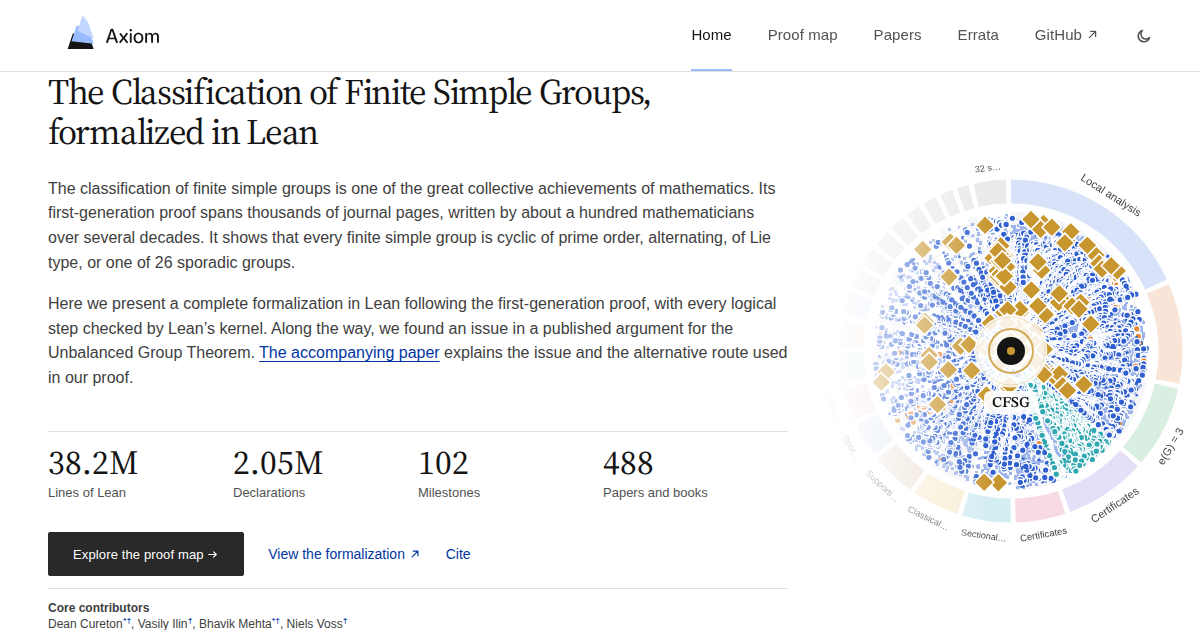
Axiom uses AI agent swarms to fully formalize the Classification of Finite Simple Groups in Lean in 24 days: about 43.1M lines, the first complete computer-checked proof of the longest proof in math history

AI math company Axiom announced on Oct 27 that swarms of dozens of AI agents formalized the Classification of Finite Simple Groups (CFSG; the original proof runs about 15,000 pages across 500+ articles by about 100 mathematicians) in the Lean proof assistant in 24 days, producing about 43.1M lines of Lean and 2.05M declarations, with the repo public on GitHub. The work surfaced 34 noteworthy deviations from the published record, and AxiomProver produced a new alternative argument for the Unbalanced Group Theorem.

Axiom uses AI agent swarms to fully formalize the Classification of Finite Simple Groups in Lean in 24 days: about 43.1M lines, the first complete computer-checked proof of the longest proof in math history

Key Takeaways

  • Per Axiom: 24 days and swarms of dozens of AI agents produced about 43.1M lines of Lean, 2.05M declarations and 100 milestones, drawing on 715 papers and books
  • The original CFSG proof spans about 15,000 pages in 500+ articles by about 100 mathematicians; this is the first time it has been fully computer-checked
  • Formalizing it exposed 34 noteworthy deviations from the literature, the biggest a closure assertion in Walter's 1986 Unbalanced Group Theorem argument, with explicit counterexamples such as PSL2(49)
  • AxiomProver produced an alternative argument built on Solomon's 1976 theory and proved a new theorem, "Preservation of simple tops", published on Hexagon (2610.00575)
  • Humans stayed essential: original CFSG group theorists including Richard Lyons and Ronald Solomon were consulted, and an errata list will be published with an advisory board
Read full story
Linked Models & Agents:
⚡ AxiomProver🌐 Axiom

Anthropic publishes a 3-SAT algorithm found by an internal Claude research model: its paper and Lean 4 proof claim to refute the Exponential Time Hypothesis

Anthropic published the paper "A 2^o(n) Time Algorithm for 3-SAT" (credited to Claude, Anthropic) and an AI-written Lean 4 formalization in its official anthropics/formal-math GitHub repo. It claims a deterministic algorithm solves 3-SAT in 2^o(n) time, which would refute the Exponential Time Hypothesis (ETH). Anthropic's Levent Alpoge said on X that an internal Claude research model found the core algorithm on Oct 16 with 14M output tokens and no human input. The repo stresses the result is purely asymptotic and says nothing about solving formulas in practice.

Key Takeaways

  • The paper claims a deterministic algorithm decides 3-SAT on n variables in 2^o(n) time, refuting ETH, and solves the harder counting problem #3-SAT in 2^O(n log log n / sqrt(log n)) time
  • Per Levent Alpoge on X, an internal Claude research model found the core algorithm on Oct 16 with 14M output tokens and no human input; researchers then worked with Claude on the presentation
  • The Lean 4 proof was written by AI models and pins Lean and Mathlib v4.33.1; the README says it depends only on Lean's three standard axioms, and CI re-checks it with a second independent kernel, nanoda
  • The repo states the result is purely asymptotic and says nothing about solving formulas in practice; independent review by mathematicians is still pending
  • A day earlier OpenAI announced its own model-produced refutation of ETH; both claims are now under review
Read full story
Linked Models & Agents:

OpenAI unveils three AI-produced results: a claimed refutation of the Exponential Time Hypothesis, local smoothing in every dimension, and an existence proof for QCD

In an Oct 26 blog post, OpenAI said its internal models produced three new results: a proof of Sogge's local smoothing conjecture in every dimension (which implies the Kakeya and Stein restriction conjectures), a Lean-verified proof that the Exponential Time Hypothesis (ETH) is false, and a rigorous existence proof for four-dimensional QCD and related quantum field theories including pure Yang-Mills. The math and CS papers and Lean proofs are in the openai/math GitHub repo; the physics artifacts are being held back while an external group led by David Gross writes them up. All of this is OpenAI's own claim and still awaits independent verification.

OpenAI unveils three AI-produced results: a claimed refutation of the Exponential Time Hypothesis, local smoothing in every dimension, and an existence proof for QCD

Key Takeaways

  • Computer science (per OpenAI): the paper gives a deterministic algorithm that exactly counts satisfying assignments of fixed-width CNF formulas in subexponential time and polynomial space, and the 3-SAT case refutes ETH; the AI found the proof on Oct 16 and it was formalized in Lean on Oct 17
  • ETH was proposed by Impagliazzo, Paturi and Zane and has been used in hundreds of papers for conditional lower bounds; the verification group is led by Impagliazzo, Paturi (UC San Diego) and Ryan Williams (MIT), and OpenAI has committed to fund a conference
  • Math: local smoothing is proved in every spatial dimension n>=2, which yields the Kakeya and Nikodym maximal conjectures and Stein restriction estimates; earlier work only covered two dimensions (2019) and three-dimensional Kakeya (2025)
  • Physics: the natural-language Yang-Mills existence proof was produced on Sep 9 and the QCD proof on Sep 18, with the Yang-Mills Lean formalization finished Oct 16; a five-person group led by David Gross will write it up and the artifacts are not public yet
  • OpenAI says it seeks no academic credit, and outside participants are unpaid volunteers with no NDAs; the openai/math repo withdrew 3 manuscripts on Oct 7 over a sign error, so these claims still need independent checking
  • Physics follow-up (Oct 28): KITP published the Yang-Mills Working Group statement. The committee is Michael Douglas, David Gross (chair), Arthur Jaffe, Igor Klebanov and Nikita Nekrasov; OpenAI asked Gross on Oct 16 to take custody of the proof, and the committee says it has no responsibility to OpenAI. It will first check that the Lean formalization matches standard definitions before releasing the Lean proof, then publish the full 1,147-page proof with its assessment once satisfied; confinement and the mass gap remain open
Read full story
Linked Models & Agents:

X discussion: Zerodha CEO Nithin Kamath asks what traders are building with free Kite APIs and AI coding agents

On Oct 26, Zerodha founder and CEO Nithin Kamath asked on X how people are using Kite APIs with AI agents now that they are free, and what they have built. He said AI coding agents such as Claude Code and Codex have made it much easier for traders and investors to build their own tools without much coding experience, and that Zerodha is seeing more Kite API usage because of these agents. Within about 10 hours the post drew more than 2,200 likes, over 2,000 bookmarks and 200+ replies. This is an X discussion and the CEO's own view, not a new product launch.

X discussion: Zerodha CEO Nithin Kamath asks what traders are building with free Kite APIs and AI coding agents

Key Takeaways

  • Engagement (as of 2026-10-26 21:08 UTC, public X API metrics): about 183K views, 2,256 likes, 2,039 bookmarks, 219 replies and 113 reposts
  • Source of the view: an original post by Zerodha founder and CEO Nithin Kamath (@Nithin0dha), who says coding agents are driving more Kite API usage; Zerodha has not published how much
  • Pricing (per the official Zerodha API page): the Personal tier is free with orders, GTT, alerts, margin computation and portfolio management; the Connect tier costs ₹500/month and adds realtime WebSocket streaming and historical candles
  • Official SDKs cover 8 languages (Python, Java, Node.js, C#/.NET, Go, Rust, PHP and C++), so coding agents can generate client code directly
  • The debate: AI coding agents make it common for non-programmers to build their own trading tools, which also puts risk control and automated order placement in individual hands
Read full story
ADSponsored

GitHub Next Releases PDD Kit: Provable Specification Enforcement for Coding Agents to Eliminate Edge-Case Regressions

GitHub Next officially released PDD Kit (Property-Driven Development Kit), establishing a formal verification toolkit tailored for autonomous coding agents. Addressing the pervasive reliability gap where agent-generated code passes isolated unit tests but crashes on subtle edge cases, PDD Kit combines property-driven specifications with automated formal solvers. Instead of testing arbitrary sample inputs, PDD Kit mathematically proves that agent code adheres to rigorous invariant specifications across every possible input, preventing regressions and elevating coding agents from probabilistic generation to provable correctness.

GitHub Next Releases PDD Kit: Provable Specification Enforcement for Coding Agents to Eliminate Edge-Case Regressions

Key Takeaways

  • GitHub Next releases PDD Kit to eliminate edge-case flaws in agent-generated code via automated mathematical proofs
  • Pioneers 'proofs for every input', replacing fragile, underspecified unit test samples with comprehensive invariant verification
  • Eliminates deadlocks, boundary index out-of-bounds, and state desynchronization in agentic refactoring workflows
  • Provides an indispensable verification foundation for deploying autonomous coding agents into mission-critical production systems
Read full story

CMU and Fudan Pioneer Looped Model Foundations with Huginn MoE: Sandwich Topology Matches 32B Feedforward Baseline with 8B Resident Weights

Looped language models reuse physical Transformer blocks across logical depth to compress parameter footprints, but existing approaches entangle recurrence placement, input injection, and recurrent-state topologies. CMU and Fudan researchers published Part I of 'Towards Looped Models Done Right' (arXiv:2610.23036). Introducing a Prelude-Recurrent-Coda sandwich architecture, an 8.0B-resident / 794M-active Huginn MoE trained on 500B tokens matches a 32.0B-resident / 3.2B-active feedforward reference across MMLU, GSM8K, and MATH500.

CMU and Fudan Pioneer Looped Model Foundations with Huginn MoE: Sandwich Topology Matches 32B Feedforward Baseline with 8B Resident Weights

Key Takeaways

  • CMU and Fudan University established Part I of 'Towards Looped Models Done Right' (arXiv:2610.23036), decoupling recurrence placement from state design
  • Proposes the Prelude-Recurrent-Coda sandwich architecture (Huginn) to prevent representational collapse in looped transformers
  • Demonstrates that an 8.0B-resident / 794M-active Huginn MoE trained on 500B tokens fully matches a 32.0B-resident / 3.2B-active feedforward reference
  • Slashes resident memory footprint by 75%, charting a clear path to run 30B-tier reasoning models on 16GB–24GB consumer GPUs
Read full story
Linked Models & Agents:

Zero-Human-Label Step Accuracy Jumps from 48.2% to 74.7%: LeanPRM Grounds Process Supervision in Lean 4, While Cornell's CPLM Matches Full Attention at w=128

Tackling step-level verification in mathematical reasoning and in-context copying bottlenecks in Transformers, NYU/UCLA/Stanford researchers introduce LeanPRM (arXiv:2610.17697)—using the Lean 4 theorem prover to automatically label 152K steps across 10,634 natural-language proofs with zero human annotation, boosting Qwen3-4B step accuracy on LeanPRM-Bench from 48.2% to 74.7% (vs. 60.3% for PRM800K). Meanwhile, Cornell University's Copy-Paste Language Models (CPLMs, arXiv:2610.19247) add a lightweight Copy-Paste head (~3% compute overhead) that relieves the LM head gradient bottleneck, boosting LAMBADA accuracy by +2.5-4.0 points and allowing a w=128 sliding-window CPLM to match full-attention perplexity.

Zero-Human-Label Step Accuracy Jumps from 48.2% to 74.7%: LeanPRM Grounds Process Supervision in Lean 4, While Cornell's CPLM Matches Full Attention at w=128

Key Takeaways

  • LeanPRM uses the Lean 4 proof assistant and a syntax-error filter to generate 152K step-level labels across 10,634 proofs with zero human annotation
  • A Qwen3-4B verifier trained on LeanPRM reaches 74.7% step accuracy on LeanPRM-Bench (vs. 48.2% base and 60.3% with PRM800K) and improves 0.6B-8B verifiers on Hard2Verify and IMO-GradingBench
  • Cornell's Copy-Paste Language Models (CPLMs) add a ~3%-overhead copy head that relieves the LM head gradient bottleneck, boosting LAMBADA by +2.5-4.0 points and matching full-attention perplexity with a w=128 sliding window
Read full story
Linked Models & Agents:

Breaking GRPO Exploration Collapse: SERO Executable Oracle Continuations (+11.2 pts on ALFWorld OOD) and EDEN Anchored Embedding Noise (+13.3 pts on AIME 2025)

Addressing rollout homogenization and zero-variance advantage collapse in group-relative reinforcement learning (GRPO), SERO (arXiv:2610.19397) restores learner-visited states to execute multi-step oracle continuations with policy-reachability weighting—boosting 7B ALFWorld OOD success by +11.20 points to 87.50%—while UNSW's EDEN (arXiv:2610.16105) appends a single anchored Gaussian-perturbed embedding position to a fraction of rollouts, lifting Qwen2.5-Math-7B AIME 2025 Pass@256 by +13.33 points (to 66.67%) without increasing rollout budgets.

Breaking GRPO Exploration Collapse: SERO Executable Oracle Continuations (+11.2 pts on ALFWorld OOD) and EDEN Anchored Embedding Noise (+13.3 pts on AIME 2025)

Key Takeaways

  • SERO restores learner-visited states and executes multi-step oracle continuations with policy-reachability weighting, boosting 7B ALFWorld unseen success by +11.20 points to 87.50% (95.57% seen)
  • UNSW's EDEN appends a single anchored Gaussian-perturbed embedding position to a fraction of rollouts, beating G=32 standard GRPO using only G=16 rollouts
  • On AIME 2025, EDEN lifts Qwen2.5-Math-7B Pass@256 by +13.33 percentage points (from 53.33% to 66.67%) while preserving diverse multi-derivation reasoning traces
Read full story
Linked Models & Agents:

Hugging Face Top Breakthroughs: Waypoint-OPD Gated Distillation (451 Upvotes) & FDE-Gym Benchmark for Forward-Deployed AI Engineering

Topping today's Hugging Face Daily Papers are Waypoint-OPD (451 upvotes, arXiv:2610.21601) and FDE-Gym (230 upvotes, arXiv:2610.22350). Waypoint-OPD leverages an intermediate RL teacher checkpoint to gate endpoint policy-shift distillation on Qwen3-8B, 14B, and 30B-A3B students, achieving #1 accuracy across all six math and coding settings. Meanwhile, FDE-Gym benchmarks 13 frontier agent configurations across 95 realistic forward-deployed engineering delivery tasks, revealing that the best system resolves only 14 of 95 tasks when unstated customer constraints must be uncovered.

Hugging Face Top Breakthroughs: Waypoint-OPD Gated Distillation (451 Upvotes) & FDE-Gym Benchmark for Forward-Deployed AI Engineering

Key Takeaways

  • Waypoint-OPD leads HF Daily Papers (451 upvotes): gates endpoint RL policy-shift distillation via intermediate checkpoint agreement, winning all 6 math and code settings on Qwen3-8B/14B/30B-A3B
  • FDE-Gym benchmarks Forward-Deployed Engineering (230 upvotes): evaluates agents across 95 live-system customer delivery tasks spanning 18 sectors
  • Exposes the last-mile delivery bottleneck: the strongest frontier agent configuration scores just 0.56 and resolves only 14 of 95 tasks when unstated constraints must be uncovered
Read full story
Linked Models & Agents: