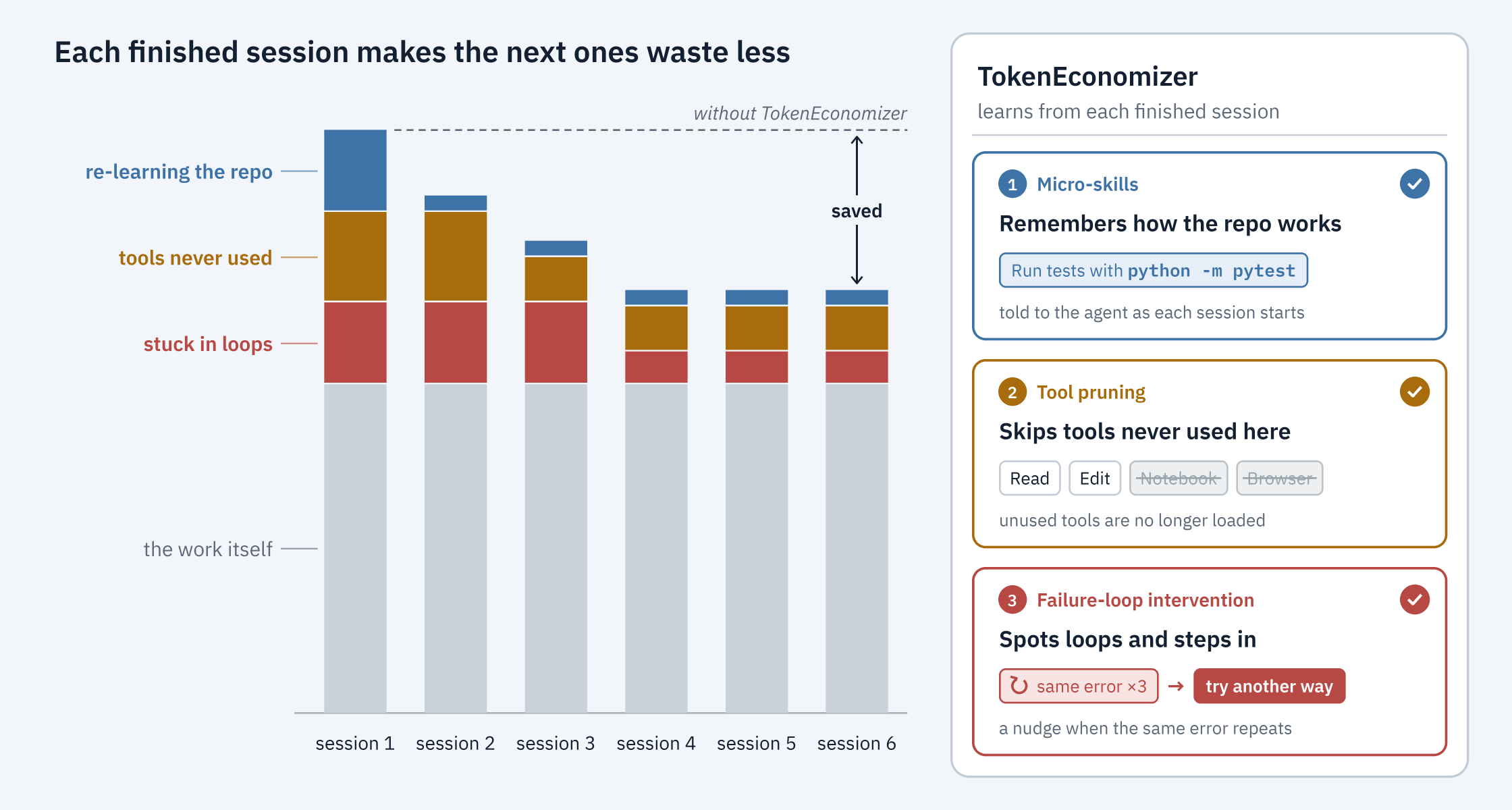
Microsoft Research, Microsoft Security and UC Berkeley open-sourced TokenEconomizer on GitHub (Apache 2.0, v0.1.0 released October 26), a plugin for Claude Code, Codex, GitHub Copilot CLI and Pi, with experimental opencode support. It learns from earlier sessions in the same repository: micro-skills remember repo facts, tool pruning drops tool definitions that go unused, and a loop guard nudges an agent that is stuck. The paper reports 18.4–30.9% lower mean cost across five agent and model combinations on 277 SWE-Bench tasks (paper figures).
Zoom
Key Takeaways
Cost: on 277 SWE-Bench tasks across 6 repositories and 5 agent and model combinations, mean cost fell 18.4–30.9%, and all 30 repository-by-combination cells got cheaper (paper figures, including the plugin's own model calls)
Success rate: Pass@1 rose in 4 of 5 combinations, e.g. Copilot CLI with Sonnet 5 cost 18.4% less with Pass@1 +2.6, while Claude Code with Opus 4.8 cost 30.9% less with Pass@1 -1.0
Three mechanisms: micro-skills (repo facts stated only after three sessions confirm them), tool pruning (by default a tool unused over 10 prompts across 2 sessions is left out), and a failure-loop guard (one redirect when a judge is at least 0.7 confident, never stopping a turn itself)
Generalization: 16–21% lower cost on Web-Bench and 6–20% lower on two security-auditing benchmarks where every task is a new repository
Deployment: Apache 2.0, Python 3.10+, no API key of its own, and learned experience stays local in ~/.tokeneconomizer
Microsoft Research (MSRA) researchers published and open-sourced WildAWM (arXiv:2610.26828, GitHub: MSR-Orchard/WildAWM), a generalist agent world model designed for open-ended 'in the wild' digital environments. Traditional computer-use agents rely on slow, brittle, and expensive live web/OS sandboxes for training and evaluation. WildAWM establishes a scalable multimodal world model that accurately predicts visual screen transitions and DOM mutations conditioned on agent actions (click, type, scroll). By replacing live execution environments with a high-fidelity neural simulator, WildAWM unlocks safe, accelerated offline reinforcement learning for GUI agents.
Zoom
Key Takeaways
Microsoft Research open-sources WildAWM (arXiv:2610.26828), establishing the first generalist world model for wild web and GUI domains
Eliminates dependency on fragile, expensive live web sandboxes that risk side-effects during agent trial-and-error training
Employs an action-conditioned multimodal autoregressive design predicting high-fidelity visual rollouts following clicks, typing, and scrolling
Decisively outperforms prior state-transition baselines across e-commerce, enterprise software, and desktop GUI simulations
Alibaba Taobao & Tmall Group detailed CommerceGen-Studio (arXiv:2610.20603, 52 HF upvotes), a production multi-agent generation system serving millions of images daily within seconds. Its 6B SKU-DiT trained via Reinforce-Distill-Reinforce (RDR) scores 9.43 (single-image) and 9.45 (multi-image) on CommerceGen-Bench, outperforming 20B open models and closed-source Nano Banana Pro. Meanwhile, Microsoft Research introduced Mine, Sample, Render (MSR, arXiv:2610.21185) for training-free test-time diversity alignment.
Zoom
Key Takeaways
Alibaba's CommerceGen-Studio (arXiv:2610.20603) serves millions of commercial product images per day in production with a latency of a few seconds per image
Its 6B SKU-DiT trained with Reinforce-Distill-Reinforce (RDR) scores 9.43 (single-image) and 9.45 (multi-image) on CommerceGen-Bench, beating 20B open models and closed-source Nano Banana Pro (9.39 / 9.33)
Combining SKU-DiT with the self-evolving PERL-Agent loop and Layout Thinker Optimization pushes scores to 9.62 (single-image) and 9.48 (multi-image)
Microsoft Research's Mine, Sample, Render (MSR, arXiv:2610.21185) externalizes test-time diversity via corpus-mined attribute sampling across webpage UI design, agent-generated 3D assets, user simulation, and text-to-image
Microsoft Research and Stanford University have unveiled AutoEnvScaling, an automated data flywheel that frames RL environment creation itself as a terminal execution task. A proposer agent builds diverse environments directly from solver rollouts, slashing cost per valid environment by 75% while achieving a 25x higher valid environment yield over prompt-only baselines. Crucially, unifying environment design and solving within a single model enables Recursive Self-Improvement (RSI), yielding +12.2 points on Terminal-Bench 2.1 and doubling scores on Terminal-Bench 4.0.
Zoom
Key Takeaways
Environment design as a terminal task: shifts RL environment synthesis from manual curation to automated terminal execution, boosting valid yield by 25x
Unlocks Recursive Self-Improvement (RSI): enables a single backbone to co-evolve as both environment architect and task solver without human bottlenecks
Broad cross-domain generalization: yields a 12.2-point surge on Terminal-Bench 2.1 and doubles Terminal-Bench 4.0 for Qwen3.6-35B-A3B across kernel coding and OS tasks
As autonomous coding agents achieve surging scores on benchmarks like SWE-bench, the prevailing assumption has been that coding proficiency primarily correlates with lines of code modified when aided by terminal search tools. However, agents routinely fail on subtle modifications in real repositories. Microsoft Research introduces CABRA (arXiv:2610.10610, code: github.com/microsoft/CABRA), a synthetic evaluation blueprint designed to isolate code comprehension from simple editing throughput. CABRA synthesizes programs as Directed Acyclic Graphs (DAGs) and scales task difficulty systematically along four orthogonal axes parameterized by n: Function Traversal, Function Search, Runtime Resolution, and Instruction Following. The findings establish that code comprehension—rather than tool invocation or editing volume—is the true bottleneck of autonomous coding agents. Crucially, the volume of tool calls allocated to code comprehension operations (such as READ and ANALYZE) serves as a substantially stronger predictor of an agent's success on SWE-bench Verified than the number of lines of code edited, with code and datasets fully open-sourced.
Zoom
Key Takeaways
Microsoft open-sources CABRA, synthesizing DAG codebases to decouple code comprehension from raw lines edited
Demonstrates comprehension is the key bottleneck, causing a 50%-78% pass rate collapse as traversal depth scales
Comprehension tool invocations predict real-world SWE-bench success far better than editing volume or search counts
Test-time self-improvement—the ability of an agent to iteratively refine solutions during inference—relies on high-fidelity reflection to surpass current proposals and long-horizon execution to maintain coherent multi-round exploration. Researchers from Renmin University of China, Microsoft Research, and USTC introduce AREX-2, establishing that these capabilities are domain-agnostic and learnable from verifiable environments. Synthesizing long-horizon reflective trajectories across machine learning and algorithmic programming, an AREX-2 agent built on Qwen3.8-27B achieves 81.8 on MLE-bench Lite and 70.7 on Frontier-CS, transferring seamlessly to deep research with 84.0 on BrowseComp, 92.2 on GAIA, and 93.8 on DeepSearchQA while monotonically scaling with compute budget.
Zoom
Key Takeaways
Identifies reflection and long-horizon execution as domain-agnostic foundations for test-time self-improving agents
Achieves 81.8 on MLE-bench Lite and 70.7 on Frontier-CS using an AREX-2 Qwen3.8-27B model
Transfers zero-shot to deep research benchmarks, scoring 92.2 on GAIA, 93.8 on DeepSearchQA, and 84.0 on BrowseComp
Completing multi-hop tasks across large document collections requires connecting disjoint evidence scattered across disparate files—such as project approvals in one document, architectural requirements in a second, and incident reports in a third. Existing search agents iterate over flat file collections where documents offer zero clues regarding their cross-file relationships, forcing agents to blindly rediscover inter-document links for every single query while incurring immense token overhead and missing complementary evidence. KAIST and Microsoft researchers introduce CorpusMap, an entity-anchored navigation layer that organizes the document collection around recurring, cross-document entities. By constructing offline Entity Pages that aggregate mentions and link to all referencing source documents, CorpusMap exposes a navigable topological graph that agents traverse to unearth scattered evidence. Evaluated across 7 models and 3 benchmarks, CorpusMap delivers superior evidence discovery and answer accuracy while consuming significantly fewer tokens.
Zoom
Key Takeaways
Offline Entity Graph Eradicates Search Redundancy: Pre-resolves recurring entities into bidirectional Entity Pages offline, transforming flat files into a navigable graph and sparing agents from repeatedly rediscovering relationships.
Substantial Token Savings in Multi-Hop Retrieval: Replaces blind iterative keyword sweeps with surgical graph traversal, drastically reducing total prompt token overhead on complex multi-document questions.
Cross-Model Superiority Across 7 Backbones: Rigorously benchmarked across seven diverse LLM architectures and three evaluation suites, outperforming raw search and four alternate navigation layers in evidence discovery and fidelity.
Understanding long-form video requires multimodal agents to gather and synthesize temporal evidence across dozens of reasoning steps. However, existing architectures predominantly employ append-only working memory, resulting in 'semantic thrashing': as contexts expand, attention across critical facts collapses and the agent loses access to previously discovered clues. Researchers from the University of Rochester and Microsoft Research introduce VideoLoop, an agent architecture featuring two coupled loops: an outer reasoning loop coupled with an inner memory rewriting loop. After each step, the inner loop queries an unbounded filesystem of past observations and continuously rewrites a bounded working memory buffer. VideoLoop provides plug-and-play gains averaging 4.2 points across four major LVLM backbones, propelling Gemini 3.1 Pro to 88.3% on VideoMME (long) and 88.8% on VideoMMMU.
Zoom
Key Takeaways
Formalizing Semantic Thrashing: Mathematically establishes that append-only memory structures inevitably fail over long horizons without an explicit rewrite operator to prune accumulated observation noise.
Coupled Dual-Loop Memory Architecture: Combines an outer multimodal reasoning loop with an inner memory rewriting loop that selectively retrieves from an unbounded observation store into a compact, bounded working context.
88.3% on VideoMME (Long) with Gemini 3.1 Pro: On the hardest quartile of VideoMME (long), blind evaluation accuracy leaps from 60.9% to 81.1%; paired with Gemini 3.1 Pro, achieves 88.3% on VideoMME and 88.8% on VideoMMMU.
Microsoft Research and ServiceNow Research introduced FrogNano (arXiv:2609.07925), a 4B-parameter compact coding agent built to solve real-world software engineering (SWE) challenges on constrained edge hardware. Diverging from traditional approaches that rely on knowledge distillation from massive frontier LLMs, FrogNano is post-trained exclusively via Reinforcement Learning (RL) across ~1,500 diverse software engineering repositories. The technical breakthrough lies in its online task synthesis pipeline, which dynamically calibrates synthetic task generation directly to the checkpoint's learnability frontier. The study provides empirical proof that compact models can develop competitive agentic coding capabilities purely through self-guided reinforcement learning.
Zoom
Key Takeaways
Ultra-compact 4B parameter scale: delivers full terminal interaction and multi-file code editing capabilities suitable for single consumer GPUs and laptops
Distillation-free reinforcement learning: eschews fine-tuning on synthetic trajectories from frontier models, training purely via RL environmental feedback
Learnability frontier synthesis: dynamic task synthesis engine calibrates task complexity to match the evolving boundary of the agent checkpoint
1,500+ diverse software environments: trained across thousands of heterogeneous repositories with realistic build and testing suites
Edge-native software engineering: provides an efficient, privacy-preserving blueprint for local code assistance without cloud API dependencies
Researchers from Microsoft Research introduced Coding-Agent Skill Distillation (CASD, arXiv:2609.26261), fundamentally rethinking prompt optimization for autonomous agents. Traditional search-based optimizers (like GEPA) iteratively propose prompt variants, execute fresh rollouts in simulation environments, and evaluate validation scores—costing dozens of dollars per task. CASD eliminates this iterative loop entirely. Given only a static corpus of past agent trajectories, an off-the-shelf coding agent writes and runs code to compute corpus-wide error distributions, inspects key failure modes, and synthesizes behavioral rules into the prompt. Across four rigorous benchmarks (ALFWorld, tau2-bench retail/telecom, SpreadsheetBench), a single CASD pass outperforms GEPA and SkillOpt, raising baseline accuracy by 16.6 percentage points for only $1.60—over 22x cheaper than validation-gated search.
Zoom
Key Takeaways
Zero online environment rollouts: optimizes complex agent prompts entirely from static trajectory corpora without sandbox interaction
Over 22x cheaper at $1.60: slashes prompt optimization costs from ~$35 down to $1.60 per run compared to validation-gated search
Outperforms state-of-the-art: lifts baseline performance by 16.6 percentage points across four benchmarks, surpassing GEPA (+10.9%) and SkillOpt (+5.3%)
Corpus-wide code reflection: agents author and execute statistical analysis scripts to identify systematic failure modes rather than localized batches
Multi-domain validation: demonstrates consistent empirical gains across embodied tasks (ALFWorld), service workflows (tau2), and tabular reasoning
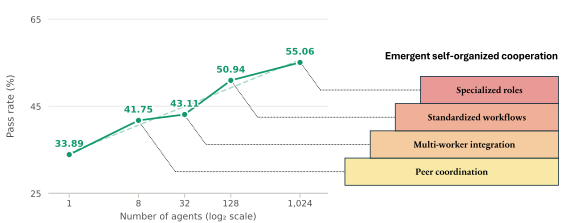
Zhihao Zhan, a Microsoft Research Asia researcher and co-first author, announced on X on Oct 24 that Agensh is now open source under MIT. It is a multi-agent coding harness with no central orchestrator: workers claim sub-tasks, verify and merge asynchronously. Per the authors, scaling from 1 to 1,024 agents lifts the final pandoc test-pass rate from 33.89% to 55.06%.
Zoom
Key Takeaways
Open-sourced on Oct 24 under MIT: harness, experiment launch scripts and reproduction guide at microsoft/Agensh.
Authors report: on the 5 hardest ProgramBench tasks (GPT-5.6-sol high, 6h budget, no Internet), mean final test-pass rate rises from 19.31% with 1 agent to 28.78% with 128 agents, about 49% relative.
Authors report: on pandoc, 1 to 128 to 1,024 agents moves the pass rate from 33.89% to 50.94% to 55.06%.
Coordination runs through Gitea (shared workspace), Mattermost (messaging) and a shared-context board adapted from DeLM; each worker uses the Copilot harness agent loop.
The release ships a single-node Docker Compose team setup plus a single-agent baseline, both on native Copilot ACP sessions.