AI Coding Live News

Google brings Gemini Robotics ER 2, DeepMind's embodied reasoning model, to Google Cloud in public preview so enterprises can orchestrate VLA models and multi-robot teams

On Oct 27 Google Cloud announced that Gemini Robotics ER 2, Google DeepMind's embodied reasoning model, is in public preview on the Gemini platform via Model Garden, under the model ID gemini-robotics-er-2-preview and built on Gemini 3.5 Flash. It acts as a robot's high-level brain: it reasons over space and time in video, plans multi-step tasks, checks whether an action succeeded, and calls VLA models and navigation APIs as tools, including across teams of different robots. Google says it pinpoints key video frames with 91.3% accuracy.

Key Takeaways

  • Model ID gemini-robotics-er-2-preview, built on Gemini 3.5 Flash, takes text, image, video and audio input, with a 131,072-token input and 65,536-token output limit
  • The core pattern is declaring VLA models, navigation APIs or custom functions as tools, with ER 2 planning and orchestrating them while explaining itself and accepting redirection in natural language
  • It classifies task progress as binary, discrete or continuous scores; Google cites 91.3% accuracy and a 0.96-second mean frame distance for finding key moments in video
  • It reads values from more than 10 instrument types, including dials, sight glasses, digital displays and rulers
  • The enterprise version adds IAM, security controls and function calling; the Cloud preview supports GenerateContent but not the Live API, and Boston Dynamics and Arm are among early users
Read full story
Linked Models & Agents:

Google Cloud Open-Sources TorchTPU: Native PyTorch on Google TPU Hardware with Day-Zero vLLM and SGLang Support

Google Cloud officially open-sourced TorchTPU, enabling native, zero-compilation-barrier PyTorch execution directly on Google Cloud TPU hardware (TPU v5p and TPU v6e). Overcoming the legacy friction of PyTorch/XLA's rigid graph compilation and dynamic-shape stalls, TorchTPU supports native PyTorch eager execution and custom Triton/C++ kernels. Leading high-throughput serving engines vLLM and SGLang announced immediate Day-0 support. Concurrently, Google Cloud introduced OpenAI models and Codex into its Vertex Model Garden, becoming the first hyperscaler to offer all three top frontier closed models.

Google Cloud Open-Sources TorchTPU: Native PyTorch on Google TPU Hardware with Day-Zero vLLM and SGLang Support

Key Takeaways

  • Google Cloud open-sources TorchTPU, delivering native, compilation-free PyTorch execution on TPU v5p and TPU v6e hardware
  • Eliminates PyTorch/XLA graph-compilation overhead, natively supporting PyTorch eager mode and custom Triton/C++ kernels
  • vLLM and SGLang announce immediate Day-0 TorchTPU releases, unlocking substantial throughput boosts on TPU infrastructure
  • OpenAI frontier models and Codex join Google Cloud's Model Garden, solidifying Google Cloud as the premier multi-model hyperscaler
Read full story

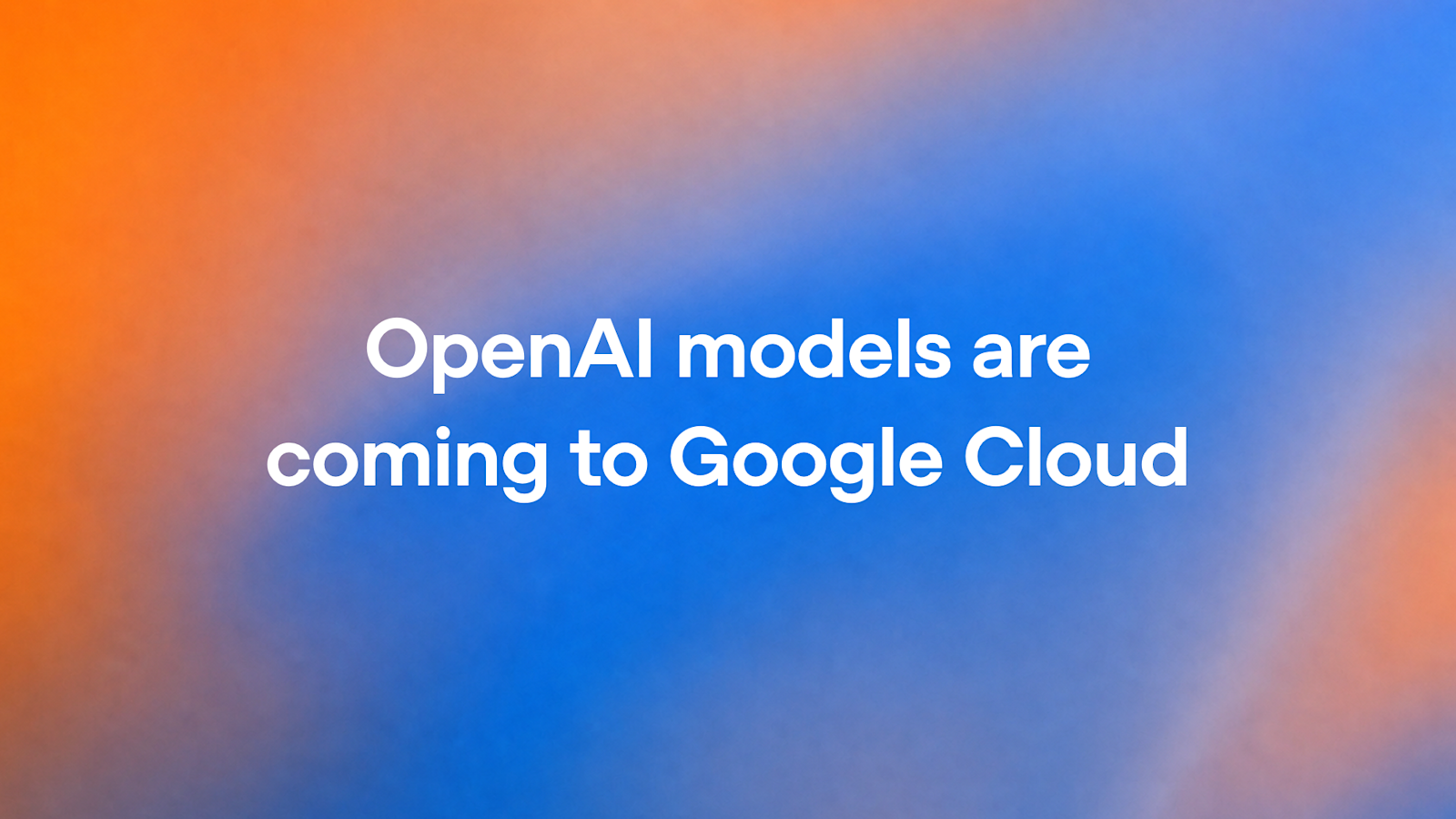
OpenAI frontier models and Codex are coming to Google Cloud: Model Garden access, bought via Marketplace against existing GCP commitments

On Oct 21, OpenAI and Google Cloud announced a partnership bringing OpenAI frontier models and Codex agentic workflows into Google Cloud Model Garden, transacted through Google Cloud Marketplace so enterprises can draw down existing GCP commitments. OpenAI models will also come to Google Antigravity and Gemini Agent soon. General availability is planned in the coming weeks, and Microsoft remains OpenAI's primary cloud partner. After AWS, this puts OpenAI models on all three major US clouds.

OpenAI frontier models and Codex are coming to Google Cloud: Model Garden access, bought via Marketplace against existing GCP commitments

Key Takeaways

  • Channel: OpenAI frontier models and Codex come to Google Cloud Model Garden, transacted through Google Cloud Marketplace (official)
  • Procurement: enterprises can draw down existing GCP commitments, no separate OpenAI contract or invoice
  • Ecosystem: OpenAI models are coming soon to Google Antigravity and Gemini Agent, selectable alongside Gemini
  • Timing: GA planned in the coming weeks, access requests open now; Microsoft remains the primary cloud partner
  • Landscape: after Microsoft exclusivity ended in April and AWS added OpenAI models, OpenAI is now on all three major US clouds (per Reuters/CNBC)
Read full story

Meta open-sources Muse Spark Open: 816B/42B natively multimodal US open-weight flagship, runs on two M5 Ultra Mac Studios

On 2026-10-15 Meta released Muse Spark Open open weights: an 816B-total / 42B-active MoE with a Perception Encoder, natively multimodal (text/image/video/audio in → text out), 1M context, aimed at coding and long-horizon agents. Weights are on Hugging Face (BF16/NVFP4), SageMaker, Model Garden and Foundry; APIs include OpenRouter, Together, Fireworks and Groq. Meta calls it the most capable US open-weight model to date and, with Apple, optimized it to run locally across two M5 Ultra Mac Studios via MLX.

Meta open-sources Muse Spark Open: 816B/42B natively multimodal US open-weight flagship, runs on two M5 Ultra Mac Studios

Key Takeaways

  • Specs: MoE 816B total / 42B active (256 experts, top-8), 62 layers, 1M context; text+image+video+audio in → text out (model card)
  • Local: NVFP4 needs ≥~700GB VRAM, BF16 ~2TB; or two Apple M5 Ultra Mac Studios via MLX (Meta blog)
  • Agentic benches (xhigh, official table): MCP-Atlas 89.2, JobBench 61.8, OSWorld Verified 80.4, Terminal-Bench 2.1 76.4, DeepSWE 1.1 60, AA Intelligence Index 39
  • Serve with SGLang / vLLM / TensorRT-LLM / Transformers / llama.cpp / Unsloth / MLX; Helion kernels claim 1.03–3.95× kernel speedups on NVIDIA/AMD
  • License: Muse Model License (display “Built with Muse Spark Open”; MaaS over $20M/yr needs a separate deal); OpenRouter ~$1.25/M in, $4.25/M out
Read full story
Linked Models & Agents:
ADSponsored