AI Coding Live News

Microsoft Open-Sources Mage-VL-Cowork, a 4B Computer-Use Agent That Chooses Between Clicking the GUI and Running Bash, Scoring 66.0% on OSWorld-Verified

On October 30, Microsoft's Mage team released Mage-VL-Cowork on Hugging Face under Apache-2.0: a 4B multimodal computer-use agent in which a single model decides at every step whether to act through screenshots and GUI clicks (computer_use) or through bash and Python in a terminal, with no external orchestrator. Microsoft reports a two-run average of 66.0% on OSWorld-Verified (361 tasks, 50-step budget), above Qwen3.6-27B at 63.9% but below the 9B SCALECUA-Qwen3.5-9B at 68.7%.
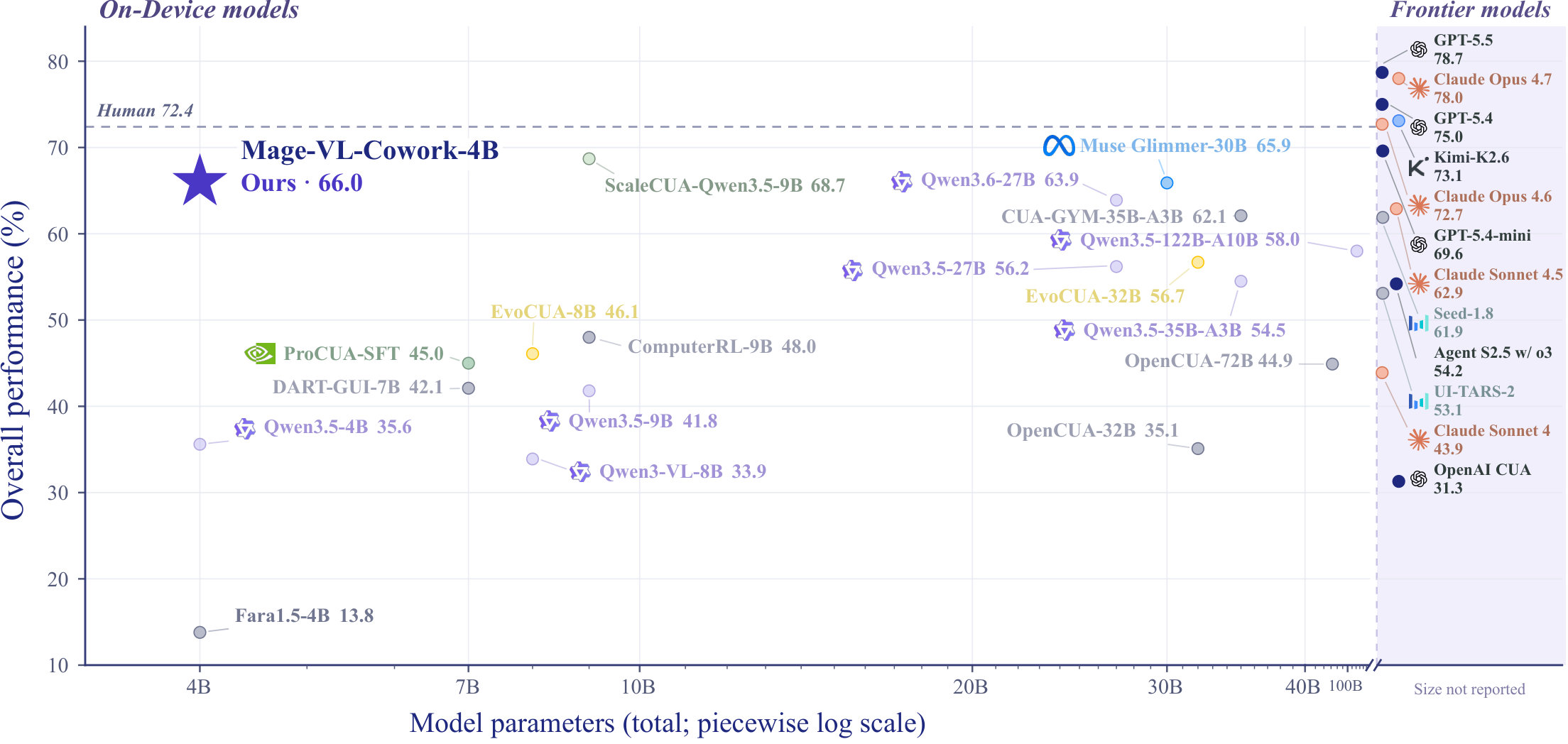
Microsoft Open-Sources Mage-VL-Cowork, a 4B Computer-Use Agent That Chooses Between Clicking the GUI and Running Bash, Scoring 66.0% on OSWorld-Verified

Key Takeaways

  • 4B parameters, built on Mage-VL (Mage-ViT vision encoder plus Qwen3-4B-Instruct-2507); about 9.48 GB of bf16 weights under Apache-2.0.
  • On OSWorld-Verified, two independent runs scored 65.33% and 66.75% for a 66.0% average; 87.5% on operating-system tasks and 62.7% on multi-app workflows.
  • In Microsoft's side-by-side, a LibreOffice Calc chart task took 39 seconds (6 steps) via Python in the terminal, versus 9:56 (39 steps) for GUI-only Qwen3.6-27B.
  • Online RL adds 10.16 points over hybrid SFT while cutting mean model calls by 13.0% and output tokens by 25.4%.
  • Training data came from Mage-CUA-Forge, which synthesized about 294K desktop and web tasks across 6,915 skills and cut per-task generation cost from $0.906 to $0.158.
Read full story
Linked Models & Agents:
⚡ Mage-VL-Cowork⚡ Mage-VL⚡ Qwen3-4B⚡ Qwen3.6-27B🌐 Microsoft

Alibaba Tongyi Labs Open-Sources OpenGCUA: Full-Stack Generalist Computer-Use Agent Cutting OSWorld Steps by 53%

Alibaba Tongyi Labs (Tongyi-MAI) has published and open-sourced OpenGCUA (arXiv:2610.22200), establishing a fully open software stack for Generalist Computer Use Agents. Moving beyond brittle single-click GUI paradigms, OpenGCUA introduces a 'Code-Execution-as-Action' framework combining visual screen perception, accessibility trees, bash scripts, and Playwright APIs into unified programmatic execution blocks. Evaluated across eight frontier models on OSWorld-v2, OpenGCUA boosted mean scores by +19.6 points while cutting task steps by 53.0%, releasing an Apache-2.0 macOS menu-bar harness and Cross-Device SDK.

Alibaba Tongyi Labs Open-Sources OpenGCUA: Full-Stack Generalist Computer-Use Agent Cutting OSWorld Steps by 53%

Key Takeaways

  • OpenGCUA published in arXiv:2610.22200 and released under Apache 2.0 as an open generalist computer-use agent stack
  • Pioneers 'Code-Execution-as-Action', synthesizing loops, conditionals, and programmatic APIs into unified Python/Bash blocks
  • On OSWorld-v2, boosts mean score by +19.6 points across eight frontier models while reducing steps per task by 53.0%
  • Releases a native macOS menu-bar harness for physical execution alongside a Cross-Device SDK spanning PC, web, and mobile
Read full story

Evolving Agent Interfaces: Empowering Computer-Use Agents to Synthesize Dynamic APIs for 58.58% Success

Researchers introduced 'Evolving Agent Interfaces' alongside the Agent S4 meta-framework in arXiv:2610.28601, removing the fundamental bottleneck of computer-use agents (CUAs). Conventional CUAs are forced to operate through human-designed graphical user interfaces—such as clicking spreadsheet cells one by one—inducing excessive action horizons and high failure rates. The new framework allows meta-agents to inspect live applications in scratch environments, dynamically synthesizing, testing, and evolving programmatic API wrappers and tool repositories on the fly. On OSWorld V2 and ScienceBoard, an open-weights 27B model raised task success from 55.03% to 58.58%, rivaling proprietary frontier models at a fraction of the cost.

Evolving Agent Interfaces: Empowering Computer-Use Agents to Synthesize Dynamic APIs for 58.58% Success

Key Takeaways

  • Evolving Agent Interfaces introduced in arXiv:2610.28601, pioneering dynamic API synthesis for computer-use agents (CUAs)
  • Meta-agents autonomously probe target applications in scratch VMs, writing bespoke programmatic wrappers to replace fragile GUI clicks
  • Elevates task completion rates on OSWorld V2 and ScienceBoard from 55.03% to 58.58% on an open 27B parameter model
  • Significantly compresses action sequences and token budgets, establishing an evolutionary paradigm for OS-level agent autonomy
Read full story
Linked Models & Agents:

SpecAgent & LEASH: Trajectory-Level Speculative Execution Halves Agent Latency while Latent-Uncertainty Escalation Beats Always-On Claude Opus 5 on OSWorld

Two new frameworks re-architect how weak and strong models collaborate in long-horizon agents: SpecAgent (arXiv:2610.21463) lets a small model draft multi-step read-only tool trajectories grounded in real observations while holding environment-modifying actions, allowing the strong model to verify the entire segment in a single parallel prefill pass—halving wall-clock time and memory traffic on τ²-Bench. Complementarily, LEASH (arXiv:2610.22280) uses training-free latent-state uncertainty to escalate and supervise computer-use agents, reaching 73.66% on OSWorld with Qwen3.5-35B-A3B—beating always-on Claude Opus 5 (72.90%) while cutting inference cost by 19.2%.

SpecAgent & LEASH: Trajectory-Level Speculative Execution Halves Agent Latency while Latent-Uncertainty Escalation Beats Always-On Claude Opus 5 on OSWorld

Key Takeaways

  • Trajectory-level speculative execution (SpecAgent): small model executes read-only tools and pauses at write barriers while the strong model verifies via a single parallel prefill pass
  • Halves wall-clock time and memory traffic: matches strong-model accuracy within 1 point on τ²-Bench while cutting strong-model token generation by >=50% on MCP-Atlas
  • LEASH beats always-on Claude Opus 5 on OSWorld: reaches 73.66% with Qwen3.5-35B-A3B vs. 72.90% for always-on Claude Opus 5 while saving 19.2% in cost
Read full story
ADSponsored

Alibaba Tongyi-MAI Releases OpenGCUA and MAI-Gym: Full Open Stack for Generalist Computer Use Boosts OSWorld-v2 by +19.6 Points and Cuts Steps by 53%

Alibaba's Tongyi-MAI team has open-sourced two foundational frameworks for generalist computer-use agents: OpenGCUA (arXiv:2610.22200) and MAI-Gym (arXiv:2610.20939). By unifying GUI interaction with programmatic code execution and harness-to-model decision transfer, OpenGCUA elevates scores on OSWorld-v2 across all eight tested models—including GPT-6 Astra and Claude Opus 5—by +19.6 points while cutting steps by 53.0%. Meanwhile, MAI-Gym scales online RL to 20,000 parallel instances, training MAI-Gym-9B to 78.4% on MobileWorld and 76.2% on OSWorld-Verified.

Alibaba Tongyi-MAI Releases OpenGCUA and MAI-Gym: Full Open Stack for Generalist Computer Use Boosts OSWorld-v2 by +19.6 Points and Cuts Steps by 53%

Key Takeaways

  • OpenGCUA boosts OSWorld-v2 by +19.6 points: unifies GUI and code execution across 8 frontier models while cutting average steps per task by 53.0%
  • Uncovers 19.4x real-device token efficiency gap: real macOS harness testing shows Qwen3.8-Max uses 19.4x as many reasoning tokens as GPT-6 Astra
  • MAI-Gym scales GUI RL to 20,000 parallel instances: MAI-Gym-9B hits 78.4% on MobileWorld and 76.2% on OSWorld-Verified, transferring mocked-app RL to physical phones (28.8% -> 48.1%)
Read full story

Anthropic launches Claude Haiku 5.5: $0.10/M input, 72.4% on OSWorld 2.1, about 75% cheaper than Haiku 4.5 on average

On Oct 7 Anthropic shipped Claude Haiku 5.5 (claude-haiku-5-5), completing the Claude 5.5 family. It targets high-volume, cost-sensitive work such as summaries, compaction, classification and coding subagents, and Anthropic calls it its fastest model at standard speed. Prompts up to 100K cost $0.10 input / $0.50 output per million tokens, and it is the first Haiku with effort levels. It scores 72.4% on the OSWorld 2.1 offline subset (Haiku 4.5: 15.7%) and 39.2% on Terminal-Bench 4.0. Sonnet 5.5 cache reads were cut 50% the same day, and Max/Team plans get monthly API credits.

Anthropic launches Claude Haiku 5.5: $0.10/M input, 72.4% on OSWorld 2.1, about 75% cheaper than Haiku 4.5 on average

Key Takeaways

  • Pricing: prompts up to 100K cost $0.10 input / $0.50 output / $0.01 cache reads per million tokens ($0.50 / $2.50 above 100K) vs $1 / $5 for Haiku 4.5; Anthropic says about 75% cheaper on average (announcement)
  • OSWorld 2.1 offline subset: 72.4% vs 15.7% (Haiku 4.5), 48.9% (GPT-6 Luna), 83.9% (Sonnet 5.5)
  • Terminal-Bench 4.0: 39.2% (Haiku 4.5 0.0%, GPT-6 Luna 16.4%); FrontierCode 1.1 Main: 46.4% (Sonnet 5.5 xhigh 52.1%)
  • First Haiku with low/medium/high/xhigh/max effort; Claude Code v2.1.293 makes it the default Haiku on the API with 1M context (release notes)
  • Same day: Sonnet 5.5 cache reads cut from $0.20 to $0.10/M; Max 5x / 20x get $100 / $200 monthly API credits, Team $20 (Standard) / $100 (Premium) per seat pooled up to $500; not valid for interactive Claude Code, no rollover
Read full story

GUI-HARVEST: Self-Improving GUI Agents via Evidence-Driven Harness Evolution Lifts OSWorld by 12.3 Points and GPT-5 by 13.8%

The executable harness surrounding a GUI model governs how multimodal visual observations are assembled, how mouse/keyboard actions are executed, and how error recovery and termination gates operate. Automatically evolving this harness with frozen base models presents coupled challenges: grounding error diagnosis in visual UI transitions, attributing failures amid execution variability, and translating multi-task failure modes into reliable runtime code edits. Researchers introduce GUI-HARVEST (arXiv:2610.00948), an evidence-driven harness optimizer. GUI-HARVEST synchronizes model intentions with before-and-after screenshots, treats repeated rollouts as joint evidence units, and abstracts recurring failure patterns into bounded Python code edits applied directly to the harness. Evaluated on OSWorld-Verified across six general and GUI-specialized backbones, Qwen3-VL-32B-Instruct improves by 12.33 points. Remarkably, transferring the evolved harness to WindowsAgentArena without further optimization elevates GPT-5 by 13.87 percentage points at 50 steps, decisively outperforming Self-Harness and Meta-Harness. Code is available at github.com/GaryYang12345/GUI-HARVEST.

Key Takeaways

  • Introduces GUI-HARVEST, an automatic evidence-driven harness optimizer enabling self-improvement for GUI agents with frozen base models
  • Grounds error diagnosis in before-and-after UI screenshot deltas, translating multi-task failure modes into bounded Python source code edits
  • Lifts Qwen3-VL-32B by 12.33 points on OSWorld-Verified and transfers zero-shot to WindowsAgentArena, boosting GPT-5 by 13.87 points
Read full story

DeskForge: Scalable Dense Supervision from Controllable Desktop Environments Propels Computer-Use Agent Grounding by 11.5%

Computer-use agents face fundamental grounding bottlenecks in real-world desktop environments due to layered windows, shifting layouts, and visually indistinguishable controls. Existing training datasets suffer from sparse labels and static capture conditions. Researchers from ETH Zurich and IBM Research present DeskForge (arXiv:2610.02320), a controllable synthetic desktop environment that orchestrates real-world software across varied window states, themes, and screen resolutions. DeskForge synthesizes dense annotations by fusing desktop screenshots, accessibility trees, and geometric window hierarchies, yielding DeskForge-1M—a corpus of 1.2M observations and 159.7M annotated UI element instances. Fine-tuning vision-language models on 200K DeskForge-1M examples improves zero-shot GUI grounding across five external benchmarks; Qwen3.5-4B gains 11.51 percentage points on ScreenSpot-Pro and 10.11 points on OSWorld-G. In end-to-end task execution, task completions surge from 31 to 50 on WebArena-Infinity and from 3 to 15 on OpenApps. The dataset, models, and code are open-sourced at saidgurbuz.github.io/deskforge.

Key Takeaways

  • ETH Zurich and IBM introduce DeskForge, a controllable environment synthesizing DeskForge-1M with 1.2M observations and 159.7M UI elements
  • Fine-tuning Qwen3.5-4B boosts GUI grounding by 11.51 points on ScreenSpot-Pro and 10.11 points on OSWorld-G across five external benchmarks
  • Multiplies long-horizon task completion: solves 50/119 tasks on WebArena-Infinity (up from 31) and 5x on OpenApps (from 3 to 15), fully open-sourced
Read full story

OSWorld-Pro: NVIDIA Unveils Process-Based Benchmark for Computer-Use Agents Spanning 2,800+ Subgoals

Computer-Use Agents (CUAs) designed to operate graphical desktop environments through virtual keyboard and mouse interactions are traditionally evaluated using outcome-based functional verifiers that assess only the final state after hundreds of operational turns. This black-box approach obscures whether failures stem from syntax typographical errors, GUI bounding-box misalignments, or intermediate state drift, preventing actionable diagnostic insights. NVIDIA Research introduces OSWorld-Pro (arXiv:2609.24890), the first comprehensive process-based evaluation suite for computer-use agents. Spanning 300+ complex desktop workflows decomposed into 2,800+ sequentially dependent subgoals grounded in 67,000+ expert human annotations, OSWorld-Pro deploys calibrated LLM judges to track incremental subgoal completion. Evaluations reveal that OSWorld-Pro presents a formidable challenge to state-of-the-art models: frontier models like Claude Opus 5 achieve only 75.7% (compared to 83.4% on standard OSWorld), systematically isolating critical procedural failure patterns such as exploratory irrelevant actions and click grounding drifts.

OSWorld-Pro: NVIDIA Unveils Process-Based Benchmark for Computer-Use Agents Spanning 2,800+ Subgoals

Key Takeaways

  • NVIDIA Research unveils OSWorld-Pro, decomposing 300+ desktop tasks into 2,800+ sequentially dependent subgoals
  • Grounded in 67,000+ expert annotations, revealing Claude Opus 5 scores only 75.7% vs 83.4% on standard OSWorld
  • Isolates subgoal-irrelevant actions and click coordinate misalignments, replacing black-box outcome verifiers with process diagnostics
Read full story

ZJU Unveils HybridCUA: Orchestrating GUI and CLI for Computer-Use Agents, Scoring 53.6% on OSWorld with a 14.8% Gain

Existing Computer-Use Agents (CUAs) face a dilemma: relying strictly on graphical user interface (GUI) interactions is slow and error-prone, while building per-application API tools demands unsustainable engineering and lacks generalizability. Researchers from Zhejiang University introduce HybridCUA, combining the UI versatility of GUIs with the execution speed and determinism of the Command Line Interface (CLI). Supported by the newly constructed HybridCUA-8K dataset (5K hybrid trajectories and 3K RLVR tasks), HybridCUA employs a two-stage training paradigm: supervised fine-tuning across interleaved GUI-CLI modalities, followed by CLI-aware reinforcement learning that rewards reliable, selective shell execution. On the OSWorld benchmark, HybridCUA-9B achieves 53.6% accuracy, improving over the base model by 14.8 percentage points, while delivering a 4.0-point gain on WindowsAgentArena.

ZJU Unveils HybridCUA: Orchestrating GUI and CLI for Computer-Use Agents, Scoring 53.6% on OSWorld with a 14.8% Gain

Key Takeaways

  • Unified GUI and CLI Paradigm: Bridges the gap between fragile vision-only screen clicking and application-specific APIs, combining the speed of shell commands with the visual ubiquity of desktop GUIs.
  • HybridCUA-8K Trajectory Dataset: Curates 5,000 interleaved GUI-CLI trajectories and 3,000 verified RLVR tasks with ground-truth environment state feedback for agent post-training.
  • 53.6% on OSWorld with Cross-OS Generalization: HybridCUA-9B hits 53.6% accuracy on OSWorld (a 14.8 percentage point gain over base) and boosts WindowsAgentArena by 4.0 points across distinct OS environments.
Read full story
Linked Models & Agents:
⚡ HybridCUA-9B⚡ Qwen2-VL-7B⚡ Claude-3.5-Computer-Use⚡ OSWorld-Agent🤖 Computer-Use Agent🤖 HybridCUA🤖 Desktop Agent🌐 Zhejiang University🌐 Hugging Face🌐 arXiv
ADSponsored

OpenAI staff: Astra jumps computer-use vs Sol — ScreenSpot-Pro 76.9%→92.7%

OpenAI staffer Vaibhav (@reach_vb) shared GPT-6 Astra computer-use gains versus GPT-5.6 Sol: ScreenSpot-Pro (click targeting) 76.9%→92.7%; OSWorld 2.0 desktop workflows 65.7%→72.6% with 47% less time in latency simulations; Mind2Web web tasks about 1.9× faster with Astra plus an updated Codex harness. Concrete signal for browser/desktop agent and Codex coding workloads.

Key Takeaways

  • ScreenSpot-Pro: 76.9% → 92.7% for click targeting.
  • OSWorld 2.0: 65.7% → 72.6%, with ~47% less time in latency simulations.
  • Mind2Web: ~1.9× faster with Astra + updated Codex harness — relevant for web/desktop agents.
Read full story

Yutori Ships Navigator n2: 27B Desktop Computer-Use Model Interleaving GUI, CLI, APIs, and Code

Yutori released Navigator n2, a 27B general-purpose computer-use model for Linux, macOS, and Windows desktops scoring 65.2% on OSWorld 2.0 with aggressive API pricing of $0.50 / $4.00 per 1M tokens.

Key Takeaways

  • Hybrid multi-modal execution: dynamically selects the fastest interface per step among GUI, CLI, API, and code;
  • Leading benchmarks: 65.2% on OSWorld 2.0, 85.3% on OSWorld-Verified, and 83.1% on MacAgentBench;
  • 27B footprint at $0.50/M input enables economically viable production desktop automation.
Read full story
Linked Models & Agents:
⚡ Yutori Navigator N2

Meta introduces Muse Glimmer: 30B open-weight local agent model under Apache 2.0

Meta released Muse Glimmer in August, a 30B open-weight local agent model under Apache 2.0 whose quantized weights fit under 20 GB for consumer Macs and single-GPU PCs. On October 19 Meta published its technical report: a ~29.6B dense design distilled from Muse Spark that, by Meta's figures, beats Gemma4-31B and Qwen3.6-27B on tool-use and agent benchmarks such as MCPAtlas, tau3-Banking and SWE-Bench Pro, while still trailing Qwen3.6-27B on SWE-Bench Verified, TerminalBench 2.1 and OSWorld.

Meta introduces Muse Glimmer: 30B open-weight local agent model under Apache 2.0

Key Takeaways

  • Technical report (Oct 19): ~29.6B dense parameters, 52 layers, ~1.8B vision encoder, 128K+ context, distilled from Muse Spark.
  • Under a 32 GB budget, dense was 2-2.5x more compute-efficient than MoE; BF16 weights are 55.7 GB, quantized LM weights under 20 GB.
  • Official scores: MCPAtlas 75.5 (Gemma4-31B 54.2, Qwen3.6-27B 62.5), SWE-Bench Pro 51.2, AA-LCR 80.0.
  • Not a clean sweep: SWE-Bench Verified 76.0 trails Qwen's 77.2; TerminalBench 2.1 is 51.7 vs 60.7.
  • Apache 2.0 weights; with a DFlash draft head it runs at practical speeds on a single RTX 5090.
Read full story