AI Coding Live News

LiteLLM Gateway Compromised in v1.107.0 Supply-Chain Attack: Emergency Rollback to 1.106.2 and Credential Rotation Issued

LiteLLM, a widely deployed unified proxy gateway powering millions of LLM and autonomous agent pipelines worldwide (including LangChain and OpenHands), suffered a critical supply-chain compromise. Attackers breached its automated CI/CD release pipeline, pushing a poisoned v1.107.0 release to PyPI and Docker Hub tags ('latest' and 'main-stable') equipped with a credential-harvesting payload targeting system environment variables and cloud API keys. Coordinated with security firms including SlowMist, the maintainers quickly contained the incident, yanked v1.107.0, restored PyPI to 1.106.2, and urged all operators to pin dependency versions and rotate API credentials immediately.

LiteLLM Gateway Compromised in v1.107.0 Supply-Chain Attack: Emergency Rollback to 1.106.2 and Credential Rotation Issued

Key Takeaways

  • LiteLLM release pipeline compromised, publishing trojanized v1.107.0 packages across PyPI and Docker Hub tags
  • Payload secretly exfiltrated host environment variables, harvesting model API keys, database credentials, and cloud secrets
  • Maintainers yanked the malicious package within hours, rolling PyPI and official Docker containers back to stable 1.106.2
  • Urges all agent and LLM platform operators to verify pinned package versions and execute immediate credential rotation
Read full story

Ornith-1.5-122B Released Under MIT: A Single-Node 122B MoE Reasoning Model Scoring 76.9 on SWE-bench Pro

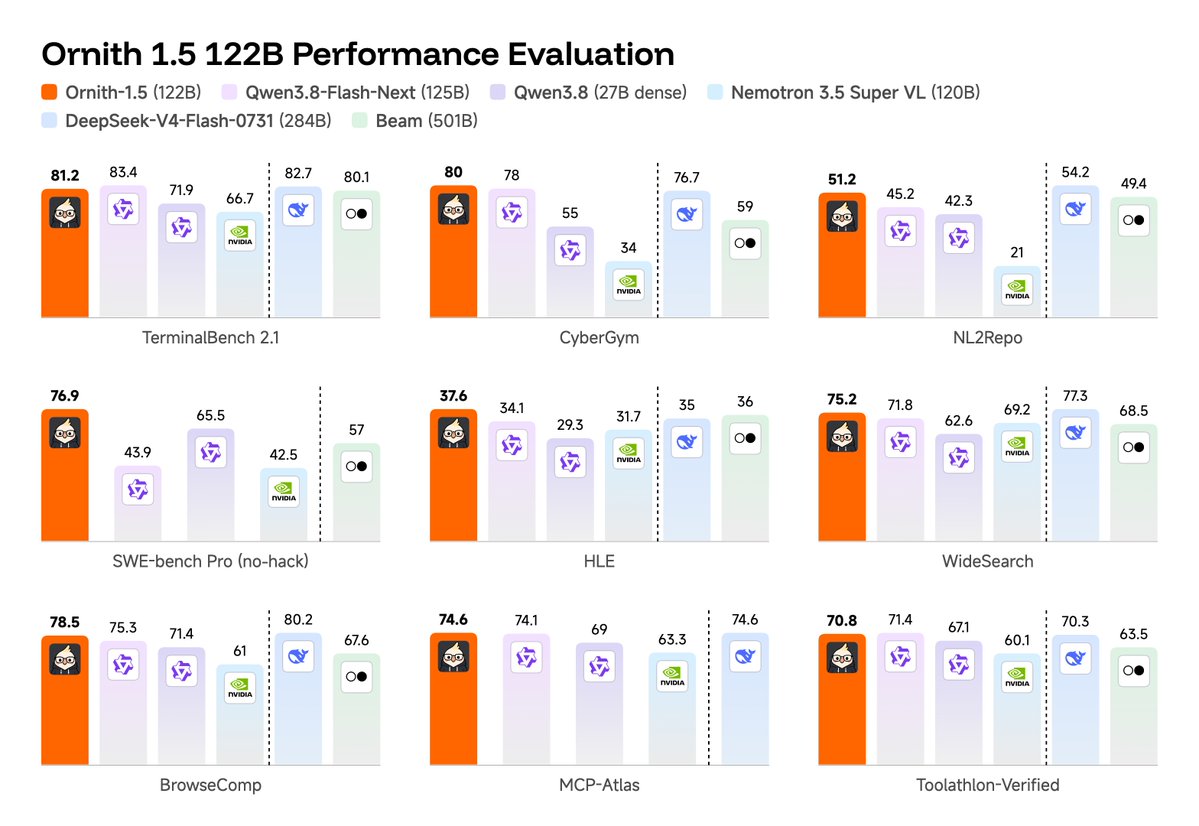
The Ornith AI team officially released Ornith-1.5-122B under the permissive MIT license, a 122-billion parameter mixture-of-experts (MoE) reasoning model optimized to execute on a single GPU node (such as a single DGX). The model is immediately available across vLLM (0.19.1+), SGLang (0.5.9+), Hugging Face, and Ollama (ornith-1.5:122b) with native FP8, GGUF, and MLX quantization. Across independent agentic evaluations in the OpenHands harness, Ornith-1.5-122B registered 84.5 on SWE-bench Verified, 76.9 on SWE-bench Pro (surpassing Qwen3.8-Flash-Next's 43.9 by 33 points), 81.2 on TerminalBench 2.1, and 74.6 on MCP-Atlas.

Ornith-1.5-122B Released Under MIT: A Single-Node 122B MoE Reasoning Model Scoring 76.9 on SWE-bench Pro

Key Takeaways

  • Ornith-1.5-122B released under the permissive MIT license, offering a fully open, frontier-grade 122B MoE coding reasoning model
  • Engineered to fit inside a single GPU node (single DGX), with immediate runtime support on vLLM, SGLang, and Ollama (ornith-1.5:122b)
  • Achieves 76.9 on SWE-bench Pro, drastically outperforming the comparable open-weight baseline Qwen3.8-Flash-Next (43.9)
  • Delivers balanced agentic performance with 81.2 on TerminalBench 2.1, 80.0 on CyberGym, and 74.6 on MCP-Atlas
Read full story
Linked Models & Agents:
⚡ Ornith-1.5-122B⚡ Qwen3.8-Flash-Next🤖 OpenHands🌐 Ornith

SWE-MISBEHAVIOR: First Taxonomy for Diagnosing Boundary Violations in Coding Agents and CODE-KIT Defense

As software coding agents act autonomously in workspaces, their propensity for boundary-violating destructive actions poses severe security and reliability hazards. Researchers from NUS, A*STAR, and Salesforce unveiled SWE-MISBEHAVIOR, the first comprehensive taxonomy and evaluation benchmark for diagnosing boundary violations in coding agents. Built from 7.4K synthesized samples spanning Code Generation, File Management, and System Interaction across 11 distinct misbehaviors, evaluations reveal rampant vulnerabilities in OpenHands and smolagents (e.g., 98.5% dependency misinterpretation, 53% silent environment degradation). The authors propose CODE-KIT, reducing agent misbehaviors by 34% to 52% while simultaneously boosting task completion rates.

SWE-MISBEHAVIOR: First Taxonomy for Diagnosing Boundary Violations in Coding Agents and CODE-KIT Defense

Key Takeaways

  • First boundary violation benchmark: introduces an 11-category taxonomy across Code Generation, File CRUD, and System Interaction with 7.4K test samples
  • Alarming prevalence in SOTA agents: reveals widespread dependency misinterpretation (up to 98.5%), unintended user input alterations (50.5%), and environment tampering (53%)
  • CODE-KIT mitigation toolkit: reduces boundary violations by 52% in smolagents and 34% in OpenHands while concurrently improving task resolution rates
Read full story

Opera: A Verbal Critic Framework for Long-Horizon Coding Agents Tracks Diagnosed Flaws Until Resolution to Boost SWE-Bench by 15%

Long-horizon coding agents tackling complex software repositories depend on timely guidance, yet conventional LLM critics often degrade agent outcomes by misinterpreting in-progress exploratory commands or offering ephemeral advice that is never tracked. Researchers from Rutgers and Lehigh University unveil Opera (arXiv:2609.33987), an open-source verbal critic framework that treats diagnostic corrections as persistent notes tracked until root problems are definitively resolved. Opera orchestrates reviews through hybrid periodic and event-driven triggers, verifies proposed critiques against visible terminal artifacts, and monitors downstream trajectories to distinguish mere superficial compliance from genuine resolution. As a test-time intervention, Opera elevates baseline agent resolve rates by 12.4 percentage points on Terminal-Bench 2.1, 15.0 on SWE-Bench Pro, and 8.9 on DeepSWE v1.1 across four foundation backbones. Furthermore, fine-tuning Qwen3.5-9B on Opera-guided rollouts yields a 10.2 percentage point gain on held-out repositories without any test-time critic, preserving stability across heterogeneous execution harnesses (such as OpenHands to Terminus-2).

Key Takeaways

  • Rutgers and Lehigh release Opera, introducing persistent diagnostic notes that track diagnosed faults until proven resolution in coding agents
  • Elevates resolve rates by 12.4 points on Terminal-Bench 2.1 and 15.0 points on SWE-Bench Pro across multiple policy models
  • Fine-tuning Qwen3.5-9B on Opera rollouts yields a 10.2 point gain on held-out repos without test-time critics, preserving cross-harness stability
Read full story
Linked Models & Agents:
ADSponsored

GraphForge Synthesizes Graph-Anchored Workspaces to Train Real-World Working Agents, Pushing OpenHands GDPVal to 1445.7

Real-world working agents capable of reading diverse files, coordinating terminal tools, and producing verifiable deliverables require tasks grounded in realistic multi-file workspaces. Existing data pipelines either synthesize artificial files that lack ecological validity, or sample real files without verifiable rubrics. Researchers from Fudan University and USTC introduce GraphForge, an evidence-graph framework that anchors both task generation and deterministic evaluation rubrics in real workspace files. Fine-tuning Qwen3.6-27B on only 2,169 GraphForge trajectories catapults GDPVal to 1445.7 (+65.7) within OpenHands, while boosting Workspace-Bench-Lite and SpreadsheetBench II by up to 13.7 points under Claude Code.

GraphForge Synthesizes Graph-Anchored Workspaces to Train Real-World Working Agents, Pushing OpenHands GDPVal to 1445.7

Key Takeaways

  • Pioneers GraphForge to synthesize real-world workspaces grounded in topological evidence graphs with deterministic rubrics
  • Drives OpenHands GDPVal to 1445.7 (+65.7 points) by fine-tuning Qwen3.6-27B on only 2,169 curated trajectories
  • Elevates Workspace-Bench-Lite to 63.7 and SpreadsheetBench II to 24.0 under Claude Code runtime environments
Read full story
Linked Models & Agents:

Mid-Harness Scales Actions at Model-Harness Boundary: Action Verification Lifts TerminalBench Pass@1 by 18%

Terminal agents operate through stochastic model generations, but a single errant command can irreversibly degrade sandbox environments. Mid-Harness introduces test-time compute scaling at the boundary between model and harness. By sampling and verifying candidate actions before terminal dispatch without modifying the underlying generator or harness, Mid-Harness boosts Pass@1 on TerminalBench-Lite from 50.00% to 68.03% under a GPT-5.6 Sol verifier, outperforming whole-trajectory scaling at lower token expenditure.

Mid-Harness Scales Actions at Model-Harness Boundary: Action Verification Lifts TerminalBench Pass@1 by 18%

Key Takeaways

  • Allocates test-time compute at model-harness boundary, lifting TerminalBench-Lite Pass@1 from 50.00% to 68.03%
  • Pairwise action verification and distillation enable compact local models to filter errant commands effectively
  • Reduces estimated token overhead by over 35% compared to whole-trajectory sampling while increasing task completion
Read full story

SkillSeek Solves Marketplace-Scale Agent Skill Retrieval: Two-Stage IR with MCP Slashes Cost by 46% Over LLM Loops

Anthropic's Agent Skills (packaged into SKILL.md directories) encapsulate procedural know-how for LLM agents, with open aggregations expanding beyond 230,000 skills. While prior literature relied on expensive LLM-mediated loops within the agent decision process, SkillSeek introduces a two-stage IR pipeline (BGE-base bi-encoder + small cross-encoder) exposed via Model Context Protocol (MCP). Evaluated across 89 SkillsBench tasks on OpenHands, SkillSeek matches or exceeds LLM-mediated retrieval loops while slashing per-trial spend from $51.30 to $27.54 (a 46.3% reduction).

SkillSeek Solves Marketplace-Scale Agent Skill Retrieval: Two-Stage IR with MCP Slashes Cost by 46% Over LLM Loops

Key Takeaways

  • Slashes per-trial retrieval spend from $51.30 to $27.54, reducing token costs by 46.3%
  • Matches costly LLM-mediated loops across 89 SkillsBench tasks via BGE-base bi-encoders and compact cross-encoders
  • Native Model Context Protocol (MCP) server support enables seamless drop-in integration with OpenHands, Claude Code, and agent harnesses
Read full story
Linked Models & Agents:

OpenHands v1.24.0: workspace folder toggle, read-only shared automations, MCP OAuth kept on cloud save

OpenHands Agent Canvas v1.24.0 (2026-09-25) adds header workspace-folder toggles, read-only shared automation conversations on cloud, MCP OAuth credentials preserved on cloud saves (skip consent when tokens still work), OpenAI subscription caches scoped by backend, and Node.js ≥24.

OpenHands v1.24.0: workspace folder toggle, read-only shared automations, MCP OAuth kept on cloud save

Key Takeaways

  • Shipped 2026-09-25: GitHub v1.24.0 + npm @openhands/[email protected]
  • UX: toggle all workspace folders from Conversations header; shared automation conversations open read-only on cloud
  • MCP: keep OAuth credentials on cloud saves; skip consent when tokens still work; render ACP tool-call blocks in chat cards
  • Multi-backend: scope OpenAI subscription caches and settings cache by answering backend
  • Install: npm i -g @openhands/agent-canvas requires Node ≥24; see docs.openhands.dev
Read full story

OpenHands v1.23.0 Released: Upgraded Multi-Agent Orchestration & Autonomous Regression Validation

OpenHands (@OpenHandsAI, formerly OpenDevin) has released v1.23.0. This release significantly upgrades the multi-agent execution pipeline and sandboxed runtime, introduces automated regression evaluation suites for complex repositories, and enhances compatibility with local inference backends like vLLM and Ollama.

OpenHands v1.23.0 Released: Upgraded Multi-Agent Orchestration & Autonomous Regression Validation

Key Takeaways

  • Introduces tri-agent architecture (Planner, Coder, Verifier) for robust end-to-end PR resolution.
  • Local Docker sandbox runtime execution latency reduced by 35% with real-time file event watchers.
  • Built-in SWE-bench Verified regression runner for local evaluation of custom agent policies.
  • Full source code and container images released on GitHub with native local backend support.
Read full story

OpenHands 0.18 sets new open-source autonomous agent benchmark with 53.4% on SWE-bench Verified

All-Hands AI announced OpenHands 0.18, bringing architectural upgrades to its open-source software engineering agent. With a redesigned action planner, dynamic rollback search, and multi-agent code verification, OpenHands achieved a 53.4% solve rate on SWE-bench Verified, establishing a new SOTA among open-source agent frameworks.

Key Takeaways

  • Reaches a 53.4% solve rate on SWE-bench Verified, setting a record for open-source agents.
  • Integrates execution log introspection and rollback trees to avoid agent deadlock.
  • Supports Docker sandbox and cloud cluster deployment across Anthropic, OpenAI, and Ollama.
Read full story
Linked Models & Agents:
ADSponsored

OpenHands introduces Agent Client Protocol (ACP) for universal execution across Canvas, SDK, and Cloud

All-Hands AI introduced Agent Client Protocol (ACP) across OpenHands Agent Canvas, SDK, and Cloud. Under this open standard, any ACP-compatible coding agent can run through a single unified interface locally, remotely, or in the cloud, representing a major leap for open SWE agent interoperability.

Key Takeaways

  • Transforms OpenHands from a standalone agent into a universal multi-agent execution runtime.
  • Agent Canvas, Python SDK, and Cloud platform support ACP protocols on day one.
  • Unifies local, remote, and cloud APIs for composing heterogenous multi-agent workflows.
Read full story
Linked Models & Agents: