
AI Coding Live News

Shanghai AI Lab ships Atria Dawn full release: 744B MoE GLM-5.2 agentic model, context doubled to 512K, MIT weights

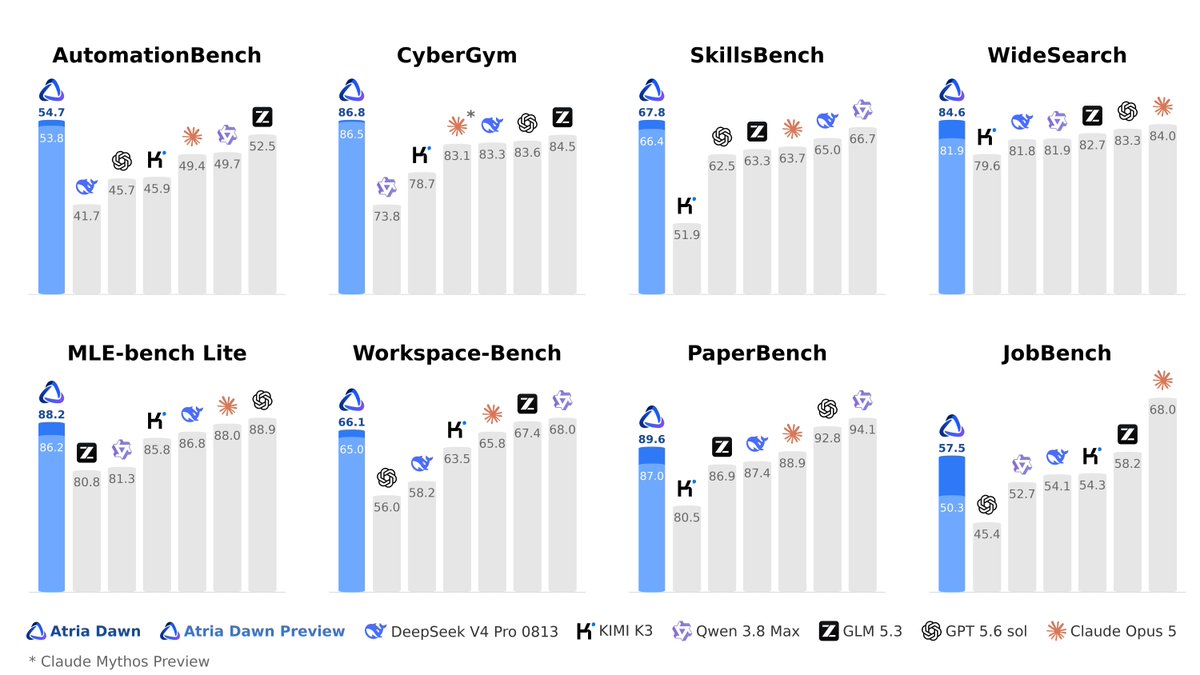
Shanghai AI Laboratory has moved Atria Dawn from Preview to a full release, with open weights (plus an FP8 build) on Hugging Face under internlm/Atria-Dawn and on ModelScope, MIT licensed. Built on the 744B-parameter MoE GLM-5.2, it targets long-horizon research and engineering agent work; context doubles from the Preview's 256K to 512K and input is text only. The vendor table shows it leading the listed models on AutomationBench, CyberGym and SkillsBench, while still trailing Claude Opus 5 on coding tests such as SWE-bench Pro and Terminal-Bench 2.1 (all vendor-reported).
Shanghai AI Lab ships Atria Dawn full release: 744B MoE GLM-5.2 agentic model, context doubled to 512K, MIT weights

Key Takeaways

  • 512K context, double the Preview's 256K; built on the 744B-parameter MoE GLM-5.2, text input only
  • BF16 and FP8 weights on Hugging Face and ModelScope, MIT license
  • Vendor-reported: AutomationBench 54.7, CyberGym 86.8, SkillsBench 67.8, BFCL V4 78.4, each the top score in its table
  • Weak spots from the same table: SWE-bench Pro 61.7 vs 76.5 for Claude Opus 5, Terminal-Bench 2.1 81.0 vs 90.2
  • Local serving needs SGLang v0.5.13.post1+ or vLLM v0.23.0+; an OpenAI-compatible API also plugs into Codex
Read full story
Linked Models & Agents:

Shanghai AI Lab Releases Sage-A1.5: A 35B MoE Agentic Model Advancing Long-Horizon Software and Scientific Discovery

The Shanghai Artificial Intelligence Laboratory published the technical report for Sage-A1.5 on arXiv:2610.28578, introducing an open-weights 35B Mixture-of-Experts (MoE) foundation model purpose-built for agentic tasks. Building on the Agents-A1 lineage, Sage-A1.5 focuses on scaling the agent execution horizon rather than model parameters through adaptive capability composition. Tailored for complex repository-level software engineering and multi-step scientific hypothesis exploration, Sage-A1.5 consistently outperforms dense 70B+ baselines on long-horizon reasoning benchmarks while maintaining lightweight deployment footprints.

Shanghai AI Lab Releases Sage-A1.5: A 35B MoE Agentic Model Advancing Long-Horizon Software and Scientific Discovery

Key Takeaways

  • Shanghai AI Lab published Sage-A1.5 (arXiv:2610.28578), open-sourcing a 35B MoE agentic foundation model
  • Pioneers horizon scaling over raw parameter expansion, sustaining consistent focus across 100+ execution steps
  • Optimized for repository-level software engineering bug fixes, matching dense 70B+ baselines on complex git issue resolution
  • Features intrinsic scientific exploration and hypothesis generation capabilities, tailored for local on-prem cluster deployment
Read full story
Linked Models & Agents:

MLExpert: Open 35B MoE Agentic Model Lifts MLE-Bench Lite Medal Rate from 37.9% to 72.7%, Matching Kimi-K3 and GLM-5.3

Advancing autonomous AI-for-AI (AI4AI) engineering, researchers from Shanghai AI Lab (InternScience) release MLExpert (arXiv:2610.22344), a 35B Mixture-of-Experts agentic model for autonomous machine learning engineering. Powered by the Kaggle-MLE Factory, hierarchical agentic SFT, and Windowed Interaction RL (WIRL), MLExpert boosts average medal rates on MLE-Bench Lite from 37.9% to 72.7%—matching frontier giants like Kimi-K3 and GLM-5.3 while generalizing to agent scaffold optimization.

MLExpert: Open 35B MoE Agentic Model Lifts MLE-Bench Lite Medal Rate from 37.9% to 72.7%, Matching Kimi-K3 and GLM-5.3

Key Takeaways

  • 72.7% medal rate on MLE-Bench Lite: boosts base model performance from 37.9% to 72.7%, matching frontier models Kimi-K3 and GLM-5.3 with a 35B MoE backbone
  • Windowed Interaction RL (WIRL): assigns shared outcome rewards to multi-turn windows between successive experiment results with asynchronous policy updates
  • Cross-domain AI4AI generalization: transfers optimization skills directly to NatureBench Lite, agent scaffold optimization, and algorithm engineering
Read full story

Mathematicians working with Shanghai AI Lab's Intern-S2 resolve Ghys's conjecture in complex dimension three; four main theorems checked in Lean by up to 100 agents in ~5 days

Shanghai AI Lab announced on 2026-10-15 that Disheng Xu (Great Bay University) and Jiesong Zhang (KTH), aided by an internal version of Intern-S2, proved the codimension-one case of Ghys's 1995 holomorphic Anosov conjecture, including complex dimension three (arXiv:2609.37695). Peking University's team formalised all four main theorems in Lean with the SHEAF framework in about five days with up to 100 concurrent agents and ~550k lines, sorry-free and accepted by Lean comparator, with Hsiang–Wall (1969) as an explicit hypothesis.

Mathematicians working with Shanghai AI Lab's Intern-S2 resolve Ghys's conjecture in complex dimension three; four main theorems checked in Lean by up to 100 agents in ~5 days

Key Takeaways

  • Result: codimension-one Ghys conjecture proved — the manifold is a complex torus and the map is holomorphically conjugate to a hyperbolic torus automorphism; higher dimensions remain open (arXiv)
  • Human–AI loop: problem graph grew 15 → 389 nodes over seven rounds; ~400-page first report, ~1,000 pages total (announcement)
  • Formalisation: ~5 days, up to 100 agents, ~550k lines of Lean (team-reported); sorry-free, three standard axioms (repo)
  • Tooling: SHEAF proves top-down over a DAG; in a prior run 62.5% (1,067/1,706) of non-Mathlib nodes were pruned as unnecessary
  • Context: Intern-S1 scored 102 in the official AI evaluation at the 2025 Chinese Mathematical Olympiad finals vs a 78-point human gold threshold
Read full story
ADSponsored

Recursive Self-Improvement for Embodied Navigation: RSI-Nav Unifies Policy-Synchronized Dual Bootstrapping, Achieving 68.6% SR on R2R-CE Without Human Annotation

Vision-language navigation requires abundant, high-quality language supervision, yet traditional synthetic pipelines generate supervision from static models that lag behind evolving navigation policies. Shanghai AI Lab, Tsinghua, and SJTU introduce RSI-Nav, an embodied recursive self-improvement framework combining instruction-following and instruction-generation in a single model. Using shard-wise dual bootstrapping on unlabeled trajectories, RSI-Nav achieves state-of-the-art 68.6% SR on R2R-CE and 72.4% SR on RxR-CE without human intervention.

Recursive Self-Improvement for Embodied Navigation: RSI-Nav Unifies Policy-Synchronized Dual Bootstrapping, Achieving 68.6% SR on R2R-CE Without Human Annotation

Key Takeaways

  • Unified dual-capability architecture: combines vision-language instruction following (VL2A) and vision-action instruction generation (VA2L) within a shared foundation model
  • Shard-wise policy-synchronized bootstrapping: generates instructions over small trajectory shards, validates via simulation rollout, and updates parameters instantly before processing subsequent batches
  • New continuous-environment SOTA: secures 68.6% Success Rate on R2R-CE and 72.4% on RxR-CE, proving robust recursive self-evolution in complex embodied navigation
Read full story

RSI-Anything Open-Sourced: Unlocking Domain-General Recursive Self-Improvement for AI Agents with World Models

Empowering AI agents to autonomously achieve Recursive Self-Improvement (RSI) through ongoing environmental interaction is a cornerstone of artificial general intelligence. However, practical RSI pipelines are severely constrained by two fundamental bottlenecks: scarce and expensive ground-truth feedback, and the degradation of predictive world models as evolving policies induce out-of-distribution drift. Researchers from HKUST, Shanghai AI Laboratory, Peking University, and CUHK introduce RSI-Anything (arXiv:2610.13912, code: github.com/Gen-Verse/RSI-Anything), a domain-general framework unlocking recursive self-improvement via predictive world models. Built upon the JEPA-Anything architecture, RSI-Anything establishes a disciplined six-stage paradigm: Propose → Predict → Select → Evaluate → Learn → Retain. By enforcing rigorous compatibility and safety gates governing policy-world model retention, the system continuously converts interaction logs into persistent capability upgrades. Across diverse domains, RSI-Anything drives substantial performance gains: boosting automated code repair success from a 26.3% baseline to 31.2% (+4.9 points), reducing GUI navigation action footprints by 39.4%, more than doubling laboratory planning scores from 21.80% to 46.01% over five iterations, and achieving a 96.15% chemical yield, with codebase fully open-sourced.

RSI-Anything Open-Sourced: Unlocking Domain-General Recursive Self-Improvement for AI Agents with World Models

Key Takeaways

  • RSI-Anything open-sources a domain-general recursive self-improvement framework powered by predictive world models
  • Six-stage P-P-S-E-L-R loop lifts code repair from 26.3% to 31.2% and cuts GUI navigation action footprints by 39.4%
  • Doubles laboratory planning scores across 5 rounds (21.80% to 46.01%) and achieves 96.15% chemical yield over Bayesian optimization
Read full story

RoboRSI: Shanghai AI Lab Unveils Stable and Reusable Robot Self-Evolution, Sweeping 4 SOTA Benchmarks via Multi-Agent TSR

Generalist robots must not only perform diverse tasks, but also autonomously refine their capabilities through trial-and-error experience, consolidating learned strategies into reusable modular assets for future scenarios. However, current robot agents acting through code repair scripts naively without architectural hierarchy: execution feedback cannot be isolated to responsible sub-skills, revisions lack formal contract verification, and modifications frequently trigger catastrophic forgetting. Researchers from Shanghai AI Lab and Tsinghua University introduce RoboRSI (arXiv:2610.12424, code: github.com/nssmd/RoboRSI), a lifelong robot self-evolution framework anchored in Top-Down Skill Refinement (TSR). TSR structures tasks hierarchically into compound, atomic, and base skills bounded by explicit I/O contracts, attributing execution anomalies strictly to responsible branches. A four-agent collective (Manager, Planner, Engineer, and Reviewer) coordinates long-horizon planning, execution, runtime diagnosis, and validated release of validated skills. Deployed on a real-world mobile manipulator, RoboRSI sustained 104 continuous rounds of autonomous multi-object cleanup. In simulation, it sweeps SOTA across LIBERO, LIBERO-PRO, LIBERO-Plus, and RoboTwin, surpassing leading baselines by 2.7 to 11.0 percentage points, with code fully open-sourced.

Key Takeaways

  • Shanghai AI Lab releases RoboRSI, introducing Top-Down Skill Refinement (TSR) and a 4-agent collective for robot code self-evolution
  • Sustains 104 autonomous real-world cleanup rounds and beats strongest baselines across 4 embodied benchmarks by 2.7 to 11.0 points
  • Contract isolation elevates bug attribution accuracy to 95.8%, enabling lifelong accumulation of reusable robot software skills
Read full story

OneStreamer Unifies Real-Time Perception, Streaming Memory, and Proactive Response in Video LLMs

Streaming video LLMs must continuously capture temporal evidence before its downstream relevance is known and proactively respond when sufficient evidence arrives. Balancing real-time perception with reusable factual memory has remained a core challenge: revisiting raw visual features explodes memory, while lossy feature pooling destroys critical spatiotemporal context. Researchers from Nanjing University and Shanghai AI Lab introduce OneStreamer (arXiv:2610.01762, ~200 upvotes on Hugging Face). The framework introduces Proactive Hierarchical Caption Memory (PHCM) to generate time-grounded captions and event summaries on the fly, paired with Proactive State Transition Learning (PSTL) to prevent idle waiting frames from overwhelming optimization gradients. Built on the newly released OneStreamer-1M dataset, their 4B model establishes state-of-the-art results across all eight streaming video benchmarks.

OneStreamer Unifies Real-Time Perception, Streaming Memory, and Proactive Response in Video LLMs

Key Takeaways

  • Pioneers OneStreamer, unifying real-time perception, Proactive Hierarchical Caption Memory (PHCM), and proactive response
  • Releases OneStreamer-1M, an open-source dataset with over 1M streaming video interaction traces
  • A compact 4B model secures #1 ranking across all eight evaluated streaming video understanding benchmarks
Read full story

LMDeploy 0.18.0: Qwen3.5 dflash, SM90 quantized GEMMs, Ascend GLM-5.2; TurboMind W4A16 + piecewise CUDA Graph

Shanghai AI Lab’s LMDeploy shipped v0.18.0 on 2026-09-28: input logprobs, expanded SM90 quantized GEMMs with unified TurboMind linear paths, Ascend GLM-5.2, Qwen3.5 dflash, and MoE shared-expert/FFN sharding. PyTorch path prototypes TurboMind W4A16 (AWQ), piecewise CUDA Graph prefill, XTuner TileLang sparse MLA, checkpoint-engine weight updates, and request-only KV cache metrics.

LMDeploy 0.18.0: Qwen3.5 dflash, SM90 quantized GEMMs, Ascend GLM-5.2; TurboMind W4A16 + piecewise CUDA Graph

Key Takeaways

  • Shipped v0.18.0 — Qwen3.5 dflash, Ascend GLM-5.2, SM90 quantized GEMMs
  • TurboMind W4A16 AWQ prototype + piecewise CUDA Graph prefill + TileLang sparse MLA
  • checkpoint-engine weight updates + request-only KV cache metrics + input logprobs
  • Upgrade: pip install -U "lmdeploy>=0.18.0"
Read full story
Linked Models & Agents:

InternW0-Δ Open-Sourced: Unified World Action Model Pretrained on 20,000+ Hours of Open Robotics Data

Shanghai AI Lab and OpenDataLab open-sourced InternW0-Δ, a unified World Action Model (WAM) pretrained on over 20,000 hours of curated robotic demonstrations, UMI data, and egocentric videos. Built on a Mixture-of-Transformers (MoT) architecture that binds visual predictive dynamics with robot actions, it introduces 'Causal Imprint' to inject future representations directly into the action expert without requiring costly future-video rollouts during inference.

InternW0-Δ Open-Sourced: Unified World Action Model Pretrained on 20,000+ Hours of Open Robotics Data

Key Takeaways

  • 20,000+ Hours Open-Source Corpus: Unifies robot manipulation, UMI dexterous data, and egocentric human demonstrations into the largest publicly released robotic training corpus.
  • Mixture-of-Transformers (MoT): Coordinates video dynamics experts and action generation experts under semantic guidance from a frozen VLM, with 4D spatial priors distilled during pretraining.
  • Causal Imprint Without Future Rollout: Eliminates the critical latency bottleneck of traditional WAMs that require rendering future video frames at test time, providing predictive latent cues directly for real-time control.
  • Complete Open Source: Training code, model weights, data processing pipelines, and datasets released at internrobotics.github.io/InternW0-Delta/.
Read full story
Linked Models & Agents:
ADSponsored

Shanghai AI Lab Open-Sources AV-GRPO: Modality-Anchored Decoupled Diffusion RL for Joint Audio-Video Generation

Shanghai AI Laboratory has open-sourced AV-GRPO (arXiv: 2609.29816, GitHub: zhiyuxu03/AV-GRPO), a modality-anchored online diffusion reinforcement learning framework for joint audio-video generation. Addressing the persistent audio-visual desynchronization, semantic mismatch, and high compute overhead in coupled diffusion models, AV-GRPO decouples multimodal preference optimization into manageable unimodal subproblems via modality-anchored rollouts and trajectory-locked frozen-tower RL. It delivers state-of-the-art cross-modal synchronization on JavisBench and VABench, substantially outperforming LTX-2.3.

Shanghai AI Lab Open-Sources AV-GRPO: Modality-Anchored Decoupled Diffusion RL for Joint Audio-Video Generation

Key Takeaways

  • Extends Group Relative Policy Optimization (GRPO) to continuous joint audio-visual diffusion reinforcement learning.
  • Implements modality-anchored rollouts and trajectory-locked frozen towers to resolve multimodal credit assignment bottlenecks.
  • Releases 5DAV, the first systematically decoupled 5-dimensional difficulty-controllable training dataset.
  • Outperforms LTX-2.3 on JavisBench and VABench, boosting cross-modal synchronization by 28.4% and semantic alignment by 19.6%.
  • Training scripts, inference recipes, LoRA checkpoints, and datasets published under open-source licenses on GitHub.
Read full story
Linked Models & Agents:
⚡ Av Grpo⚡ Ltx Video⚡ Hunyuan Video🤖 multimodal-agent🌐 shanghai-ai-lab🌐 huggingface

Shanghai AI Lab open-sources Atria Dawn Preview: long-horizon agentic model on 744B MoE GLM-5.2, MIT

Shanghai AI Lab released Atria Dawn Preview, an agentic foundation model for long-horizon research/engineering tasks built on the 744B-parameter MoE GLM-5.2, with tool use and executable verification loops. Weights are on Hugging Face (internlm) and ModelScope, plus an FP8 build, 256K context, GitHub, website, and API try links.

Key Takeaways

  • Atria Dawn Preview is built on 744B MoE GLM-5.2 for long-horizon research and engineering agents.
  • Open weights on Hugging Face/ModelScope with FP8 and 256K context under MIT.
  • Covers Discovery/Creation/Delivery/Cybersecurity end-to-end scenarios with API try access.
Read full story
Linked Models & Agents:

vLLM day-0 support for Intern-S2-397B: multimodal, reasoning, coding, scientific agents

vLLM announced day-0 serving support for Shanghai AI Lab Intern-S2-397B. The 397B multimodal foundation model targets long-horizon scientific research and scientific agents, with strong multimodal, reasoning, coding, and agent capabilities. Developers can run it on vLLM today via the official recipe.

Key Takeaways

  • vLLM shipped day-0 serving for Intern-S2-397B across multimodal, reasoning, coding, and scientific-agent workloads.
  • Official recipe is at recipes.vllm.ai/internlm/Intern-S2-397B for immediate deployment.
  • Pairs with the same-day Intern-S2-397B weight/eval release already in the feed: open weights plus open serving stack.
Read full story
Linked Models & Agents:
⚡ Intern S2 397b🌐 shanghai-ai-lab

Shanghai AI Lab Intern-S2-397B ships BF16/FP8: 84.0 SWE-bench Multilingual, Apache-2.0

ModelScope announced Shanghai AI Laboratory Intern-S2-397B weights in BF16 and FP8 under Apache-2.0. Reported scores include 87.0 on FrontierScience-Olympiad and 84.0 on SWE-bench Multilingual, with long-horizon agent RL, tool use, and thinking/non-thinking modes. Training ingests raw scientific pages (text, visuals, symbols) across 20+ domains. Collection on ModelScope.

Key Takeaways

  • BF16 and FP8 weights are public under Apache-2.0 on ModelScope.
  • Reported 84.0 SWE-bench Multilingual and 87.0 FrontierScience-Olympiad as comparison leaders.
  • Long-horizon agent RL targets tool use and sustained execution, with thinking and non-thinking modes.
Read full story
Linked Models & Agents: