
AI Coding Live News

Stanford Retests 50 Well-Known LLM Findings on 20 Models: 44% Have Expired, Median Shelf Life About 15 Months

On November 2, Stanford researchers Owen Queen and James Zou published an interactive report, "The shelf life of LLM findings", retesting 50 widely cited claims about LLM behavior on 20 models released from July 2024 to September 2026 by eight developers. Verdict: 22 claims (44%) expired, 17 (34%) weakened, 8 (16%) persist and 3 (6%) strengthened; the median time from publication to expiration for expired claims was 14.7 months. Capability failures such as letter counting, lost-in-the-middle and fabricated citations have largely faded, while preference issues such as sycophancy and judges favoring their own answers persist.
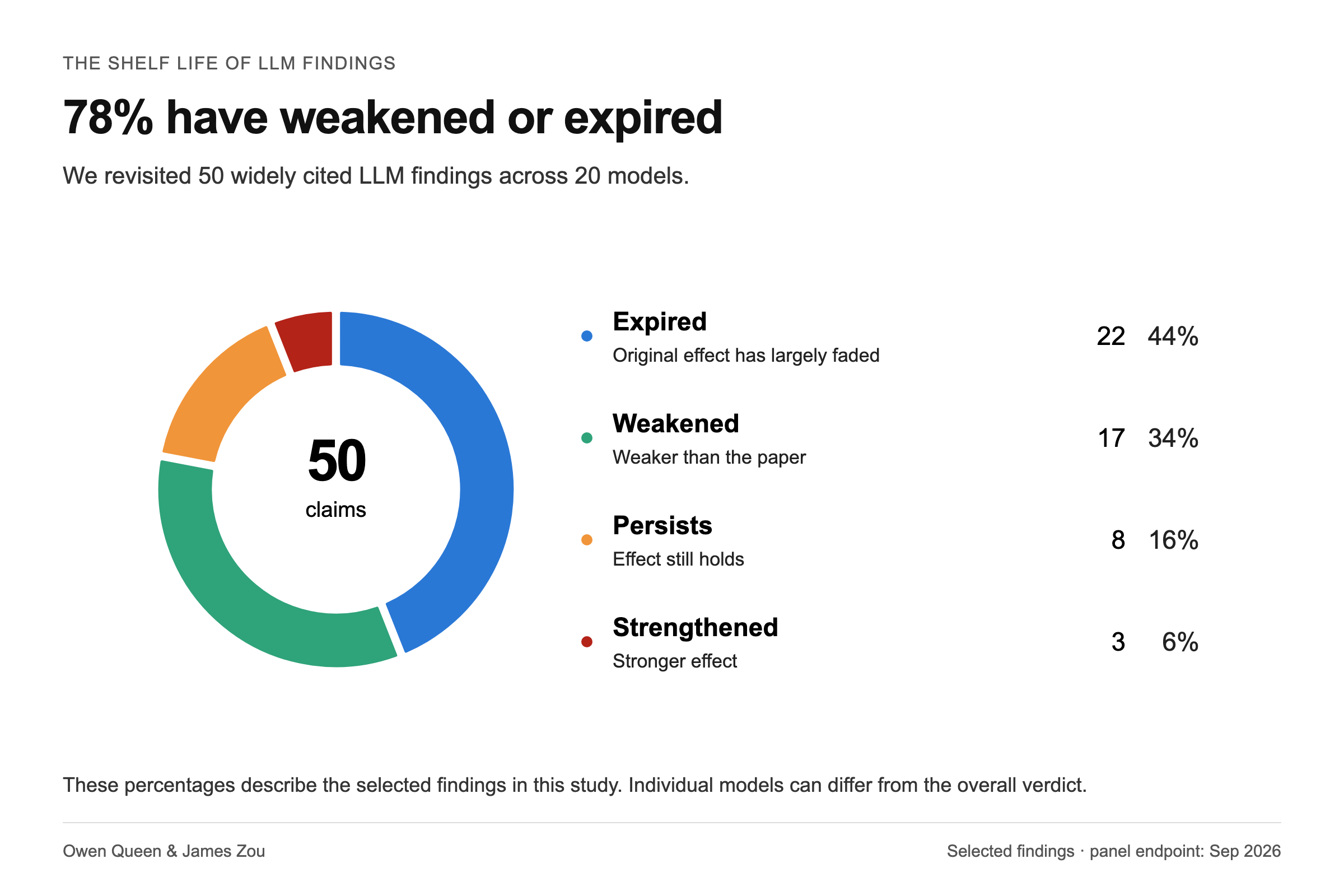
Stanford Retests 50 Well-Known LLM Findings on 20 Models: 44% Have Expired, Median Shelf Life About 15 Months

Key Takeaways

  • 50 claims, 20 models, eight developers; verdicts reflect fitted effects as of September 30, 2026.
  • 44% expired, 34% weakened, 16% persist, 6% strengthened; expired claims had a median lifetime of 14.7 months (mean 15.7).
  • Kaplan-Meier estimates put the expired share at about 4%, 16% and 39% six months, one year and two years after publication.
  • Citation fabrication is expired overall, yet Qwen3.7-Flash still fabricated 69% of references in the same test (about 1% for Sonnet 5.5, 0% for GPT-6.1 Sol).
  • The pipelines were built with Claude Code and Codex; 43 of 48 reproduction checks matched the original papers within tolerance.
Read full story

X discussion: big-tech CEOs talk openly about RSI - Google's Sundar Pichai says "we are pretty far from the end state of RSI" yet expects "continued acceleration because of RSI" over the next 12 months, while Sam Altman and Dario Amodei weigh in

Recursive self-improvement (RSI), using models to speed up the development of the next models, became one of the most-used terms in AI circles on X this past week after several big-tech CEOs talked about it in public. Google CEO Sundar Pichai framed it differently on two podcasts. On Alex Kantrowitz's Big Technology Podcast he said "We are pretty far from the end state of RSI." On Alex Heath's Sources podcast he said researchers are co-working with models "in a deep way" and "I would expect the next 12 months to see continued acceleration because of RSI." The widely shared 12-month line comes from the Sources episode, not Big Technology. OpenAI CEO Sam Altman told Stanford GSB that besides AI recursive self-improvement there is another loop, robots that build robots and data centers that build data centers, that gets "much less talk". Anthropic CEO Dario Amodei, replying to a critic on X, wrote about the point where AI-driven acceleration gets fast enough that safety struggles to keep up: "We are nearing that point." This is an X discussion of public remarks by CEOs, not an announcement of any new research program.

Key Takeaways

  • On the Big Technology Podcast (released Oct 20), Pichai said "We are pretty far from the end state of RSI", that today there are "RSI loops along with AI researchers", and that he expects that continuum to keep progressing into next year (Big Technology recap; Kantrowitz post, 68 likes and 9,643 views when we pulled it)
  • On the Sources podcast (released Oct 21, from about 11:52), Pichai said researchers co-work with models "in a deep way", with models suggesting recipes and automatically evaluating next checkpoints, and added "I would expect the next 12 months to see continued acceleration because of RSI" (Alex Heath episode post, 253 likes and 388K views when we pulled it)
  • Reposts that place the 12-month line in the Big Technology interview are wrong; after checking transcripts of both shows we found it in the Sources episode. The early repost from @ONagel33303 had only 4 likes, and its "CONFIRMED: Google plans to accelerate" framing is the reposter's own reading
  • At Stanford GSB's View From The Top (video released Oct 21, at about 33:18), Altman described "robots that can build more robots and then data centers that can effectively build more data centers" as a loop besides AI recursive self-improvement that gets "much less talk"
  • Anthropic CEO Dario Amodei, replying to Encode AI's Nathan Calvin, wrote about the point where AI-driven acceleration gets fast enough that it is hard for safety to keep up: "We are nearing that point" (post, 4,103 likes and 1.59M views when we pulled it); Calvin and journalist Garrison Lovely then criticized Anthropic for warning about RSI while backing the AEGIS Act, which they say makes it harder for governments to stop it
Read full story

ControlNet Author Team Releases MTEdit: Packed Trajectories Beat Sequential Rollouts with 2.69M Multi-Turn Edits

ControlNet creator Lvmin Zhang and researchers from Stanford and CUHK unveiled MTEdit (arXiv:2610.23751). To resolve the visual degradation and cumulative error drift inherent in conventional sequential rollout for multi-turn image editing, the team introduced Packed Trajectory Canvas (PTC). MTEdit constructs a landmark dataset of 500K trajectories and 2.69M editing turns (averaging 5.38 turns, up to 8 turns), demonstrating stable instruction following and ambient identity consistency across 8 consecutive edits.

ControlNet Author Team Releases MTEdit: Packed Trajectories Beat Sequential Rollouts with 2.69M Multi-Turn Edits

Key Takeaways

  • ControlNet author Lvmin Zhang's team released MTEdit (arXiv:2610.23751), introducing Packed Trajectory Canvas (PTC) to eliminate visual drift in multi-turn image editing
  • Packs four progressive edits into a single 2x2 canvas, generating the full trajectory in one diffusion pass to enforce ambient consistency
  • Constructs the largest multi-turn dataset with 500K trajectories and 2.69M edits spanning up to 8 turns (averaging 5.38 turns per trajectory)
  • Maintains superior fidelity through Turn 8 with a 7.63 score, with full code and datasets released on GitHub
Read full story
Linked Models & Agents:

Stanford & UC Berkeley Introduce Librarian Agents: Training LLMs to Proactively Curate Workspaces, Cutting Navigation Costs by 33.8%

Researchers from Stanford University and UC Berkeley introduced Librarian Agents (arXiv:2610.22273). To overcome the bottleneck of reactive RAG methods struggling with complex cross-document reasoning at query time, the framework uses reinforcement learning to train LLMs to perform anticipatory directed curation on messy long-context workspaces into structured synthetic filesystems. On BrowseComp+, it hits 55.86% accuracy while reducing navigation token consumption by 33.8% to 51%.

Stanford & UC Berkeley Introduce Librarian Agents: Training LLMs to Proactively Curate Workspaces, Cutting Navigation Costs by 33.8%

Key Takeaways

  • Stanford and UC Berkeley introduced Librarian Agents (arXiv:2610.22273), replacing reactive RAG with anticipatory directed workspace curation
  • Uses reinforcement learning to train builder agents to restructure raw documents into modular synthetic filesystems via CreateFile and MergeFiles
  • Achieves 55.86% accuracy on BrowseComp+ with only 3,635 navigation tokens, cutting navigation token costs by 51% compared to flattened workspaces
  • Reduces tokens per correct answer by 33.8% at 10 queries per corpus, establishing an amortized curation paradigm for repeatedly queried knowledge bases
Read full story
Linked Models & Agents:
ADSponsored

Stanford and CMU Introduce T2-z for Test-Time Latent Optimization in Robot World Models: Single Trajectory Lifts Real-Robot Success from 33.7% to 73.0%

Robotic world models struggle to predict physics when key environmental properties (friction, mass, contact dynamics) cannot be directly seen. Researchers from Stanford, CMU, and Toyota Research Institute introduced T2-z (arXiv:2610.22364, GitHub: T2-z-latent-optimization/T2-z). By freezing the world model and optimizing a compact environment latent z_e at test time from as little as a single interaction trajectory, T2-z halves physical error and raises real-world robot task success from 33.73% to 72.96%.

Stanford and CMU Introduce T2-z for Test-Time Latent Optimization in Robot World Models: Single Trajectory Lifts Real-Robot Success from 33.7% to 73.0%

Key Takeaways

  • Stanford, CMU, and TRI introduced T2-z (arXiv:2610.22364) for test-time optimization of unobservable physical latents in robot world models
  • Freezes the world model and optimizes a compact environment latent z_e using as little as a single test trajectory
  • Reduces physical prediction error from 15.20 to 7.00 and elevates action success from 33.73% to 72.96% across 7 simulated tasks
  • Dramatically improves real-robot manipulation, raising Ball Friction success from 0% to 62.50% and Door Close from 22.22% to 55.56%
Read full story
Linked Models & Agents:

Zero-Human-Label Step Accuracy Jumps from 48.2% to 74.7%: LeanPRM Grounds Process Supervision in Lean 4, While Cornell's CPLM Matches Full Attention at w=128

Tackling step-level verification in mathematical reasoning and in-context copying bottlenecks in Transformers, NYU/UCLA/Stanford researchers introduce LeanPRM (arXiv:2610.17697)—using the Lean 4 theorem prover to automatically label 152K steps across 10,634 natural-language proofs with zero human annotation, boosting Qwen3-4B step accuracy on LeanPRM-Bench from 48.2% to 74.7% (vs. 60.3% for PRM800K). Meanwhile, Cornell University's Copy-Paste Language Models (CPLMs, arXiv:2610.19247) add a lightweight Copy-Paste head (~3% compute overhead) that relieves the LM head gradient bottleneck, boosting LAMBADA accuracy by +2.5-4.0 points and allowing a w=128 sliding-window CPLM to match full-attention perplexity.

Zero-Human-Label Step Accuracy Jumps from 48.2% to 74.7%: LeanPRM Grounds Process Supervision in Lean 4, While Cornell's CPLM Matches Full Attention at w=128

Key Takeaways

  • LeanPRM uses the Lean 4 proof assistant and a syntax-error filter to generate 152K step-level labels across 10,634 proofs with zero human annotation
  • A Qwen3-4B verifier trained on LeanPRM reaches 74.7% step accuracy on LeanPRM-Bench (vs. 48.2% base and 60.3% with PRM800K) and improves 0.6B-8B verifiers on Hard2Verify and IMO-GradingBench
  • Cornell's Copy-Paste Language Models (CPLMs) add a ~3%-overhead copy head that relieves the LM head gradient bottleneck, boosting LAMBADA by +2.5-4.0 points and matching full-attention perplexity with a w=128 sliding window
Read full story
Linked Models & Agents:

AutoEnvScaling: Microsoft and Stanford Automate RL Environment Design via Terminal Agents, Unlocking 25x Data Flywheel

Microsoft Research and Stanford University have unveiled AutoEnvScaling, an automated data flywheel that frames RL environment creation itself as a terminal execution task. A proposer agent builds diverse environments directly from solver rollouts, slashing cost per valid environment by 75% while achieving a 25x higher valid environment yield over prompt-only baselines. Crucially, unifying environment design and solving within a single model enables Recursive Self-Improvement (RSI), yielding +12.2 points on Terminal-Bench 2.1 and doubling scores on Terminal-Bench 4.0.

AutoEnvScaling: Microsoft and Stanford Automate RL Environment Design via Terminal Agents, Unlocking 25x Data Flywheel

Key Takeaways

  • Environment design as a terminal task: shifts RL environment synthesis from manual curation to automated terminal execution, boosting valid yield by 25x
  • Unlocks Recursive Self-Improvement (RSI): enables a single backbone to co-evolve as both environment architect and task solver without human bottlenecks
  • Broad cross-domain generalization: yields a 12.2-point surge on Terminal-Bench 2.1 and doubles Terminal-Bench 4.0 for Qwen3.6-35B-A3B across kernel coding and OS tasks
Read full story

Thinking Inertia: Stanford and Oxford Reveal Why LLMs Keep Reasoning When Explicitly Told Not To

Researchers from Stanford University and the University of Oxford have published an empirical study examining 'no-thinking' behavior in reasoning LLMs. While developers frequently prompt models to disable explicit thinking to reduce latency and token consumption, the authors discover pervasive 'Thinking Inertia': models persist in generating explicit inference traces even under strict negation instructions, revealing an inherent trade-off between answer-only compliance and task accuracy.

Thinking Inertia: Stanford and Oxford Reveal Why LLMs Keep Reasoning When Explicitly Told Not To

Key Takeaways

  • First systematic study on Thinking Inertia: Stanford and Oxford show explicit prompt negations cannot reliably eliminate reasoning in open-ended tasks
  • Three-tier evaluation framework: introduces Empty-Thinking Rate, Question-Pre-answer Relevance, and Explicit Inference Rate to replace flawed heuristics
  • Compliance vs. accuracy dilemma: enforcing answer-only responses severely degrades open-ended problem solving, while discrete options increase compliance by >40%
Read full story

BrickBench: Stanford and Inria Unveil Benchmark for Agentic 3D LEGO Assembly, Exposing Gaps Between Coding Agents and Humans

As autonomous coding agents demonstrate proficiency in software debugging and code generation, researchers are advancing them into discrete 3D spatial engineering and physical assembly. Researchers from Stanford University and Inria introduce BrickBench and the BrickAgent interactive environment (arXiv:2610.12452, website: brickben.ch), formulating the first comprehensive benchmark for agentic, text-conditioned LEGO set design. Given natural language prompts, coding agents must select parts from discrete modular libraries and generate executable Python code defining 3D coordinates, orientations, and interlocking poses. Generated assemblies are formally scored across structural validity, text-design alignment, and aesthetic complexity under rigorous physics-based simulation. Evaluating frontier models reveals that while leading coding agents can satisfy verifiable physical and semantic requirements, they consistently fall short of human design elegance and structural efficiency, establishing a pivotal milestone for spatial coding agents.

Key Takeaways

  • Stanford and Inria introduce BrickBench and BrickAgent, benchmarking coding agents on text-conditioned 3D LEGO set assembly
  • Frontier agents satisfy basic interlocking rules but exhibit 45% greater part redundancy than human builders on complex structures
  • Demonstrates that iterative physics simulation within BrickAgent elevates structural assembly validity by 28.4 percentage points
Read full story

4DCodeBench: Stanford and MIT Benchmark Coding Agents on Inverse Graphics of Dynamic Physical Scenes

Inverse graphics—interpreting raw visual inputs into executable generative code representing scene geometry and dynamics—constitutes a foundational cognitive frontier for physical world models and embodied agents. Existing code generation benchmarks remain confined to static 2D/3D geometries or conversational software development, failing to assess an agent's grasp of physical causality. Researchers from Stanford University, MIT, and Johns Hopkins introduce 4DCodeBench (arXiv:2610.03715), the first benchmark evaluating agents on 4D inverse graphics through executable code synthesis. Agents must parse dynamic videos and implement compact abstractions such as physics simulators to reproduce observed continuum behaviors, including fluid dynamics, non-rigid deformation, and structural fractures. Evaluating frontier models reveals a stark capability gap: models with strong static 3D spatial reconstruction fail to generate executable simulations for complex time-evolving dynamics. 4DCodeBench establishes an open-source testbed and dataset to measure how coding agents interpret the physical dynamics of the physical universe.

4DCodeBench: Stanford and MIT Benchmark Coding Agents on Inverse Graphics of Dynamic Physical Scenes

Key Takeaways

  • Stanford, MIT, and JHU introduce 4DCodeBench, the first inverse graphics benchmark synthesizing executable dynamic physics code
  • Encompasses fluid dynamics, non-rigid deformations, and fractures with rigorous spatiotemporal and momentum-conservation evaluations
  • Exposes that frontier models excelling at static 3D fail on dynamic 4D physics, with physically valid code rates dropping below 15%
Read full story
ADSponsored

FrugalEvo: Cost-Aware LLM-Guided Program Evolution Slashes Multi-Agent Optimization Costs by 97% with Prefix-Cache Reuse

LLM-guided evolutionary algorithms (such as AlphaEvolve) have achieved breakthrough results in computational optimization, including circle packing and systems tuning. However, existing methods optimize strictly over iteration counts rather than fiscal expenditure, burning dozens of dollars per task. Researchers from NUS, Stanford, and HKUST present FrugalEvo (arXiv:2610.03675), a cost-aware program evolution framework maximizing gain per dollar. FrugalEvo implements an asymmetric dual-LLM division of labor: a powerful, higher-cost LLM explores high-level solution concepts, while a cheap, high-speed LLM generates and iteratively refines concrete implementations. Additionally, FrugalEvo engineers prompt harnesses to maximize prefix KV-cache reuse across evolutionary generations. Across 10 mathematical optimization problems and ALE-Bench-Lite suites, FrugalEvo matches or outperforms OpenEvolve, EvoX, and SwarmResearch. On circle packing, FrugalEvo achieves SOTA performance using GLM-5.3/Flash for only $0.55 and GPT-5.6 Terra/Luna for $1.68—slashing costs by up to 99% compared to conventional $50 multi-agent baselines.

FrugalEvo: Cost-Aware LLM-Guided Program Evolution Slashes Multi-Agent Optimization Costs by 97% with Prefix-Cache Reuse

Key Takeaways

  • Pioneers FrugalEvo, the first cost-aware LLM program evolution framework maximizing optimization gain per dollar spent
  • Pairs an asymmetric dual-LLM hierarchy with prefix KV-cache reuse, establishing the new Budget-Aware AUC (BA-AUC) benchmark
  • Achieves SOTA on circle packing for $0.55-$1.68, outperforming $50 multi-agent baselines like CORAL and SwarmResearch
Read full story

The Sharpening Tax in Post-Training: How RL Alignment Sacrifices Agentic Solution Coverage and How PTGS Restores It

Reinforcement learning (RL) post-training is widely assumed to instill novel agentic reasoning capabilities into large language models. However, groundbreaking research from Stanford, UW-Madison, and Google DeepMind titled 'Sharpening Tax in Post-Training' (arXiv:2610.01509) challenges this paradigm. The authors demonstrate that RL post-training predominantly sharpens preexisting base-model behaviors, inflating single-shot Pass@1 accuracy at the steep cost of solution coverage (Pass@K) on multi-turn agentic tasks. Under sufficient test-time compute budgets, raw pretrained models wrapped in lightweight harnesses frequently solve a broader variety of challenging tasks than their aligned counterparts. The team formalizes the 'Sharpening Tax' diagnostic metric and introduces Posterior-Tempered Group Sampling (PTGS), a plug-and-play Bayesian temperature adaptation algorithm that minimizes the tax while simultaneously elevating both Pass@1 accuracy and diverse solution coverage.

The Sharpening Tax in Post-Training: How RL Alignment Sacrifices Agentic Solution Coverage and How PTGS Restores It

Key Takeaways

  • Identifies the 'Sharpening Tax' in RL post-training, demonstrating that optimizing Pass@1 severely degrades test-time agentic solution coverage (Pass@K)
  • Audits 14 model pairs across 42 evaluations, proving raw base models wrapped in light harnesses often solve more total tasks under repeated sampling
  • Proposes Posterior-Tempered Group Sampling (PTGS), reducing the sharpening tax while improving both single-shot accuracy and solution coverage
Read full story

UniEvo-VL: On-Policy Self-Distillation Enables Recursive Self-Improvement in Multimodal Diffusion Generation

Modern unified multimodal models integrate visual generation and semantic understanding within a single parameter footprint, allowing them to critique their own generations. However, post-training pipelines conventionally depend on larger external teacher models. Researchers from Stanford, the University of Washington, and collaborating institutions (including Yejin Choi, Jure Leskovec, and Li Erran Li) introduce UniEvo-VL. The framework assigns a single model to act simultaneously as student (conditioned on raw prompts) and teacher (conditioned on privileged self-critiques), minimizing per-state divergence across denoising diffusion trajectories sampled on-policy. Built on Qwen-image-2512, UniEvo-VL elevates GenEval scores from 0.747 to 0.808 and GenEval2 Soft-TIFA from 32.97 to 35.53 without external supervision.

UniEvo-VL: On-Policy Self-Distillation Enables Recursive Self-Improvement in Multimodal Diffusion Generation

Key Takeaways

  • Introduces UniEvo-VL, enabling autonomous self-improvement in multimodal diffusion models without external teacher models
  • Enforces on-policy divergence minimization between student rollouts and privileged self-critique teacher trajectories
  • Improves GenEval accuracy from 0.747 to 0.808 and Soft-TIFA from 32.97 to 35.53 on Qwen-image-2512
Read full story

Coding Agents Enter the Physical World: Harvard & MIT Open-Source RLE-Bench as Qualifying Exam for Robot Learning Engineers

Coding agents are moving beyond virtual codebases into the physical world of robotics. However, existing benchmarks primarily focus on isolated control policies, overlooking the broader engineering capabilities required of real-world robotics engineers. Researchers from Harvard, MIT, and Stanford introduce RLE-Bench, a comprehensive benchmark and qualifying exam for coding agents as Robot Learning Engineers. Spanning interactive control, policy learning, perception/estimation, and mechanical design, RLE-Bench evaluates agents across heterogeneous artifact synthesis, multimodal feedback reasoning, and hardware-constrained execution, introducing the aggregate RLE Index to benchmark frontier agent engineering capabilities.

Coding Agents Enter the Physical World: Harvard & MIT Open-Source RLE-Bench as Qualifying Exam for Robot Learning Engineers

Key Takeaways

  • First comprehensive qualifying exam benchmark evaluating coding agents as end-to-end Robot Learning Engineers
  • Spans four essential robotics workflows: interactive control, policy learning, perception/estimation, and mechanical design
  • Reveals engineering gap: frontier agents score 62% on basic control but plummet to 14.2% on autonomous RL pipeline synthesis
Read full story

Can Agents Design Libraries for Agents? Stanford & UW-Madison Release LibraryDesignBench to Fix Downstream Code Reusability

As autonomous software engineering agents increasingly build upon artifacts generated by peer agents, they exhibit a destructive tendency to reimplement capabilities from scratch rather than reuse existing modules, causing codebase bloat. Researchers from UW-Madison and Stanford introduce LibraryDesignBench, the first two-phase benchmark measuring how effectively agents architect reusable libraries for downstream agents. Across 242 expert-validated programming problems, 15 library tasks, and four languages, agent architects successfully reproduce human-engineered abstractions on 11 of 15 tasks. However, downstream consumer agents systematically underutilize these libraries, reimplementing existing routines. Detailed failure audits reveal that downstream agents reimplement functions not due to missing features, but because agent-written libraries are structurally rigid and difficult to invoke. Equipping agent designers with subagent-testing harnesses dramatically improves API ergonomics and downstream reuse.

Can Agents Design Libraries for Agents? Stanford & UW-Madison Release LibraryDesignBench to Fix Downstream Code Reusability

Key Takeaways

  • First Benchmark for Agent-Authored Libraries: LibraryDesignBench evaluates agent-designed libraries across 242 expert-validated tasks in 4 languages, establishing how agents build for other agents.
  • Diagnosing Reimplementation Traps: Downstream agents avoid agent-written libraries not due to missing features, but because agent-designed APIs suffer from interface rigidity and poor developer ergonomics.
  • Subagent Co-Testing Boosts Reuse: Directing designer agents to test their libraries with consumer subagents iteratively refines API signatures, dramatically improving downstream code simplicity and reuse rates.
Read full story