
AI Coding Live News

T
Tsinghua University & Z.AI (HarnessPro, arXiv 2610.26770)arxiv.org·
👀13
🔥80

Tsinghua and Z.AI open-source HarnessPro: agents rewrite their own harness, reaching 80.8% on Terminal-Bench 2 at 34% lower cost per task

HarnessPro (arXiv 2610.26770, submitted Oct 19 and revised Oct 20), from Tsinghua University, Z.AI (Zhipu) and collaborators, is a label-free way to improve an agent harness: specialized agents diagnose execution traces, rewrite instructions and runtime policies, score candidates with LLM-generated tests, and keep Lite, Medium and Heavy harnesses along the performance-cost frontier. Per the paper, with GPT-5.5 and Codex the Heavy mode reaches 80.8% on Terminal-Bench 2, 4.5 points above the prior RHO method, while cost per task drops from $1.09 to $0.72. The code is MIT-licensed and drew wider media coverage this week, including from Pandaily.
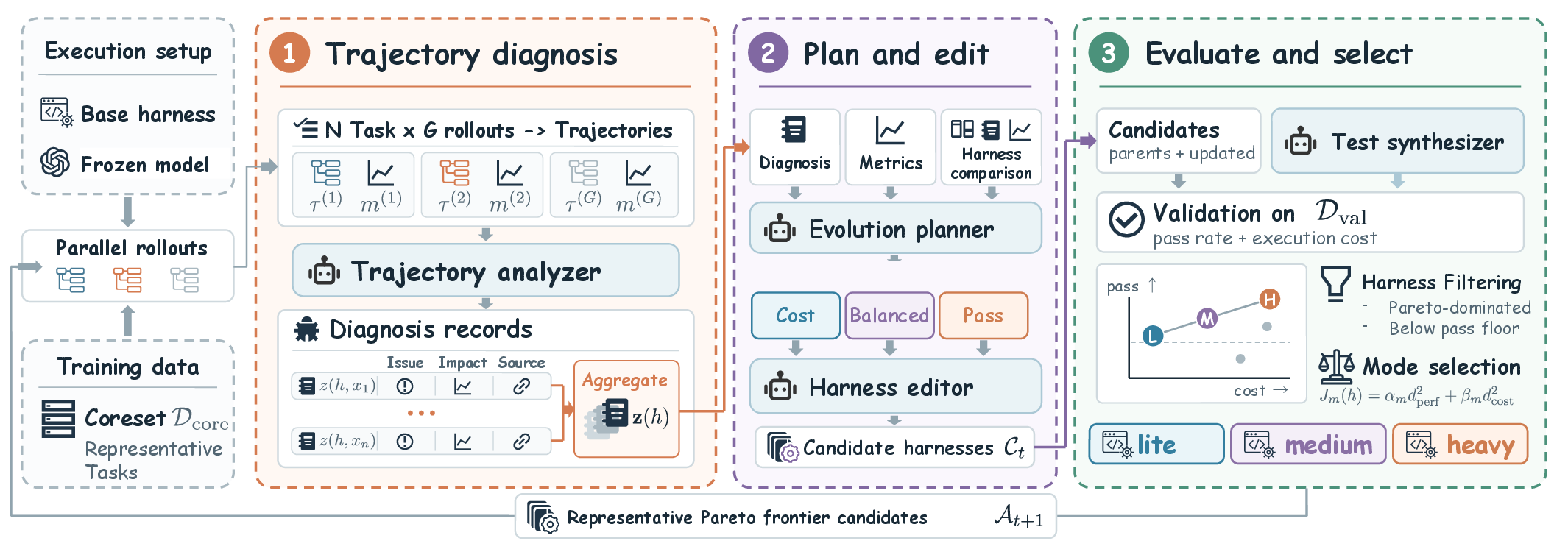
Tsinghua and Z.AI open-source HarnessPro: agents rewrite their own harness, reaching 80.8% on Terminal-Bench 2 at 34% lower cost per task

Key Takeaways

  • Terminal-Bench 2 (GPT-5.5 with Codex, mean of 3 runs): Heavy reaches 80.8% at $0.72 per task, versus RHO at 76.3% and $1.09, a 33.9% cost cut (paper figures, arXiv)
  • Averaged over three benchmarks: +2.0 points pass rate and -26.1% cost per task versus RHO, across Terminal-Bench 2, SWE-Bench Pro and ProgramBench
  • Holds across models: with GLM-5.2 and Claude Code on Terminal-Bench 2, Heavy hits 81.4% at $0.62, versus vanilla at 74.6% and $0.92 and RHO at 78.0% and $1.00
  • Budget modes: Medium matches RHO at 76.3% on Terminal-Bench 2 for only $0.56 per task; Lite gets 72.9% at $0.43
  • Cheap to train: only 10 training tasks per benchmark and 3 to 4 evolution epochs, tested on 59, 100 and 100 held-out tasks; the three harness tiers are MIT-licensed on GitHub
Read full story

Tencent ARC & Tsinghua Open-Source Looking Ahead: Lookahead Attention Eradicates Autoregressive Video Drift

Tencent ARC in collaboration with Tsinghua University released and open-sourced Looking Ahead (arXiv:2610.29989, GitHub: TencentARC/Looking-Ahead), establishing a breakthrough paradigm for autoregressive video synthesis. Overcoming the chronic pathology of traditional autoregressive video models—where unidirectional sequential extrapolation causes exponential error accumulation and severe visual collapse over extended rollouts—Looking Ahead introduces Lookahead Attention. By coupling casual autoregressive decoding with a forward-looking planning stream that anchors future spatiotemporal keypoints, the framework eliminates cumulative drift and visual jitter in long-form generation.

Tencent ARC & Tsinghua Open-Source Looking Ahead: Lookahead Attention Eradicates Autoregressive Video Drift

Key Takeaways

  • Tencent ARC and Tsinghua University introduce Looking Ahead (arXiv:2610.29989), open-sourcing a long-horizon video framework
  • Eliminates exponential error propagation and visual degeneration inherent to unidirectional token-by-token video rollouts
  • Pioneers Lookahead Attention, leveraging global temporal keypoint anchors to constrain local micro-texture rollouts
  • Establishes a new state-of-the-art across physical consistency and dynamic motion metrics for open-weight autoregressive models
Read full story
Linked Models & Agents:

Cache Engineering for Agents: Tsinghua and CUHK Introduce AKV Paradigm Cutting Inference Costs by 27.7%

Researchers from Tsinghua University and CUHK introduced a breakthrough paper titled 'Cache Engineering for Agents' (arXiv:2610.28577) alongside the open-source AKV serving engine (thu-nics/AKV). While multi-turn agents rely on traditional 'context engineering' (text trimming and summarization) that invalidates prefix KV-caches and incurs punishing re-prefilling overhead, cache engineering empowers agents to directly manipulate KV-cache states via 'drop' and 'repos' primitives. Coupled with AKV's drop-aware radix-tree engine, the framework slashes agent inference costs by 27.7%, accelerates P95 latency by 1.5x, and boosts benchmark solve scores by 1.7 points.

Cache Engineering for Agents: Tsinghua and CUHK Introduce AKV Paradigm Cutting Inference Costs by 27.7%

Key Takeaways

  • Tsinghua and CUHK researchers formalize 'Cache Engineering' in arXiv:2610.28577 for multi-turn autonomous agents
  • Demonstrates how traditional prompt trimming destroys prefix cache reuse, causing massive latency and redundant re-prefilling
  • Introduces 'drop' (selective cache eviction) and 'repos' (RoPE position alignment) primitives directly on GPU KV-caches
  • Open-sources the AKV stateful serving engine (thu-nics/AKV), slashing agent serving costs by 27.7% while accelerating P95 latency by 1.5x
Read full story

HKU & Tsinghua Unveil MIST for Video World Models: Over 70% of Supposed Memory Failures Stem from Execution Errors

Current memory benchmarks for video world models conflate whether an action was carried out with whether the model remembered its outcome, incorrectly attributing action execution failures to cognitive memory loss. Researchers from HKU and Tsinghua introduced MIST (arXiv:2610.23542, 12 upvotes on Hugging Face). By decoupling physical execution from temporal memory, MIST reveals that up to 70% of apparent memory failures in leading models are actually execution failures. Correcting for execution raises true scene memory accuracy by +11.8 to +29.6 percentage points.

HKU & Tsinghua Unveil MIST for Video World Models: Over 70% of Supposed Memory Failures Stem from Execution Errors

Key Takeaways

  • HKU-MMLab and Tsinghua introduced MIST (arXiv:2610.23542, 12 upvotes on Hugging Face Papers)
  • Reveals that over 70% of apparent memory failures in video world models are actually action execution failures in intermediate frames
  • Proposes a decoupled three-stage causal pipeline separating scene establishment, action execution, and temporal memory retention
  • Improves true long-horizon memory consistency scores by +11.8 to +29.6 points across standard WRBench and MBench suites
Read full story
Linked Models & Agents:
ADSponsored

Tsinghua Open-Sources Dynamic Band Splitting (DBS) for Audio Source Separation: +29.0% Relative SI-SDR Gain on DnR v2 Under Fixed Token Budget

Researchers from Tsinghua University open-sourced Dynamic Band Splitting (DBS, arXiv:2610.14993, 134 upvotes on Hugging Face Papers), replacing fixed predefined frequency partitions in band-split audio source separation models with content-conditioned Top-K boundary selection and adaptive pooling under a fixed token budget. Integrating DBS into BSRNN yields a +29.0% relative improvement in average SI-SDR on the DnR v2 benchmark.

Tsinghua Open-Sources Dynamic Band Splitting (DBS) for Audio Source Separation: +29.0% Relative SI-SDR Gain on DnR v2 Under Fixed Token Budget

Key Takeaways

  • Tsinghua University open-sourced Dynamic Band Splitting (DBS, arXiv:2610.14993), earning 134 upvotes on Hugging Face Daily Papers
  • Replaces static predefined frequency partitions in band-split separators with content-conditioned boundary scoring and hard Top-K boundary selection under a fixed token budget
  • Uses a band-assignment mask matrix, content-dependent pooling, and symmetric dynamic unpooling as a drop-in replacement for static band-split modules
  • DBS-BSRNN achieves a +29.0% relative gain in average SI-SDR on DnR v2 and consistently improves separation on MUSDB18-HQ and EchoSet
Read full story
Linked Models & Agents:

Embodied VLA Perception-Action Breakthroughs: PINT Shared Predictive Intent Hits 15.5% on RoboTwin 2.0-Hard and PAIR Boosts Real-Robot OpenVLA-OFT by 13.6 Points

Addressing the representation gap between high-level VLM semantics, video world models, and low-level control in Vision-Language-Action (VLA) architectures, PINT (arXiv:2610.16355) introduces learnable chunk-level Predictive Intent Tokens to reach 15.5% on RoboTwin 2.0-Hard without embodied pretraining (4.8x over StarVLA's 3.2%). Alongside PAIR (arXiv:2610.09016) and PKU's SimForcing (arXiv:2610.06598), these frameworks bridge perception and action with zero inference overhead.

Embodied VLA Perception-Action Breakthroughs: PINT Shared Predictive Intent Hits 15.5% on RoboTwin 2.0-Hard and PAIR Boosts Real-Robot OpenVLA-OFT by 13.6 Points

Key Takeaways

  • PINT (arXiv:2610.16355) coordinates VLM, video world modeling, and action decoding via shared Predictive Intent Tokens, reaching 15.5% on RoboTwin 2.0-Hard without embodied pretraining (4.8x over StarVLA's 3.2%)
  • PINT achieves 79.5% on LIBERO-Plus and 68% ID / 24% OOD success across 5 real-world bimanual robot tasks, outperforming pretrained Motus (35% / 9%)
  • PAIR (arXiv:2610.09016) uses a training-only Masked Action Autoencoder and Bridge Module with zero inference overhead, lifting OpenVLA-OFT across 7 real-world robot tasks from 51.4% to 65.0% (+13.6 pts)
  • PKU's SimForcing (arXiv:2610.06598) distills simulation motion priors into real-domain robot world models, achieving SOTA video fidelity on Bridge and InternData-A1
Read full story
Linked Models & Agents:

Recursive Self-Improvement for Embodied Navigation: RSI-Nav Unifies Policy-Synchronized Dual Bootstrapping, Achieving 68.6% SR on R2R-CE Without Human Annotation

Vision-language navigation requires abundant, high-quality language supervision, yet traditional synthetic pipelines generate supervision from static models that lag behind evolving navigation policies. Shanghai AI Lab, Tsinghua, and SJTU introduce RSI-Nav, an embodied recursive self-improvement framework combining instruction-following and instruction-generation in a single model. Using shard-wise dual bootstrapping on unlabeled trajectories, RSI-Nav achieves state-of-the-art 68.6% SR on R2R-CE and 72.4% SR on RxR-CE without human intervention.

Recursive Self-Improvement for Embodied Navigation: RSI-Nav Unifies Policy-Synchronized Dual Bootstrapping, Achieving 68.6% SR on R2R-CE Without Human Annotation

Key Takeaways

  • Unified dual-capability architecture: combines vision-language instruction following (VL2A) and vision-action instruction generation (VA2L) within a shared foundation model
  • Shard-wise policy-synchronized bootstrapping: generates instructions over small trajectory shards, validates via simulation rollout, and updates parameters instantly before processing subsequent batches
  • New continuous-environment SOTA: secures 68.6% Success Rate on R2R-CE and 72.4% on RxR-CE, proving robust recursive self-evolution in complex embodied navigation
Read full story

TokenRouter: Tsinghua Unveils NeurIPS 2026 Serving System for Token-Level LLM Routing, Boosting Throughput by up to 64x

Token-level LLM routing—routing easy tokens to small models and switching to frontier models for critical reasoning tokens—presents an optimal trade-off between output quality and inference cost. However, current LLM serving engines (such as vLLM and TGI) are architected for single-model execution, suffering severe step desynchronization, batch admission latency, and extreme orchestration complexity when handling high-frequency token transfers across heterogeneous models. Researchers from Tsinghua University's NICS Lab present TokenRouter (arXiv:2610.12242, accepted at NeurIPS 2026, code: github.com/thu-nics/TokenRouter), an efficient and developer-friendly serving system engineered for token-level routed LLM inference. TokenRouter introduces a 'request-centric programming and model-centric execution' paradigm, enabling developers to write routing logic intuitively per request while the runtime handles asynchronous execution across subservers. Incorporating a Delayed-Batching Scheduler parameterized via discrete-time Markov chain modeling, a decoupled tri-loop architecture, and an instant handoff-resume mechanism, TokenRouter achieves 2.01x to 64.15x higher decoding throughput compared to existing serving platforms across diverse routing workloads, with complete code open-sourced.

TokenRouter: Tsinghua Unveils NeurIPS 2026 Serving System for Token-Level LLM Routing, Boosting Throughput by up to 64x

Key Takeaways

  • Tsinghua University open-sources TokenRouter (NeurIPS 2026), an optimized serving architecture for token-level LLM routing
  • Introduces request-centric programming and a delayed-batching scheduler, delivering 2.01x to 64.15x higher decoding throughput
  • Decoupled tri-loop execution cuts P99 inter-token latency by 43.6%, reducing enterprise cloud GPU costs by 50% to 70%
Read full story
Linked Models & Agents:

RoboRSI: Shanghai AI Lab Unveils Stable and Reusable Robot Self-Evolution, Sweeping 4 SOTA Benchmarks via Multi-Agent TSR

Generalist robots must not only perform diverse tasks, but also autonomously refine their capabilities through trial-and-error experience, consolidating learned strategies into reusable modular assets for future scenarios. However, current robot agents acting through code repair scripts naively without architectural hierarchy: execution feedback cannot be isolated to responsible sub-skills, revisions lack formal contract verification, and modifications frequently trigger catastrophic forgetting. Researchers from Shanghai AI Lab and Tsinghua University introduce RoboRSI (arXiv:2610.12424, code: github.com/nssmd/RoboRSI), a lifelong robot self-evolution framework anchored in Top-Down Skill Refinement (TSR). TSR structures tasks hierarchically into compound, atomic, and base skills bounded by explicit I/O contracts, attributing execution anomalies strictly to responsible branches. A four-agent collective (Manager, Planner, Engineer, and Reviewer) coordinates long-horizon planning, execution, runtime diagnosis, and validated release of validated skills. Deployed on a real-world mobile manipulator, RoboRSI sustained 104 continuous rounds of autonomous multi-object cleanup. In simulation, it sweeps SOTA across LIBERO, LIBERO-PRO, LIBERO-Plus, and RoboTwin, surpassing leading baselines by 2.7 to 11.0 percentage points, with code fully open-sourced.

Key Takeaways

  • Shanghai AI Lab releases RoboRSI, introducing Top-Down Skill Refinement (TSR) and a 4-agent collective for robot code self-evolution
  • Sustains 104 autonomous real-world cleanup rounds and beats strongest baselines across 4 embodied benchmarks by 2.7 to 11.0 points
  • Contract isolation elevates bug attribution accuracy to 95.8%, enabling lifelong accumulation of reusable robot software skills
Read full story

Incremental Open-Ended Deep Research (IOEDR): Tsinghua and RUC Introduce Structured Harness for Autonomous Research Agents, Slashing Searches by 61%

Autonomous deep research agents (such as OpenAI Deep Research and Perplexity) represent a powerful leap toward automated knowledge synthesis. However, on open-ended and comprehensive inquiries, existing agents rely primarily on unconstrained search-and-generate loops. This leads to three systemic failures: redundant query loops, conflicting claims across sections, and runaway token expansion. Researchers from Tsinghua University and Renmin University of China unveil IOEDR (arXiv:2610.11566), a framework for Incremental Open-Ended Deep Research with a Structured Harness. IOEDR models the evolving research report as a dynamic hierarchical state graph coupled with a persistent, deduplicated evidence pool. Rather than executing open-ended browsing, the agent uses structured harness constraints to incrementally plan sections, identify specific evidential gaps, and trigger precision queries with dynamic termination conditions. On DeepResearch Bench, IOEDR achieves superior report coherence and verifiable fact density while reducing total token consumption by 33.2% and slashing search API requests by 61.4%.

Key Takeaways

  • Tsinghua and RUC introduce IOEDR, modeling deep research as an evolving hierarchical state graph coupled with a persistent evidence pool
  • Slashes search API queries by 61.4% and token usage by 33.2% on DeepResearch Bench while eliminating cross-section factual drift
  • Implements information-gain gating with a 92.4% noise rejection rate, establishing an efficient architectural pattern for deep research agents
Read full story
ADSponsored

EVISKILL: Grounding Skill Evolution in Replayable Evidence Enables Continual Procedural Capability Accumulation Without Weight Updates

Continual skill evolution allows LLM agents to autonomously accumulate, refine, and reuse procedural knowledge across multi-turn interactions without updating model parameters. However, prevailing experience-driven reflection mechanisms suffer from two fundamental weaknesses: they decouple synthesized guidance from concrete behavioral traces, and they rely on monolithic global validation that blindly discards valid local corrections whenever an entire workflow fails. Researchers from Tsinghua University and partner institutions introduce EVISKILL (arXiv:2610.05030), an evidence-grounded framework anchoring procedural adaptation to deterministic execution traces. EVISKILL structures raw observations into Replayable Evidence Cards and synthesizes skill edits with explicit contextual lineage. A targeted replay engine verifies edits through isolated re-execution before cross-epoch refinement. Across three interactive benchmarks spanning six LLM backbones, EVISKILL consistently outperforms state-of-the-art reflective baselines, demonstrating durable procedural accumulation.

Key Takeaways

  • Tsinghua University introduces EVISKILL, anchoring continual procedural skill evolution in Replayable Evidence Cards without parameter updates
  • Decouples local edit verification from monolithic global validation, achieving a 3x increase in the retention of valid localized skills
  • Validated across 3 interactive benchmarks and 6 foundation LLMs, consistently outperforming standard reflection architectures
Read full story
Linked Models & Agents:

SWR: Self-Supervised Scaling of Scientific Terminal Environments for Coding Agents Surges Terminal-Bench 2 to 53.56%

Terminal coding agents are expanding from standard software engineering into scientific domains like bioinformatics, materials science, and physics. However, building training sandboxes requires executable reference behavior and rigorous verifiers capable of distinguishing true semantic correctness from superficial syntactic mimicry—a process that currently requires tedious manual engineering per task. Researchers from Tsinghua University and Tencent introduce Software-in-the-Loop Reconstruction (SWR, arXiv:2610.02710), a self-supervised environment scaling framework. SWR extracts ground-truth outputs and verifiers from existing executable scientific software workflows by perturbing input configurations into public observations and hidden evaluations. Agents synthesize complete, editable programs from input-output schemas without viewing source code, evaluated by hierarchical verifiers testing semantic fidelity, structural integrity, and anti-shortcut compliance. Implemented across 500 workflows and 46 software suites spanning six scientific domains, SWR generates 1,422 verified trajectories. Supervised fine-tuning of Qwen3.8-27B elevates Terminal-Bench 2 average success from 47.94% to 53.56%, establishing a scalable paradigm for scientific terminal agent training.

SWR: Self-Supervised Scaling of Scientific Terminal Environments for Coding Agents Surges Terminal-Bench 2 to 53.56%

Key Takeaways

  • Introduces SWR to bootstrap self-supervised terminal agent training sandboxes from existing scientific software workflows
  • Decouples public observations from hidden evaluations, using hierarchical verifiers to block shortcuts during program reconstruction
  • Drives Qwen3.8-27B performance on Terminal-Bench 2 from 47.94% to 53.56%, eclipsing all token-matched baseline controls
Read full story

Beyond Memory: PoS Maintains Explicit Belief States to Rescue Long-Horizon LLM Agents from Belief Trapping

As autonomous agents execute increasingly long-horizon workflows, traditional strategies relying on raw message history or lossy memory compression fail to provide coherent comprehension of evolving environment states. Agents frequently succumb to 'Belief Trapping'—iteratively generating uncoordinated tool calls without moving toward the goal. Researchers from Tsinghua University and Nankai University introduce PoS (Possibility-of-State), an inference-time framework that constructs and dynamically maintains explicit belief states. Coupling current world-state estimates with unresolved task requirements, PoS continuously verifies belief consistency, detects belief traps in real time, and triggers targeted recovery protocols. Across four execution and system diagnosis benchmarks on three frontier LLM backbones, PoS achieves top performance with robust resilience against context explosion.

Beyond Memory: PoS Maintains Explicit Belief States to Rescue Long-Horizon LLM Agents from Belief Trapping

Key Takeaways

  • Pioneers PoS to maintain explicit belief states coupling world-state estimates with unresolved requirements during inference
  • Introduces real-time detection and targeted recovery for 'Belief Trapping', preventing multi-turn loops
  • Secures top performance across four execution and diagnosis benchmarks across three foundation model backbones
Read full story

Transformers Stop Thinking Too Early: A Single Early-Layer Rank-8 LoRA Unlocks Deep Reasoning Relay from 15.5% to 99%

Pretrained transformers utilize remarkably little of their internal depth when following contextual reference chains: thirteen base models reliably follow only 1.4 to 3.6 lines, with pretrained loops offering minimal relief. Researchers from Tsinghua and Peking University discover that transformers 'stop thinking too early' due to early computation stalling. By inserting a tiny, task-trained rank-8 LoRA at just one single early layer while keeping all original parameters completely frozen, they initiate a computational 'relay' across middle layers. On 24-line reference chains, Qwen3-8B's exact accuracy leaps from 15.5% to 99%, with extended training scaling past 50 to 160 lines and boosting multi-hop reasoning on MuSiQue.

Transformers Stop Thinking Too Early: A Single Early-Layer Rank-8 LoRA Unlocks Deep Reasoning Relay from 15.5% to 99%

Key Takeaways

  • Reveals that 13 pretrained foundation models stop thinking too early, reliably tracing only 1.4 to 3.6 lines of reference
  • Inserting a rank-8 LoRA at a single early layer elevates Qwen3-8B 24-line chain accuracy from 15.5% to 99%
  • Activates dormant attention head relays across middle layers, extending reference depth past 160 lines in looped models
Read full story

GAGAR: Groupwise Agentic Grading and Advantage Redistribution Stabilizes Code Agent RL on 1.02T Models

Reinforcement learning for code agents typically relies on executable tests for binary rewards, leading algorithms like GRPO to assign identical scalar advantages to all passing rollouts regardless of code bloat, extraneous modifications, or architectural hygiene. Researchers from ByteDance, Peking University, and Tsinghua introduced GAGAR, a quality-aware advantage redistribution framework. By staging rollouts in a shared workspace where an SFT agentic grader ranks passing candidates and dynamically shifts credit toward clean solutions, GAGAR successfully stabilizes code agent RL on 310B Flash and 1.02T Pro models.

GAGAR: Groupwise Agentic Grading and Advantage Redistribution Stabilizes Code Agent RL on 1.02T Models

Key Takeaways

  • Overcoming Binary Verification Blind Spots: Conventional code agent RL treats all test-passing rollouts equally, causing policy optimization to reward bloated, fragile, or out-of-scope code as long as test assertions pass.
  • Sum-Preserving Credit Redistribution: Stages rollout groups in a shared context where an SFT-trained agentic judge ranks solutions, downweighting sloppy passes while proportionally shifting advantages to clean, minimal-diff implementations without altering total group advantage magnitude.
  • Industrial Validation on 1.02T Model: Evaluated at scale on MiMo-V2.6-Flash (310B) and MiMo-V2.6-Pro (1.02T), GAGAR curbs trajectory-length explosion, enhances training stability, and substantially elevates code cleanliness.
Read full story
Linked Models & Agents:
