
AI Coding Live News

Microsoft Research and UC Berkeley open-source TokenEconomizer, a plugin that cuts Claude Code and Codex costs by 18.4–30.9% on SWE-Bench without changing the agent

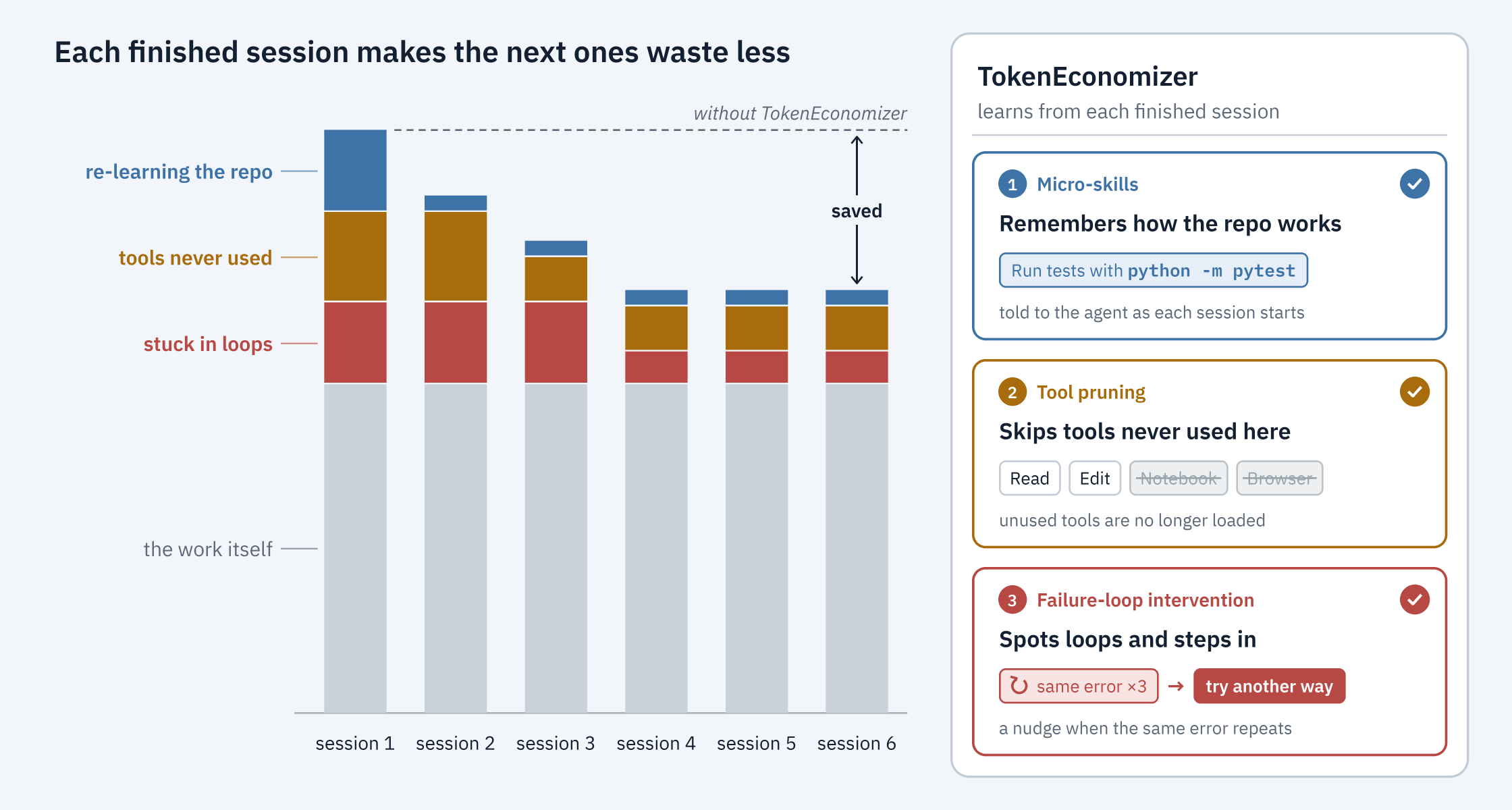
Microsoft Research, Microsoft Security and UC Berkeley open-sourced TokenEconomizer on GitHub (Apache 2.0, v0.1.0 released October 26), a plugin for Claude Code, Codex, GitHub Copilot CLI and Pi, with experimental opencode support. It learns from earlier sessions in the same repository: micro-skills remember repo facts, tool pruning drops tool definitions that go unused, and a loop guard nudges an agent that is stuck. The paper reports 18.4–30.9% lower mean cost across five agent and model combinations on 277 SWE-Bench tasks (paper figures).
Microsoft Research and UC Berkeley open-source TokenEconomizer, a plugin that cuts Claude Code and Codex costs by 18.4–30.9% on SWE-Bench without changing the agent

Key Takeaways

  • Cost: on 277 SWE-Bench tasks across 6 repositories and 5 agent and model combinations, mean cost fell 18.4–30.9%, and all 30 repository-by-combination cells got cheaper (paper figures, including the plugin's own model calls)
  • Success rate: Pass@1 rose in 4 of 5 combinations, e.g. Copilot CLI with Sonnet 5 cost 18.4% less with Pass@1 +2.6, while Claude Code with Opus 4.8 cost 30.9% less with Pass@1 -1.0
  • Three mechanisms: micro-skills (repo facts stated only after three sessions confirm them), tool pruning (by default a tool unused over 10 prompts across 2 sessions is left out), and a failure-loop guard (one redirect when a judge is at least 0.7 confident, never stopping a turn itself)
  • Generalization: 16–21% lower cost on Web-Bench and 6–20% lower on two security-auditing benchmarks where every task is a new repository
  • Deployment: Apache 2.0, Python 3.10+, no API key of its own, and learned experience stays local in ~/.tokeneconomizer
Read full story

FrontierCS 2 benchmark: agents must rebuild a paper's deleted contribution in its own repo and beat the authors' code; Claude Opus 5.5 leads at 58%, 16 tasks unsolved

Teams from UC Berkeley, Princeton and others released FrontierCS 2 (arXiv 2610.29932): 48 tasks across 13 CS domains, each built by deleting a paper's contribution from the authors' released code. An agent has 5 hours to write it back and passes only if it beats the original on every metric and every hidden workload. Of 12 agents, Claude Opus 5.5 in Claude Code leads with a 58% pass rate, every other agent passes fewer than half, and 16 tasks have no passing run. On Oct 26 maintainer Wenhao Chai said a trace audit showed the Pi harness ends runs on refusals; rerun in Antigravity, Gemini 4 Argon now beats GPT-6 Astra and sits right behind Opus 5.5.

Key Takeaways

  • 48 tasks, 13 domains, 12 agents, one run per agent per task (paper)
  • Strict pass rule: the final submission must beat the authors' code on every metric and every hidden workload; a higher total score can still fail
  • Claude Opus 5.5 in Claude Code leads with a 58% pass rate; 16 tasks have no passing run
  • Under the Pi harness, 10 of Gemini 4 Argon's 48 runs ended on provider refusals; rerun in Antigravity it beats GPT-6 Astra (Wenhao Chai's post)
  • Tasks and evaluators are open source on GitHub; the authors estimate a full 48-task run with Opus 5.5 at about $1,000 in API fees, $300 GPU and $100 CPU
Read full story

Stanford & UC Berkeley Introduce Librarian Agents: Training LLMs to Proactively Curate Workspaces, Cutting Navigation Costs by 33.8%

Researchers from Stanford University and UC Berkeley introduced Librarian Agents (arXiv:2610.22273). To overcome the bottleneck of reactive RAG methods struggling with complex cross-document reasoning at query time, the framework uses reinforcement learning to train LLMs to perform anticipatory directed curation on messy long-context workspaces into structured synthetic filesystems. On BrowseComp+, it hits 55.86% accuracy while reducing navigation token consumption by 33.8% to 51%.

Stanford & UC Berkeley Introduce Librarian Agents: Training LLMs to Proactively Curate Workspaces, Cutting Navigation Costs by 33.8%

Key Takeaways

  • Stanford and UC Berkeley introduced Librarian Agents (arXiv:2610.22273), replacing reactive RAG with anticipatory directed workspace curation
  • Uses reinforcement learning to train builder agents to restructure raw documents into modular synthetic filesystems via CreateFile and MergeFiles
  • Achieves 55.86% accuracy on BrowseComp+ with only 3,635 navigation tokens, cutting navigation token costs by 51% compared to flattened workspaces
  • Reduces tokens per correct answer by 33.8% at 10 queries per corpus, establishing an amortized curation paradigm for repeatedly queried knowledge bases
Read full story
Linked Models & Agents:

NVIDIA and UC Berkeley Unveil Post-Training Performance Predictors for Coding Agents from Base Checkpoints

Agentic post-training (scaling multi-turn RL and SFT) requires massive GPU investments, but AI labs lack reliable heuristics to predict which base model checkpoint possesses the highest potential before committing to multi-million-dollar post-training runs. Cold-start zero-shot evaluations on SWE-bench fail because unaligned base checkpoints cannot emit formatted tool invocations, while single-turn patch benchmarks ignore multi-step state management. Researchers from NVIDIA and UC Berkeley (including Bryan Catanzaro and Ashish Vaswani) present a lookahead evaluation framework (arXiv:2610.10478). By replaying successful post-trained trajectories and rerunning unit tests after every edit, they isolate the 'decisive step' that flips a repository from failing to passing. They introduce three lightweight evaluation screens at this decisive step that require zero cold-start tool calling: Decisive-Action Bits Per Byte (BPB), Patch MCQ, and prefix-conditioned pass@K. Across ten pairs of public base and post-trained models, these screens rank candidate checkpoints in tight agreement with final post-trained SWE-bench Verified pass@1 scores, establishing a low-cost lookahead methodology for model selection.

Key Takeaways

  • NVIDIA and UC Berkeley introduce lookahead screens to predict post-training coding agent performance from base checkpoints
  • Isolates the 'decisive step' that flips test suites to passing, introducing Decisive-Action BPB, Patch MCQ, and prefix-pass@K
  • Ranks base model potential in tight agreement with post-trained SWE-bench Verified pass@1 across 10 model pairs
Read full story
Linked Models & Agents:
ADSponsored