AI Coding Live News

Microsoft Research and UC Berkeley open-source TokenEconomizer, a plugin that cuts Claude Code and Codex costs by 18.4–30.9% on SWE-Bench without changing the agent

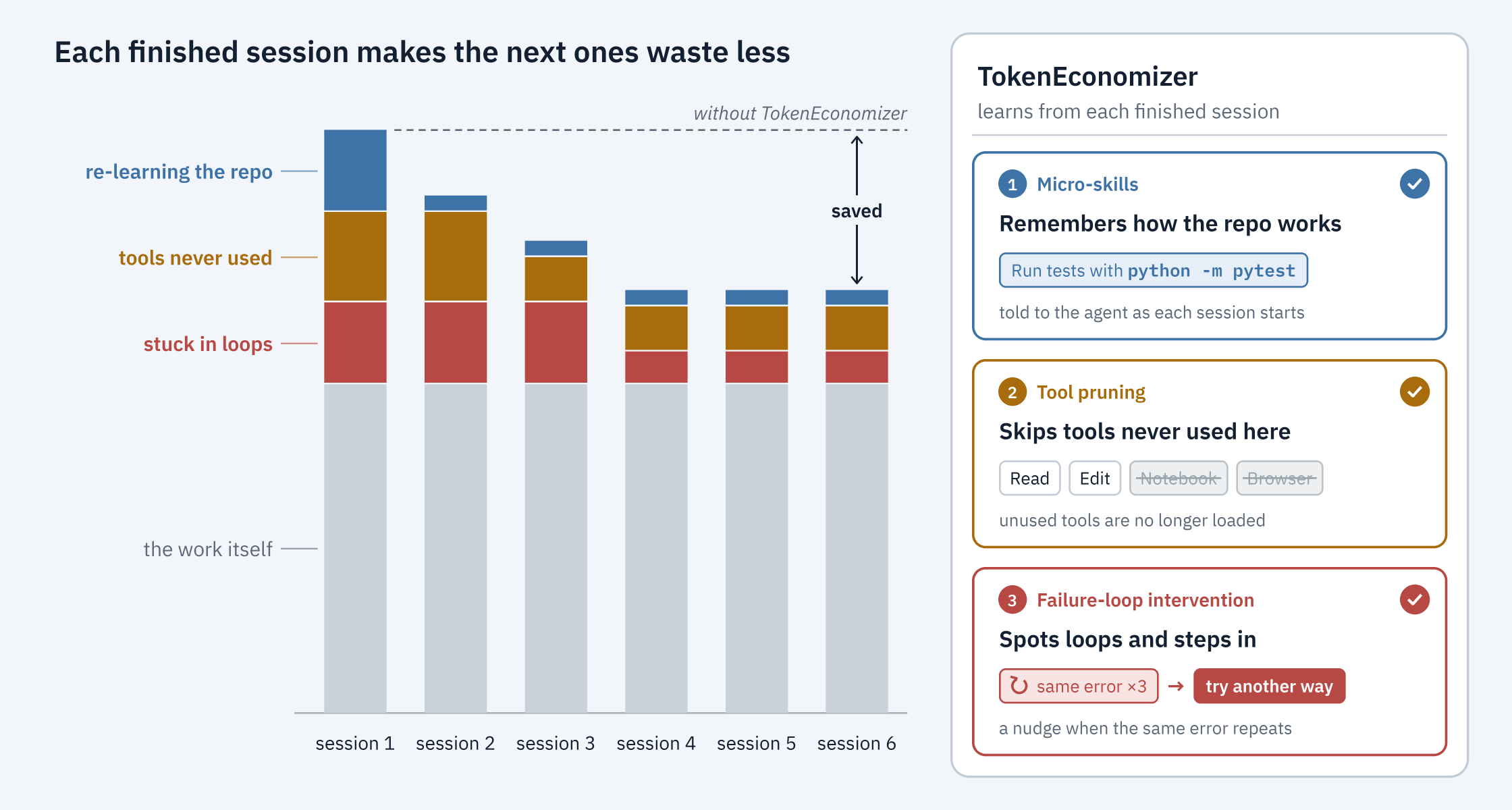
Microsoft Research, Microsoft Security and UC Berkeley open-sourced TokenEconomizer on GitHub (Apache 2.0, v0.1.0 released October 26), a plugin for Claude Code, Codex, GitHub Copilot CLI and Pi, with experimental opencode support. It learns from earlier sessions in the same repository: micro-skills remember repo facts, tool pruning drops tool definitions that go unused, and a loop guard nudges an agent that is stuck. The paper reports 18.4–30.9% lower mean cost across five agent and model combinations on 277 SWE-Bench tasks (paper figures).
Microsoft Research and UC Berkeley open-source TokenEconomizer, a plugin that cuts Claude Code and Codex costs by 18.4–30.9% on SWE-Bench without changing the agent

Key Takeaways

  • Cost: on 277 SWE-Bench tasks across 6 repositories and 5 agent and model combinations, mean cost fell 18.4–30.9%, and all 30 repository-by-combination cells got cheaper (paper figures, including the plugin's own model calls)
  • Success rate: Pass@1 rose in 4 of 5 combinations, e.g. Copilot CLI with Sonnet 5 cost 18.4% less with Pass@1 +2.6, while Claude Code with Opus 4.8 cost 30.9% less with Pass@1 -1.0
  • Three mechanisms: micro-skills (repo facts stated only after three sessions confirm them), tool pruning (by default a tool unused over 10 prompts across 2 sessions is left out), and a failure-loop guard (one redirect when a judge is at least 0.7 confident, never stopping a turn itself)
  • Generalization: 16–21% lower cost on Web-Bench and 6–20% lower on two security-auditing benchmarks where every task is a new repository
  • Deployment: Apache 2.0, Python 3.10+, no API key of its own, and learned experience stays local in ~/.tokeneconomizer
Read full story
O
OpenAI@AICoder·
👀40
🔥80

OpenAI Codex CLI 0.166.0: keyboard transcript selection, GPT-6.1 Terra in Vertex AI and Bedrock catalogs, codex doctor network checks

OpenAI published the stable Codex CLI release rust-v0.166.0 on GitHub at 19:47 UTC on Oct 29. It adds keyboard-driven transcript selection by word, line and page with built-in search, adds GPT-6.1 Terra to the bundled, Vertex AI and Amazon Bedrock model catalogs, introduces codex queue --resume and codex doctor --network-only, and shows clearer safety-block explanations with selectable safer follow-up prompts in the TUI.

Key Takeaways

  • Model catalogs: GPT-6.1 Terra added to the bundled, Vertex AI and Amazon Bedrock catalogs (#57293)
  • Transcript: keyboard selection by word, line and page, integrated search and configurable shortcuts (#57221 to #57224)
  • New commands: codex queue --resume resumes unloaded threads after queueing a message; codex doctor --network-only checks config, connectivity and WebSocket
  • Safety UX: clearer explanations when a request is blocked, plus selectable safer follow-up prompts (#57363, #57365)
  • Fixes: approval and permission settings survive resume and fork, and reasoning-token accounting is preserved to avoid premature compaction
Read full story

Cloudflare discloses a cross-request KV cache leak in GLM-5.3 on Workers AI: a config mismatch plus an SGLang bug let 155 responses carry other users' data over 13 days

In an Oct 26 incident report on its blog, Cloudflare said that between Aug 27 and Sep 9, 155 responses from GLM-5.3 on Workers AI (@cf/zai-org/glm-5.3) to prompts longer than 681,280 tokens contained data from other customers' recent requests, all returned with HTTP 200. The cause was a prefill KV cache pool smaller than the 1,048,576-token context window, combined with an SGLang bug in disaggregated prefill/decode mode. Cloudflare found no evidence of deliberate exploitation, has fixed it, and recommends operators upgrade to SGLang v0.5.22 or later.

Cloudflare discloses a cross-request KV cache leak in GLM-5.3 on Workers AI: a config mismatch plus an SGLang bug let 155 responses carry other users' data over 13 days

Key Takeaways

  • Scope: 155 responses between 2026-08-27 and 09-09, all to prompts over 681,280 tokens; Cloudflare confirmed no other Workers AI model was affected
  • Cause 1: GLM-5.3 advertised a 1,048,576-token context but the prefill KV pool held only 681,280 tokens; after the fix the pool holds about 2.04 million tokens, roughly twice the context
  • Cause 2: SGLang marked over-length requests as rejected and swapped in a one-token placeholder without aborting, so the decode node read stale cache pages from earlier requests
  • Response: report from Gadi Evron of Knostic via HackerOne on Sep 8; model taken offline within 40 minutes of declaring the incident on Sep 9 and restored at 19:40 UTC that day
  • Action: teams running SGLang should upgrade to v0.5.22 or later and check KV pool size against context length directly
Read full story
Linked Models & Agents:
⚡ Z.ai GLM 5.3🌐 cloudflare🌐 zai

vLLM and Ant Group Open-Source Humming: Up to 5x Kernel Acceleration and +43.3% MoE Throughput

The vLLM project team and Ant Group officially open-sourced Humming (humming-kernels), a specialized high-performance kernel library designed for serving quantized MoE and dense LLMs at massive scale. Humming natively supports WnA16, W8A8, W4A8, and W4A4 across INT1–INT8 and FP4–FP8 formats, spanning NVIDIA architectures from Turing through Blackwell as well as T-Head Zhenwu 810E silicon. In production benchmarks, Humming kernels outpace cuBLAS by 3–4x at small batch sizes and surpass Marlin by 2x on H200 clusters. Serving DeepSeek-V4.1-Flash across 8x H20 GPUs, Humming drives a +43.3% throughput gain under 64 concurrent requests while reducing time-to-first-token (TTFT) by 32%, pre-integrated directly into vLLM v0.29.0+.

vLLM and Ant Group Open-Source Humming: Up to 5x Kernel Acceleration and +43.3% MoE Throughput

Key Takeaways

  • vLLM and Ant Group open-sourced Humming (humming-kernels), integrated out-of-the-box into vLLM v0.29.0+
  • Covers WnA16, W8A8, W4A8, and W4A4, compiling JIT kernels in just 1.82 seconds versus 23.35 seconds for CUTLASS
  • Serving DeepSeek-V4.1-Flash on 8x H20 GPUs yields a +43.3% throughput boost at 64 concurrency (442 to 634 tokens/sec)
  • Cuts time-to-first-token (TTFT) by 25% to 32% while delivering up to 5x kernel speedups on Blackwell B300 systems
Read full story
ADSponsored

Eagle releases EAGLE-4, a speculative-decoding drafter that adapts to batch size and hardware; it reports 961.6 tok/s on Qwen3.8-27B for a single request

On Oct 20, inference company Eagle released EAGLE-4, the fourth generation of the EAGLE speculative-decoding family. One drafter resizes its speculative tree for the batch size, hardware and workload while keeping the target model's output distribution. Eagle reports 961.6 tokens/s for one request on Qwen3.8-27B with 4x B300. The code ships as eagle-harness v0.1.0 with plugins for SGLang, vLLM and an experimental TokenSpeed backend. Many reposts call it open source, but the official license is source-available, not OSI open source.

Eagle releases EAGLE-4, a speculative-decoding drafter that adapts to batch size and hardware; it reports 961.6 tok/s on Qwen3.8-27B for a single request

Key Takeaways

  • Vendor figure: 961.6 tokens/s on Qwen3.8-27B with TokenSpeed, BF16, 4x B300, TP4, one request, T=0 (paper Figure 1(a))
  • Repo measurements: vLLM on 4x B300 goes from 241.6 to 722.8 tok/s at concurrency 1 (2.99x) and 1.70x at concurrency 8; SGLang gets 1.91x at concurrency 8 and 1.35x at 64
  • AMD numbers too: SGLang on one MI355X gets 2.07x at concurrency 8 and 1.56x at 32 (ROCm 7.2)
  • Design: sliding-window draft layer, low-rank candidate head and append-only draft cache; the harness calibrates verify latency offline and grows the tree while gain per cost stays high
  • License: Eagle 4 Source-Available; free for noncommercial use, commercial use only under $20M trailing 12-month revenue and outside competing offerings
Read full story

humans& releases its first model, Ampersand v0.1: a group-collaboration model trained from GLM 5.3, now open via its Agents API

On Oct 20, AI startup humans& released its first model, Ampersand v0.1, pitched as a collaborator that helps groups reach individual and shared goals rather than an assistant that completes tasks alone. It is trained from Z.ai's GLM 5.3 (about 744B total, about 40B active parameters) with long-horizon multi-party RL against simulated users played by humans&'s own user model, Persimmon. It is available now, with no waitlist, through an API compatible with OpenAI's Agents API.

humans& releases its first model, Ampersand v0.1: a group-collaboration model trained from GLM 5.3, now open via its Agents API

Key Takeaways

  • Base: GLM 5.3 MoE with about 744B total and about 40B active parameters and a 1,048,576-token context (official model card)
  • Long-term collaboration simulation (vendor figures): 12.94 for Ampersand versus 9.89 for base GLM 5.3
  • Collaborative Intelligence teamwork 59.1% (GLM 5.3: 54.3%); CooperBench cooperative success 39.0% versus 17.3% for GLM 5.3
  • Trade-off: SWE-bench Pro v2 (Hard-51) 82.4%, slightly below the base model's 84.3%; humans& also admits it sometimes over-coaches
  • Access: model ID ampersand-v0.1, usable with the official OpenAI SDK pointed at the humans& base URL
Read full story
Linked Models & Agents:

vLLM Ships Precompiled Bytecode Images and Decision 3.0 Serving: Cold Start Accelerated by 18%, MI325X Decision Throughput Hits 1.8x

The vLLM team announced two major milestones: shipping precompiled Python bytecode via uv in v0.32.0 release images cuts cold-start container launch by 14–18% (~18s on NVIDIA H100) with zero runtime recompiles. Additionally, vLLM integrated the Decision 3.0 (D3) structured reasoning family (0.6B to 27B) into the /v1/systemone endpoint, ranking #1 on the Jev Decision Index and delivering 1.8x req/s on a single AMD MI325X under 64 concurrent clients.

vLLM Ships Precompiled Bytecode Images and Decision 3.0 Serving: Cold Start Accelerated by 18%, MI325X Decision Throughput Hits 1.8x

Key Takeaways

  • vLLM ships precompiled Python bytecode via uv in official images, reducing H100 cold starts by 14–18% (~18 seconds saved)
  • Natively serves the Decision 3.0 (D3) family (0.6B to 27B) via the /v1/systemone structured decision endpoint
  • D3 models rank #1 on the Jev Decision Index with 66.3 in text and 71.3 in vision
  • D3 27B achieves 1.8x the request throughput of standard checkpoint servers on a single AMD Instinct MI325X under 64 concurrent clients
Read full story
Linked Models & Agents:

SGLang v0.5.22 Released: DeepSeek-V4.1 Throughput Jumps 2.3x on H200 and 1.9x on MI355X, InstantTensor Loads Models 10x Faster

The SGLang team released v0.5.22 featuring 950 PRs from 245 contributors: DeepSeek-V4.1 delivers up to 2.3x more throughput per GPU on NVIDIA H200 and 1.9x on AMD MI350X/MI355X via DSpark. The new InstantTensor loader cuts model loading time by 10x. B200 decodes Qwen3.8-Flash-Next 12% faster, while B300 speeds up GLM-5.3-Flash by 10% and yields 1.85x decode throughput for MiMo-V2.6-Pro. SGLang also adds native Apple Silicon PyTorch support and ComfyUI integration.

SGLang v0.5.22 Released: DeepSeek-V4.1 Throughput Jumps 2.3x on H200 and 1.9x on MI355X, InstantTensor Loads Models 10x Faster

Key Takeaways

  • SGLang v0.5.22 released with 950 PRs from 245 contributors across heterogeneous platforms
  • DeepSeek-V4.1 achieves up to 2.3x throughput per GPU on NVIDIA H200 and 1.9x on AMD MI350X/MI355X via DSpark
  • New InstantTensor loader speeds up large model checkpoint ingestion by 10x
  • Qwen3.8-Flash-Next decodes 12% faster on B200; MiMo-V2.6-Pro reaches 1.85x decode throughput on B300
  • PD disaggregation cuts p95 TTFT in half (-50%) on long prompts, alongside native Apple Silicon and ComfyUI diffusion support
Read full story
Linked Models & Agents:

vLLM v0.32.0: 814 commits, built-in /v1/systemone structured-decision endpoint, NVFP4 KV cache on more GPUs, and 43–85% more req/s with multiple API workers

vLLM shipped v0.32.0 on Oct 18 with 814 commits from 363 contributors (121 new). Highlights: a default-served POST /v1/systemone structured-decision endpoint and a generic hf tool/reasoning parser; NVFP4 KV cache on SM8x/SM90/SM12x and FP8 KV by default for GLM-5.x on SM100; Model Runner V2 gains a GPU n-gram speculator and Elastic EP and becomes the ROCm default; three security advisories are fixed, default CORS is restricted, and Python 3.10 is dropped.

vLLM v0.32.0: 814 commits, built-in /v1/systemone structured-decision endpoint, NVFP4 KV cache on more GPUs, and 43–85% more req/s with multiple API workers

Key Takeaways

  • Scale: 814 commits from 363 contributors (121 new); see the release notes.
  • Structured decisions: POST /v1/systemone is new and served by default for choice/score questions, including Cloudflare/clef-omni and LiquidAI/d1-3B; --tool-call-parser hf reads a checkpoint's response_template so no model-specific parser is needed.
  • Low-precision KV: GLM-5.x defaults to FP8 KV on SM100, halving KV memory per rank with 2.3–5.5% more throughput at a 7–11% TTFT cost (PR benchmark, vendor figures); ROCm adds a 4-bit KV cache at about 2x FP8 density.
  • Serving: with --api-server-count above 1, connections go to the least-loaded worker for 43–85% more req/s on short requests (Qwen3-0.6B, 32 in / 1 out tokens, PR benchmark).
  • Breaking: Python 3.10 dropped, default CORS origins restricted, cascade attention removed, and max_tokens is no longer reserved from the context window.
Read full story

Ollama Cloud Launches US/EU Zero-Data-Retention Hosting for DeepSeek-V4.1-Flash-1017 with Claude Code CLI, While SemiAnalysis Reveals GLM-5.3 Was Built 100% via Post-Training

Ollama launched US- and EU-hosted Ollama Cloud with strict zero data retention and zero training, adding immediate support for DeepSeek-V4.1-Flash-1017 via one-line launch commands for Claude Code and OpenCode alongside Ollama v0.40.6. Meanwhile, SemiAnalysis revealed that GLM-5.3 was built entirely by post-training the previous GLM-5.2 base model without pretraining from scratch, achieving a 'night and day difference' in cybersecurity and agentic capabilities.

Ollama Cloud Launches US/EU Zero-Data-Retention Hosting for DeepSeek-V4.1-Flash-1017 with Claude Code CLI, While SemiAnalysis Reveals GLM-5.3 Was Built 100% via Post-Training

Key Takeaways

  • Ollama Cloud launches US- and EU-hosted zero-data-retention serving for DeepSeek-V4.1-Flash-1017 with one-line ollama launch integrations for Claude Code and OpenCode
  • Ollama v0.40.6 adds GGUF q2_0 tensor support, clef cloud integration, and fixes orphaned runner processes on Windows
  • SemiAnalysis reveals GLM-5.3 was built entirely by post-training the previous model without pretraining from scratch, delivering a 'night and day difference' in cyber capabilities over GLM-5.2
Read full story
Linked Models & Agents:
ADSponsored

Artificial Analysis launches AA-Robotics v0.1: coding agents drive a real robot arm, GPT-6 Astra leads at 69.4

Artificial Analysis released AA-Robotics v0.1 on 2026-10-14, a research preview in which frontier models running inside coding-agent harnesses (Codex, Claude Code, Antigravity) control a 6-axis robot arm over an HTTP API across eight tabletop tasks. GPT-6 Astra scores 69.4, ahead of GPT-6.1 Sol (64.6), Gemini 4 Argon (55.3), Claude Opus 5.5 (48.8) and Claude Fable 5.1 (46.3). Models take about 30 minutes per task versus roughly 20 seconds for a human.

Artificial Analysis launches AA-Robotics v0.1: coding agents drive a real robot arm, GPT-6 Astra leads at 69.4

Key Takeaways

  • Scores (out of 100): GPT-6 Astra 69.4, GPT-6.1 Sol 64.6, Gemini 4 Argon 55.3, Claude Opus 5.5 48.8, Claude Fable 5.1 46.3 (AA article)
  • Speed: ~30 min per task for models (Argon ~52 min) vs ~20 s for a human
  • Cost: GPT-6.1 Sol cheapest at $1.93/task, GPT-6 Astra $16.36/task; ~70% of spend is input context
  • Grasp success: Astra 45%, Fable 5.1 44%, Opus 5.5 40%, Argon 36%, Sol 28%
  • Measure-the-box (within 2 mm) tops out at 17/100 across all five models
Read full story

Hermes Agent v0.22.0: keyless guided onboarding, one-click local llama.cpp models, Gmail/Linear/Notion connectors and a 600-plugin catalog

Nous Research shipped Hermes Agent v0.22.0, "The Threshold Release", on Oct 14 (UTC). Fresh desktop installs open a guided setup chat on a free trial model (nous/welcome) with no API key, connectors reach Gmail, Linear and Notion through the Nous tool gateway, a one-click llama.cpp runtime runs local models, installs now follow tested SemVer stable releases, and desktop builds are signed (including the Microsoft Store). The source tree shrank from about 1.06M to 698K lines (−34%).

Hermes Agent v0.22.0: keyless guided onboarding, one-click local llama.cpp models, Gmail/Linear/Notion connectors and a 600-plugin catalog

Key Takeaways

  • Scale since v0.21.0: ~24,200 commits, ~6,080 merged PRs, ~7,180 issues closed, ~2,520 contributors, about 2.5x the v0.21.0 cycle
  • Leaner: source went from ~1.06M to 698K lines (−34%); gateway/run.py from 34,847 to 5,512 lines; ~19 rarely used tools now load on demand, roughly halving the desktop tool schema, and ~2.1k tokens came off the fixed prompt
  • Local models: installs llama.cpp b11370 for CPU/CUDA/Metal/Vulkan/ROCm, recommends only models that fit fully in GPU memory; catalog includes Qwen3.8 27B, Qwen3.6 35B-A3B, DeepSeek V4 Flash and any Hugging Face GGUF
  • 600-plugin catalog, each pinned to a reviewed commit; memory providers (Honcho, Mem0, Supermemory and others) moved out of core
  • Faster updates that rebuild only what changed: 16.5 s vs 32.5 s on macOS (vendor figure)
Read full story

Theo open-sources tsc-rs: Opus 5.5 ported the TypeScript 7 compiler to Rust in two weeks for ~$24K, type-checking ~1.6x faster than the Go version

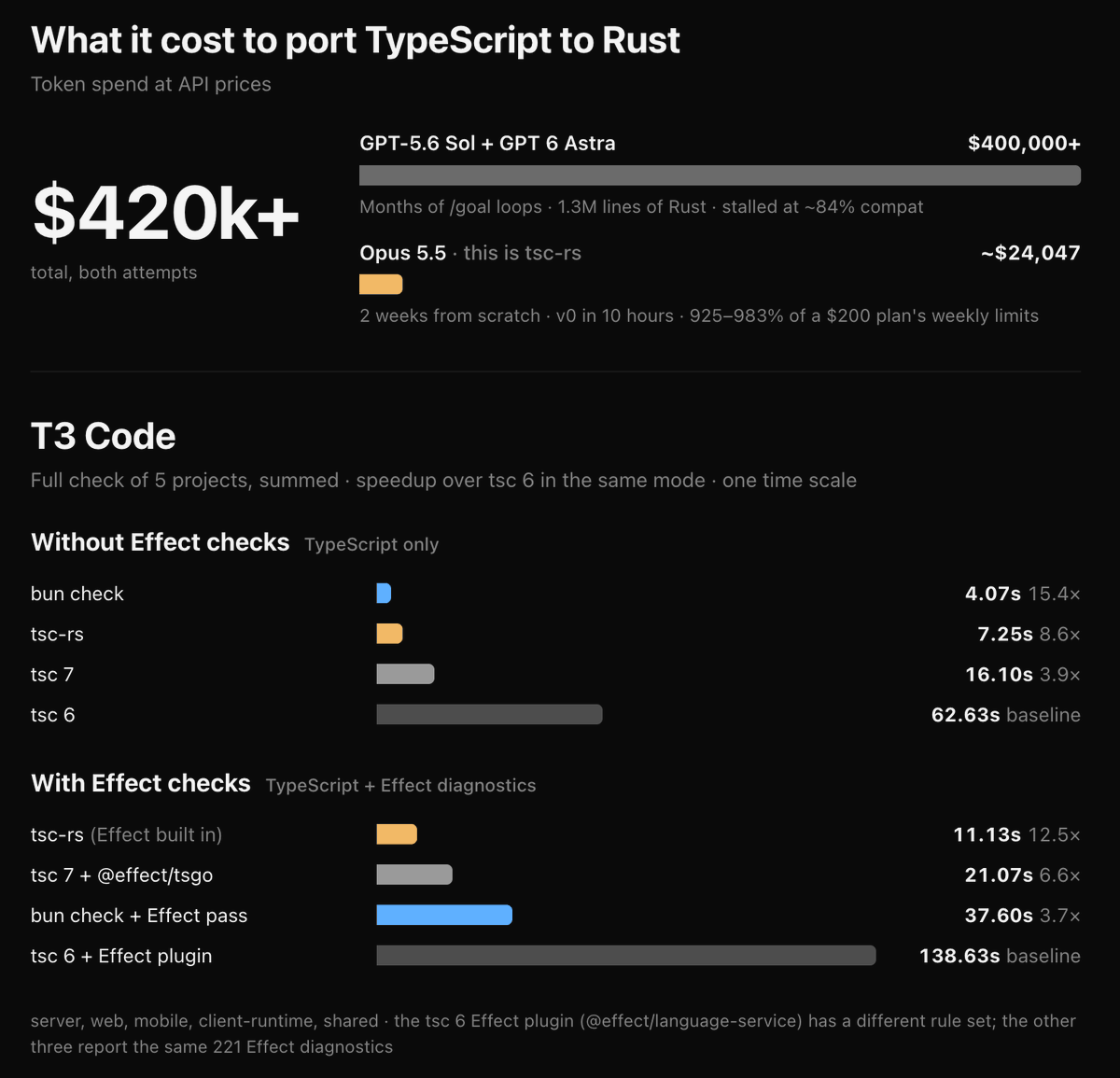
Theo (T3) open-sourced ts-rust (npm: tsc-rs), a Rust port of Microsoft's Go-native TypeScript compiler, checker and language server. Months of GPT-5.6 Sol / GPT 6 Astra runs cost over $400K in API-priced tokens and stalled near 84% compatibility; Claude Opus 5.5 restarted from scratch, reached a working v0 in 10 hours and finished in two weeks for about $24,047. All 181,711 ported Go tests pass, it type-checks 1.61x faster than tsc 7 (geometric mean over six open-source apps), ships Effect diagnostics built in and has a WASM build.

Theo open-sources tsc-rs: Opus 5.5 ported the TypeScript 7 compiler to Rust in two weeks for ~$24K, type-checking ~1.6x faster than the Go version

Key Takeaways

  • Cost: GPT-5.6 Sol / GPT 6 Astra burned $400K+ and stalled near 84% compat; Opus 5.5 finished in 2 weeks for ~$24,047 (README)
  • Correctness: all 181,711 ported Go tests pass; TanStack Query core and Hono diagnostics match Go exactly
  • Speed: geometric mean 11.4x over tsc 6 and 1.61x over tsc 7 on six apps; VS Code (3.75M lines) 4.20s vs 6.84s for tsc 7; bun check is still fastest (20.9x)
  • T3 Code: 7.25s vs 16.10s for tsc 7 without Effect (2.22x); 11.13s vs 21.07s with Effect diagnostics (1.89x)
  • Early release: Linux x64 and macOS arm64 only; known monorepo TS6059 and tsc -b stale-output issues
Read full story

Liquid AI open-sources Open d1: d1-3B and d1-omni-600M decision models answer in one forward pass, 8 ms on RTX 4090

Liquid AI released two open-weight multimodal decision models: d1-3B (text+vision) and the experimental d1-omni-600M (text+image or text+audio). Instead of generating tokens they answer in a single forward pass. d1-3B scores 48.57 on Decision Index v0.2.1 (public split), first among sub-10B models and on par with the 12x larger Decider 35B-A3B, and answers in 8 ms on an RTX 4090 and 50 ms on a Jetson Orin Nano, with day-one llama.cpp support.

Liquid AI open-sources Open d1: d1-3B and d1-omni-600M decision models answer in one forward pass, 8 ms on RTX 4090

Key Takeaways

  • d1-3B: 48.57 on Decision Index v0.2.1 public split, #1 under 10B, on par with Decider 35B-A3B; d1-omni-600M: 15.95
  • Text benchmark mean: d1-3B 82.9 vs Decider 4B 81.1; d1-omni-600M 78.4 vs Decider 2B 77.1 (Civil Comments 95.8)
  • Single-question latency: 8 ms RTX 4090, 9 ms MI325X, 16 ms Jetson AGX Thor, 30 ms Apple M5 Pro, 50 ms Jetson Orin Nano
  • Packed throughput: 475 states/s on RTX 4090, 1,106/s on MI325X; three questions cost ~1.3x one
  • Weights on Hugging Face (incl. GGUF and w8a8), LFM Open License v1.0, day-one llama.cpp and NVFP4 support
Read full story
Linked Models & Agents:
⚡ d1-3B⚡ d1-omni-600M⚡ LFM2.5-VL-3B🌐 Liquid AI🌐 NVIDIA

Grok Bot 0.68.1: slide decks to PowerPoint/Google Slides, formatted email from drafts, 1920×1200 Bot computer

Grok Bot v0.68.1 (Oct 7, official changelog): slide decks delivered as PowerPoint or Google Slides, formatted email from draft cards, Gmail Spam search, Bot-colored 1:1 chats, and a 1920×1200 Bot computer (up from 1280×800) with faster actions. No official speedup figures.

Grok Bot 0.68.1: slide decks to PowerPoint/Google Slides, formatted email from drafts, 1920×1200 Bot computer

Key Takeaways

  • Version: Grok Bot v0.68.1, released 2026-10-07 (official changelog)
  • Slides: sample slides to choose from, delivered as PowerPoint or Google Slides
  • Bot computer screen 1280×800 → 1920×1200 (~2.25× pixels); new windows skip a 5 s wait
  • Email: formatted send from draft cards; Gmail Spam search/restore; Gmail send waits out rate limits
  • Reliability: stuck steps stop within ~30 s, stuck pages abandoned after 25 s; no official speedup %
Read full story
Linked Models & Agents: