AI Coding Live News

OpenBMB open-sources the MiniCPM-OCR suite: a 1.3B parser scoring 93.68 on Real5-OmniDocBench, plus a 2B judge model that flags OCR errors

On Oct 27 OpenBMB (ModelBest) open-sourced the MiniCPM-OCR suite with two models: MiniCPM-OCR 1.0, a 1.3B-parameter document parser that scores 93.68 on Real5-OmniDocBench and 54.7 on OCRBench v2 (vendor-reported), and MiniCPM-OCR Jev, a 2B OCR quality judge that scores any parser's output region by region from 0 to 1 and flags content that needs human review. Code and weights are Apache 2.0, with day-one support for vLLM, SGLang, llama.cpp, Ollama and multiple chip platforms.

OpenBMB open-sources the MiniCPM-OCR suite: a 1.3B parser scoring 93.68 on Real5-OmniDocBench, plus a 2B judge model that flags OCR errors

Key Takeaways

  • MiniCPM-OCR 1.0 has just 1.3B parameters and scores 93.68 on Real5-OmniDocBench and 54.7 on OCRBench v2 (vendor-reported, both claimed SOTA)
  • The 2B MiniCPM-OCR Jev judge reaches 93.6 AUROC on JevOCRBench, above JEV-35B-A3B at 90.1 and close to Qwen3.5-397B-A17B at 93.8 (vendor-reported)
  • Jev is parser-agnostic: AUROC stays between 91.9 and 93.4 on outputs from MiniCPM-OCR, GLM-OCR, PaddleOCR-VL-1.6 and Xiaomi-OCR-0
  • Throughput is about 1.49x PaddleOCR-VL-1.6 and 3.62x MinerU2.5 Pro, reaching up to about 128 pages per minute with SDK concurrency (vendor-reported)
  • Code and weights on GitHub are all Apache 2.0, with GGUF/AWQ/GPTQ quantized builds and a SKILL.md for coding agents
Read full story
Linked Models & Agents:
⚡ MiniCPM-OCR 1.0⚡ MiniCPM-OCR Jev⚡ PaddleOCR-VL-1.6⚡ MinerU2.5 Pro⚡ Qwen3.5-397B-A17B🌐 OpenBMB🌐 ModelBest🌐 Intel🌐 NVIDIA🌐 Arm


DiffuSpace, founded by the HKU Dream team, open-sources Clover-35B-A3B, a diffusion LLM hitting 680 tokens/s on one GPU and 73.6 on SWE-bench Verified

On Oct 28 DiffuSpace, whose members come from the HKU NLP group behind Dream 7B, released its first model, Clover-35B-A3B-Preview: a mixture-of-experts diffusion language model initialized from Qwen3.6-35B-A3B, with 35B total and about 3B active parameters, a 128K context window and block-parallel denoising. Vendor-reported results include 73.6 on SWE-bench Verified, 51.7 on Terminal-Bench 2.1 and 83.8 on GPQA Diamond, with 680 tokens/s on a single GB300 in agent workloads. Weights are Apache 2.0 on Hugging Face, ModelScope and GitHub, with SGLang and llama.cpp support.

DiffuSpace, founded by the HKU Dream team, open-sources Clover-35B-A3B, a diffusion LLM hitting 680 tokens/s on one GPU and 73.6 on SWE-bench Verified

Key Takeaways

  • A 35B-total, roughly 3B-active MoE diffusion model initialized from Qwen3.6-35B-A3B, with 128K context and a thinking mode
  • DiffuSpace says it tops all six agent benchmarks it compared: SWE-bench Verified 73.6, Terminal-Bench 2.1 51.7 and tau3 Overall 65.3, ahead of LLaDA2.2 flash, Mercury 2.5 and Qwen3.6-35B-A3B
  • Speed (vendor-reported): 680 tokens/s on one GB300 at BF16 and batch size 1 in agent workloads, and 515 tokens/s on one H200 versus 365 tokens/s for Qwen with DFlash2
  • An INT4 build runs on a 16GB RTX 5070 Ti at 101.8 tokens/s on MATH-500
  • Weights on Hugging Face are Apache 2.0, about 69GB in BF16, and SGLang is the recommended serving path
Read full story
Linked Models & Agents:
⚡ Clover-35B-A3B-Preview⚡ Qwen3.6-35B-A3B⚡ Dream 7B⚡ LLaDA2.2 flash⚡ Mercury 2.5🌐 DiffuSpace🌐 HKU NLP🌐 Alibaba Qwen🌐 NVIDIA

Ollama Natively Supports Recursive Flint 40B: 2.5B Active MoE Coding Agent Delivering 125+ tok/s on MacBook Pro

Recursive, founded by Richard Socher, has officially open-sourced Flint (RecursiveSI/flint), a 39.8B Mixture-of-Experts (MoE) coding agent model under Apache 2.0 with day-zero Ollama support (ollama run flint). Activating just 2.5B parameters per token across 47 MoE layers with a 262K context window, Flint hits 125+ tokens/sec on an M4 Pro MacBook Pro. It sets new benchmarks for sub-50B local models, scoring 74.2% on SWE-bench Verified and 89.7% on SWE-bench Pro v2.

Ollama Natively Supports Recursive Flint 40B: 2.5B Active MoE Coding Agent Delivering 125+ tok/s on MacBook Pro

Key Takeaways

  • Flint employs a 49-layer architecture (2 dense + 47 MoE layers) with 39.8B total and 2.5B active parameters per token
  • Native 262,144-token (256K) context window supports end-to-end repository indexing and cross-file debugging
  • Blazing local inference speed: 125+ tokens/sec on M4 Pro MacBook Pro and 150+ tokens/sec on RTX Spark
  • Scores 74.2% on SWE-bench Verified, 89.7% on SWE-bench Pro v2, and 80.3% on LiveCodeBench v6 with instant 'ollama run flint' execution
Read full story
Linked Models & Agents:

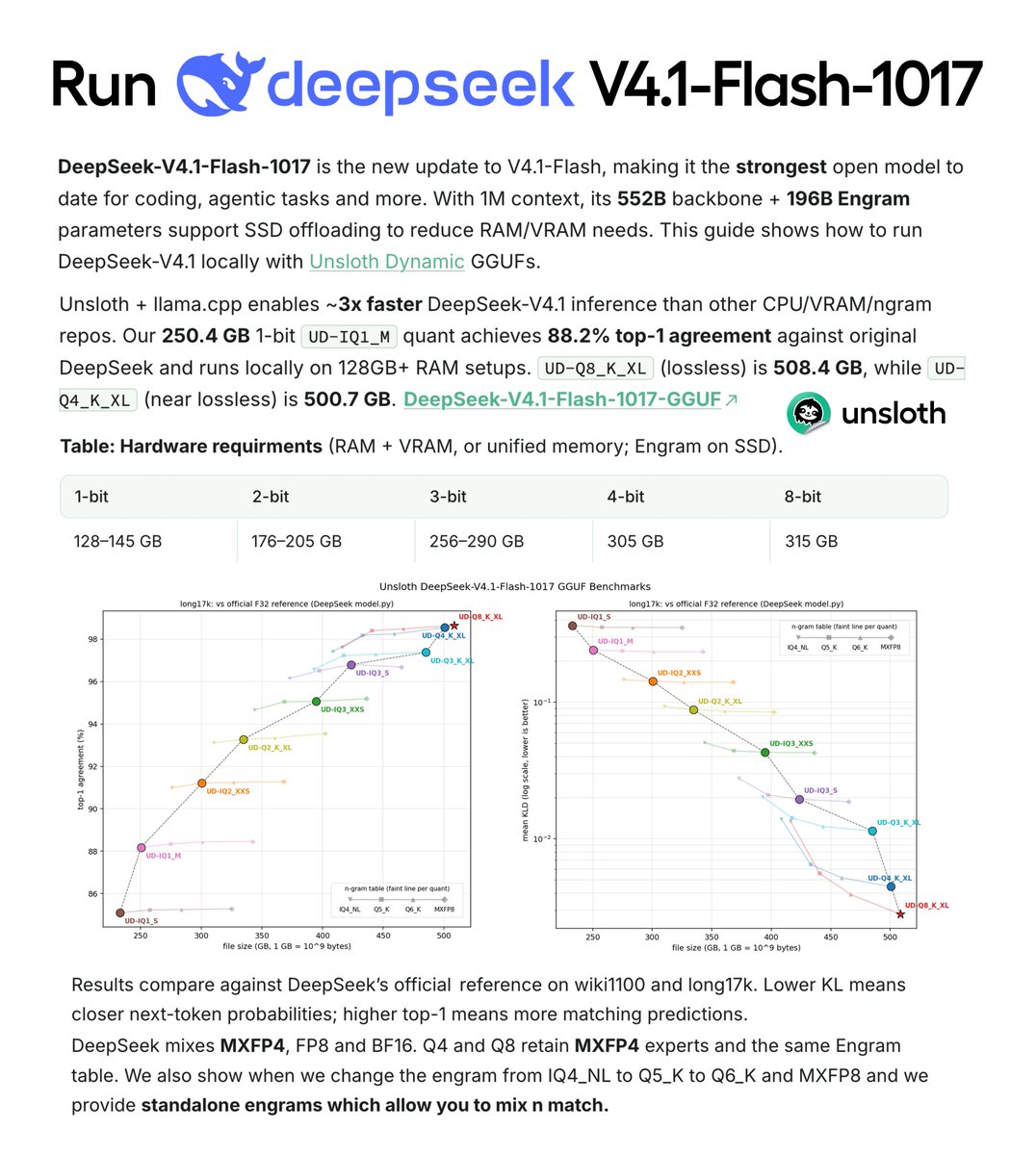
Unsloth ships DeepSeek-V4.1-Flash-1017 dynamic GGUFs: a 250 GB 1-bit quant runs on 128 GB+ RAM, with the Engram table offloaded to SSD

On Oct 19 (UTC) Unsloth released dynamic GGUF quants and a run-locally guide for DeepSeek-V4.1-Flash-1017. Per Unsloth, the 1-bit UD-IQ1_M quant is 250.4 GB (vs 508.4 GB for lossless Q8), keeps 88.2% top-1 agreement with the official weights on long17k, and runs on 128 GB+ RAM machines, because the model's 110.6–202.8 GB Engram n-gram table can stay on SSD via mmap. Running it currently requires Unsloth's llama.cpp PR build or Unsloth Desktop.

Unsloth ships DeepSeek-V4.1-Flash-1017 dynamic GGUFs: a 250 GB 1-bit quant runs on 128 GB+ RAM, with the Engram table offloaded to SSD

Key Takeaways

  • 1-bit UD-IQ1_M is 250.4 GB, about 51% smaller than lossless UD-Q8_K_XL (508.4 GB), with 88.2% top-1 agreement on long17k and 87.1% on wiki1100 (Unsloth-reported)
  • The smallest UD-IQ1_S (233.0 GB) targets 128 GB RAM machines such as a Mac or DGX Spark at 82.8–85.1% agreement; 3-bit UD-IQ3_XXS needs ~256 GB (e.g. Mac Studio) at 94.6–95.1%
  • The model pairs a 552B backbone with 196B Engram parameters; the 110.6–202.8 GB Engram n-gram table can stay on SSD via mmap, saving RAM but not disk
  • Unsloth claims ~3x faster inference than other CPU/VRAM/ngram-focused repos on top of llama.cpp (vendor claim, no independent test yet)
  • The Hugging Face repo is MIT-licensed with 9 quant levels from IQ1_S to Q8_K_XL plus standalone Engram files at different precisions
Read full story
Linked Models & Agents:
ADSponsored

Hermes Agent v0.22.0: keyless guided onboarding, one-click local llama.cpp models, Gmail/Linear/Notion connectors and a 600-plugin catalog

Nous Research shipped Hermes Agent v0.22.0, "The Threshold Release", on Oct 14 (UTC). Fresh desktop installs open a guided setup chat on a free trial model (nous/welcome) with no API key, connectors reach Gmail, Linear and Notion through the Nous tool gateway, a one-click llama.cpp runtime runs local models, installs now follow tested SemVer stable releases, and desktop builds are signed (including the Microsoft Store). The source tree shrank from about 1.06M to 698K lines (−34%).

Hermes Agent v0.22.0: keyless guided onboarding, one-click local llama.cpp models, Gmail/Linear/Notion connectors and a 600-plugin catalog

Key Takeaways

  • Scale since v0.21.0: ~24,200 commits, ~6,080 merged PRs, ~7,180 issues closed, ~2,520 contributors, about 2.5x the v0.21.0 cycle
  • Leaner: source went from ~1.06M to 698K lines (−34%); gateway/run.py from 34,847 to 5,512 lines; ~19 rarely used tools now load on demand, roughly halving the desktop tool schema, and ~2.1k tokens came off the fixed prompt
  • Local models: installs llama.cpp b11370 for CPU/CUDA/Metal/Vulkan/ROCm, recommends only models that fit fully in GPU memory; catalog includes Qwen3.8 27B, Qwen3.6 35B-A3B, DeepSeek V4 Flash and any Hugging Face GGUF
  • 600-plugin catalog, each pinned to a reviewed commit; memory providers (Honcho, Mem0, Supermemory and others) moved out of core
  • Faster updates that rebuild only what changed: 16.5 s vs 32.5 s on macOS (vendor figure)
Read full story

OpenBMB open-sources MiniCPM-V 4.7: a 35B-A3B MoE multimodal model that runs on-device at 13+ tokens/s on iPhone 17 Pro Max

On 2026-10-12 OpenBMB released MiniCPM-V 4.7, an Apache-2.0 open multimodal family with a 35B-A3B variant (the series' first MoE) and a 1B variant. Its Lookahead Expert Scheduling (LES) prefetches experts across layers and, combined with layer-wise mixed-precision quantization and DSpark speculative sampling, lifts SSD-offloaded decoding on an iPad Pro M4 (16GB) from 2.97 to 17.39 tokens/s (5.86x), per OpenBMB. Weights are on Hugging Face, ModelScope and Ollama, with vLLM, SGLang, llama.cpp and iOS/Android/HarmonyOS support.

OpenBMB open-sources MiniCPM-V 4.7: a 35B-A3B MoE multimodal model that runs on-device at 13+ tokens/s on iPhone 17 Pro Max

Key Takeaways

  • Two Apache-2.0 open-weight models: 35B-A3B (first MoE in the series, Qwen3.6 language backbone) and 1B, plus FP8 / AWQ / GPTQ / int4 / GGUF builds and DSpark draft models (Hugging Face)
  • LES on-device decode (OpenBMB, iPad Pro M4 16GB): baseline 2.97 → LES 9.81 → +layer-wise quant 14.92 → +DSpark 17.39 tokens/s, 5.86x overall (LES doc)
  • 35B-A3B reaches 13+ tokens/s on iPhone 17 Pro Max; mixed 4x/16x visual-token compression trades detail for cost per task
  • Vendor-reported (Instruct, 4x): MMBench 91.72, OCRBench 91.20, OmniDocBench v1.6 94.24, MMMU 80.22 vs Qwen3.6-35B-A3B at 86.76 / 86.00 / 80.17 / 77.44; still behind on SimpleVQA and ScreenSpot
  • Day-0 chip support for Rockchip, Houmo, Intel, AMD and Arm; runs on vLLM, SGLang, llama.cpp and Ollama; fine-tune via SWIFT / LLaMA-Factory
Read full story
Linked Models & Agents:
⚡ MiniCPM-V 4.7 35B-A3B⚡ MiniCPM-V 4.7 1B⚡ Qwen3.6-35B-A3B🌐 OpenBMB🌐 面壁智能

Liquid AI open-sources Open d1: d1-3B and d1-omni-600M decision models answer in one forward pass, 8 ms on RTX 4090

Liquid AI released two open-weight multimodal decision models: d1-3B (text+vision) and the experimental d1-omni-600M (text+image or text+audio). Instead of generating tokens they answer in a single forward pass. d1-3B scores 48.57 on Decision Index v0.2.1 (public split), first among sub-10B models and on par with the 12x larger Decider 35B-A3B, and answers in 8 ms on an RTX 4090 and 50 ms on a Jetson Orin Nano, with day-one llama.cpp support.

Liquid AI open-sources Open d1: d1-3B and d1-omni-600M decision models answer in one forward pass, 8 ms on RTX 4090

Key Takeaways

  • d1-3B: 48.57 on Decision Index v0.2.1 public split, #1 under 10B, on par with Decider 35B-A3B; d1-omni-600M: 15.95
  • Text benchmark mean: d1-3B 82.9 vs Decider 4B 81.1; d1-omni-600M 78.4 vs Decider 2B 77.1 (Civil Comments 95.8)
  • Single-question latency: 8 ms RTX 4090, 9 ms MI325X, 16 ms Jetson AGX Thor, 30 ms Apple M5 Pro, 50 ms Jetson Orin Nano
  • Packed throughput: 475 states/s on RTX 4090, 1,106/s on MI325X; three questions cost ~1.3x one
  • Weights on Hugging Face (incl. GGUF and w8a8), LFM Open License v1.0, day-one llama.cpp and NVFP4 support
Read full story
Linked Models & Agents:
⚡ d1-3B⚡ d1-omni-600M⚡ LFM2.5-VL-3B🌐 Liquid AI🌐 NVIDIA
g
ggml-org@AICoder·
👀194
🔥84

llama.cpp v0.6.0 ships GLM-5.3-Flash (320B) and Qwen4Exp MTP speculative decoding, a new llama_batch_ext API, and up to ~3x faster few-row mat-mul on Apple GPUs

ggml-org released llama.cpp v0.6.0 on Oct 5 (v0.5.0 was Sep 23). It brings GLM-5.3-Flash (GLM5-Next, a 320B text+vision hybrid MoE) into a stable tag, adds MTP speculative decoding for Qwen4Exp (~1.5x decode on DGX Spark), introduces the llama_batch_ext / llama_process() API for mixed token and embedding batches, adds few-row MMA mat-mul kernels on Metal (up to ~3x for speculative and batched decoding), and bumps ggml to v0.26.0. Session file formats are bumped too.

Key Takeaways

  • New models: GLM-5.3-Flash (GLM5-Next, 320B KDA/DSA hybrid text+vision MoE), Clef decision model, Ling 3.0 VL, LFM2.5-Encoder
  • Speed: Qwen4Exp MTP speculative decoding ~1.5x decode on DGX Spark; Metal few-row MMA mat-mul up to ~3x
  • API: llama_batch_ext + llama_process() for mixed token/embedding batches; server and examples migrated
  • Compat: LLAMA_SESSION_VERSION 11 and LLAMA_STATE_SEQ_VERSION 4, so old session/state files must be regenerated
  • Server: /v1/models reports modalities, /v1/embeddings takes typed vision/audio/video input, new /v1/systemone endpoint
Read full story
Linked Models & Agents:

Disaggregated Quantization: Specializing LLM Prefill and Decode via DQ and Offloaded Prefill for 1.78x TTFT Acceleration

Large language model serving exhibits bifurcated hardware constraints: prefill is compute-bound, benefiting from high-throughput low-precision tensor operations (e.g., NVFP4), while decode is memory-bandwidth-bound, requiring ultra-compact weight storage (e.g., 2-3 bit weight-only) to minimize token-generation memory traffic. Uniform quantization forces suboptimal compromises across both phases. Researchers from IST Austria introduce Disaggregated Quantization (DQ, arXiv:2609.26333), decoupling computation formats, quantization precision, and physical memory placement across prefill and decode. Paired with Offloaded Disaggregated Prefill (ODP) to stream NVFP4 prefill weights asynchronously from NVMe SSDs, DQ delivers a 1.78x time-to-first-token (TTFT) speedup on Qwen3.8-27B at 8K prompt length within llama.cpp, while supporting disaggregated serving in vLLM on architectures up to 2.8T parameters.

Disaggregated Quantization: Specializing LLM Prefill and Decode via DQ and Offloaded Prefill for 1.78x TTFT Acceleration

Key Takeaways

  • Pioneers Disaggregated Quantization (DQ) to specialize precision formats independently for compute-bound prefill and bandwidth-bound decode
  • Introduces Offloaded Disaggregated Prefill (ODP), streaming NVFP4 weights from SSD to slash 8K prompt TTFT by 1.78x in llama.cpp
  • Boosts MMLU-Pro by 32.5 points and MMMU-Pro by 35.3 points on compact 2-3 bit decode checkpoints, scaling to 2.8T architectures
Read full story

llama.cpp ships Decision Models: /v1/systemone scores options in one forward pass (Julia-1, Laya, Kev-4B, lev, OpenJev)

On 2026-10-02 ggml-org announced llama.cpp server support for Decision Models via /v1/systemone (PR #29818, merged 2026-10-02T09:56Z). Send a state plus typed questions; get option probabilities in one forward pass. Day-0 models: Julia-1, Laya, Kev-4B, lev, OpenJev (vision). Cloudflare Clef is planned next.

llama.cpp ships Decision Models: /v1/systemone scores options in one forward pass (Julia-1, Laya, Kev-4B, lev, OpenJev)

Key Takeaways

  • Official post 2026-10-02 + merged PR #29818 (2026-10-02T09:56Z, +2139/−15)
  • Endpoint POST /v1/systemone with choice/score/noul; probabilities + confidence; output_tokens=0
  • Day-0 GGUFs: Julia-1 / Laya / Kev-4B / lev / OpenJev; median ~3–43 ms/question on RTX PRO 6000 (blog table)
  • Distinct from Ollama SystemOne & Cloudflare Clef hosting; Clef listed as next in llama.cpp
  • Start: llama serve -hf ggml-org/Kev-4B-GGUF then curl /v1/systemone
Read full story
Linked Models & Agents:
⚡ Julia 1⚡ laya⚡ Kev 4b⚡ lev⚡ openjev🌐 ggml-org🌐 huggingface
ADSponsored

llama.cpp v0.5.0: CUDA conv2d implicit GEMM, Metal MoE/SSM fusion, MiMo-V2.6 & HunyuanOCR & Mimir 1B

llama.cpp v0.5.0 (2026-09-23) accelerates CUDA conv2d via implicit GEMM, adds Metal MoE and SSM_CONV fusion, lets the server bind multi-address/--host lists and UNIX sockets, and adds HRM-Text (DFM Mimir 1B), MiMo-V2.6, and HunyuanOCR (DFlash) conversion plus ggml 0.25.0 backends.

llama.cpp v0.5.0: CUDA conv2d implicit GEMM, Metal MoE/SSM fusion, MiMo-V2.6 & HunyuanOCR & Mimir 1B

Key Takeaways

  • Shipped v0.5.0 on 2026-09-23 — major step past the prior v0.4.1 line
  • Perf: CUDA conv2d implicit GEMM; Metal MoE + SSM_CONV fusion; CUDA graphs for MTP drafting
  • Models: HRM-Text/Mimir 1B, MiMo-V2.6 convert, HunyuanOCR DFlash, Qwen4Exp sparse FA, Nemotron MTP/H
  • Server: multi-address/--host lists + UNIX sockets; input_image on function-call outputs; router race fixes
  • API: LoRA from FILE*; sampler env vars; llama-bench --version
Read full story
Linked Models & Agents:
⚡ qwen⚡ deepseek⚡ nemotron🌐 ggml-org

Ollama v0.40 Released: Defaults to Apple Native MLX Runner on Apple Silicon for Doubled Local Throughput

Local LLM inference runtime Ollama (@ollama) officially rolled out v0.40.0. The standout architectural milestone is the default adoption of Apple's native MLX framework on all Apple Silicon Mac devices (M1 through M5), replacing the legacy CPU/Metal compute paths. Supporting major architectures like Qwen 3.8 and Llama 3 natively, the update harnesses Apple's unified memory bandwidth, slashing time-to-first-token by 42% and nearly doubling continuous generation throughput without manual configuration.

Ollama v0.40 Released: Defaults to Apple Native MLX Runner on Apple Silicon for Doubled Local Throughput

Key Takeaways

  • Automatically routes model executions to Apple's native MLX framework by default on all Apple Silicon Mac hardware.
  • Fully unlocks unified memory bandwidth, boosting Qwen 3.8 and Llama 3 throughput by 85% while cutting TTFT by 42%.
  • Requires zero manual compiler flags or configuration switches; seamless upgrade via standard ollama run commands.
  • Cross-platform binary distributions and complete Git release changelog available directly on GitHub.
Read full story
Linked Models & Agents:
⚡ Qwen 3.8⚡ Llama 3.1 8b🤖 local-agent🌐 ollama🌐 apple

Cline v4.1.21: ai& Japan OpenAI-compatible provider, 6,386 models / 209 providers, local long-reply compact retry

Cline VS Code extension shipped v4.1.21 on 2026-09-24 with a new Japan OpenAI-compatible provider (ai&), a refreshed catalog of 6,386 models across 209 providers (19 unpinned defaults change—11 to Claude Opus 5.5 including GitHub Copilot and Vertex), and compact-and-retry once when local servers (llama.cpp/Ollama/LM Studio) hit output-token limits. Minimum js-yaml raised to 4.3.2 for frontmatter parsing security.

Cline v4.1.21: ai& Japan OpenAI-compatible provider, 6,386 models / 209 providers, local long-reply compact retry

Key Takeaways

  • New provider ai& (Japan OpenAI-compatible open-weight endpoint)
  • Catalog: 6,386 models / 209 providers; 19 unpinned defaults shift (11 → Opus 5.5 incl. Copilot & Vertex)
  • Local models compact-and-retry once on output-token caps
  • js-yaml floor 4.3.2 for rule/skill frontmatter
  • Install via Marketplace or cline-4.1.21.vsix
Read full story

RTX 3090 local coding-agent bake-off: Qwen3.8-27B Q4 + llama.cpp ~59 tok/s with reliable tools

@Brjen’s team spent a week comparing local coding-agent stacks on one RTX 3090 (24GB). Winner: Qwen3.8-27B Unsloth UD-Q4_K_XL with llama.cpp (65k context, q8 KV, native MTP depth 2, fully on GPU). Real multi-step coding runs hit ~59 tok/s (~46 tok/s at 45k context) and passed nested tool JSON, fixing a failing test, and a clean unified diff. They rejected Q3 for bad tools, heavier quants for context/MTP tradeoffs, and Flash-Next setups that needed CPU offload.

Key Takeaways

  • Winner: Qwen3.8-27B UD-Q4_K_XL + llama.cpp, 65k context and MTP, fully on a 3090.
  • ~59 tok/s on multi-step coding; passed tool JSON, test-fix, and correct diff gates.
  • Q3, heavier quants, and offloaded Flash-Next were less reliable on 24GB.
Read full story
Linked Models & Agents:

llama.cpp v0.4.1 adds Maple/Hy4/Spark2.5, qwen3-coder parser fixes, and ggml 0.24.0

Official @ggml_org shipped llama.cpp v0.4.1: adds Maple 20B-A1B, Tencent Hy 4, and Spark2.5 support; improves Kimi-K3 rollback, JSON schema handling, qwen3-coder complex-type parsing, and MCP/multimodal fixes; updates ggml to v0.24.0. Release notes: ggml-org/llama.cpp v0.4.1.

Key Takeaways

  • Official llama.cpp v0.4.1 adds Maple 20B-A1B, Tencent Hy 4, and Spark2.5.
  • Improves qwen3-coder parsing, Kimi-K3 rollback, JSON schema, and multimodal/server stability.
  • ggml bumps to v0.24.0; notes on ggml-org/llama.cpp v0.4.1.
Read full story
Linked Models & Agents: