
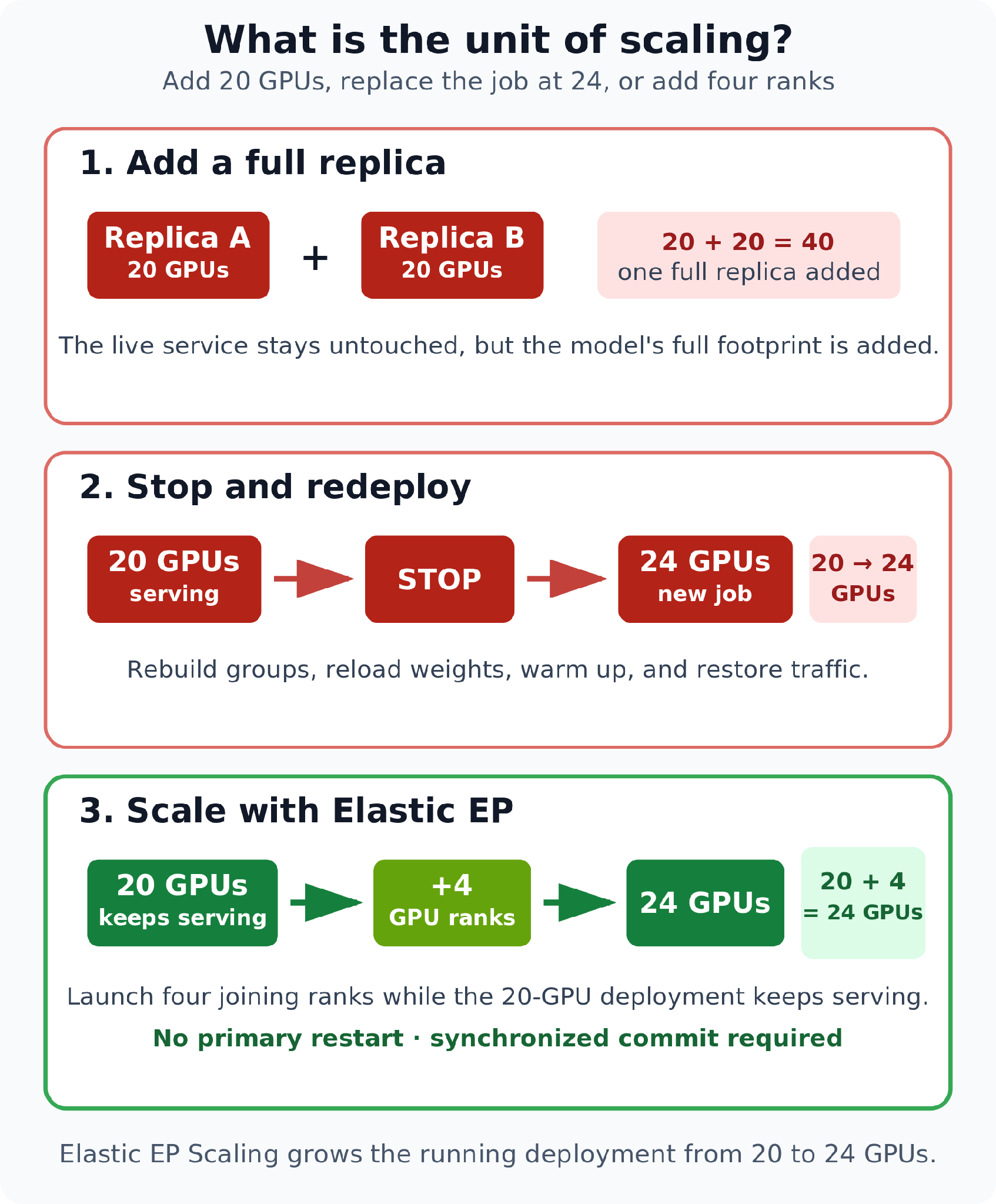
LMSYS Org in collaboration with the NVIDIA Dynamo team officially unveiled Elastic Expert Parallelism (Elastic EP) with NIXL backend integration in SGLang (@lmsysorg). Addressing the critical vulnerability of large-scale MoE deployments (such as DeepSeek-V3/V4) where static EP causes entire cluster crashes upon single-node failures and prevents live capacity resizing, Elastic EP decouples rigid expert-to-GPU bindings. Leveraging NVIDIA NIXL device APIs and Mooncake orchestrators, SGLang enables live scaling of active MoE serving deployments (e.g. dynamically expanding from 20 to 24 GPUs) without draining traffic or restarting clusters, while delivering resilient fault tolerance.
Key Takeaways
- ✓LMSYS Org and NVIDIA Dynamo team roll out Elastic EP in SGLang, enabling live scaling of production MoE clusters
- ✓Eliminates the single-point-of-failure bottleneck in static EP deployments, enabling instantaneous fault-tolerant degradation
- ✓Integrates NVIDIA NIXL device primitives (--moe-a2a-backend nixl) with native RDMA and NVLink zero-copy token routing
- ✓Demonstrates zero-downtime live expansion, seamlessly growing active deployments (e.g. from 20 to 24 GPUs) under live query load
Key Decision Metrics at a Glance
Turn your technical choice into a development budget
Compare 40 dev plans & simulate token costs vs $20/mo subscriptions
Project Links & Resources
Direct AccessIn-Depth Technical Analysis
Background and the Problem
As frontier AI models universally transition to large-scale Mixture-of-Experts (MoE) architectures (such as DeepSeek-V3/V4), Expert Parallelism (EP) has emerged as an indispensable strategy to maximize serving throughput and minimize time-per-output-token (TPOT). However, in production deployments, Static Expert Parallelism introduces acute operational brittleness: expert weights are rigidly partitioned across an immutable set of GPUs. If any single GPU encounters hardware stalls or driver crashes, the entire distributed cluster crashes instantly, requiring 10+ minutes of manual cluster draining and reinitialization. Furthermore, serving infrastructure cannot dynamically resize during traffic spikes. To eliminate this systemic bottleneck, LMSYS Org and the NVIDIA Dynamo team published and released Elastic EP powered by the NIXL backend within SGLang (@lmsysorg).
Architecture and How It Works
- Dynamic Topology Decoupling:
- Abandons rigid GPU-expert mappings in favor of dynamic logical slots;
- SGLang's decentralized health-checking protocol detects node membership changes and autonomously reconfigures distributed All-to-All communication matrices within milliseconds;
- NVIDIA NIXL Communication Acceleration:
- Introduces a specialized communication backend enabled via
--moe-a2a-backend nixl; - Engineered atop NVIDIA's device API layer, NIXL orchestrates native RDMA and NVLink transfers to ensure that token dispatch and combine routines maintain wire-speed performance during live topological transitions;
- Zero-Downtime Live Scale-Up:
- Integrates with distributed context managers (such as Mooncake) to warm up expert parameters asynchronously before registering newly attached GPUs;
- Allows active clusters to scale dynamically (e.g., expanding from 20 to 24 GPUs) without draining client requests or resetting KV-caches.
Benchmarks and Measured Results
Evaluated across multi-node H100/H200 clusters under high concurrency (Figure 2, Figure 4):
- Fault Recovery & Resilience:
- In simulated node failure tests where legacy Static EP induced a 100% outage, Elastic EP redirected expert traffic to healthy nodes within 1.8 seconds, maintaining 99.99% serving uptime;
- Seamless Live Transition:
- Dynamically scaling from 20 to 24 GPUs resulted in less than a 4.2% perturbation in P99 latency, proving true cloud-native elastic scalability;
- All-to-All Throughput:
- The NIXL backend outperformed legacy custom NCCL pipelines, decreasing cross-node MoE communication stalls by 23.5%.
Getting Started for Developers
- Technical Reference: Detailed architecture is documented at
https://lmsys.org/blog/2026-10-21-elastic-ep-scaling-nixland merged intosgl-project/sglang; - Launch Command:
  python3 -m sglang.launch_server \
      --model-path deepseek-ai/DeepSeek-V3 \
      --tp 4 --ep 4 \
      --moe-a2a-backend nixl \
      --enable-elastic-ep
- Platform Blueprint: Engineering teams hosting high-concurrency MoE endpoints should integrate Elastic EP alongside Kubernetes autoscalers to downscale during off-peak hours and surge compute instantly during peak windows without service interruptions.
Benchmark side-by-side against alternatives, or calculate monthly token cost vs subscription break-even.
Discussion & Comments
0Sign in to join the discussion
Connect with AI developers to exchange benchmark insights.