
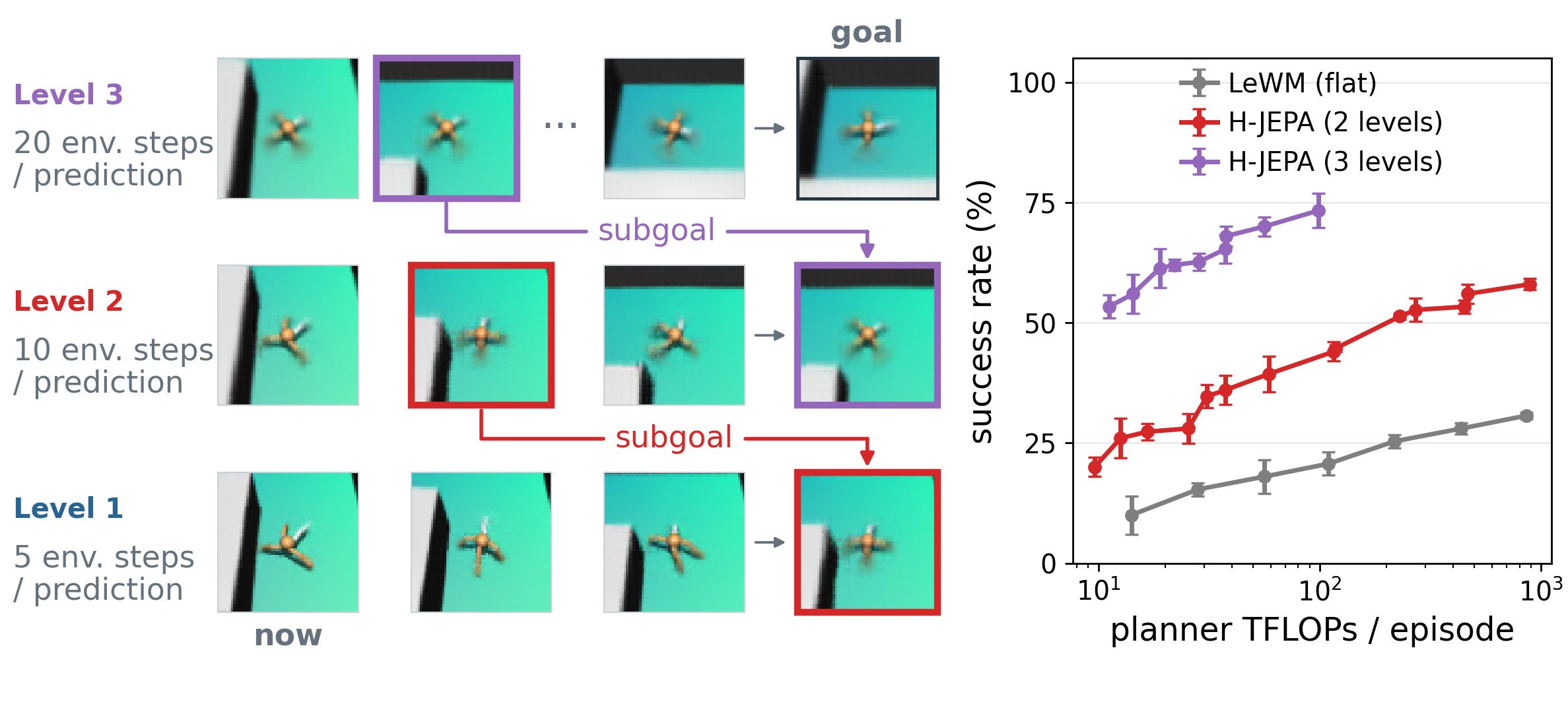
AMI Labs (Yann LeCun's Advanced Machine Intelligence) with NYU, INRIA Paris and Brown released H-JEPA (arXiv 2610.06805), an end-to-end recipe for a stack of action-conditioned JEPA world models, each predicting farther ahead in its own latent space and planning top-down via subgoals. Paper-reported: a three-level model reaches 73.3% success on Visual AntMaze vs 18.0% for flat LeWM, with less planner compute. MIT-licensed code plus 93 checkpoints are public on GitHub and Hugging Face.
Key Takeaways
- ✓Visual AntMaze: three-level H-JEPA 73.3%±3.5 vs flat LeWM 18.0%±3.5 (paper-reported, 3 seeds) at lower planner FLOPs
- ✓FourRoom Distractors: 96.0% for three-level H-JEPA vs 40.7% for flat LeWM; on AntMaze nearly 2x the shared-latent HWM baseline
- ✓Subgoal-tracking cost monotonicity 0.89–1.00 vs 0.48–0.75 for the full-horizon goal cost
- ✓Limits: three levels fail on Push-T (only 58% of LeWM's training clips); DROID needs an inverse-dynamics loss or the encoder collapses to zero score
- ✓MIT code plus 93 checkpoints (~12.4 GB) on Hugging Face across AntMaze, FourRoom, Cube, Push-T and DROID
Turn your technical choice into a development budget
Compare 40 dev plans & simulate token costs vs $20/mo subscriptions
Project Links & Resources
Direct AccessIn-Depth Technical Analysis
H-JEPA is the first public research release from AMI Labs (Advanced Machine Intelligence), the world-model startup associated with Yann LeCun, co-authored with NYU, INRIA Paris and Brown University (arXiv 2610.06805).
Problem. Existing task-agnostic JEPA world models (LeWM, V-JEPA 2, DINO-WM) predict and plan in one latent space at one timescale, so long horizons compound prediction error and blow up the action search, and a single latent must serve both fast low-level dynamics and abstract goal matching.
Method. H-JEPA trains a stack of action-conditioned JEPAs end-to-end. Each level has its own state encoder, action encoder and causal-transformer predictor, reads the level below at stride 2, and is regularized with SIGReg against collapse; upper-level gradients flow into lower encoders. Planning runs top-down: the top level optimizes toward the goal, and its first predicted state becomes the subgoal for the level below, down to primitive actions. Where data has separated timescales, upper levels discard fast detail (leg pose) and keep slow state (position). On real-robot DROID video an inverse-dynamics loss is required to avoid slow-feature collapse.
Results (paper-reported, 3 seeds, not independently replicated). Visual AntMaze: 73.3% success for three levels vs 18.0% for flat LeWM at lower planner compute, and nearly 2x the shared-latent HWM baseline. FourRoom Distractors: 96.0% vs 40.7%. Three levels fail on Push-T because short episodes leave only 58% of training clips. On DROID, H-JEPA improves offline Frechet planning fidelity over HWM and LeWM+IDM at lower budget.
Try it. MIT-licensed code at github.com/kevinghst/H-JEPA (built on LeWM and stable-worldmodel); python main_hjepa.py --config-name ant_hjepa_l3 seed=42. 93 checkpoints (~12.4 GB) on Hugging Face (jepa-world-models/h-jepa). The authors note closed-loop control on a physical robot is the next step.
Benchmark side-by-side against alternatives, or calculate monthly token cost vs subscription break-even.
Discussion & Comments
0Sign in to join the discussion
Connect with AI developers to exchange benchmark insights.