
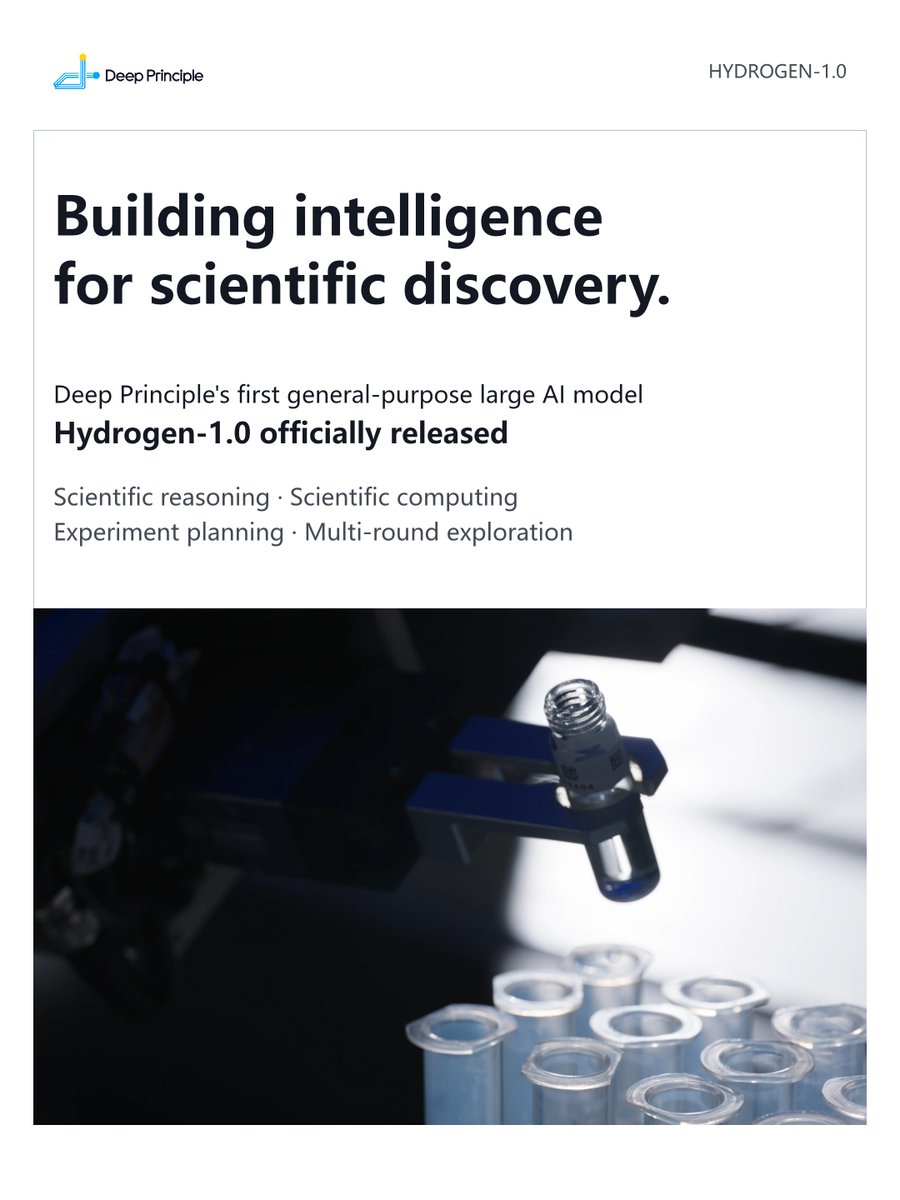
Hangzhou-based AI-for-science company Deep Principle released Hydrogen-1.0 on November 2, its first general-purpose scientific model. It post-trains Zhipu's GLM-5.3 with SFT and RL on chemistry, materials and life-science data plus its own lab records and discovery trajectories, and ships about 753B parameters of BF16 weights on Hugging Face under the MIT license. By the vendor's own evaluation it scores 38.3% on FrontierScience-Research versus 33.3% for GPT-6 Astra; none of the results have been independently reproduced yet.
Key Takeaways
- ✓Scale: Hugging Face lists about 753B total parameters (BF16, roughly 1.5 TB of weights), glm_moe_dsa architecture, 1M-token context and 128K max output, MIT licensed (download requires accepting HF terms).
- ✓Benchmarks (vendor-reported): 38.3% on FrontierScience-Research vs 33.3% for GPT-6 Astra; 93.0% on GPQA Diamond, which the company says roughly matches Kimi K3.
- ✓Internal scenarios (vendor-reported): leads max-thinking GPT-6 Astra by 5.13 points on scientific computing and 4.76 points on forward reaction prediction, but trails it by 3.33 points on NMR structure elucidation.
- ✓Materials discovery: after five rounds of transition-metal-complex search, the mean best HOMO-LUMO gap reached 4.318 eV vs 3.689 eV for GPT-6 Astra and 3.353 eV for Kimi K3 (official blog).
- ✓Access: weights on HF and ModelScope, plus NVFP4 (B200/B300) and MXFP4 (MI350X/MI355X) quantized repos; API via NeuroSpark and in-app use in the Mira AI Scientist; tested with SGLang on 8 GPUs.
Key Decision Metrics at a Glance
Turn your technical choice into a development budget
Compare 40 dev plans & simulate token costs vs $20/mo subscriptions
Project Links & Resources
Direct AccessIn-Depth Technical Analysis
Core Background & Industry Pain Points
Most recent headline AI-for-science results come from closed models whose weights researchers cannot inspect, reproduce or adapt. Deep Principle, whose co-founder and CTO is Chenru Duan, released Hydrogen-1.0 on November 2 as an open-weight scientific model, aiming to show that domain post-training on an open base can catch up with closed flagships.
Architecture Highlights & Internals
It builds on GLM-5.3 and keeps its MoE plus dynamic sparse attention (DSA) design, at about 753B total parameters. Training combines SFT and RL over domain knowledge, scientist feedback, full lab records including failed experiments, and materials discovery trajectories. The infrastructure uses Megatron and SGLang on both CUDA and ROCm.
Authoritative Benchmarks & Measured Scores
All figures are vendor-reported and not yet independently reproduced. It scores 38.3% on FrontierScience-Research vs 33.3% for GPT-6 Astra, and 93.0% on GPQA Diamond. It trails Astra by 3.33 points on NMR structure elucidation. In the experiment-design comparison, Astra and Opus 5.5 were dropped for refusing over half of the requests, so conditions are not fully like-for-like.
Developer Hands-on Guide
Weights are at deep-principle/Hydrogen-1.0 on Hugging Face after accepting the terms; BF16 is about 1.5 TB. The official example serves it with SGLang on 8 GPUs, and generation_config.json must be kept or generation will not stop. NVFP4 and MXFP4 quantized repos lower the hardware bar, and the NeuroSpark API or Mira platform allow trials without hosting. Key claims still need checking against literature or experiment.
Benchmark side-by-side against alternatives, or calculate monthly token cost vs subscription break-even.
Discussion & Comments
0Sign in to join the discussion
Connect with AI developers to exchange benchmark insights.