
AI Coding Live News

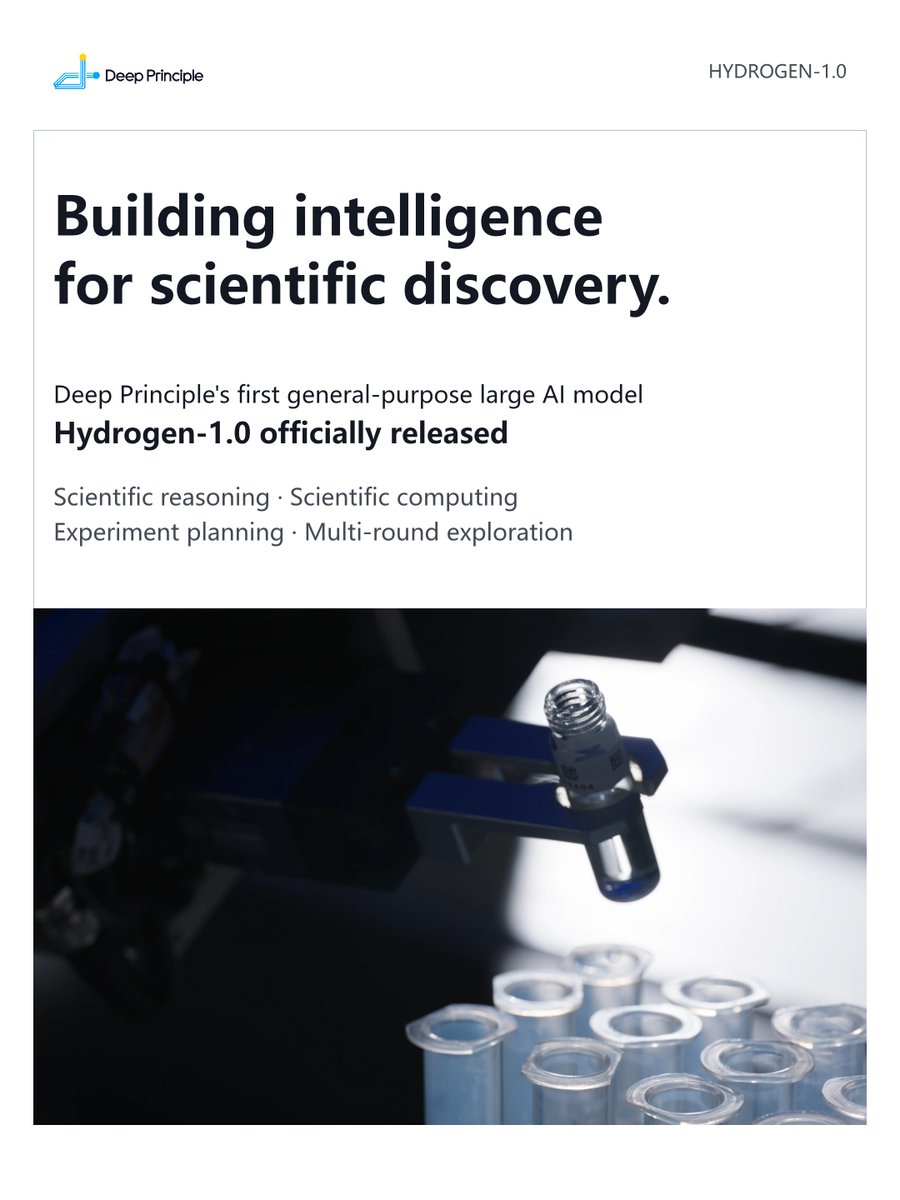
Deep Principle Open-Sources Hydrogen-1.0, a 753B Science Model Post-Trained From GLM-5.3 on Lab Records, MIT Licensed

Hangzhou-based AI-for-science company Deep Principle released Hydrogen-1.0 on November 2, its first general-purpose scientific model. It post-trains Zhipu's GLM-5.3 with SFT and RL on chemistry, materials and life-science data plus its own lab records and discovery trajectories, and ships about 753B parameters of BF16 weights on Hugging Face under the MIT license. By the vendor's own evaluation it scores 38.3% on FrontierScience-Research versus 33.3% for GPT-6 Astra; none of the results have been independently reproduced yet.
Deep Principle Open-Sources Hydrogen-1.0, a 753B Science Model Post-Trained From GLM-5.3 on Lab Records, MIT Licensed

Key Takeaways

  • Scale: Hugging Face lists about 753B total parameters (BF16, roughly 1.5 TB of weights), glm_moe_dsa architecture, 1M-token context and 128K max output, MIT licensed (download requires accepting HF terms).
  • Benchmarks (vendor-reported): 38.3% on FrontierScience-Research vs 33.3% for GPT-6 Astra; 93.0% on GPQA Diamond, which the company says roughly matches Kimi K3.
  • Internal scenarios (vendor-reported): leads max-thinking GPT-6 Astra by 5.13 points on scientific computing and 4.76 points on forward reaction prediction, but trails it by 3.33 points on NMR structure elucidation.
  • Materials discovery: after five rounds of transition-metal-complex search, the mean best HOMO-LUMO gap reached 4.318 eV vs 3.689 eV for GPT-6 Astra and 3.353 eV for Kimi K3 (official blog).
  • Access: weights on HF and ModelScope, plus NVFP4 (B200/B300) and MXFP4 (MI350X/MI355X) quantized repos; API via NeuroSpark and in-app use in the Mira AI Scientist; tested with SGLang on 8 GPUs.
Read full story

SemiAnalysis releases GDPx, an agentic benchmark of 206 tasks across 11 high-value domains where the top model, Claude Opus 5.5, scores just 12%

On Nov 2, semiconductor and AI research firm SemiAnalysis released GDPx, a benchmark of agentic capability across 11 domains: chip design, cybersecurity, biology, finance, legal, quant trading, recursive self-improvement (RSI), hardware design, materials science, alignment and software engineering. Its 206 tasks were built by 14 specialist data partners, with SemiAnalysis doing final QA. On the official leaderboard Claude Opus 5.5 leads at 12.0%, followed by Gemini 4 Carbon at 10.9% and GPT-6 Astra at 9.6%; nearly every model scores 0 on finance and legal. SemiAnalysis says safety classifiers drag down Opus 5.5 and GPT-6 Astra, and plans a new version every 3–6 months. All scores are as reported by SemiAnalysis.

SemiAnalysis releases GDPx, an agentic benchmark of 206 tasks across 11 high-value domains where the top model, Claude Opus 5.5, scores just 12%

Key Takeaways

  • Scale: 11 domains, 14 data partners and 206 tasks, with a default time limit of 8 hours per task (GDPx site)
  • Leaderboard (as reported by SemiAnalysis): Claude Opus 5.5 12.0%, Gemini 4 Carbon 10.9%, GPT-6 Astra 9.6%, Muse Wonder Full 9.0%, Claude Fable 5.1 8.5%, GPT 6.1 Sol 8.4%, Claude Sonnet 5.5 8.2%
  • Lower tier and open weights: DeepSeek 4.1 Flash 1017 5.4%, GPT-6 Luna 5.1%, Grok 4.7 3.9%, GLM 5.3 2.7%; almost every model scores 0 on finance and legal
  • Method: each model runs in its native harness where one exists (Claude Code for Opus, Codex for Astra, Antigravity for Carbon), otherwise OpenCode; the headline is pass@1 over three attempts with all domains weighted equally (SemiAnalysis blog)
  • By domain: Opus 5.5 wins quant trading, hardware and chip design; Gemini 4 Carbon wins biology and software engineering; GPT-6 Astra wins RSI and materials science; Muse Wonder Full is the strongest cyber model
Read full story

LMBuild: Benchmarking LLM Agents on Generating Buildable and Functional 3D Structures with Physics and Kinematic Constraints

LLM agents have demonstrated striking dexterity in generating intricate 3D geometries, raising expectations for automated industrial design and physical manufacturing. However, producing visually aesthetic 3D meshes is fundamentally distinct from synthesizing objects that can be physically manufactured, assembled, and operate as intended. Contemporary benchmarks evaluate visual fidelity while ignoring physical realizability, joint kinematics, and assembly sequencing. Researchers from UIUC and Microsoft introduce LMBuild (arXiv:2610.04292), a comprehensive benchmark for evaluating LLM agents on generating buildable and functional 3D structures. LMBuild models generated objects as assembled physical systems encompassing discrete part decompositions, mechanical joints, physical materials, and procedural build sequences. Evaluating 30 frontier agent systems, LMBuild discovers that while basic geometric structural soundness is solved by top frontier models, kinematic functional affordance and physical operability remain profound bottlenecks; moreover, providing explicit functional specifications dramatically improves assembly completeness and physical kinematics.

Key Takeaways

  • UIUC and Microsoft present LMBuild, a 64-page benchmark evaluating LLM agents on generating physically buildable, functional 3D assemblies
  • Formalizes structures into part decompositions, kinematic joints, materials, and assembly sequences under four physical evaluation dimensions
  • Benchmarking 30 agent systems reveals that while geometry alignment is solved, physical operability remains difficult, needing functional specifications
Read full story

SWR: Self-Supervised Scaling of Scientific Terminal Environments for Coding Agents Surges Terminal-Bench 2 to 53.56%

Terminal coding agents are expanding from standard software engineering into scientific domains like bioinformatics, materials science, and physics. However, building training sandboxes requires executable reference behavior and rigorous verifiers capable of distinguishing true semantic correctness from superficial syntactic mimicry—a process that currently requires tedious manual engineering per task. Researchers from Tsinghua University and Tencent introduce Software-in-the-Loop Reconstruction (SWR, arXiv:2610.02710), a self-supervised environment scaling framework. SWR extracts ground-truth outputs and verifiers from existing executable scientific software workflows by perturbing input configurations into public observations and hidden evaluations. Agents synthesize complete, editable programs from input-output schemas without viewing source code, evaluated by hierarchical verifiers testing semantic fidelity, structural integrity, and anti-shortcut compliance. Implemented across 500 workflows and 46 software suites spanning six scientific domains, SWR generates 1,422 verified trajectories. Supervised fine-tuning of Qwen3.8-27B elevates Terminal-Bench 2 average success from 47.94% to 53.56%, establishing a scalable paradigm for scientific terminal agent training.

SWR: Self-Supervised Scaling of Scientific Terminal Environments for Coding Agents Surges Terminal-Bench 2 to 53.56%

Key Takeaways

  • Introduces SWR to bootstrap self-supervised terminal agent training sandboxes from existing scientific software workflows
  • Decouples public observations from hidden evaluations, using hierarchical verifiers to block shortcuts during program reconstruction
  • Drives Qwen3.8-27B performance on Terminal-Bench 2 from 47.94% to 53.56%, eclipsing all token-matched baseline controls
Read full story
ADSponsored

OpenAI launches ChatGPT for Financial Services with built-in data and GPT-6 Astra

@OpenAI launched ChatGPT for Financial Services, a tailored ChatGPT Work experience that pairs built-in financial data with GPT-6 Astra reasoning so teams can research, build models, and create client materials. Shaped with Morgan Stanley and Evercore, it includes premium data from providers such as Daloopa, PitchBook, LSEG News, and Crunchbase.

Key Takeaways

  • @OpenAI launched ChatGPT for Financial Services, a tailored ChatGPT Work experience that pairs built-in financial data with GPT-6 Astra reasoning so teams can research, build models, and create client materials. Shaped with Morgan Stanley and Evercore, it includes premium data from providers such as Daloopa, PitchBook, LSEG News, and Crunchbase.
Read full story
Linked Models & Agents:

ChatGPT for Financial Services is now available with GPT-6 Astra

OpenAI released ChatGPT for Financial Services, a tailored ChatGPT Work experience that combines built-in financial data with GPT-6 Astra reasoning. Teams can develop research, build financial models, and create customized client materials.

Key Takeaways

  • OpenAI released ChatGPT for Financial Services, a tailored ChatGPT Work experience that combines built-in financial data with GPT-6 Astra reasoning. Teams can develop research, build financial models, and create customized client materials.
Read full story
Linked Models & Agents:
