On the evening of November 2, SenseTime released the official version of SenseNova 6.8 Flash, a multimodal agent model with two main upgrades. First, long-term memory and proactive interaction: it keeps user goals and constraints across tasks and sessions and flags affected items when information changes. Second, design generation across Web, SVG, Three.js, Blender, animated PPT and motion posters, with Figma integration. It is live in SenseNova Studio, the Raccoon assistant and the SenseNova Token Plan; the official X account says the Token Plan offers a free trial of 1,500 API requests every 5 hours. SenseTime says it beats some international frontier models on agent collaboration, data analysis and presentation generation, but the announcement lists no specific scores.
Zoom
Key Takeaways
The official release landed on the evening of November 2, positioned as a multimodal agent model for office collaboration and design delivery
Long-term memory plus proactive interaction: it remembers goals, constraints and preferences across sessions and suggests changes when related information shifts (demos ran on an internal Raccoon build)
Design output spans Web, SVG, Three.js, Blender, animated PPT and motion posters, producing editable PPTX files and Blender projects, with Figma integration
Available in SenseNova Studio, the Raccoon assistant and the SenseNova Token Plan; the official X post cites 1,500 free API requests every 5 hours
SenseTime only says it beats some international frontier models on agent collaboration, data analysis and presentation generation; no scores were published and there is no independent evaluation yet
DeepSeek Harness, DeepSeek's open-source, MIT-licensed agent app, announced Creator Mode on its official X account on November 2: users describe the plugin they want in plain language, and the agent turns it into a plugin they can use. Demos include a 3D landmark gallery, a 3D Transformer visualizer, a video editing workbench and a paper reader. DeepSeek also published seven bilingual demo prompts on cdn.deepseek.com, cautioning that some plugins took several rounds of conversation, so a single prompt may not reproduce the video exactly. The post drew about 20,000 likes and 1.69 million views. No benchmarks were published.
Zoom
Key Takeaways
Creator Mode: describe the plugin you want in natural language and the agent turns it into a usable plugin, from a design workspace to a sandbox game or a 3D LLM visualizer.
DeepSeek published 7 demo prompts: a 3D landmark gallery, a 3D Transformer demo, a five-style app theme switcher, a poster workbench, a video editor, a paper reader and a token-usage statistics plugin.
The entry point shipped in v0.2.1-rc.5 (Oct 30 pre-release): plugin management gained a "Let Agent create a plugin" button that opens Creator mode and keeps the draft.
The GitHub repo has about 270,000 stars under the MIT license; Harness is still in preview.
No benchmarks or success rates were published; the announcement drew about 20,000 likes and 1.69 million views.
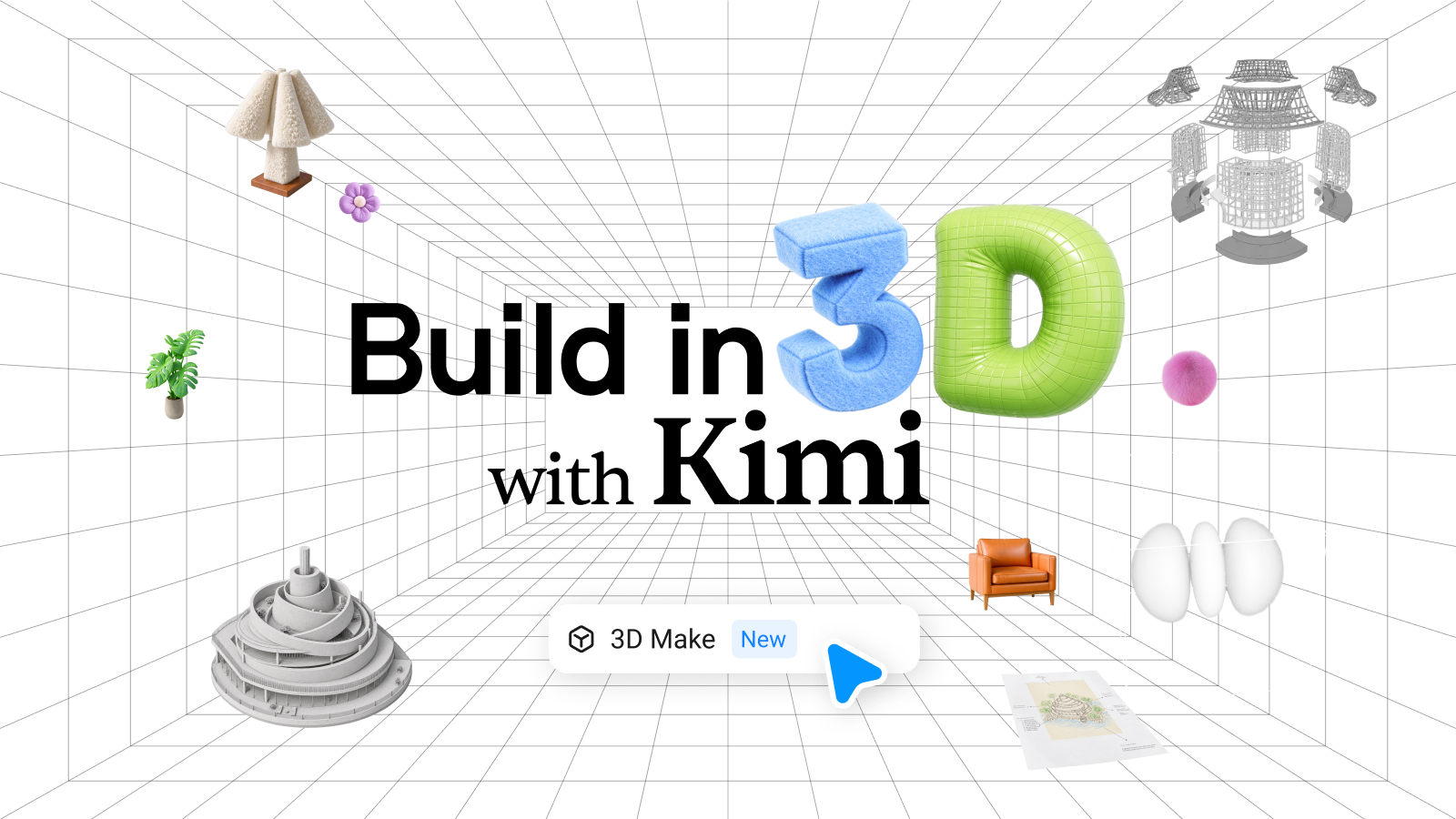
Moonshot AI's official Kimi account announced 3D Make at 03:14 UTC on Oct 30, saying Kimi connects to tools such as Blender and CAD software to create models, assemble scenes and develop games, available now on kimi.ai and Kimi Work. The companion 3D guide says K3.1 Pro was specifically trained to drive 3D software through Python scripts, so specialized tools without MCP support can join the workflow, while meshes such as people and animals are handed to diffusion services like Tripo. Plugins that need locally installed software work only in Kimi Work.
Zoom
Key Takeaways
Availability: 3D Make is live on kimi.ai and Kimi Work; plugins that need locally installed software are Kimi Work only
Two modeling routes: parametric models (furniture, mechanical parts, buildings) via Python scripts written by K3.1 Pro, and meshes via services such as Tripo, Meshy and Hyper3D
Engines: Kimi says it is adapted to Unreal Engine, Unity and Godot to import models, assemble scenes and build gameplay step by step
Showcase: the celestial palace in the K3.1 Pro launch video was built in Unreal Engine 5.8 from source models totaling 36 million triangles, rendered with Nanite and Lumen
Benchmarks: no 3D benchmarks were published; the guide admits some tasks need several rounds, and rigging and complex materials remain weak spots
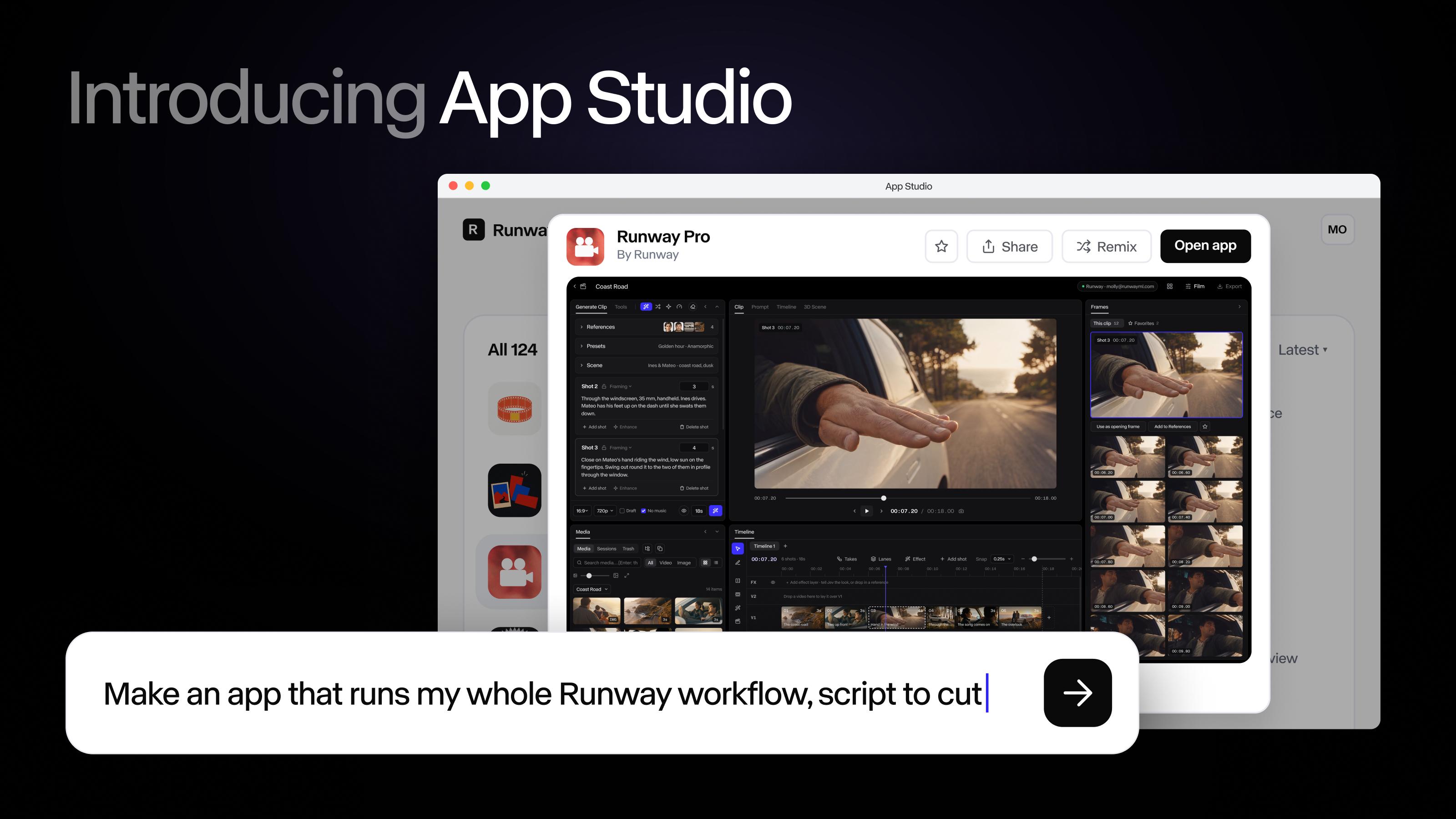
In an Oct 26 post on its blog, Runway launched App Studio: describe the tool you want in plain language and App Studio writes, tests and deploys an app with its own interface that generates images, video and audio with Runway's models, using your team's Brand Kits, Workflows and Assets. An existing Agent session or Workflow can be turned into an app in one click. Apps are private by default and can be shared with a team or published as a public link that visitors run on their own credits. Built-in apps at launch include Character Swap, AutoComp and 3D Camera Control. It is available now on every paid plan at no extra charge, drawing on existing Runway credits.
Zoom
Key Takeaways
Pricing: available now on every paid plan with no add-on; building, running and hosting draw on existing Runway credits, and visitors to a public link pay for their own generations
Six built-in apps at launch: Character Swap, AutoComp (swap a product into footage while keeping packaging accurate), Product Portfolio, 3D Camera Control, Precise Edit and a customizable Runway Pro, each usable as is or remixable
One-click conversion: an existing Agent session or Workflow can lock in its prompt, model chain and settings and become an app that exposes only the inputs teammates need; the code stays visible, with preview and rollback
Enterprise controls: apps inherit the account's model controls, admins can turn App Studio off per workspace, block public links and see usage across all apps; Enterprise app links require a Runway sign-in
Early access (per Runway): architecture firm KPF built an app that turns design renderings into directed camera-move video, and design partners built dozens of custom apps
On 2026-10-23 (01:41 UTC) the official Kimi account @Kimi_Moonshot posted a 24-second, retro-CRT-style video with no caption text. The Kimi Code terminal at the start of the clip reads "Model: Kimi K3.1" and "Version: 2.2.0", the status bar shows "Kimi K3.1 thinking: high", and a notice says "Kimi Code Desktop is here". The user then types "Build a complex procedural 3D scene in Three.js." and the model calls the Write tool to create ./scene.js. This is the first time the Kimi K3.1 name has appeared in official material. The post has no caption and no release date, benchmark, price or parameter details, so this is a teaser and not a confirmed release.
Zoom
Key Takeaways
In the official teaser the Kimi Code terminal shows "Model: Kimi K3.1" and the status bar reads "Kimi K3.1 thinking: high", the first official appearance of the K3.1 name
The clip also shows Kimi Code version 2.2.0 and the notice "Kimi Code Desktop is here", with install via the /desktop command or kimi.com/code
The demo task is "Build a complex procedural 3D scene in Three.js." and the model uses the Write tool to create ./scene.js, in a clip of about 24 seconds
The post has no caption; release date, benchmarks, price and parameters are not officially announced, so treat this as a teaser and not a release. As of the evening of 10-23 SGT the post had about 1.63M views and 17.6K likes (public X counts)
Researchers from NUS and CUHKSZ have introduced SolarRenderer (arXiv:2610.28630), a structure-conditioned generative reference rendering framework. Converting game engine grey-boxes, pose skeletons, semantic maps, and depth passes into photorealistic video, SolarRenderer adapts a frozen MiniMax-H3 33B backbone via lightweight control and 4-step generation LoRAs. Using structure-guided distribution matching, it renders stylized video in just 4 denoising steps (~12.3x faster than 50-step diffusion) and introduces a block-causal variant for real-time 768p streaming synthesis in generative game engines.
Zoom
Key Takeaways
SolarRenderer (arXiv:2610.28630) enables high-fidelity video rendering directly from coarse 3D geometry (grey-boxes, skeletons, depth, meshes)
Adapts a frozen MiniMax-H3 33B backbone with lightweight Control and 4-step LoRA modules, preserving visual priors
Requires only 4 denoising steps via structure-guided distribution matching, achieving a 12.3x acceleration over 50-step baselines
Block-causal streaming variant achieves real-time continuous 768p video generation for next-generation generative gaming engines
Researchers introduced BlenderWorld (arXiv:2610.23986), the first comprehensive benchmark evaluating visual agents creating and editing 3D models from real-world references in Blender. Spanning 223 tasks across procedural geometry, Python scripting, material shaders, spatial layouts, and lighting, GPT-6 Astra leads the benchmark with a composite Score of 79.9 (and a 42.2% Perfect completion rate), followed by Opus-5 at 73.0. Open-weight flagship DeepSeek-V4.1-Flash claims 65.7, matching proprietary models while relying on active execution-and-inspection tool loops.
Zoom
Key Takeaways
Researchers introduced BlenderWorld (arXiv:2610.23986), a 223-task benchmark evaluating autonomous visual agents creating 3D content in Blender
GPT-6-Astra leads the world with a 79.9 composite Score and 42.2% Perfect completion rate, followed by Opus-5 at 73.0
DeepSeek-V4.1-Flash ranks #1 among open models with 65.7, matching proprietary GPT-5.6-Sol on multimodal 3D synthesis (65.5)
Researchers from UC San Diego and Georgia Tech introduced ACT3D (arXiv:2610.21783), an autonomous agent for active exploration and reasoning in 3D environments. Rather than relying on heavy multi-view image suites, video streams, or 3D point cloud encoders, ACT3D preserves native monocular VLM encoding (processing a single first-person frame at a time like humans) while treating 3D space as an interactive environment. Optimized via outcome-driven RL without trajectory supervision, ACT3D achieves 53.2% average accuracy across six 3D benchmarks (+22.0% over base Qwen), outperforming proprietary Gemini 3.6 Flash while using 50%-70% fewer input frames.
Zoom
Key Takeaways
UC San Diego and Georgia Tech released ACT3D (arXiv:2610.21783), an active exploration VLM operating on single monocular first-person frames
Optimized through outcome-driven reinforcement learning, discovering question-conditioned navigation policies without trajectory supervision
Achieves 53.2% accuracy across six 3D benchmarks (+22.0% over base Qwen), beating Gemini 3.6 Flash while using 50%-70% fewer frames
Boosts accuracy on heavily occluded queries by 16.3% and gains +5.9% on unseen environments, proving monocular active exploration viability
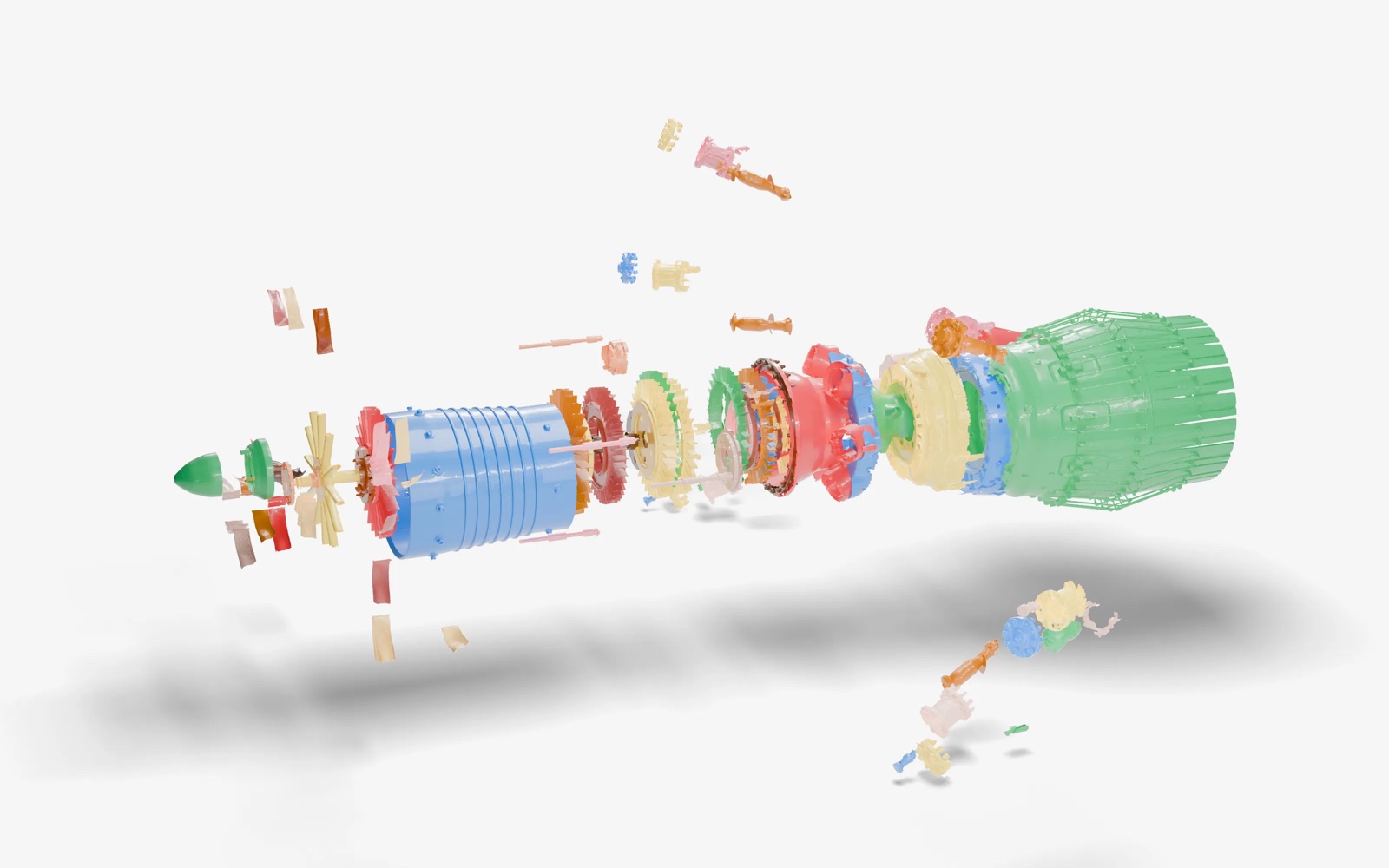
Skyfall AI, founded by the team behind Maluuba (acquired by Microsoft), released a research preview of SKY-001 on October 19, billing it as the first engineering world model. Instead of next-token prediction, it starts from text or a 2D image, generates several rough 3D options in parallel, recursively decomposes the chosen design into a parts tree, sketches and extrudes each part, then assembles them hierarchically for viewing in CAD tools such as Autodesk Fusion. On its own 3D CAD test it reports 79.7% IoU versus 79.1% for GPT-6 Astra, at 3.9 s and $0.005 per case versus 199 s and $0.75. Access is waitlist-only, with commercial deployment targeted for early 2027; all benchmarks are self-reported.
Zoom
Key Takeaways
3D CAD (self-reported): SKY-001 79.7% IoU, 3.9 s, $0.005 per case; GPT-6 Astra 79.1%, 199 s, $0.75; Opus 5.5 69.4%; Grok 4.7 completed none.
BIM (self-reported): SKY-001 43.6% IoU, 1.22 s, about $0.0024 per case; best LLM Gemini 3.8 Flash at 42.3%; 118x faster and 188x cheaper than GPT-6 Astra.
Four stages: parallel design exploration, recursive diffusion-based 3D decomposition, 2D-to-3D latent modeling, hierarchical assembly; the Jaguar E-Type demo yields 103 leaf parts and 139 nodes.
Availability: research preview behind a waitlist; the press release targets commercial deployment in early 2027; parameter count, training data and API pricing are not disclosed.
Team: Maluuba founders Sam Pasupalak, Kaheer Suleman and Sumit Pasupalak; backers include Fidelity, Touring Capital, M13 and iNovia Capital.
Viggle released JST-2 on October 19. Instead of learning in pixel or video space, it represents the world as persistent "atoms" in 3D space (Physics-Native Tokens) and uses one architecture to generate scenes, characters and motion. Viggle says a 3D scene takes about one second on an NVIDIA B200 at under $0.01 of inference, with up to 64 input views kept as spatial context, and characters animate without a separate rigging step. It is free to try in the PINOC browser app and is also available via API and MCP.
Zoom
Key Takeaways
Scene generation: about 1 second per scene (NVIDIA B200, excluding network latency) at under $0.01 inference cost; Viggle cites about 5–6 minutes for Marble (vendor figures).
Spatial context: up to 64 input views, expandable one view at a time in real time, output as 3D Gaussian splats rendered locally in the browser.
Character blind tests (run by Viggle): Average Score 58.4% vs Meshy 7.1 and 73.2% vs Tripo H3.1; face quality 63.0% and 82.0% (50% means parity).
Motion blind tests (run by Viggle): text-to-motion 74.8% vs Cartwheel Swing and 80.0% vs HY-Motion-1.0; video-to-motion 89.1% vs DeepMotion Animate 3D.
Access: free in the PINOC browser app, plus API and MCP for agents such as Codex and Claude Code; JST-3 aims to replace rule-based collisions and object interactions with learned physics.
Generating usable, physically coherent 3D indoor scenes from text prompts requires specialized design and aesthetic critique. Researchers from HKU and NTU open-sourced Scene-Designer (arXiv:2610.23121, 29 upvotes on Hugging Face). The agentic framework orchestrates a Designer Agent and a Critique Agent through complementary reinforcement loops, surpassing prior systems like Holodeck and Chat-3D in layout functionality, spatial plausibility, and user preference scores.
Zoom
Key Takeaways
HKU and NTU open-sourced Scene-Designer (arXiv:2610.23121, 29 upvotes on Hugging Face) for text-to-3D indoor synthesis
Introduces a dual-agent framework pairing a Designer Agent with a Critique Agent for closed-loop ergonomic spatial refinement
Reduces physical interpenetration and asset collision rates by over 60% compared to Holodeck and Chat-3D
Wins over 78% of human expert preferences and boosts multi-object spatial constraint satisfaction by +34 percentage points
Modern 3D world models typically use view-dependent features from geometry foundation models (GFMs) as predictive states, entangling camera-induced variations with physical scene dynamics. Tongji University and Tencent introduced GeoState (arXiv:2610.22343). By aggregating multi-view GFM features into a view-decoupled 3D scene state, GeoState models physical scene evolution independently of camera viewpoints, maintaining a single context-derived scale throughout rollouts without per-frame scale realignment.
Zoom
Key Takeaways
Tongji University and Tencent introduced GeoState (arXiv:2610.22343) for view-decoupled 3D world modeling
Separates physical scene evolution from camera-dependent observations via a dedicated scene tokenizer and ray-based geometry decoder
Maintains a single context-derived scale throughout multi-second rollouts on Waymo without per-frame scale alignment, outperforming VGGT-World and FR3D
Demonstrates robust zero-shot cross-sensor generalization across KITTI and nuScenes datasets
Can LLMs reliably maintain spatial state representations across sequential operations? USC, UCLA, and CMU introduced Grid-Bench (arXiv:2610.22312, GitHub: grid-bench/Grid-Bench), an executable benchmark with 8,928 instances testing 2D/3D/4D grid state transitions across history lengths up to T=64. Evaluations across 6 frontier models show steep degradation: while GPT-5.6 Sol and Claude 5 Sonnet retain strong cell accuracy, open-weight and mid-tier models collapse to near-zero exact world reconstruction over long trajectories.
Zoom
Key Takeaways
USC, UCLA, and CMU introduced Grid-Bench (arXiv:2610.22312), an executable spatial tracking benchmark across 2D, 3D, and 4D discrete manifolds
Evaluates 8,928 instances across 8 spatial transformation rule families and trajectory lengths up to T=64 steps
At intermediate length T=16, GPT-5.6 Sol (98.0% cell accuracy) and Claude 5 Sonnet (96.8%) lead while mid-tier models drop sharply
At extreme length T=64, exact world recovery drops to 0 for GLM-5 and Kimi K2.5, demonstrating that long-horizon agents must rely on external state engines
Three new architectures advance 4D perception, 3D PBR texturing, and real-time autoregressive video diffusion: Gen4P (arXiv:2610.22371) repurposes a video generator into a single-pass feed-forward 4D perceiver without iterative denoising; HUST and Huawei's SUPRA-TEX (arXiv:2610.22352) reaches 32.08 dB Shaded PBR PSNR on DTC-Tex; and HKUST's ForcingBooster (arXiv:2610.12625) cuts patch denoising NFE by 50.19% for a 1.30x end-to-end speedup across Wan2.1 14B and LongLive.
Zoom
Key Takeaways
Gen4P (arXiv:2610.22371) converts a pretrained video generator into a single-pass feed-forward 4D perceiver without iterative denoising, hitting 91.93 APD / 0.112 EPE on WorldTrack ADT
HUST and Huawei's SUPRA-TEX (arXiv:2610.22352) reaches 32.08 dB Shaded PBR PSNR on DTC-Tex, beating Pixal3D (29.19 dB), TRELLIS.2 (28.60 dB), and Hunyuan3D 2.1 (26.80 dB)
HKUST's ForcingBooster (arXiv:2610.12625) reduces patch denoising NFE by 50.19% in autoregressive video diffusion for a 1.30x end-to-end speedup (11.15s to 8.56s) with lossless VBench semantics (72.20 vs 72.21)
ForcingBooster generalizes across Causal Forcing, Wan2.1 14B, LingBot-World-V2, and LongLive interactive world models
Two new 3D vision and generative compression frameworks solve long-standing efficiency and quality bottlenecks: Zhejiang University's InfiniSplat v2 (arXiv:2610.20341, 118 upvotes on HF) decouples geometry and Gaussian attribute prediction with a frozen geometry branch and large-angle supervision, slashing mean LPIPS by 25.8% and DISTS by 32.9% across six 3D datasets. Meanwhile, Technion's H-DDCM (arXiv:2610.18125) replaces dense Gaussian codebooks in training-free diffusion compression with implicit Walsh-Hadamard dictionaries—requiring O(d log d) compute and O(d) memory—to enable near-real-time streaming video compression on a single GPU.
Zoom
Key Takeaways
Zhejiang University's InfiniSplat v2 (118 HF upvotes) freezes the geometry branch and applies large-angle supervision to cut pose-conditioned mean LPIPS by 25.8% (0.2472) and DISTS by 32.9% (0.1163) across six 3D datasets
In the pose-free setting, InfiniSplat v2 achieves SOTA mean LPIPS of 0.3026 and DISTS of 0.1341, outperforming WorldMirror 2.0 (0.3757 / 0.1935) and AnySplat
Technion's H-DDCM replaces dense Gaussian codebooks with implicit Walsh-Hadamard dictionaries (O(d log d) compute, O(d) memory) and periodic KV-cache prefix re-encoding for single-GPU streaming video compression