AI Coding Live News

OpenAI Launches Grid Protectors Program: Future Compute Campuses Will Cut Power When Grids Are Strained, Starting With Up to 1,000 MW in Georgia

On November 2, OpenAI announced the Grid Protectors Program on its official blog: working with utilities and regulators so its future self-built compute campuses (its new term for data centers) cut electricity use when the grid is strained, while paying the full infrastructure and electric-service costs. The pilot is the planned campus in Effingham County, Georgia (Project Camellia), which Georgia Power says needs about 3,200 MW and commits up to 1,000 MW of flexible demand response, equal per OpenAI to the average use of roughly 700,000 households. The campus is still in development.
OpenAI Launches Grid Protectors Program: Future Compute Campuses Will Cut Power When Grids Are Strained, Starting With Up to 1,000 MW in Georgia

Key Takeaways

  • The Effingham campus (Project Camellia) needs about 3,200 MW, and Georgia Power can cut up to 1,000 MW of supply to it during peaks under a 25-year agreement (Georgia Power figures).
  • OpenAI says 1,000 MW equals the average demand of roughly 700,000 households, more than Washington, D.C., and Boston combined.
  • Georgia Power projects about $950 million a year in customer savings from 2029 from its large-load portfolio including this project, at least $15 a month for a typical home.
  • OpenAI commits to paying the full grid infrastructure and electric-service costs; terms for other campuses will be shared once finalized.
  • OpenAI cites a projection that U.S. data center capacity will exceed 100 GW by 2030.
Read full story
Linked Models & Agents:

X Discussion: MIT Team Says GPT-6 Astra Can Read and Write Neural Network Weights, Editing 0.016% of Qwen3.5-0.8B to Lift MATH-500 From 7.9% to 48.1%

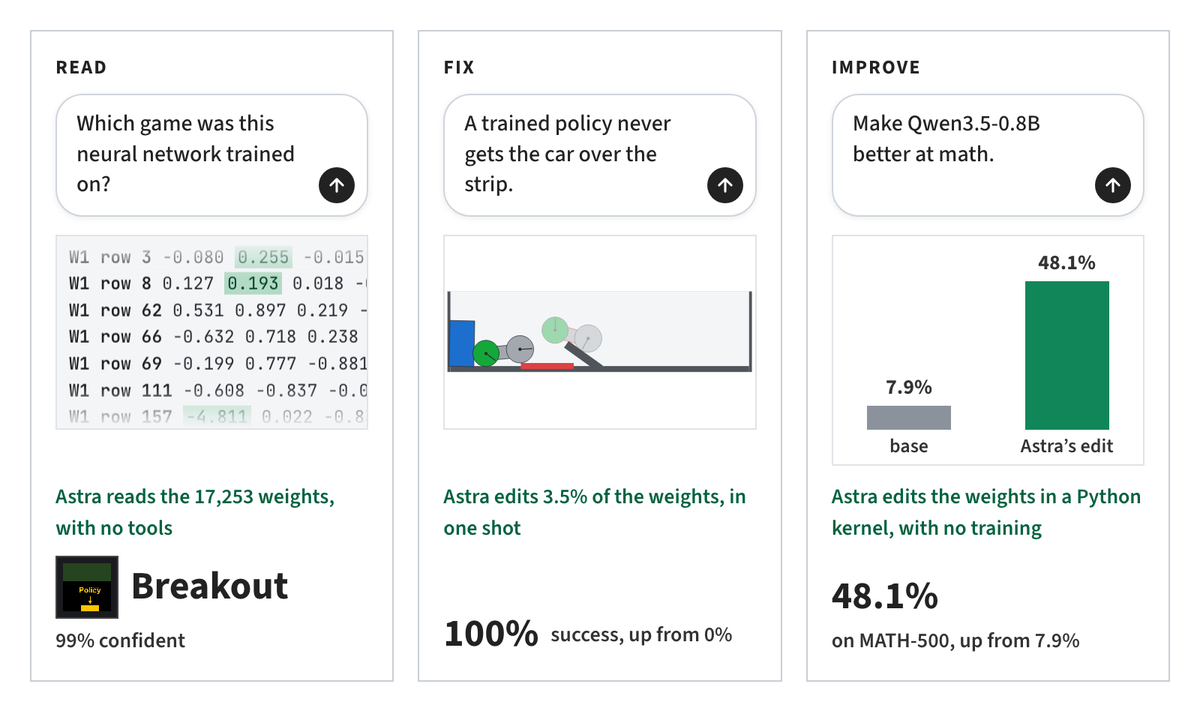
On November 2, MIT CSAIL PhD student Rikiya Takehi posted "Weight-Space Programming" on X: a team (Takehi, Jayden Teoh, Alex Zhang, Omar Khattab) had GPT-6 Astra read and edit neural network weights directly, with no gradients or training. Their blog says Astra changed only 131,072 weights (0.016%) of Qwen3.5-0.8B, fixed its thinking loops and raised MATH-500 from 7.9% to 48.1%. The post drew about 24K likes and 1.77M views, and Ethan Mollick quoted it saying it is a big deal pending replication. All results are self-reported by the authors and not yet independently reproduced.

X Discussion: MIT Team Says GPT-6 Astra Can Read and Write Neural Network Weights, Editing 0.016% of Qwen3.5-0.8B to Lift MATH-500 From 7.9% to 48.1%

Key Takeaways

  • The original post (2026-11-02 17:51 UTC) had about 24,320 likes, 2,697 reposts, 2,284 quotes, 1.77M views and 15K bookmarks at fetch time; Wharton professor Ethan Mollick quoted it saying it is a pretty big deal pending replication (about 880 likes).
  • Experiment 8 (authors' figures): with a 50 forward-pass budget, Astra edited 131,072 weights (0.016%) of Qwen3.5-0.8B, raising MATH-500 from 7.9% to 48.1% and IFEval from 21.0% to 62.3%, while answers hitting the token limit fell from 93.0% to 33.1%.
  • Experiment 5 (authors' figures): with no data, gradients or tools, Astra wrote MinAtar policy networks in one shot that scored 517.4 on Breakout versus 15.8 for PPO at 100M steps and 25.3 at 500M steps; on Seaquest it scored 53.1, below the 88.9 of 500M-step PPO.
  • Limits the authors report: on Gemma 3 270M, which rarely loops, Astra's edits moved MATH-500 by no more than about a point; they conclude weight edits can remove an obstacle hiding an ability but cannot add one the model lacks.
  • Full experiment logs are public at RikiyaT/lm_understand-logs; so far there is only a blog post, with no peer-reviewed paper and no third-party replication.
Read full story
Linked Models & Agents:

Deep Principle Open-Sources Hydrogen-1.0, a 753B Science Model Post-Trained From GLM-5.3 on Lab Records, MIT Licensed

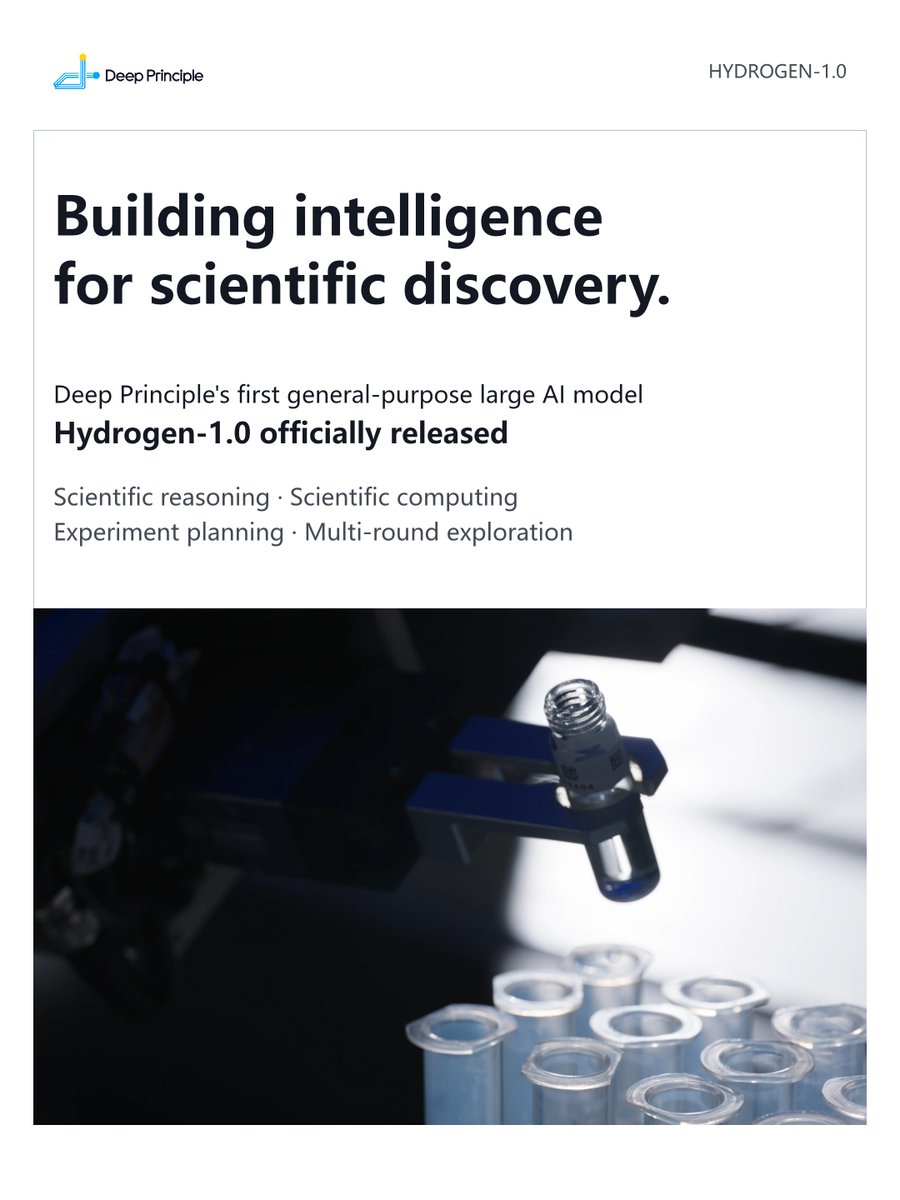
Hangzhou-based AI-for-science company Deep Principle released Hydrogen-1.0 on November 2, its first general-purpose scientific model. It post-trains Zhipu's GLM-5.3 with SFT and RL on chemistry, materials and life-science data plus its own lab records and discovery trajectories, and ships about 753B parameters of BF16 weights on Hugging Face under the MIT license. By the vendor's own evaluation it scores 38.3% on FrontierScience-Research versus 33.3% for GPT-6 Astra; none of the results have been independently reproduced yet.

Deep Principle Open-Sources Hydrogen-1.0, a 753B Science Model Post-Trained From GLM-5.3 on Lab Records, MIT Licensed

Key Takeaways

  • Scale: Hugging Face lists about 753B total parameters (BF16, roughly 1.5 TB of weights), glm_moe_dsa architecture, 1M-token context and 128K max output, MIT licensed (download requires accepting HF terms).
  • Benchmarks (vendor-reported): 38.3% on FrontierScience-Research vs 33.3% for GPT-6 Astra; 93.0% on GPQA Diamond, which the company says roughly matches Kimi K3.
  • Internal scenarios (vendor-reported): leads max-thinking GPT-6 Astra by 5.13 points on scientific computing and 4.76 points on forward reaction prediction, but trails it by 3.33 points on NMR structure elucidation.
  • Materials discovery: after five rounds of transition-metal-complex search, the mean best HOMO-LUMO gap reached 4.318 eV vs 3.689 eV for GPT-6 Astra and 3.353 eV for Kimi K3 (official blog).
  • Access: weights on HF and ModelScope, plus NVFP4 (B200/B300) and MXFP4 (MI350X/MI355X) quantized repos; API via NeuroSpark and in-app use in the Mira AI Scientist; tested with SGLang on 8 GPUs.
Read full story

Altman at ADIPEC: The Internal Model Behind the 10,000-Agent Navier-Stokes Proof Is "the Next GPT," Coming Soon

Speaking at the ADIPEC energy conference in Abu Dhabi on November 2, OpenAI CEO Sam Altman said the September run in which 10,000 agents collaborated for about four days used "the model that is going to be released soon, the next GPT," stressing that the agents had no hierarchy and were fully decentralized. It is the first public statement tying the internal model behind OpenAI's September Navier-Stokes proof to its next flagship, though OpenAI has given no name, release date or price.

Altman at ADIPEC: The Internal Model Behind the 10,000-Agent Navier-Stokes Proof Is "the Next GPT," Coming Soon

Key Takeaways

  • Quote (ADIPEC keynote video): "It was 10,000 agents of the model that is going to be released soon, the next GPT, working for about four days, nonstop."
  • OpenAI's September 8 blog post: about 10,000 concurrent agents reached the result in about 88 hours, and GPT-6 Astra took another 17 hours for Lean formalization and verification.
  • Scale (OpenAI figures): 2.7 million agent messages and about 130 billion output tokens for Navier-Stokes alone; 4.9 million messages and about 300 billion output tokens across all attempted problems.
  • The Lean proof is public at openai/NavierStokesAndEuler and establishes statements C and D of the official Clay formulation (breakdown with smooth forcing).
  • Not disclosed: the next GPT's name, release date, price or benchmarks; names like "GPT-6.2 Astra" circulating on X are speculation.
Read full story
Linked Models & Agents:
ADSponsored

Anthropic's Amended S-1 Says Future Models May Imminently Meet Its RSP Threshold for Dramatically Accelerated AI Progress

On November 2 Anthropic filed Amendment No. 1 to its S-1 with the SEC, adding a risk disclosure: based on internal estimates and expectations about future models, not current ones, the company may imminently meet its Responsible Scaling Policy definition of dramatically accelerated progress attributable to AI. No current model has been designated as exceeding the threshold. Anthropic says it is evaluating the implications of meeting the AI R&D capability threshold, is considering RSP updates that would require human review and approval of certain R&D decisions, and does not expect to safely let Claude fully autonomously design and build successive frontier models without meaningful human supervision.

Key Takeaways

  • Filing: Anthropic, PBC's Amendment No. 1 to Form S-1, filed November 2, 2026 (SEC filing), Registration No. 333-299633.
  • Key line: based on internal estimates for future models, the company may imminently meet the RSP definition of dramatically accelerated progress attributable to AI; no current model has been designated as exceeding it.
  • Proposed measures: possible RSP updates requiring human review and approval of certain R&D decisions; Anthropic also says it recently delayed pre-training a new frontier base model by more than a month to strengthen safeguards such as preventing weight exfiltration.
  • Same filing (company figures): over 90% of contributions to Anthropic's codebase in September 2026 were written by Claude, and revenue for the three months ended September 30, 2026 was $17.0 billion.
Read full story
Linked Models & Agents:

OpenAI Introduces LifeVal, a Benchmark for Everyday Life Tasks Built From Time-Use Studies and a 3,995-Person Survey

On November 2 OpenAI published LifeVal, an evaluation of whether AI can actually get everyday tasks done for ordinary people, such as finding childcare, accessing government services, budgeting, ordering groceries and adapting recipes. The task list draws on the American Time Use Survey, the Multinational Time Use Study and a new demographically representative OpenAI survey of 3,995 people. OpenAI says it has used LifeVal for the past year to track and improve its models, and it lists several best recorded GPT-6 Astra task scores, many at 100%. All scores are vendor-reported and have not been independently reproduced.

OpenAI Introduces LifeVal, a Benchmark for Everyday Life Tasks Built From Time-Use Studies and a 3,995-Person Survey

Key Takeaways

  • Task sources: the American Time Use Survey, the Multinational Time Use Study and a new representative OpenAI survey of 3,995 respondents (official blog).
  • Domains covered: caregiving, health, education, household administration, personal finances, shopping and government services.
  • Example scores (vendor-reported): kindergarten enrollment after a move 93.1%, flood volunteer coordination 98.0%, home search with deed added to cart 100%, diabetes meal plan 90.4%.
  • GPT-6 Astra's best recorded score is 100% on tasks such as booking a toddler sensory class, booking a car inspection, ordering halal groceries within budget and unsubscribing from email lists.
  • The official text we read gives no full task count or overall score, so overall figures circulating on X are not used here.
Read full story

X Discussion: DHH Says the Age of Agents Will Be Great for Most Programmers but Hard on Cantankerous Ones Who Relied on Rare Skills

Ruby on Rails creator and 37signals CTO DHH (David Heinemeier Hansson) posted two related takes on X on November 2. First: "The great gift of agents is how they allow you to route around every insufferable gatekeeper in software." Then: the age of agents will be amazing for most programmers but hard on the cantankerous ones, because specialized knowledge and rare skills will no longer offer immunity to people who are a pain to work with, so they should learn basic people skills. The second post drew about 3,600 likes, 106K views and 280+ replies in roughly four hours. This is a personal opinion, not an announcement from any company.

Key Takeaways

  • This is a personal opinion post by DHH, not an official statement from 37signals or any AI company, and it cites no data or study.
  • The main post (2026-11-02 13:03 UTC) had about 3,609 likes, 180 reposts, 282 replies, 60 quotes, 106K views and 400 bookmarks at fetch time.
  • His earlier post about 1.5 hours before, saying agents let you route around every insufferable gatekeeper in software (11:41 UTC), had about 2,831 likes, 131 reposts and 80K views.
  • Supporters: tech analyst Ben Dickson (@bendee983) quoted it saying great engineers used to get a free pass for being difficult, and AI is leveling the field, though solid engineering knowledge is still required.
  • Pushback and additions: one reply joked that cantankerous people just found a coworker who never complains back; another argued an agent will do the work but will not make you nicer, so being easy to work with becomes more valuable.
Read full story
Linked Models & Agents:

OpenAI's Tibo Says Dots Will Expand Its Model Family to Include GPT-6.1 Terra for Speed and Wider Reach

At 15:50 UTC on Nov 2, Tibo (@thsottiaux), whose X bio reads "Codex & ChatGPT @OpenAI", posted that OpenAI is working on expanding the family of frontier models that power dots, including GPT-6 Astra and GPT-6.1 Terra, with others to come. He said Terra brings speed and "a nice personality upgrade" and will help bring dots to more people. Dots are the always-on agents in ChatGPT with their own cloud computer, launched on GPT-6 Astra. This is a first-hand post by an OpenAI employee, not a formal company announcement; no timing or plan details have been published.

OpenAI's Tibo Says Dots Will Expand Its Model Family to Include GPT-6.1 Terra for Speed and Wider Reach

Key Takeaways

  • Source: an original post by Tibo (@thsottiaux, X bio "Codex & ChatGPT @OpenAI"), which drew about 2,475 likes, 622 replies and 127K views within roughly 20 minutes.
  • Key point: dots will no longer run only on GPT-6 Astra; GPT-6.1 Terra is being added, with more models later. It is described as work in progress with no launch date.
  • Terra per OpenAI: standard API pricing of $1 input and $5 output per million tokens, 50% below GPT-5.6 Terra and GPT-6.1 Sol, and over 3x faster task completion than GPT-6 Astra (OpenAI).
  • Current access: dots are rolling out to Pro users 18+ outside the EEA, Switzerland and the UK and to Business Premium; Enterprise needs an admin to enable the beta (Help Center).
Read full story

Marvell to Acquire Lumentum in $115 Billion All-Stock Deal, Betting on Optical Connectivity for AI Data Centers

Marvell and Lumentum announced on November 2 a definitive agreement for Marvell to acquire Lumentum in an all-stock deal: 4.5 Marvell shares per Lumentum share, an implied enterprise value of $115 billion (about $1,132 per share, a roughly 23.9% premium). Marvell holders will own about 67% of the combined company. The companies say AI clusters are shifting from copper to optics, and the combination will cover connectivity from data center interconnect down to in-package links, targeting a $550 billion market. Closing is expected in the first half of 2028.

Marvell to Acquire Lumentum in $115 Billion All-Stock Deal, Betting on Optical Connectivity for AI Data Centers

Key Takeaways

  • Fixed exchange ratio of 4.5 to 1 implies a $115 billion enterprise value for Lumentum, a roughly 23.9% premium to the unaffected October 28 close.
  • Marvell holders will own about 67% and Lumentum holders about 33%; Matt Murphy stays chairman and CEO, and three Lumentum directors including CEO Michael Hurlston join the board.
  • The deal combines Marvell electrical and optical interconnect, switching and custom XPU silicon with Lumentum lasers, optical transceivers, optical circuit switching (OCS) and indium phosphide (InP) manufacturing.
  • The companies cite more than $1 billion in run-rate cost synergies and year-one non-GAAP EPS accretion; shareholder and regulatory approvals are required, with closing expected in the first half of 2028.
Read full story

X Discussion: Jason Calacanis Says Under $40K a Year in AI Subscriptions Delivers $2M+ in Value and Has Automated at Least Seven Full-Time Jobs

Angel investor and This Week in Startups host Jason Calacanis posted on X on November 2 that he spends under $40K a year on tokens and subscriptions from Anthropic, Lovable, Grok Bot, ElevenLabs and other AI products, yet gets more than $2M in value at LAUNCH and This Week in Startups. He said they have automated at least seven full-time jobs and become 100% faster at the average task, and that the last 90 days changed more than the previous two years. Within about 9 hours the post drew about 2,200 likes and 230K views, with debate centered on AI ROI and job replacement. All figures are his own claims and have not been independently verified.

Key Takeaways

  • This is Calacanis's personal post, not official data or an announcement from any AI company; the $40K, $2M, seven jobs and 100% faster figures are self-reported with no public breakdown.
  • The original post (2026-11-02 05:27 UTC) had about 2,201 likes, 106 reposts, 244 replies, 42 quotes, 230K views and 715 bookmarks at fetch time.
  • Tools he named include Anthropic, Lovable, Grok Bot and ElevenLabs plus a long tail of other products; he also said anyone who has not used the last 90 days of products for at least 30 hours a week has no idea how profound this software is.
  • Supporters: entrepreneur Steven Cohn (@spcohn) quoted it saying his team has seen the same level of ROI; Farzad (@farzyness), with about 400K followers, quoted it saying "The ROI for AI is mind-boggling," drawing about 157 likes.
  • Skeptics: one user mocked posting "we automated seven full-time jobs" with a siren emoji like a product launch, noting that 30 hours a week of usage is itself like a new full-time job.
Read full story
ADSponsored

South Korea Nearly Doubles 2027 AI and Chip Spending to 21.3 Trillion Won, With 4.7 Trillion for a Sovereign Frontier Model and 10,000 Vera Rubin GPUs

In his 2027 budget address to the National Assembly on November 2, South Korean President Lee Jae Myung proposed a record 820.9 trillion won budget (+12.8%), with 21.3 trillion won (about $16B) for semiconductors, physical AI, AI data centers and AI, nearly double the 10.8 trillion won in 2026. The Ministry of Planning and Budget document allocates 4.7 trillion won to a sovereign AI model aiming for world-leading performance, including the purchase of 10,000 Vera Rubin GPUs. Parliament still has to pass the budget.

South Korea Nearly Doubles 2027 AI and Chip Spending to 21.3 Trillion Won, With 4.7 Trillion for a Sovereign Frontier Model and 10,000 Vera Rubin GPUs

Key Takeaways

  • The three mega-projects plus AI rise from 10.8 to 21.3 trillion won, up 97.2%; the total budget is 820.9 trillion won, up 12.8% (official budget document).
  • The 4.7 trillion won frontier AI program buys 10,000 Vera Rubin GPUs (3.9T won), training data (0.8T won), and recruits 20 top overseas researchers (25B won).
  • Until then, about 7,000 government-owned GPUs go first, plus about 8,000 leased from industry and academia; companies are picked by open competition and the state invests as an equity holder.
  • A new 0.25 trillion won AI for All program builds public AI agents on the domestic model that can handle ID documents, KTX train bookings and passport renewals; AI education gets 2.1T won for 3.9 million people.
  • Another 70B won funds a dedicated AI security model and 50B won subsidizes AI security subscriptions for 10,000 SMEs; physical AI rises from 0.9T to 3.1T won.
Read full story

X Discussion: Vercel CEO Guillermo Rauch Says "Own Your Intelligence," Urging Local Models to Keep Spreading and Developers to Own Their Agent Harness and Data

Vercel CEO Guillermo Rauch posted on X on November 1: "Own your intelligence. Anyone that opposes this has something to sell you (perhaps your own intelligence back to you.)" He argued that local models need to keep proliferating; since the biggest models may be out of reach locally for now, the best option is to keep your options open: own your harness, data, connections and runtime, meaning your agents, and embrace open source. Within about 12 hours the post drew about 2,500 likes, 128K views and over 100 quote posts, with debate centered on how to balance local and cloud AI.

Key Takeaways

  • This is Rauch's personal opinion post, not an official Vercel announcement or product release.
  • The original post (2026-11-01 21:08 UTC) had about 2,533 likes, 255 reposts, 266 replies, 107 quotes, 128K views and 581 bookmarks at fetch time.
  • Core claim: local models should keep spreading; until the biggest models can run locally, keep your options open by owning your harness, data, connections, runtime and agents, and embrace open source.
  • Mark (@marksuman), co-founder and CEO of Maple AI, replied in a quote post that it will be hybrid: cloud will always be more powerful, so local-first AI should be paired with private cloud.
  • Engineer Shantanu Goel (@shantanugoel) quoted it saying "Guillermo says the truth that most others won't!", drawing about 37 likes.
Read full story
Linked Models & Agents:

Google Project Suncatcher Gets First AI Response From a TPU in Orbit: Gemma 4 Downlinks a Haiku, Twin Satellites Planned for 2027

Google CEO Sundar Pichai and Google Research announced that the Project Suncatcher prototype satellite, launched on October 1, finished commissioning and ran a prompt on its onboard TPU with the open Gemma 4 model, downlinking a haiku as it passed over Svalbard, Norway. Google calls it the first AI response from a data-center-class TPU in orbit. Next come thermal-stress and radiation tests, then two interconnected satellites in 2027 to test AI computation distributed across satellites.

Google Project Suncatcher Gets First AI Response From a TPU in Orbit: Gemma 4 Downlinks a Haiku, Twin Satellites Planned for 2027

Key Takeaways

  • The satellite launched on October 1 on SpaceX's Transporter-18 rideshare, built with Planet, and ran its first in-orbit inference after about three weeks of commissioning (official account).
  • Per TechCrunch, it carries four TPUs and generates up to about 1 kW, so power limits it to one TPU at a time for roughly 20 minutes.
  • Sundar Pichai's announcement drew about 26K likes and 3.97M views; Google's official account said "Our TPUs just phoned home... from space."
  • Ground proton-beam tests in Google's paper found high-bandwidth memory irregularities only after a cumulative 2 krad(Si), about 3x the 750 rad(Si) minimum requirement (as cited by The Register).
  • Two interconnected satellites are planned for 2027 to test optical inter-satellite links and AI computation distributed across satellites.
Read full story

X Discussion: Elon Musk Says Grok Bot Serving Costs Were Unsustainably High Relative to Revenue; Replit CEO Amjad Masad Warns Subsidized AI Subscriptions Face a Rug Pull

After users on X complained that their Grok Bot usage ran out early this cycle, Elon Musk replied that "the cost of serving Grok Bot was unsustainably high relative to revenue", a reply with about 13K likes and 5.5M views. Replit CEO Amjad Masad then quoted the news, saying people enjoying subsidized AI subscriptions should "get ready to get rug pulled", sparking a debate over whether flat-rate AI plans can last. This is an X discussion with personal views; xAI has not published a formal pricing or limit announcement.

Key Takeaways

  • Trigger: user @DogecoinNorway said their Grok Bot usage hit 100% with 4 days left until reset, a post with about 1.24M views.
  • Musk replied that the cost of serving Grok Bot was unsustainably high relative to revenue, with about 13.2K likes, 5.51M views and 1,900+ quotes.
  • Amjad Masad (Replit CEO) quoted it, warning subsidized AI subscriptions are about to get rug pulled, with about 2,347 likes and 146K views; in replies he said Replit never subsidized.
  • xAI has not published a formal limit or pricing change; rely on official notices for specifics.
Read full story

OpenAI Signs Four Abu Dhabi Agreements: ADNOC Becomes First Energy Company to Deploy Its Frontier Tech, Machine-Readable Government Pilot Already Live

On November 2, Abu Dhabi Crown Prince Sheikh Khaled met OpenAI CEO Sam Altman and witnessed four agreements: ADNOC, with G42 subsidiary Inception42, will deploy OpenAI frontier technology; the Abu Dhabi Government and OpenAI launched an AI-native Machine-Readable Government initiative whose first food-import compliance pilot is already in production; Mubadala will apply AI to investment analysis; and Inception42 and OpenAI signed a five-year partnership. Inference runs inside the UAE.

OpenAI Signs Four Abu Dhabi Agreements: ADNOC Becomes First Energy Company to Deploy Its Frontier Tech, Machine-Readable Government Pilot Already Live

Key Takeaways

  • Four agreements in one signing, spanning government, energy and investment, announced officially by the Abu Dhabi Media Office.
  • ADNOC becomes the first energy company globally to deploy OpenAI frontier technology, powered by GPT models on in-country UAE inference, with human experts keeping oversight of consequential decisions.
  • The Machine-Readable Government initiative turns a defined set of policies and regulations into machine-readable form to help officials with permit and certificate compliance checks, each traceable to the governing rule; its first pilot is already in production with ADAFSA on food imports.
  • Inception42 and OpenAI signed a five-year partnership for government, enterprise and education; Mubadala will use AI for investment analysis and risk assessment.
  • No deal value was disclosed.
Read full story