AI Coding Live News

GitHub Copilot Automations go team-wide: repo-owned shared automations, 24 new triggers, 20 new tools and AI credit limits

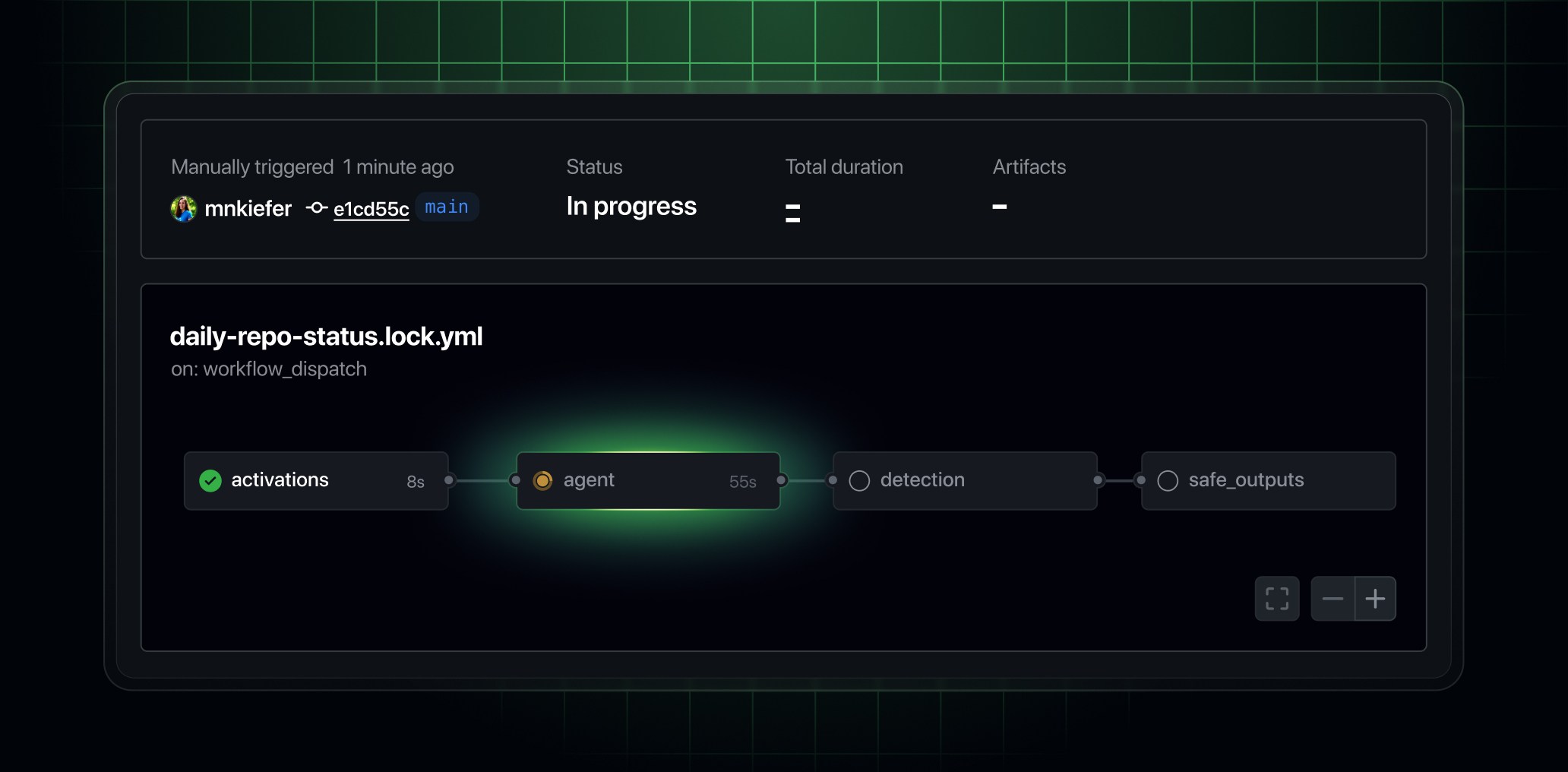
At GitHub Universe on Oct 28, GitHub shipped a batch of Copilot Automations updates. Shared automations now belong to the repository, act as Copilot, bill AI credits to the repo owner and keep running after their creator leaves. Automations gain 24 new GitHub event triggers, REST API triggers from external systems and chaining, plus 20 new tools and custom MCP servers. Teams can cap AI credits per run, day, week or month, automations can propose improvements to their own prompts from real outcomes, and VS Code 1.144 can run them in the cloud.

GitHub Copilot Automations go team-wide: repo-owned shared automations, 24 new triggers, 20 new tools and AI credit limits

Key Takeaways

  • Shared automations belong to the repository: anyone with read access can view them, anyone with write access can edit, actions are attributed to Copilot and AI credits bill to the repo owner
  • 24 new triggers across issues, pull requests, discussions and security alerts, plus REST API triggers from systems like Jira, Sentry and PagerDuty
  • 20 new GitHub tools (merge PRs, retry workflow runs, upload screenshots and more) and support for custom MCP servers
  • AI credit limits can be set per run, day, week or month; org repos need an admin to enable the "Allow use of Copilot cloud agent billed to the organization" policy
  • Rolling out to Copilot Pro, Pro+, Max, Business and Enterprise; VS Code 1.144 runs them in the cloud with chat.automations.cloud.enabled
Read full story

GitHub Agentic Workflows is generally available: write automation in Markdown, compile it to Actions YAML, run Copilot or your own coding agent, now with ARC self-hosting and micro-VM isolation

At Universe 2026 on Oct 28, GitHub made GitHub Agentic Workflows, an open source GitHub Next project, generally available on GitHub Free, Team and Enterprise. Developers describe tasks such as issue triage, CI failure analysis, documentation updates and test writing in natural-language Markdown, and gh aw compiles them into standard Actions YAML run by Copilot or a coding agent of their choice. GA adds self-hosted ARC runners with Docker-in-Docker, a non-experimental gh aw forecast cost estimate, per-workflow model providers and model routing, and Cloud Hypervisor or NVX micro-VM isolation.

GitHub Agentic Workflows is generally available: write automation in Markdown, compile it to Actions YAML, run Copilot or your own coding agent, now with ARC self-hosting and micro-VM isolation

Key Takeaways

  • Availability: GitHub Free, Team and Enterprise on github.com; using the default Copilot CLI engine requires a Copilot license
  • How it works: requirements in Markdown, compiled to standard Actions YAML that reuses existing runner groups and policies; run with Copilot or your own coding agent
  • Safe defaults: read-only permissions, a sandboxed container behind the Agent Workflow Firewall, safe-outputs validation, and a threat detection job before changes are applied
  • New at GA: self-hosted ARC runners with Docker-in-Docker, gh aw forecast out of experimental (with threat detection credits and monthly ranges), per-workflow model providers, model routing, micro-VM isolation and cross-repo enclaves
  • Customer story (Accenture's figures): one lead saved about 29 hours a week, AI authors 91% of the team's commits, and production errors fell from about 11,000 a day to under 1,000
Read full story

X discussion: Box CEO Aaron Levie says under 1% of enterprise workflows really use AI agents, echoing Sarah Guo's "early Claude Code era" take

Conviction founder Sarah Guo posted on Oct 27 that enterprise workflow automation is "in the autocomplete / early claude code era", "but not for long", drawing about 80K views and nearly 500 likes. Box CEO Aaron Levie quoted it the next day and argued that most enterprise workflows have not had agents applied in any meaningful way, putting deployment at probably under 1%, mainly because of AI capability itself; he says computer use, long-running agents and agent swarms are changing that. His post has about 635 likes, 486 bookmarks, 63K views and 150+ replies. These are opinions and rough estimates, not measured statistics.

Key Takeaways

  • Sarah Guo (Conviction founder): enterprise workflow automation is still in the "autocomplete / early claude code era", but not for long
  • Aaron Levie (Box CEO): most enterprise workflows have not had agents applied meaningfully, and deployment across the economy is "probably < 1%", which is his estimate
  • Levie says the main bottleneck is AI capability itself, with enterprise adoption speed a smaller factor
  • He points to computer use, long-running agents, harness improvements and agent swarms as what now makes more complex workflows workable for agents
  • His view: the shift is less about users prompting agents and more about organizations re-engineering workflows, with the biggest impact in finance, life sciences, healthcare and other information-heavy fields
Read full story

Ant Ling open-sources Ling-3.1-flash-1019: further post-trained 560B/25B-active MoE lifts AA Intelligence Index from 41 to 44, base checkpoint also released

On Oct 27 Ant Ling (inclusionAI) open-sourced Ling-3.1-flash-1019, a further post-trained upgrade of the early-October Ling-3.1-flash: 560B total parameters, 25B active per token, a 1M-token context and an MIT license. Ant says it scores 44 on the Artificial Analysis Intelligence Index v4.3.2 (up from 41), with clear gains on agent tasks such as AA-Briefcase and AutomationBench-AA. It also released Ling-3.1-flash-base, an open foundation checkpoint for further training.

Ant Ling open-sources Ling-3.1-flash-1019: further post-trained 560B/25B-active MoE lifts AA Intelligence Index from 41 to 44, base checkpoint also released

Key Takeaways

  • Scale: 560B total and 25B active parameters, 1M-token context, MIT license, on Hugging Face and ModelScope
  • Artificial Analysis Intelligence Index v4.3.2: 44, up from 41 for Ling-3.1-flash (vendor-reported)
  • AA-Briefcase rises from about 1400 to 1524 Elo and AutomationBench-AA from 62% to 68% (vendor-reported)
  • Science: CritPt from 18% to 26% and SciCode from 54% to 57% (vendor-reported)
  • Architecture: hybrid-linear MoE with 63 KDA layers plus 9 gated MLA layers (7:1), 512 routed experts and 8 active per token
Read full story
Linked Models & Agents:
ADSponsored

Shanghai AI Lab ships Atria Dawn full release: 744B MoE GLM-5.2 agentic model, context doubled to 512K, MIT weights

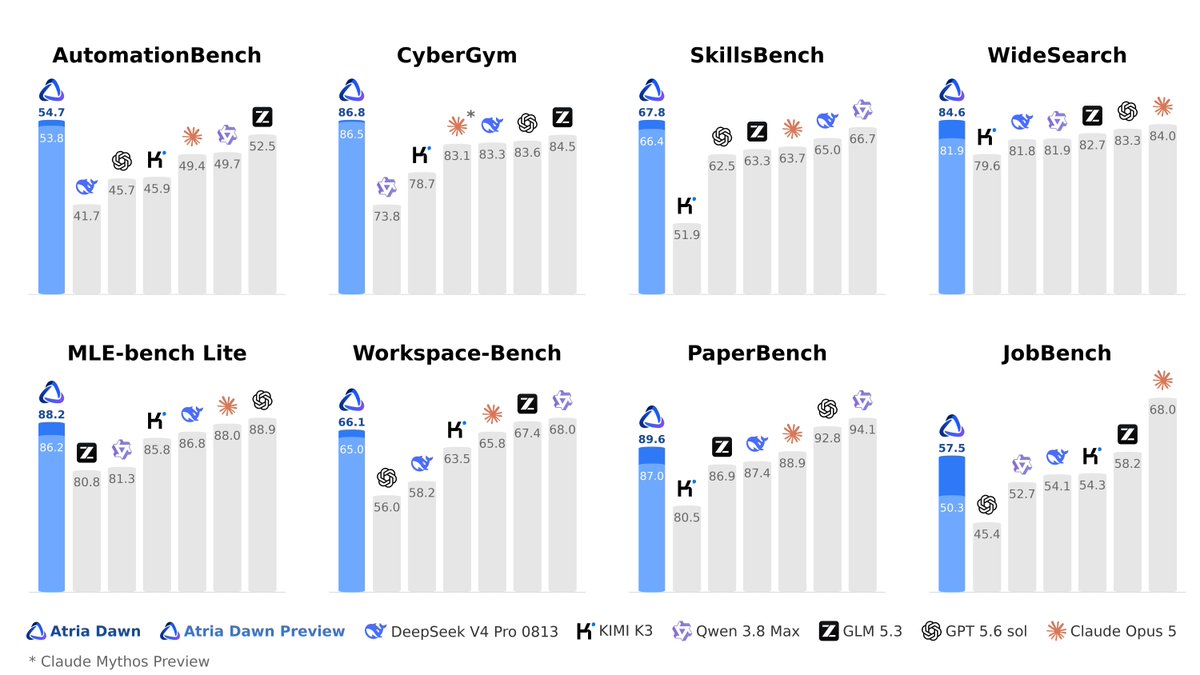
Shanghai AI Laboratory has moved Atria Dawn from Preview to a full release, with open weights (plus an FP8 build) on Hugging Face under internlm/Atria-Dawn and on ModelScope, MIT licensed. Built on the 744B-parameter MoE GLM-5.2, it targets long-horizon research and engineering agent work; context doubles from the Preview's 256K to 512K and input is text only. The vendor table shows it leading the listed models on AutomationBench, CyberGym and SkillsBench, while still trailing Claude Opus 5 on coding tests such as SWE-bench Pro and Terminal-Bench 2.1 (all vendor-reported).

Shanghai AI Lab ships Atria Dawn full release: 744B MoE GLM-5.2 agentic model, context doubled to 512K, MIT weights

Key Takeaways

  • 512K context, double the Preview's 256K; built on the 744B-parameter MoE GLM-5.2, text input only
  • BF16 and FP8 weights on Hugging Face and ModelScope, MIT license
  • Vendor-reported: AutomationBench 54.7, CyberGym 86.8, SkillsBench 67.8, BFCL V4 78.4, each the top score in its table
  • Weak spots from the same table: SWE-bench Pro 61.7 vs 76.5 for Claude Opus 5, Terminal-Bench 2.1 81.0 vs 90.2
  • Local serving needs SGLang v0.5.13.post1+ or vLLM v0.23.0+; an OpenAI-compatible API also plugs into Codex
Read full story
Linked Models & Agents:

Mistral AI and NVIDIA Forge Industrial Engineering AI Alliance, Previewing 1T Mistral Large 4

At GTC Berlin, Mistral AI and NVIDIA announced a strategic partnership dedicated to advancing AI for industrial engineering, computational physics, and electronic design automation (EDA). The alliance couples Mistral frontier architectures with NVIDIA CUDA-X libraries, Warp physics simulation frameworks, and Omniverse digital twins. Mistral simultaneously revealed architectural specifics for its forthcoming flagship, Mistral Large 4: spanning roughly 1 trillion total parameters with 49 billion active parameters (MoE), trained on 3,800 Grace Blackwell GPUs, with open weights slated for official release at the end of October 2026.

Mistral AI and NVIDIA Forge Industrial Engineering AI Alliance, Previewing 1T Mistral Large 4

Key Takeaways

  • Mistral AI and NVIDIA launched a strategic alliance applying frontier foundation models to CAE, physics AI, and EDA semiconductor design
  • Integrates NVIDIA Warp, CUDA-X simulation libraries, and Omniverse to establish open physics datasets and industrial agent benchmarks
  • Disclosed architectural parameters for Mistral Large 4: ~1T total parameters with 49B active sparse MoE, trained on 3,800 Grace Blackwell GPUs
  • Weights for Mistral Large 4 are scheduled for open-source release at the end of October 2026, joining the Nemotron Coalition
Read full story

MiniMax M3.1 Flash weights now open on Hugging Face: 428B-total / 23B-active MoE, $0.15 input and $0.60 output per million tokens, 73.7% on DeepSWE

MiniMax confirmed that Space Bunny, the anonymous model that led usage rankings on OpenRouter and elsewhere, was an early version of M3.1 Flash, and launched it on its API on October 19. Pay-as-you-go pricing is $0.15 input, $0.60 output and $0.015 cache read per million tokens, with a 1M context, text, image and video input, and an effort setting for thinking depth. Per MiniMax, it costs one third of M3 and runs 3x faster, scoring 73.7% on DeepSWE and 62.2% on Automation-Bench; the weights went live on Hugging Face on schedule on October 23 (MiniMax Community license, MXFP8), with day-0 support from Together, Inferact (vLLM) and LightSeek TokenSpeed.

MiniMax M3.1 Flash weights now open on Hugging Face: 428B-total / 23B-active MoE, $0.15 input and $0.60 output per million tokens, 73.7% on DeepSWE

Key Takeaways

  • Official pay-as-you-go pricing: $0.15 input / $0.60 output / $0.015 cache read per million tokens; per token that is half of M3 ($0.30/$1.20), and MiniMax does not explain how it gets one third of the cost.
  • Vendor benchmarks: DeepSWE v1.1 73.7% (Opus 5: 74.0%), Automation-Bench 62.2%, BabyVision with tools 91.0%, Terminal Bench 4.0 38.1% (Opus 5: 51.8%).
  • 1M context, text/image/video input, five effort levels from low to max, default max, thinking cannot be turned off.
  • Weights opened October 23 at Hugging Face MiniMaxAI/MiniMax-M3.1-Flash: ungated, MiniMax Community license (not MIT/Apache), MXFP8 quantized, native multimodal MoE with about 428B total and 23B active parameters per token, plus a DSpark speculative-decoding draft head.
  • Migration: M2.5 and M2.7 closed to new users on October 19 and retire on November 18; M Plan and Token Plan requests now route to M3.1 Flash automatically.
  • Day-0 serving: Together AI runs it fully managed, MiniMax is partnering with Inferact to contribute production-inference improvements back to vLLM, and LightSeek's TokenSpeed added day-0 support.
Read full story

Liquid AI open-sources LFM2.5-24B-A2B: a 24B-total, ~2B-active reasoning MoE built for on-device agents and tool use

On Oct 13 Liquid AI released LFM2.5-24B-A2B, the largest and final LFM2.5 model: 24B total parameters, ~2.45B active per token, 131K context, and always-on reasoning. By Liquid's own numbers it leads or matches Qwen3.6-35B-A3B on 5 of 8 tool-use/agent benchmarks (AutomationBench 27.69 vs 8.72) while trailing on SWE-Bench Verified, GPQA and other knowledge/coding tests. Open weights are on Hugging Face with GGUF, MLX, FP8 and ONNX builds; API pricing is $0.10 / $1.00 per million tokens and it is also on OpenRouter.

Liquid AI open-sources LFM2.5-24B-A2B: a 24B-total, ~2B-active reasoning MoE built for on-device agents and tool use

Key Takeaways

  • Specs (model card): 24.0B total / 2.45B active, 40 layers (30 gated short-conv + 10 GQA), 64 experts top-4, 131,072 context, 128K vocab
  • Agent benchmarks (vendor-reported, vs Qwen3.6-35B-A3B): AutomationBench 27.69 vs 8.72, LiveClaw 48.09 vs 38.19, ToolSandbox 80.71 vs 75.02, BFCLv4 65.01 vs 65.00
  • Disclosed weaknesses: SWE-Bench Verified (OpenCode) 51.00 vs 66.20, GPQA Diamond 74.42 vs 83.69, WebArena Verified 26.75 vs 37.62
  • Speed: 184 tok/s decode on Apple M5 Max, 114 tok/s on Ryzen AI Max+ 395, 21K+ output tok/s on one B300 with SGLang
  • Training: pretraining scaled 17T to 33T tokens; agentic RL inside OpenClaw, Hermes Agent, Pi and OpenCode; API $0.10 in / $1.00 out per M tokens
Read full story
Linked Models & Agents:
⚡ LFM2.5-24B-A2B⚡ LFM2.5-24B-A2B-Base⚡ LFM2-24B-A2B⚡ Qwen3.6-35B-A3B⚡ Gemma-4-26B-A4B-it🤖 Hermes Agent🤖 OpenClaw🤖 OpenCode🤖 Pi🌐 Liquid AI🌐 Hugging Face🌐 OpenRouter

ChatGPT dots update: create your dot on iOS/Android and delegate work to Codex threads

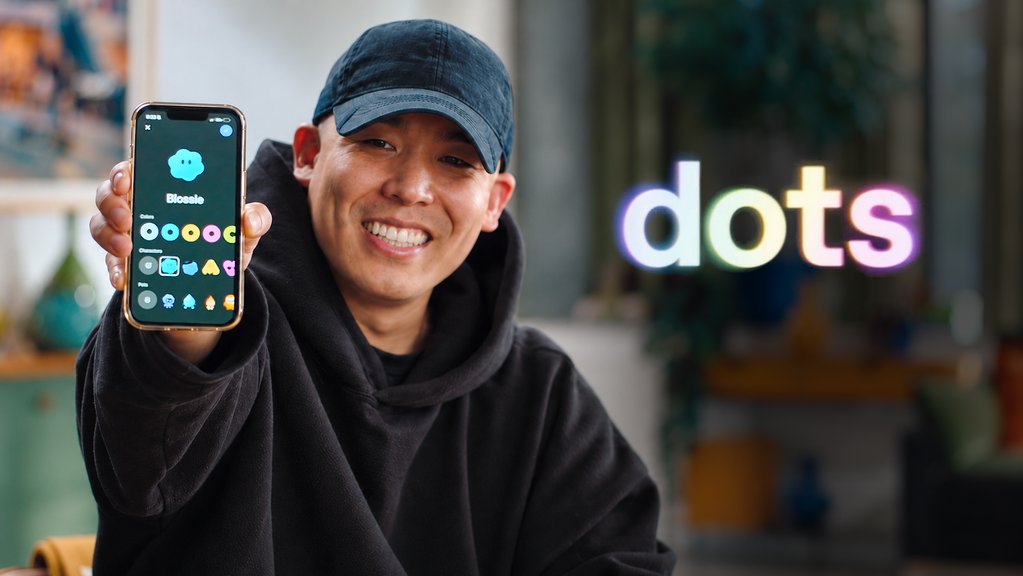
OpenAI's Oct 9 dots update lets you create and customize a dot from the ChatGPT iOS and Android apps. Dots can now start work in Codex, follow up on existing threads using ChatGPT conversations, Codex threads and automations as context, and read and edit ChatGPT Work scheduled tasks.

ChatGPT dots update: create your dot on iOS/Android and delegate work to Codex threads

Key Takeaways

  • Create, name, theme and connect plugins to a dot from the iOS/Android app
  • Dots can start Codex work and continue existing threads, choosing when to start fresh
  • Context from ChatGPT conversations, Codex threads and automations
  • Dots can read and edit ChatGPT Work scheduled automations
  • Announcement: ~1,090 likes, ~119K views
Read full story

Anthropic cuts Sonnet 5.5 cache reads to $0.10/MTok, adds $100–$200 monthly API credits to Max, ships Managed Agents automation playbook

Sonnet 5.5 cache hits now cost 0.05x base input ($0.10/MTok), which Anthropic says makes most agentic work ~20% cheaper. Max 5x/20x plans now include $100/$200 in monthly Claude API credits (Team $20–$100 per seat) usable on the API, Managed Agents and Agent SDK, alongside an official reference implementation for scheduled Managed Agents automations.

Key Takeaways

  • Sonnet 5.5 cache reads $0.20 to $0.10/MTok (0.05x base input); input $2 / output $10 unchanged; Opus 5.5 also 0.05x ($0.20/MTok)
  • Anthropic says ~20% cheaper on most agentic work; API only, Claude Code limits unchanged
  • Max 5x gets $100/mo, Max 20x $200/mo; Team $20 (Standard) / $100 (Premium) per seat, pooled up to $500; no rollover
  • Credits cover Claude API, Managed Agents, Agent SDK and playground, not Claude Code or app extra usage
  • Managed Agents bills tokens plus $0.08 per session-hour; official daily-brief template sets up via a Claude Code command
Read full story
ADSponsored

DAEDALUS: Bootstrapping Reusable Agent Memory via Self-Generated Tasks and Autonomous Dual-Agent Practice Without Human Oracles

LLM agents operating in novel API or terminal environments frequently repeat identical errors due to an absence of procedural memory. Existing memory bootstrapping approaches rely heavily on curated prompt playbooks or oracle verifiers that require extensive domain foresight. Illuin Technology releases DAEDALUS (arXiv:2610.08048), an autonomous dual-agent framework bootstrapping reusable memory entirely from self-generated practice without human oracles. DAEDALUS pairs an Explorer agent—which probes the execution environment to formulate curriculum-style tasks—with a Solver agent. When the solver stumbles, it extracts candidate heuristics that are committed into a persistent memory bank only after proving their efficacy across repeated verification trials. Across AppWorld, tau^2-bench, and AutomationBench, DAEDALUS boosts average success rates by up to 15.9 percentage points and raises Pass^5 rates by 2.2x over memory-less baselines, with generated procedural memories transferring seamlessly across heterogeneous foundation model families.

Key Takeaways

  • Illuin Technology open-sources DAEDALUS, bootstrapping reusable procedural memory without human labels or oracle verifiers
  • Employs an Explorer-Solver dual-agent self-play architecture to synthesize verified operational heuristics from failure traces
  • Lifts task completion by up to 15.9 points and doubles Pass^5 by 2.2x across AppWorld, tau^2-bench, and AutomationBench
Read full story
Linked Models & Agents:

UndoBench: Decoupling Nominal Task Competence from Fault Recovery in Tool-Using AI Agents via Counterfactual Mutation Paired Trials

Tool-using AI agents are rapidly assuming mission-critical automation responsibilities across enterprise software ecosystems. However, standard agent benchmarks focus exclusively on nominal, forward task completion—conflating initial planning competency with operational resilience and fault recovery. In real-world enterprise environments where network drops, idempotency failures, and partial commits are commonplace, unguided LLM retries routinely cause devastating side effects such as duplicate payments or corrupted databases. Researchers introduce UndoBench (arXiv:2610.05622), a comprehensive evaluation suite spanning 36 enterprise workflows and 36 production fault scenarios across 8 enterprise verticals. Utilizing counterfactual paired trials alongside wire-level effect-history and state oracles, UndoBench decouples task competence from recovery capability. Experiments reveal a severe vulnerability gap: while nominal task competence achieves 83.54%, conditional recovery success rates (CRSR) collapse to 46.72%, with naive retry producing duplicated external mutations in 53.33% of trials. The code is available at GitHub (tradertanmay/undobench).

Key Takeaways

  • Introduces UndoBench, the first enterprise fault recovery and undo benchmark for tool-using AI agents across 8 domains and 36 fault scenarios
  • Decouples nominal task competence from fault recovery: nominal task completion hits 83.54% while conditional recovery plunges to 46.72%, with naive retries causing duplicate mutations in 53.33% of trials
  • Pinpoints phase-dependent execution vulnerabilities, urging agent frameworks to move from naive retry loops to deterministic compensation transactions
Read full story

Google DeepMind launches Gemini 4 Argon: DeepSWE 77.9%, 1M output; Fairwind trusted defenders first

DeepMind announced frontier Gemini 4 Argon for long-horizon coding, enterprise knowledge work, and cyber defense—first via Fairwind trusted defenders. Official: DeepSWE v1.1 77.9%, AutomationBench #1 at 51.3%, LVBench 91.7%, CWE-bench v1 tied 68%; intro $2/$10 per 1M tokens; 1M output limit.

Google DeepMind launches Gemini 4 Argon: DeepSWE 77.9%, 1M output; Fairwind trusted defenders first

Key Takeaways

  • Model: Gemini 4 Argon for long-horizon coding / enterprise knowledge work / cyber defense — official blog
  • Benchmarks (official): DeepSWE v1.1 77.9% SOTA; AutomationBench 51.3% #1; LVBench 91.7%; CWE-bench v1 tied 68%; Fairwind charts: vuln discovery 85.8% / Wiz pen-test 70.9%
  • Capacity & price: 1M output tokens (from ~64K); intro $2/$10 per 1M in/out (~95% off cached input), then $4/$20
  • Access: Fairwind trusted defenders today; next paid API + Google AI Ultra; not in public AI Studio yet — Fairwind
  • Internal: quantum subroutine spacetime −40% vs published baseline; libgav1 Rust port 2.7× faster; 300+ TiB memory freed in datacenters
Read full story
C
Comet@comet-ml·
👀51
🔥91

Comet Opik 2.2.84: online eval rules call Jev via OpenRouter Decisions API; queue automation + provenance

Comet Opik 2.2.84 (2026-09-29) lets online LLM-as-a-Judge rules call TypeSafe Jev end-to-end via OpenRouter POST /api/alpha/decisions (not chat/completions). Each Boolean metric becomes a yes/no question answered in one call; score 1 if probability ≥0.5, with Probability: 0.93 in the reason. Backend adds OpenRouterDecisionsClient (workspace OpenRouter key, 429/5xx retries) for ~typesafe/jev-latest / typesafe/jev-1.13. Also: Annotation Queue automation + item provenance. ~8 commits / 104 files vs 2.2.83.

Comet Opik 2.2.84: online eval rules call Jev via OpenRouter Decisions API; queue automation + provenance

Key Takeaways

  • Release 2.2.84; ~8 commits / 104 files vs 2.2.83
  • PR #8540: online judges call Jev via OpenRouter Decisions API
  • Boolean metrics → yes/no questions; score 1 if p≥0.5; reason shows Probability
  • Models: ~typesafe/jev-latest, typesafe/jev-1.13
  • Queue automation + item provenance; trace stats / thread_id fixes
Read full story

CompoWorld: Compositional Environment Scaling with 10,130 Tools and 448 Services Outperforms Frontier Agents

Addressing the limitation where synthetic training environments only generate tasks within isolated individual domains, researchers introduced CompoWorld. By scaling task spaces across 448 typed services exposing 10,130 tools and generating cross-service workflows via dependency graphs, paired with Completion-Focused Rubric Rewards in RL, a Qwen3.6-35B-A3B agent trained on just 3K SFT trajectories and 1K RL tasks gains +9.17 points across eight benchmarks and surpasses Claude Opus 4.6 on AutomationBench.

CompoWorld: Compositional Environment Scaling with 10,130 Tools and 448 Services Outperforms Frontier Agents

Key Takeaways

  • Compositional Scaling Across 10,130 Tools: Breaks the single-environment toy benchmark barrier by deploying coding agents to implement 448 verified microservices exposing 10,130 tools under unified state schemas.
  • Dependency Graph Random-Walk Workflows: Chains disparate services through dependency topologies to generate verifiable agent workflows where context and execution state must navigate multi-service boundaries.
  • 35B Backbone Surpasses Frontier Models: Lifts eight agent benchmark averages by +9.17 points, overtaking Claude Opus 4.6 on AutomationBench and setting a new efficiency record for open-weights agent models.
Read full story
Linked Models & Agents: