AI Coding Live News

Ant Ling open-sources Ling-3.1-flash-1019: further post-trained 560B/25B-active MoE lifts AA Intelligence Index from 41 to 44, base checkpoint also released

On Oct 27 Ant Ling (inclusionAI) open-sourced Ling-3.1-flash-1019, a further post-trained upgrade of the early-October Ling-3.1-flash: 560B total parameters, 25B active per token, a 1M-token context and an MIT license. Ant says it scores 44 on the Artificial Analysis Intelligence Index v4.3.2 (up from 41), with clear gains on agent tasks such as AA-Briefcase and AutomationBench-AA. It also released Ling-3.1-flash-base, an open foundation checkpoint for further training.

Ant Ling open-sources Ling-3.1-flash-1019: further post-trained 560B/25B-active MoE lifts AA Intelligence Index from 41 to 44, base checkpoint also released

Key Takeaways

  • Scale: 560B total and 25B active parameters, 1M-token context, MIT license, on Hugging Face and ModelScope
  • Artificial Analysis Intelligence Index v4.3.2: 44, up from 41 for Ling-3.1-flash (vendor-reported)
  • AA-Briefcase rises from about 1400 to 1524 Elo and AutomationBench-AA from 62% to 68% (vendor-reported)
  • Science: CritPt from 18% to 26% and SciCode from 54% to 57% (vendor-reported)
  • Architecture: hybrid-linear MoE with 63 KDA layers plus 9 gated MLA layers (7:1), 512 routed experts and 8 active per token
Read full story
Linked Models & Agents:

Shanghai AI Lab ships Atria Dawn full release: 744B MoE GLM-5.2 agentic model, context doubled to 512K, MIT weights

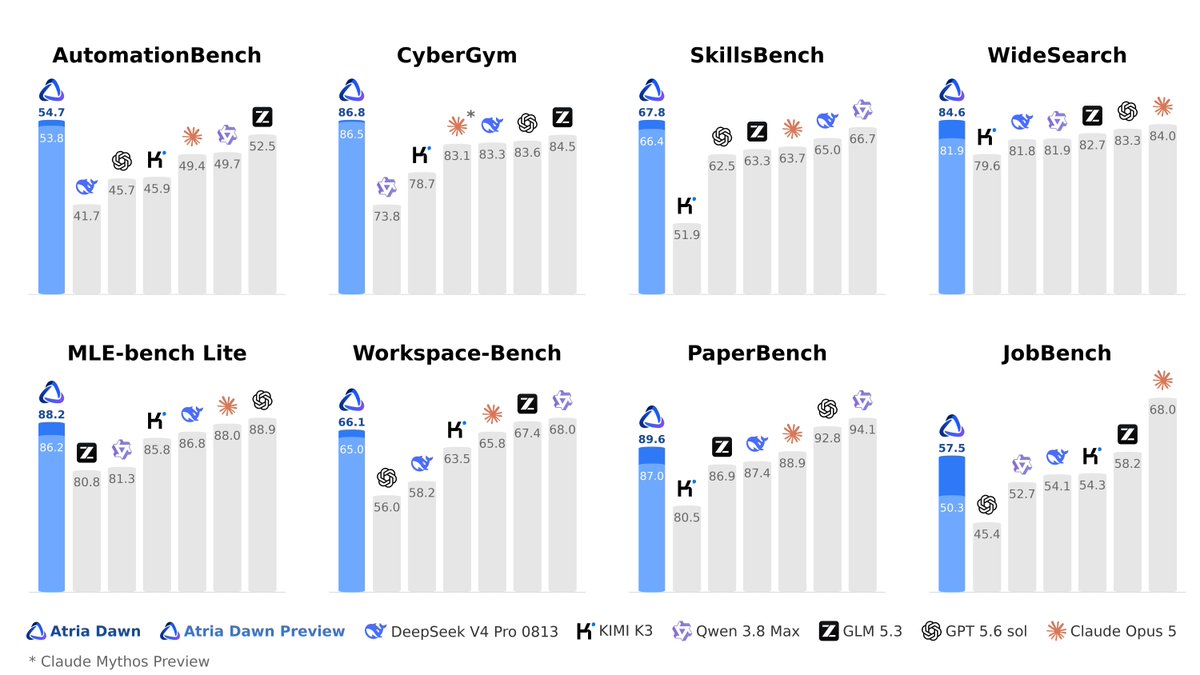
Shanghai AI Laboratory has moved Atria Dawn from Preview to a full release, with open weights (plus an FP8 build) on Hugging Face under internlm/Atria-Dawn and on ModelScope, MIT licensed. Built on the 744B-parameter MoE GLM-5.2, it targets long-horizon research and engineering agent work; context doubles from the Preview's 256K to 512K and input is text only. The vendor table shows it leading the listed models on AutomationBench, CyberGym and SkillsBench, while still trailing Claude Opus 5 on coding tests such as SWE-bench Pro and Terminal-Bench 2.1 (all vendor-reported).

Shanghai AI Lab ships Atria Dawn full release: 744B MoE GLM-5.2 agentic model, context doubled to 512K, MIT weights

Key Takeaways

  • 512K context, double the Preview's 256K; built on the 744B-parameter MoE GLM-5.2, text input only
  • BF16 and FP8 weights on Hugging Face and ModelScope, MIT license
  • Vendor-reported: AutomationBench 54.7, CyberGym 86.8, SkillsBench 67.8, BFCL V4 78.4, each the top score in its table
  • Weak spots from the same table: SWE-bench Pro 61.7 vs 76.5 for Claude Opus 5, Terminal-Bench 2.1 81.0 vs 90.2
  • Local serving needs SGLang v0.5.13.post1+ or vLLM v0.23.0+; an OpenAI-compatible API also plugs into Codex
Read full story
Linked Models & Agents:

Liquid AI open-sources LFM2.5-24B-A2B: a 24B-total, ~2B-active reasoning MoE built for on-device agents and tool use

On Oct 13 Liquid AI released LFM2.5-24B-A2B, the largest and final LFM2.5 model: 24B total parameters, ~2.45B active per token, 131K context, and always-on reasoning. By Liquid's own numbers it leads or matches Qwen3.6-35B-A3B on 5 of 8 tool-use/agent benchmarks (AutomationBench 27.69 vs 8.72) while trailing on SWE-Bench Verified, GPQA and other knowledge/coding tests. Open weights are on Hugging Face with GGUF, MLX, FP8 and ONNX builds; API pricing is $0.10 / $1.00 per million tokens and it is also on OpenRouter.

Liquid AI open-sources LFM2.5-24B-A2B: a 24B-total, ~2B-active reasoning MoE built for on-device agents and tool use

Key Takeaways

  • Specs (model card): 24.0B total / 2.45B active, 40 layers (30 gated short-conv + 10 GQA), 64 experts top-4, 131,072 context, 128K vocab
  • Agent benchmarks (vendor-reported, vs Qwen3.6-35B-A3B): AutomationBench 27.69 vs 8.72, LiveClaw 48.09 vs 38.19, ToolSandbox 80.71 vs 75.02, BFCLv4 65.01 vs 65.00
  • Disclosed weaknesses: SWE-Bench Verified (OpenCode) 51.00 vs 66.20, GPQA Diamond 74.42 vs 83.69, WebArena Verified 26.75 vs 37.62
  • Speed: 184 tok/s decode on Apple M5 Max, 114 tok/s on Ryzen AI Max+ 395, 21K+ output tok/s on one B300 with SGLang
  • Training: pretraining scaled 17T to 33T tokens; agentic RL inside OpenClaw, Hermes Agent, Pi and OpenCode; API $0.10 in / $1.00 out per M tokens
Read full story
Linked Models & Agents:
⚡ LFM2.5-24B-A2B⚡ LFM2.5-24B-A2B-Base⚡ LFM2-24B-A2B⚡ Qwen3.6-35B-A3B⚡ Gemma-4-26B-A4B-it🤖 Hermes Agent🤖 OpenClaw🤖 OpenCode🤖 Pi🌐 Liquid AI🌐 Hugging Face🌐 OpenRouter

DAEDALUS: Bootstrapping Reusable Agent Memory via Self-Generated Tasks and Autonomous Dual-Agent Practice Without Human Oracles

LLM agents operating in novel API or terminal environments frequently repeat identical errors due to an absence of procedural memory. Existing memory bootstrapping approaches rely heavily on curated prompt playbooks or oracle verifiers that require extensive domain foresight. Illuin Technology releases DAEDALUS (arXiv:2610.08048), an autonomous dual-agent framework bootstrapping reusable memory entirely from self-generated practice without human oracles. DAEDALUS pairs an Explorer agent—which probes the execution environment to formulate curriculum-style tasks—with a Solver agent. When the solver stumbles, it extracts candidate heuristics that are committed into a persistent memory bank only after proving their efficacy across repeated verification trials. Across AppWorld, tau^2-bench, and AutomationBench, DAEDALUS boosts average success rates by up to 15.9 percentage points and raises Pass^5 rates by 2.2x over memory-less baselines, with generated procedural memories transferring seamlessly across heterogeneous foundation model families.

Key Takeaways

  • Illuin Technology open-sources DAEDALUS, bootstrapping reusable procedural memory without human labels or oracle verifiers
  • Employs an Explorer-Solver dual-agent self-play architecture to synthesize verified operational heuristics from failure traces
  • Lifts task completion by up to 15.9 points and doubles Pass^5 by 2.2x across AppWorld, tau^2-bench, and AutomationBench
Read full story
Linked Models & Agents:
ADSponsored

Google DeepMind launches Gemini 4 Argon: DeepSWE 77.9%, 1M output; Fairwind trusted defenders first

DeepMind announced frontier Gemini 4 Argon for long-horizon coding, enterprise knowledge work, and cyber defense—first via Fairwind trusted defenders. Official: DeepSWE v1.1 77.9%, AutomationBench #1 at 51.3%, LVBench 91.7%, CWE-bench v1 tied 68%; intro $2/$10 per 1M tokens; 1M output limit.

Google DeepMind launches Gemini 4 Argon: DeepSWE 77.9%, 1M output; Fairwind trusted defenders first

Key Takeaways

  • Model: Gemini 4 Argon for long-horizon coding / enterprise knowledge work / cyber defense — official blog
  • Benchmarks (official): DeepSWE v1.1 77.9% SOTA; AutomationBench 51.3% #1; LVBench 91.7%; CWE-bench v1 tied 68%; Fairwind charts: vuln discovery 85.8% / Wiz pen-test 70.9%
  • Capacity & price: 1M output tokens (from ~64K); intro $2/$10 per 1M in/out (~95% off cached input), then $4/$20
  • Access: Fairwind trusted defenders today; next paid API + Google AI Ultra; not in public AI Studio yet — Fairwind
  • Internal: quantum subroutine spacetime −40% vs published baseline; libgav1 Rust port 2.7× faster; 300+ TiB memory freed in datacenters
Read full story

CompoWorld: Compositional Environment Scaling with 10,130 Tools and 448 Services Outperforms Frontier Agents

Addressing the limitation where synthetic training environments only generate tasks within isolated individual domains, researchers introduced CompoWorld. By scaling task spaces across 448 typed services exposing 10,130 tools and generating cross-service workflows via dependency graphs, paired with Completion-Focused Rubric Rewards in RL, a Qwen3.6-35B-A3B agent trained on just 3K SFT trajectories and 1K RL tasks gains +9.17 points across eight benchmarks and surpasses Claude Opus 4.6 on AutomationBench.

CompoWorld: Compositional Environment Scaling with 10,130 Tools and 448 Services Outperforms Frontier Agents

Key Takeaways

  • Compositional Scaling Across 10,130 Tools: Breaks the single-environment toy benchmark barrier by deploying coding agents to implement 448 verified microservices exposing 10,130 tools under unified state schemas.
  • Dependency Graph Random-Walk Workflows: Chains disparate services through dependency topologies to generate verifiable agent workflows where context and execution state must navigate multi-service boundaries.
  • 35B Backbone Surpasses Frontier Models: Lifts eight agent benchmark averages by +9.17 points, overtaking Claude Opus 4.6 on AutomationBench and setting a new efficiency record for open-weights agent models.
Read full story
Linked Models & Agents:

Artificial Analysis Intelligence Index v4.3: Terminal-Bench 4.0 + AutomationBench-AA

Artificial Analysis (@ArtificialAnlys) shipped Intelligence Index v4.3: Terminal-Bench upgraded 2.1→4.0 (now mini-SWE-agent harness) and τ³-Banking replaced by AutomationBench-AA (657 private Zapier business workflows). Claude Fable 5.1 and GPT-6 Astra tie at 53; OpenAI holds most of the intelligence-vs-cost frontier across Astra reasoning efforts.

Key Takeaways

  • Benchmarks: Index v4.3 upgrades Terminal-Bench to 4.0 and adds AutomationBench-AA (private set).
  • Weighting: private-task/answer evals rise from 40% to 45%; category weights unchanged.
  • Results: Claude Fable 5.1 and GPT-6 Astra tie at 53; open-weights led by GLM-5.3 / Kimi K3 at 44.
Read full story

OpenAI: GPT-6 Astra SOTA on Agents’ Last Exam, AutomationBench, and ScreenSpot Pro

OpenAI says GPT-6 Astra is state-of-the-art on Agents’ Last Exam, AutomationBench, and ScreenSpot Pro—benchmarks for cross-profession computer workflows and screen grounding—adding computer-use evidence beyond the already announced TerminalBench / ARC-AGI / FrontierMath results.

Key Takeaways

  • Claims SOTA on Agents’ Last Exam, AutomationBench, and ScreenSpot Pro for computer workflows/screen ops.
  • Framed as cross-profession computer use, not just repo-fix coding.
  • Complements already-announced TerminalBench / ARC-AGI / FrontierMath agentic evidence.
Read full story
Linked Models & Agents: