AI Coding Live News

Google Cloud Open-Sources TorchTPU: Native PyTorch on Google TPU Hardware with Day-Zero vLLM and SGLang Support

Google Cloud officially open-sourced TorchTPU, enabling native, zero-compilation-barrier PyTorch execution directly on Google Cloud TPU hardware (TPU v5p and TPU v6e). Overcoming the legacy friction of PyTorch/XLA's rigid graph compilation and dynamic-shape stalls, TorchTPU supports native PyTorch eager execution and custom Triton/C++ kernels. Leading high-throughput serving engines vLLM and SGLang announced immediate Day-0 support. Concurrently, Google Cloud introduced OpenAI models and Codex into its Vertex Model Garden, becoming the first hyperscaler to offer all three top frontier closed models.

Google Cloud Open-Sources TorchTPU: Native PyTorch on Google TPU Hardware with Day-Zero vLLM and SGLang Support

Key Takeaways

  • Google Cloud open-sources TorchTPU, delivering native, compilation-free PyTorch execution on TPU v5p and TPU v6e hardware
  • Eliminates PyTorch/XLA graph-compilation overhead, natively supporting PyTorch eager mode and custom Triton/C++ kernels
  • vLLM and SGLang announce immediate Day-0 TorchTPU releases, unlocking substantial throughput boosts on TPU infrastructure
  • OpenAI frontier models and Codex join Google Cloud's Model Garden, solidifying Google Cloud as the premier multi-model hyperscaler
Read full story

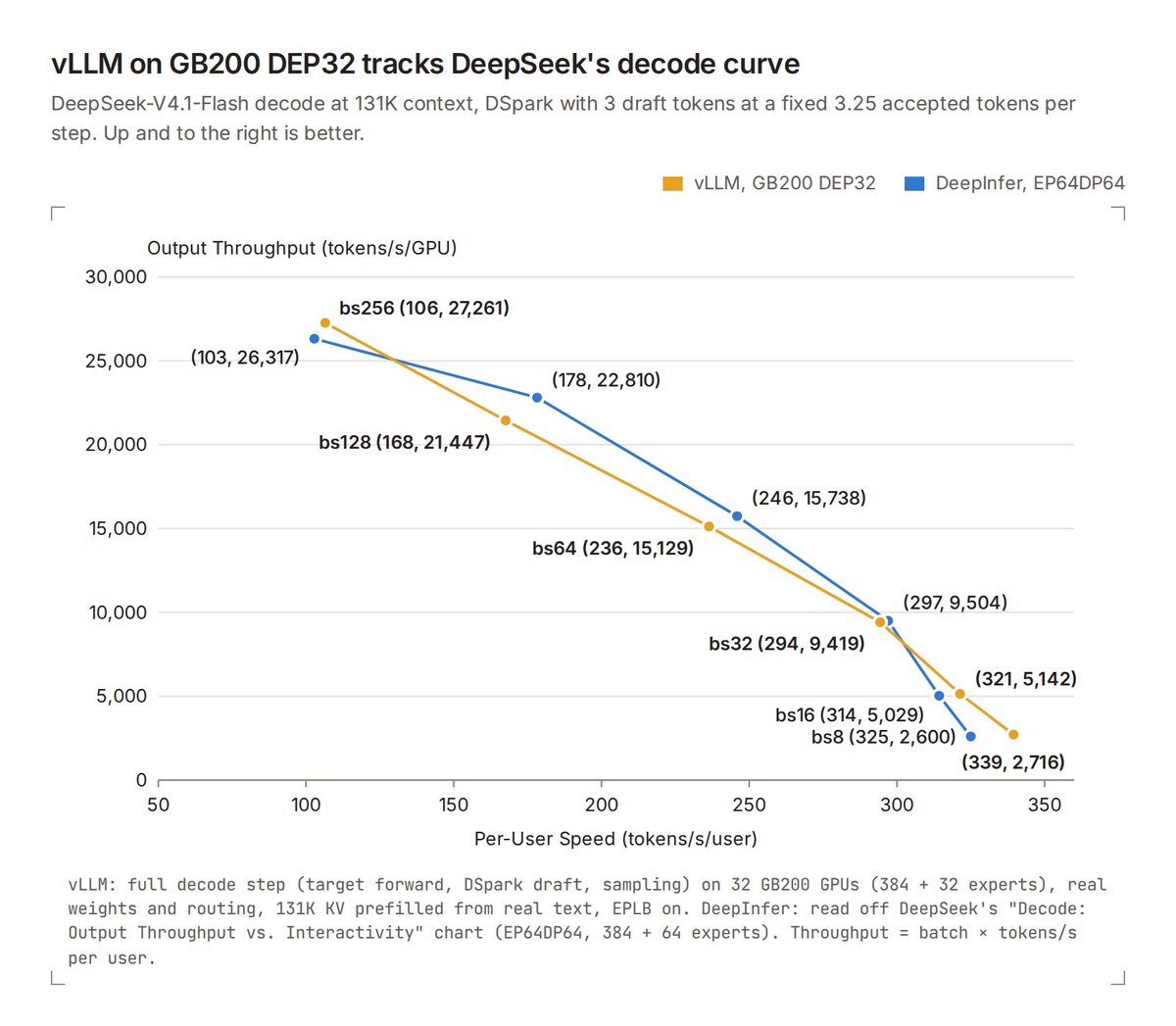
vLLM Narrows Gap with DeepInfer to 6% on NVIDIA GB200, Reaching 1M Tokens/s per GPU on GB300

Hours after DeepSeek open-sourced DeepInfer, the vLLM project team released official benchmark parity data serving DeepSeek-V4.1-Flash. Utilizing DeepSeek's identical decoding setup (131K context window, nextn=3 speculative decoding), vLLM closed its throughput performance delta to within 6% of DeepInfer across batch sizes 8 through 256 on NVIDIA GB200 systems. On GB300 hardware, vLLM attained up to 1,000,000 tokens/second per GPU and 826 tokens/second per user, generating $38.96 in hourly GPU revenue at DeepSeek off-peak rates. vLLM simultaneously shipped day-0 runtime support for FastH3-Omni and Spark-X2.6-4B.

vLLM Narrows Gap with DeepInfer to 6% on NVIDIA GB200, Reaching 1M Tokens/s per GPU on GB300

Key Takeaways

  • vLLM published direct benchmark comparisons, demonstrating that its serving throughput on NVIDIA GB200 is within 6% of DeepInfer
  • Achieves unprecedented scaling on NVIDIA GB300: up to 1,000,000 tokens/second per GPU and 826 tokens/second per active user stream
  • Generates up to $38.96 per GPU-hour in revenue when mapped to DeepSeek's production off-peak API pricing schedule
  • Delivers immediate Day-0 support for the FastH3-Omni video model and the 1M-token Apache 2.0 model Spark-X2.6-4B
Read full story
Linked Models & Agents:

Ant inclusionAI open-sources five Ming-3.0 speech models: a 0.5B TTS tops open-weight controlled voice, plus a 126B MoE audio-understanding model

On October 19 Ant Ling (inclusionAI) open-sourced five Ming-3.0 models under MIT, spanning speech synthesis (tts-0.5B; tts-tiny, 7.9B total/1.3B active), audio understanding (audio-flash, 126B/6.5B active; audio-tiny, 9.3B/2.7B active) and speech recognition (asr-tiny, 8.6B/2B active). Per the vendor, tts-0.5B ranks #1 among open-weight models on Artificial Analysis Controlled Voice at 1069 Elo and ties #1 overall on pronunciation robustness at 93.2%; asr-tiny averages 4.41% error across four ASR categories. Weights are on Hugging Face and ModelScope, with day-0 SGLang and vLLM support.

Ant inclusionAI open-sources five Ming-3.0 speech models: a 0.5B TTS tops open-weight controlled voice, plus a 126B MoE audio-understanding model

Key Takeaways

  • Lineup: five models in three families, two TTS, two audio-understanding and one ASR, all MIT-licensed.
  • TTS results: tts-0.5B scores 1069 Elo on AA Controlled Voice, #1 among open weights; 1188 Elo and #3 on Provider Voice; ties #1 overall on pronunciation robustness at 93.2% (vendor figures).
  • TTS features: 7 languages plus Sichuanese and Cantonese, 14 inline paralinguistic tags (laughter, sighs, coughs and more), 44.1 kHz output, built on Qwen2.5-0.5B.
  • Audio understanding: audio-flash has 126B total and 6.5B active parameters, and handles long-recording summaries, spoken Q&A, audio reasoning and tool-call generation.
  • ASR: asr-tiny accepts hotwords and dialogue context, is evaluated on 15 dialect test sets, and averages 4.41% error across four categories (vendor figures).
Read full story
Linked Models & Agents:
⚡ Ming-3.0-tts-0.5B⚡ Ming-3.0-tts-tiny⚡ Ming-3.0-audio-flash⚡ Ming-3.0-audio-tiny⚡ Ming-3.0-asr-tiny🌐 Ant Group🌐 inclusionAI🌐 SGLang🌐 vLLM

MiniMax M3.1 Flash weights now open on Hugging Face: 428B-total / 23B-active MoE, $0.15 input and $0.60 output per million tokens, 73.7% on DeepSWE

MiniMax confirmed that Space Bunny, the anonymous model that led usage rankings on OpenRouter and elsewhere, was an early version of M3.1 Flash, and launched it on its API on October 19. Pay-as-you-go pricing is $0.15 input, $0.60 output and $0.015 cache read per million tokens, with a 1M context, text, image and video input, and an effort setting for thinking depth. Per MiniMax, it costs one third of M3 and runs 3x faster, scoring 73.7% on DeepSWE and 62.2% on Automation-Bench; the weights went live on Hugging Face on schedule on October 23 (MiniMax Community license, MXFP8), with day-0 support from Together, Inferact (vLLM) and LightSeek TokenSpeed.

MiniMax M3.1 Flash weights now open on Hugging Face: 428B-total / 23B-active MoE, $0.15 input and $0.60 output per million tokens, 73.7% on DeepSWE

Key Takeaways

  • Official pay-as-you-go pricing: $0.15 input / $0.60 output / $0.015 cache read per million tokens; per token that is half of M3 ($0.30/$1.20), and MiniMax does not explain how it gets one third of the cost.
  • Vendor benchmarks: DeepSWE v1.1 73.7% (Opus 5: 74.0%), Automation-Bench 62.2%, BabyVision with tools 91.0%, Terminal Bench 4.0 38.1% (Opus 5: 51.8%).
  • 1M context, text/image/video input, five effort levels from low to max, default max, thinking cannot be turned off.
  • Weights opened October 23 at Hugging Face MiniMaxAI/MiniMax-M3.1-Flash: ungated, MiniMax Community license (not MIT/Apache), MXFP8 quantized, native multimodal MoE with about 428B total and 23B active parameters per token, plus a DSpark speculative-decoding draft head.
  • Migration: M2.5 and M2.7 closed to new users on October 19 and retire on November 18; M Plan and Token Plan requests now route to M3.1 Flash automatically.
  • Day-0 serving: Together AI runs it fully managed, MiniMax is partnering with Inferact to contribute production-inference improvements back to vLLM, and LightSeek's TokenSpeed added day-0 support.
Read full story
ADSponsored

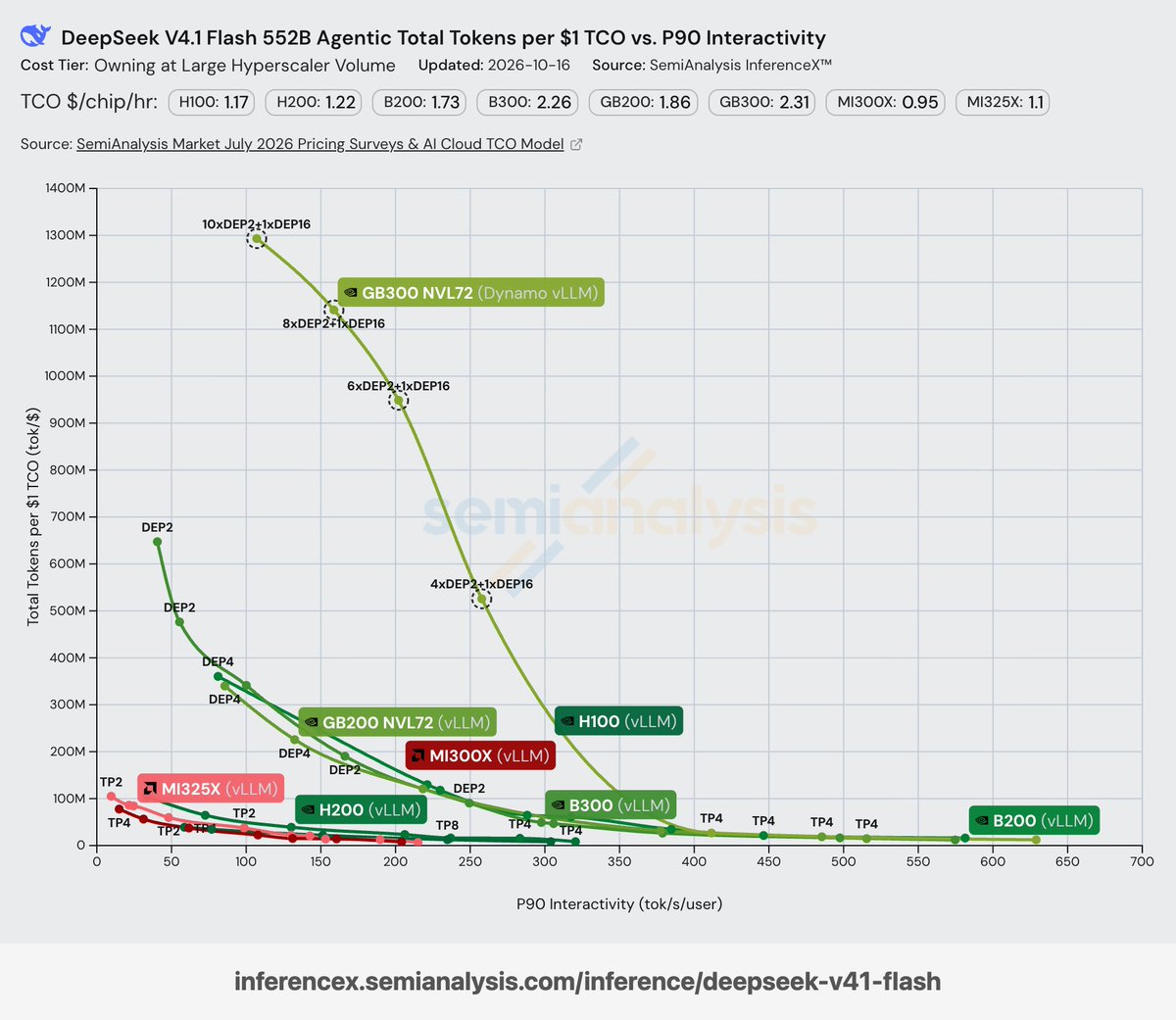
vLLM and OpenRouter Launch Day-0 Serving for DeepSeek-V4.1-Flash-1017: 830K tok/s per GPU and 1.3B Tokens/$ TCO on SemiAnalysis AgentX

Following the release of DeepSeek-V4.1-Flash-1017, vLLM announced Day-0 serving optimization delivering 1.3B tokens per dollar TCO and 830K tok/s per GPU at 100 tok/s/user on SemiAnalysis AgentX (5x agentic throughput gain since Day 0), while OpenRouter launched live multi-provider routing starting at $0.10/M input and $0.50/M output tokens.

vLLM and OpenRouter Launch Day-0 Serving for DeepSeek-V4.1-Flash-1017: 830K tok/s per GPU and 1.3B Tokens/$ TCO on SemiAnalysis AgentX

Key Takeaways

  • vLLM delivers 830K tok/s per GPU (cached + input + output) at 100 tok/s per user and 1.3B tokens/$ TCO on SemiAnalysis AgentX for DeepSeek-V4.1-Flash-1017 (5x faster since Day 0)
  • DeepSeek-V4.1-Flash-1017 reaches 77.0% on DeepSWE v1.1 (beating Claude Opus 5 at 74.0%), 68.2% on NL2Repo-Bench, and 72.1% on Apex Bench with shorter agentic outputs
  • Live on OpenRouter from $0.10/M input and $0.50/M output tokens, while DeepSeek's official API alias deepseek-flash remains at $0.15/M input and $0.60/M output
Read full story
Linked Models & Agents:

IFM and Inception42 launch Jais 3: six open Arabic-native agentic models (0.9B–375B) plus Jais Speech, 512K context on Hugging Face

On 2026-10-15, MBZUAI’s Institute of Foundation Models (IFM) and Inception42 released Jais 3—the first language adaptation of the open K2 Horizon fleet. Six open-weight sizes run from a 0.9B dense phone model to a 375B-A23B sparse MoE (≈23B active), plus Jais Speech for Arabic ASR. Models share one training recipe and agent stack, with up to 512K context (128K on 0.9B), Apache-2.0 weights and stage checkpoints on Hugging Face, and day-0 vLLM support.

IFM and Inception42 launch Jais 3: six open Arabic-native agentic models (0.9B–375B) plus Jais Speech, 512K context on Hugging Face

Key Takeaways

  • Sizes: 0.9B / 3.7B / 7B / 32B dense + 36B-A4B (MoE+MoVA, ~4B active) + 375B-A23B (~23B active); flagship needs ~8×H200 BF16 (model card)
  • Vendor Arabic average: 375B leads open peers at 84.0 (Qwen3.5-397B 82.0); 7B scores 79.4 vs K2 Horizon base 56.4→79.6 (tech blog)
  • Agents: 3.7B/7B lead their size class by ~20 points; 375B agentic average 60.2 with SWE-Bench Verified 70.2 and Terminal-Bench 2.1 73.8 (same-harness vendor runs)
  • Speech: Jais Speech macro-average WER/CER 22.85/8.37 across six public ASR sets, ahead of Audar, Cohere Transcribe Arabic, omniASR (Jais page)
  • Ship: Apache-2.0; HF collection IFM/jais-3; vLLM≥0.30 / SGLang≥0.5.20 recipes; k2_horizon parsers; companion github.com/ifm-ai/JaisVoice
Read full story
Linked Models & Agents:
H
Hugging Face / Reflectionhuggingface.co·
👀313
🔥98

Reflection Beam weights are live: 501B/23B MoE under Apache 2.0, BF16/FP8/NVFP4 on Hugging Face, 80.1% Terminal-Bench 2.1

On 2026-10-16 Hugging Face and Reflection confirmed Beam weights are downloadable: ~501B-total / ~23B-active sparse MoE, 1M context, Apache 2.0. BF16/FP8/NVFP4 checkpoints ship with day-0 transformers≥5.20.1, vLLM and SGLang. Model-card figures (vendor): SWE-bench Verified 81.6% (BF16), Terminal-Bench 2.1 80.1%, MCP Atlas 80.8%. This closes the Oct 5 promise to release weights later that month.

Reflection Beam weights are live: 501B/23B MoE under Apache 2.0, BF16/FP8/NVFP4 on Hugging Face, 80.1% Terminal-Bench 2.1

Key Takeaways

  • Weights live: reflection/Beam-1.0-501B-A23B plus FP8/NVFP4; Apache 2.0 (HF blog)
  • Scale: ~501B total / 23B active; 52 layers (3 dense + 49 MoE), 256 experts, top-8; hybrid sliding-window + global attention; 1M context
  • Coding/terminal (model card BF16, temp=0.7): SWE-bench Verified 81.6%; Terminal-Bench 2.1 80.1%; DeepSWE v1.1 43.3%; MCP Atlas 80.8% (vendor-reported)
  • Efficiency: Reflection claims ~3× fewer inference reasoning tokens vs leading open peers; effort low–max with preserve_thinking
  • Deploy: vLLM/SGLang recipes with DFlash2; BF16 ~1TB, NVFP4 ~280GB; plan ≥4×B200; try HF Inference Providers (Baseten/Fireworks/Together)
Read full story
Linked Models & Agents:

llama.cpp ships Decision Models: /v1/systemone scores options in one forward pass (Julia-1, Laya, Kev-4B, lev, OpenJev)

On 2026-10-02 ggml-org announced llama.cpp server support for Decision Models via /v1/systemone (PR #29818, merged 2026-10-02T09:56Z). Send a state plus typed questions; get option probabilities in one forward pass. Day-0 models: Julia-1, Laya, Kev-4B, lev, OpenJev (vision). Cloudflare Clef is planned next.

llama.cpp ships Decision Models: /v1/systemone scores options in one forward pass (Julia-1, Laya, Kev-4B, lev, OpenJev)

Key Takeaways

  • Official post 2026-10-02 + merged PR #29818 (2026-10-02T09:56Z, +2139/−15)
  • Endpoint POST /v1/systemone with choice/score/noul; probabilities + confidence; output_tokens=0
  • Day-0 GGUFs: Julia-1 / Laya / Kev-4B / lev / OpenJev; median ~3–43 ms/question on RTX PRO 6000 (blog table)
  • Distinct from Ollama SystemOne & Cloudflare Clef hosting; Clef listed as next in llama.cpp
  • Start: llama serve -hf ggml-org/Kev-4B-GGUF then curl /v1/systemone
Read full story
Linked Models & Agents:
⚡ Julia 1⚡ laya⚡ Kev 4b⚡ lev⚡ openjev🌐 ggml-org🌐 huggingface

LM Studio ships Inco Splash day 0: ~144 tok/s Qwen3.8-27B on M5 Max

LM Studio announced a day-0 partnership with Inco to bring the Splash inference engine into LM Studio. They cite up to about 144 tok/s for Qwen3.8-27B on M5 Max, with setup docs at lmstudio.ai/blog/splash-engine. Splash was already open-sourced by Inco; this puts the Apple-silicon-optimized stack inside LM Studio so local desktop users do not have to assemble the engine separately.

Key Takeaways

  • LM Studio integrates Inco Splash on day 0 for one-click local desktop use.
  • Claims ~144 tok/s for Qwen3.8-27B on M5 Max, with an official setup post.
  • Moves Apple-silicon-optimized inference into a mainstream local client distribution path.
Read full story

Inco open-sources Splash: ~144 tok/s for Qwen3.8-27B on M5 Max

Inco AI open-sourced Splash, a local inference engine built for Apple silicon and models like Qwen3.8-27B. On an M5 Max MacBook Pro it reports about 144 tok/s—up to 3× Ollama, 2× oMLX, and nearly 4× when an agent fans out sub-agents. LM Studio shipped day-0 support under Settings > Runtime > Experimental backends.

Key Takeaways

  • Open-source Splash: local inference tuned for Apple silicon and Qwen3.8-27B.
  • Demo: ~144 tok/s on M5 Max; up to ~3× Ollama / 2× oMLX, nearly 4× with agent fan-out.
  • LM Studio day-0 support; repo github.com/incoai/splash; blog lmstudio.ai/blog/splash-engine.
Read full story
ADSponsored

Google Cloud and Inferact partner to make TPU first-class in vLLM with open-source serving work

Inferact (@inferact) announced a Google Cloud partnership to make TPU first-class in vLLM: one engineering roadmap for production serving/kernels, a native PyTorch path via TorchTPU, and day-0 frontier-model support, plus a community program with shared TPU capacity and maintainer review — all open source.

Key Takeaways

  • Google Cloud and Inferact are making TPU first-class in vLLM.
  • Roadmap covers production serving/kernels, TorchTPU, and day-0 frontier models.
  • Community shared TPU capacity; all collaboration work is open source.
Read full story
Linked Models & Agents:

vLLM day-0 support for Intern-S2-397B: multimodal, reasoning, coding, scientific agents

vLLM announced day-0 serving support for Shanghai AI Lab Intern-S2-397B. The 397B multimodal foundation model targets long-horizon scientific research and scientific agents, with strong multimodal, reasoning, coding, and agent capabilities. Developers can run it on vLLM today via the official recipe.

Key Takeaways

  • vLLM shipped day-0 serving for Intern-S2-397B across multimodal, reasoning, coding, and scientific-agent workloads.
  • Official recipe is at recipes.vllm.ai/internlm/Intern-S2-397B for immediate deployment.
  • Pairs with the same-day Intern-S2-397B weight/eval release already in the feed: open weights plus open serving stack.
Read full story
Linked Models & Agents:
⚡ Intern S2 397b🌐 shanghai-ai-lab

Databricks day-0 DeepSeek 4.1 Flash via Unity Gateway; Pareto on OfficeQA Pro V2

Databricks shipped DeepSeek 4.1 Flash on Unity Gateway the day it launched. On OfficeQA Pro V2 it sits on the Pareto frontier, so teams can point governed Lakehouse data at the model for apps and agents under one access, spend, and performance layer.

Key Takeaways

  • DeepSeek 4.1 Flash is on Databricks Unity Gateway day-0.
  • Pareto-frontier results on OfficeQA Pro V2 for enterprise document reasoning.
  • Build governed apps/agents on Lakehouse data with unified access, spend, and performance.
Read full story

vLLM: day-0 MiniCPM5-2B on stable — 131K context, Think/No-Think, tool calling

vLLM (@vllm_project) announced day-0 support for OpenBMB MiniCPM5-2B on stable vLLM: 2.6B dense with native 131K context, Think/No-Think from one checkpoint, and tool calling via vLLM’s minicpm5 parser. Built on stock LlamaForCausalLM with training data opened alongside weights.

Key Takeaways

  • Engine: day-0 MiniCPM5-2B on stable vLLM.
  • Capabilities: native 131K context; Think/No-Think from one checkpoint; tool calling via minicpm5 parser.
  • Ecosystem: stock LlamaForCausalLM; training data opened with weights.
Read full story
Linked Models & Agents:
⚡ Openbmb Minicpm5 2b🌐 vllm🌐 openbmb

Ant Ling open-sources Ling-3.0-flash-Fin and FinFIRST for financial search agents

Ant Ling (AntLingAGI) open-sourced Ling-3.0-flash-Fin for real-world finance workflows and FinFIRST, an expert-built benchmark for financial search agents, aiming to make financial AI more accessible and verifiable. SGLang already announced Day-0 serving; this is the primary open-source + benchmark announcement.

Key Takeaways

  • Open-sources Ling-3.0-flash-Fin for real finance workflows.
  • Ships FinFIRST: expert-built benchmark for financial search agents.
  • Goal: more accessible, verifiable financial AI; pairs with SGLang Day-0 serving.
Read full story
Linked Models & Agents: