On November 2 OpenAI published "Scaling Git at OpenAI", describing Pando, a Git-compatible backend it built for its monorepo. Per OpenAI, Pando cut median push latency by nearly 5x (about 80%), now delivers nearly a petabyte of Git data per day, and has served more than 57 TB in a single hour. It is written in Rust, its core was designed by one engineer and implemented by teams of Codex agents, and it went from kick-off to production in 10 weeks, serving production traffic since April. The trigger: Codex multiplied parallel branches and pushes, and the old system's reliability at times fell below 90%.
Zoom
Key Takeaways
Per OpenAI: median push latency down nearly 5x (about 80%), nearly 1 PB of Git data delivered per day, and a peak of more than 57 TB in one hour, with over 99% of bytes from local disk cache.
The trigger: Codex let engineers run far more branches and CI jobs in parallel; the old system struggled from late last year, with reliability at times below 90%.
The key trade-off: Pando drops repository-wide consistency for per-branch causal consistency and reuses pushed packfiles, stored as immutable blobs, to serve later fetches.
Written in Rust, core designed by one engineer and implemented by teams of Codex agents in 10 weeks; agents using GPT-6 Astra also wrote Lean and TLA+ specs to find bugs and prove properties.
Several improvements, such as packfile-uri fixes, are already in upstream Git, and OpenAI says it is exploring ways to share the technology with users.
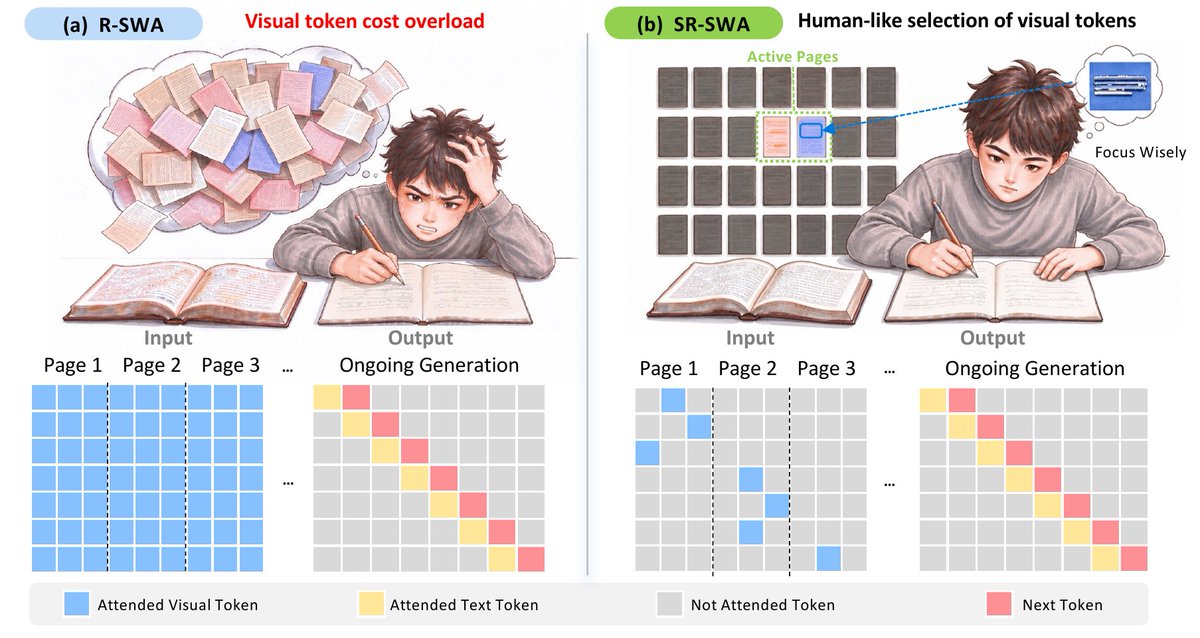
On Oct 27, Baidu's official @Baidu_Inc account announced the open-source release of Unlimited OCR 2 on Hugging Face under the MIT license. Its new SR-SWA attention compresses text-visual interactions into a fixed-size reference set, which Baidu says lets it parse documents of any length within a finite context window. Baidu reports 84.6 on MPDocBench (dozens of pages) and 77.1 on MarathonDocBench (hundreds of pages), both self-reported.
Zoom
Key Takeaways
SR-SWA compresses text-visual attention over very long sequences into a fixed-size reference set (e.g. 512 tokens), which Baidu says keeps per-step decode latency and memory nearly flat as page count grows
Per Baidu: 84.6 overall on MPDocBench, 6.3 points above the next best, Qwen3.8-Max (78.3)
Per Baidu: 77.1 overall on MarathonDocBench, 43.3 points above the next best, Kimi-K3 (33.7); the first Unlimited-OCR scores 0 there
Weights are on Hugging Face under MIT, about 3.3B parameters by the HF weight count, with Transformers and a customized SGLang build for serving
All scores are Baidu's own measurements with no third-party reproduction yet
On 2026-10-22, Anthropic's Applied AI team published "Building agents: When to fold subagents into your main agent loop" on claude.com, along with an open-source reference implementation, anthropics/single-agent-loop-kit. The article says that across several enterprise deployments, a single agent with skills frequently beat both the one-big-prompt design and the subagent design on quality, often at lower cost and latency per task; one customer that swapped its multi-agent harness for a single loop saw roughly 2x faster runtime. Anthropic also says it cut Claude Code's system prompt for more advanced models by over 80%. Subagents still make sense in three cases: measurable context bloat, parallel tasks with disposable context, or trouble selecting tools and conflicting instructions. The piece has drawn wide discussion on X over the past two days.
Customer result (vendor-reported): one customer comparing its multi-agent harness with a single agent loop saw roughly 2x faster runtime with the single loop
Anthropic says it cut Claude Code's system prompt for more advanced models by over 80%, partly by progressively disclosing skills and tools
Keep subagents in only 3 cases: measurable degradation from context bloat, parallel tasks with disposable fresh context, or difficulty choosing tools and conflicting system-prompt instructions
Companion open-source single-agent-loop-kit migrates in three steps (measure, combine, fold); Anthropic suggests starting with an end-to-end eval of as few as 10 golden examples
Researchers from Tsinghua University and CUHK introduced a breakthrough paper titled 'Cache Engineering for Agents' (arXiv:2610.28577) alongside the open-source AKV serving engine (thu-nics/AKV). While multi-turn agents rely on traditional 'context engineering' (text trimming and summarization) that invalidates prefix KV-caches and incurs punishing re-prefilling overhead, cache engineering empowers agents to directly manipulate KV-cache states via 'drop' and 'repos' primitives. Coupled with AKV's drop-aware radix-tree engine, the framework slashes agent inference costs by 27.7%, accelerates P95 latency by 1.5x, and boosts benchmark solve scores by 1.7 points.
Zoom
Key Takeaways
Tsinghua and CUHK researchers formalize 'Cache Engineering' in arXiv:2610.28577 for multi-turn autonomous agents
Demonstrates how traditional prompt trimming destroys prefix cache reuse, causing massive latency and redundant re-prefilling
Introduces 'drop' (selective cache eviction) and 'repos' (RoPE position alignment) primitives directly on GPU KV-caches
Open-sources the AKV stateful serving engine (thu-nics/AKV), slashing agent serving costs by 27.7% while accelerating P95 latency by 1.5x
At GTC Berlin, NVIDIA unveiled the OpenShell Reference Architecture alongside the Agent Knowledge Foundation within its Agent Toolkit. Addressing critical enterprise vulnerabilities where autonomous tool-using agents succumb to prompt injections, hallucinated destructive commands, or unauthorized data exfiltration, OpenShell establishes hardware-isolated runtime boundaries. Operating through hardware roots of trust, OpenShell dynamically intercepts out-of-boundary tool calls and file access in real time with sub-microsecond latency, establishing an authoritative blueprint for secure, auditable enterprise agent deployments.
Zoom
Key Takeaways
NVIDIA officially launched the OpenShell Reference Architecture at GTC Berlin, establishing hardware-isolated boundaries for autonomous agents
Implements dynamic runtime interception, strictly preventing out-of-boundary tool invocations, malicious script execution, and data leaks
Natively integrates with the NVIDIA Agent Toolkit and Agent Knowledge Foundation for end-to-end access control and compliance auditing
Solves critical enterprise security roadblocks preventing production rollout of high-privilege coding and autonomous operations agents
Krafton AI, the research division of global gaming giant Krafton, officially announced the open-weights release of Raon-1 mini under Apache 2.0. Pretrained from scratch, Raon-1 mini features a sparse Mixture-of-Experts (MoE) architecture with 30 billion total parameters and only 4 billion active parameters per token. The release is accompanied by a dedicated DFlash speculative drafting model and a live interactive playground. Internal evaluations reveal that Raon-1 mini matches Meta's Muse Glimmer across agentic tool-use and coding benchmarks while requiring substantially lower VRAM and sustaining lower generation latency.
Zoom
Key Takeaways
Krafton AI released Raon-1 mini under Apache 2.0, architecting a 30B total / 4B active parameter sparse MoE model
Trained entirely from scratch, matching Meta's Muse Glimmer across agentic coding and multi-turn tool orchestration
Bundled with a dedicated DFlash draft model for high-throughput speculative decoding on consumer-grade workstations
Accompanied by a live public evaluation playground, providing a viable open backbone for local gaming and coding copilots
Researchers introduced Matrix-Game 4.0 in arXiv:2610.27999, bridging the chasm between controllable video generation and genuinely playable, interactive virtual worlds. Current video world models suffer from severe state hallucination, inability to enforce rigid game mechanics (collision physics, inventory, win/loss rules), and sluggish response latency. Matrix-Game 4.0 resolves these barriers by decoupling game logic execution from visual synthesis through an executable game harness. A lightweight runtime tracks deterministic game states and rules, steering high-fidelity streaming video backbones to deliver playable, persistent, and low-latency virtual game environments.
Zoom
Key Takeaways
Matrix-Game 4.0 introduced in arXiv:2610.27999, architecting a decoupled paradigm separating game rule execution from generative video synthesis
Employs an executable game harness maintaining deterministic physics, collision boundaries, and game state, eliminating visual state drift
Transitions generative AI from passive controllable video playback to genuinely playable interactive game sandboxes
Maintains low-latency streaming inference, establishing an open blueprint for next-generation AI-native game design and interactive simulations
Mistral AI unveiled Voxtral 3, a production audio intelligence suite paired with a real-time Voice-Agent API. The lineup features the 4B-parameter Mini Transcribe, Small Transcribe 3, and a turn-key voice agent SDK built on LiveKit. Supporting transcription across 50 languages with diarization, multi-lingual TTS with emotional tags across 35+ languages, and 30-minute voice cloning, Voxtral 3 redefines voice AI economics. In Artificial Analysis independent benchmarks, Small Transcribe 3 secured rank #3 globally with a 2.1% error index (outperforming ElevenLabs Scribe v2), while Realtime Transcribe delivers sub-500ms latency at $0.04/min for full voice agent turns.
Zoom
Key Takeaways
Mistral AI launched the Voxtral 3 suite spanning transcription, emotional TTS, studio-grade voice cloning, and a LiveKit-powered Voice-Agent SDK
Artificial Analysis independently verified Small Transcribe 3 at a 2.1% error index, outperforming ElevenLabs Scribe v2 (2.2%) and Grok Voice 2.0 (2.3%)
On Oct 20, the FastVideo team at UCSD's Hao AI Lab open-sourced FastH3 Omni, a distilled version of MiniMax H3's reference-to-video-and-audio (Ref2VA) model that generates video with synchronized stereo audio from text plus up to nine images, video clips and voice references. Sampling drops from 50 steps to eight transformer evaluations, cutting end-to-end latency 5.6-11.9x on eight GB200s by the team's measurements. Training code is open, with NVFP4 weights for DGX Spark and RTX 5090 and ComfyUI support.
Zoom
Key Takeaways
Steps: eight transformer evaluations versus 50 for base MiniMax H3, via PDD plus DMD distillation
Speed (team figures): 5.6-11.9x lower end-to-end latency across 27 matched workloads on 8x GB200; a 15-second single-image request drops from 139.69s to 14.14s
Inputs: up to nine images, three videos and three audio clips, at most 12 references; output is 24 FPS video with 32 kHz stereo audio
Local: NVFP4 QAD weights for DGX Spark (128 GB) and RTX 5090 (32 GB), 480p by default; FP8 weights for RTX 4090
License: MiniMax-H3 Community License, not Apache or MIT
Perplexity officially unveiled that Perplexity Computer now operates 100% locally on macOS through the native desktop application. Breaking away from cloud-dependent computer-use paradigms that ship continuous video feeds across the internet, Perplexity Computer executes both the underlying inference model and the agent orchestration runtime directly on local Mac silicon. By interfacing natively with macOS Accessibility APIs, the system eliminates network latency, guarantees complete screen privacy, and empowers autonomous desktop copilots to orchestrate multi-application workflows entirely offline.
Zoom
Key Takeaways
Perplexity launched Perplexity Computer inside the native macOS app, hosting both model inference and agent loops locally
Eliminates privacy vulnerabilities of cloud-based GUI agents by keeping all screen frames and keystrokes strictly on-device
Achieves near-instantaneous interaction latency leveraging Apple Silicon unified memory and the Neural Engine
Seamlessly interfaces with native macOS Accessibility APIs and app sandboxes for cross-application workflow automation
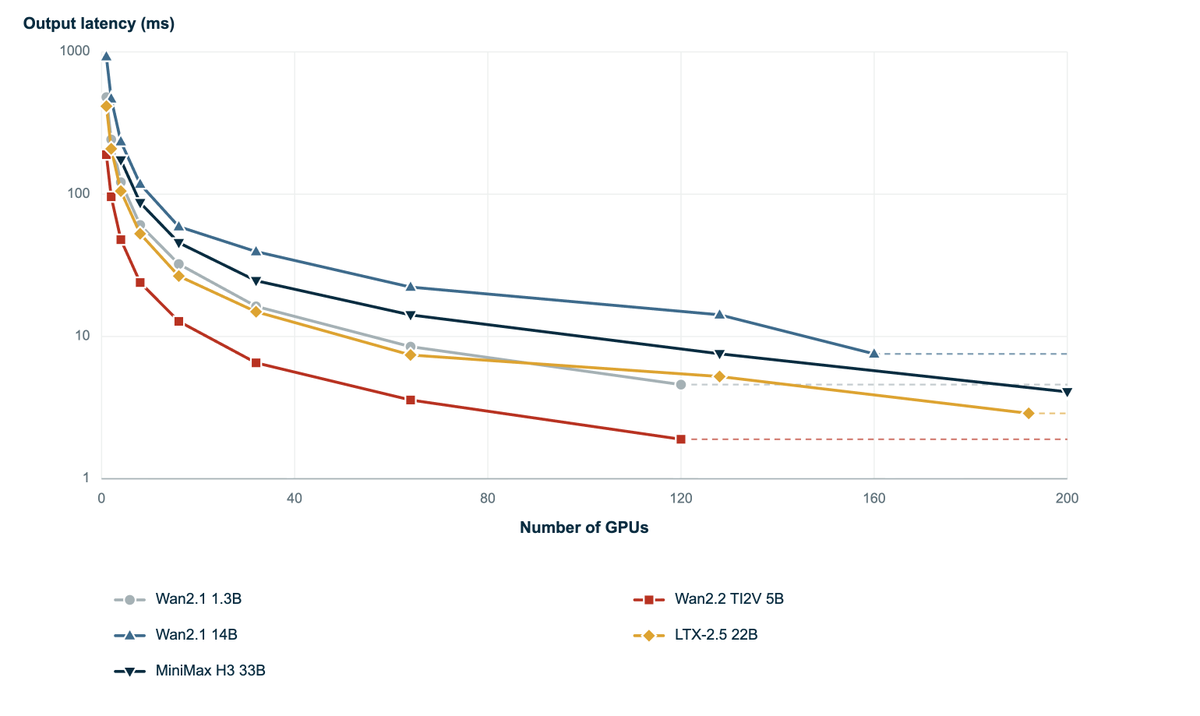
The vLLM Project officially announced that PhysisServe's core physical-world serving techniques are being integrated into vLLM-Omni. Addressing the severe memory bottlenecks and latency spikes of multi-step video diffusion and physical AI generation, PhysisServe introduces cross-denoising-step pipeline parallelism across Transformer blocks, time-shared batching, and virtual-rank joint scheduling. Benchmarked on MiniMax H3 33B across 200 GPUs, it generates a chunk every 4.1 ms (~1,000 FPS without VAE decoding), while cutting single-GPU latency for Wan2.2 5B from 173 ms down to 98 ms.
Zoom
Key Takeaways
The vLLM project announced the upstream integration of PhysisServe's serving architecture into vLLM-Omni for physical AI and video models
Introduces cross-timestep block pipelining and time-shared batching to eliminate GPU communication bubbles in multi-step diffusion
Generates a video chunk every 4.1 ms on MiniMax H3 33B across 200 GPUs (~1,000 FPS), cutting Wan2.2 5B single-card latency to 98 ms
Expands 24-GPU serving concurrency by 1.7x to 3.3x, with full open-source code merging into the vLLM-Omni mainline
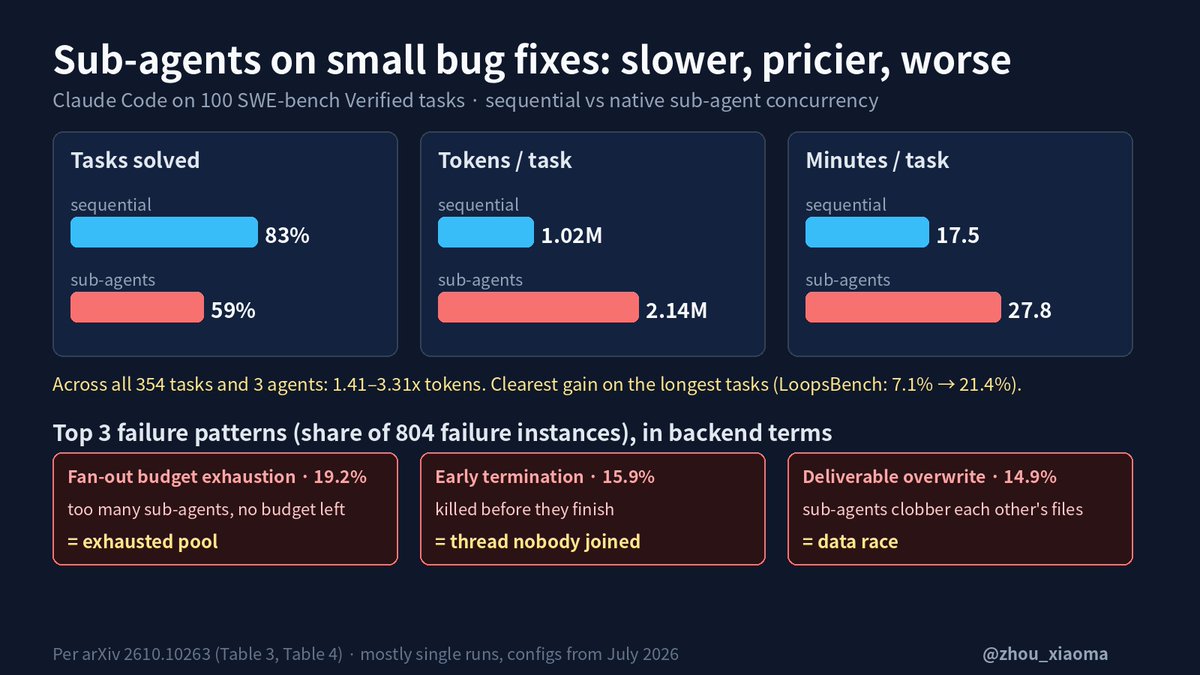
A comprehensive empirical study evaluated native sub-agent concurrency across 2,124 runs on Claude Code, Codex, and Kimi Code (354 tasks, ~$20.8K API cost). On 100 standard SWE-bench Verified tasks, enabling sub-agents caused Claude Code's solve rate to collapse from 83% to 59% (with latency increasing from 17.5 to 27.8 minutes) and Kimi Code from 77% to 59%, while token consumption inflated by 1.41x to 3.31x. The study revealed severe failure modes including budget-exhausting fan-outs, orphaned child processes, and concurrent delivery race conditions.
Zoom
Key Takeaways
A $20,800 empirical study across 2,124 runs revealed the real costs of native sub-agent concurrency in Claude Code, Codex, and Kimi Code
On SWE-bench Verified, sub-agent concurrency dropped Claude Code's solve rate from 83% to 59% and Kimi Code from 77% to 59%
Token consumption inflated by 1.41x-3.31x while execution times lengthened, caused by thread race conditions and budget exhaustion
Delivered gains only on massive multi-file projects (LoopsBench: 7.1% to 21.4%); authors recommend sequential execution as the default
Modal said in an October 19 blog post that it will add NVIDIA's Arm-based Vera CPU to power Modal Sandboxes, its first step beyond an all-x86 fleet. Using Agentless Agent Bench, a 50-task suite built from Terminal-Bench, Modal measured up to 2x the task throughput of a comparable x86 GNR machine under heavy concurrency, with per-task latency equal or lower (vendor figures). On an idle host running tasks serially, Vera's edge was small. The capacity targets background coding agents and reinforcement learning rollouts.
Zoom
Key Takeaways
Throughput: under heavy concurrency Vera reached up to 2x the task throughput of a comparable x86 GNR machine, with per-task latency equal or lower (Modal early tests, vendor figures).
Benchmark: Agentless Agent Bench uses 50 Terminal-Bench oracle solutions and verifiers with network calls removed, isolating CPU work such as compilation, grep, git and device emulation.
Idle serial runs: across the 50 tasks Vera was often but not always faster, and not by a large margin; the gap opens under contention.
Why: Modal credits Vera's high memory bandwidth for packing more containers per core without throttling; x86 alternatives plateaued earlier as CPU counts rose.
Rollout: this is Modal's first Arm support and needs infrastructure and image-build changes; no launch date or pricing was announced.
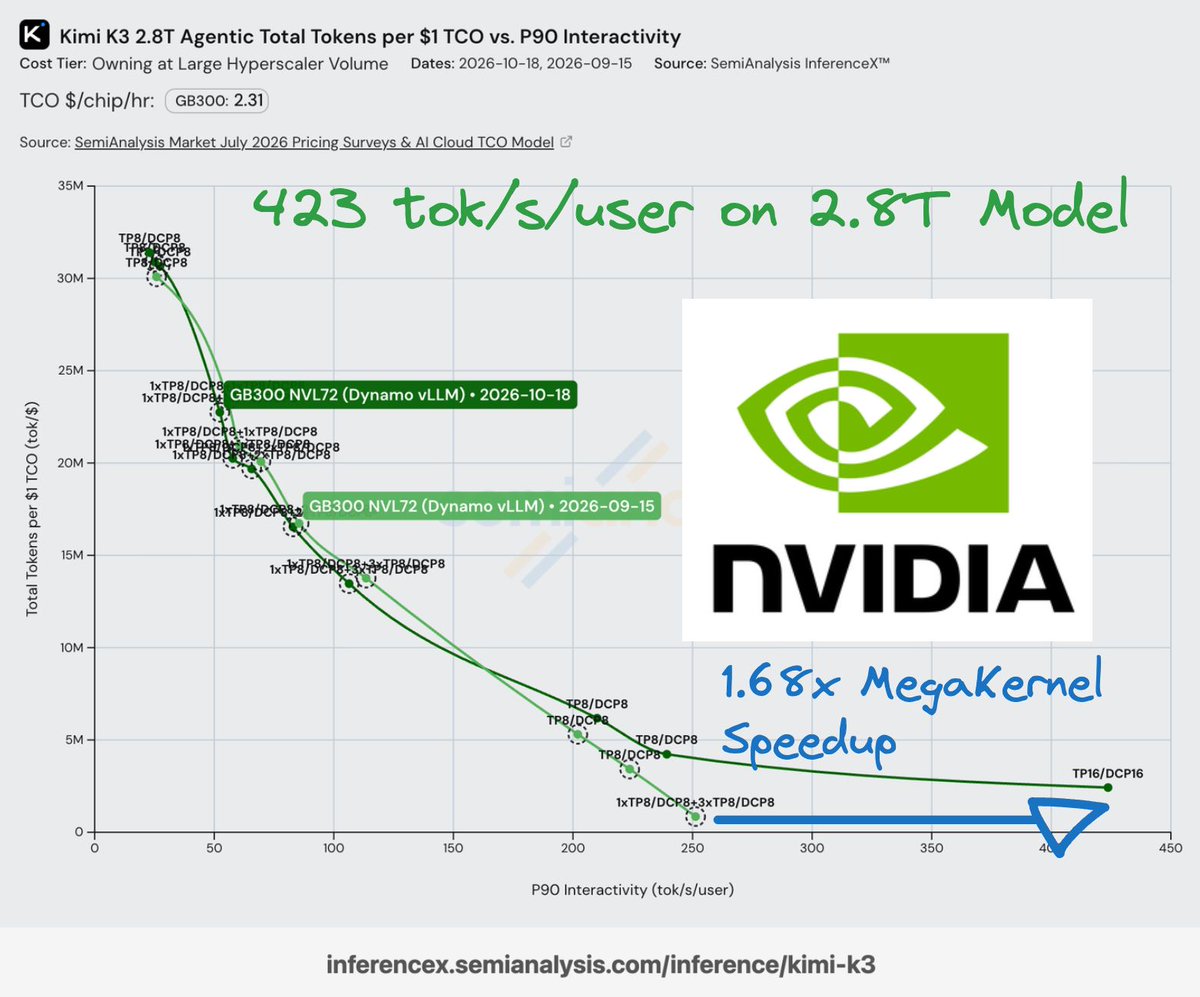
vLLM and NVIDIA unveiled a unified CuTe DSL decode megakernel (~12,000 LoC authored by NVIDIA CentML's Benjamin Chislett) for Moonshot AI's frontier Kimi K3 model on NVIDIA GB300 NVL72. By fusing attention, MoE, and cross-GPU communication, the optimization cuts per-layer latency from 130 µs (23 kernels) to 69 µs (13 kernels), delivering 842 tokens/s at batch=1 with DSpark speculative decoding (1.73x faster than stock vLLM) and up to 1.8x higher P90 per-user interactivity (403.2–423 tok/s/user) on SemiAnalysis AgentX, with DeepSeek-V4.1-Flash (PR #61868) and GLM-5.3 support coming next.
Zoom
Key Takeaways
NVIDIA and vLLM introduce a 12,000-line CuTe DSL decode megakernel for the 2.8T-parameter Kimi K3, reducing per-layer execution from 23 kernels (130 µs) to 13 kernels (69 µs)
On 16x NVIDIA GB300 NVL72 GPUs, batch-1 decode hits 842 tok/s with DSpark speculative decoding (1.73x faster) and 256.4 tok/s without speculation (1.88x faster)
Delivers up to 1.8x higher P90 interactivity (403.2-423 tok/s/user) on SemiAnalysis AgentX, with DeepSeek-V4.1-Flash (vLLM PR #61868) and GLM-5.3 megakernels following next
Tackling high latency and safety failures in spatial VLM and embodied VLA deployment, MJev-Spatial (arXiv:2610.22276, #1 on HF Daily Papers with 350 upvotes) reformulates spatial judgment as single-pass native Q/K attention matching with zero added parameters—achieving 65.64% across 12 benchmarks while running 5.6x faster than its Qwen3.5-4B base—while CUHK JIA-Lab's CarryOn (arXiv:2610.21453) wraps frozen VLA policies in a dual-loop harness that cuts safety violations from 52.6% to 6.1% and raises physical recovery success from 13% to 80%.
Zoom
Key Takeaways
MJev-Spatial reuses pretrained Q/K projections for single-pass spatial classification with zero generated tokens, running 5.6x faster than its Qwen3.5-4B base with a top 65.64% average across 12 benchmarks
Teacher-forced coarse-to-fine supervision and length-aware global batching boost MJev-Spatial training throughput by 30.8% across 12.3M spatial QA pairs
CUHK JIA-Lab's CarryOn dual-loop VLA harness cuts safety violations from 52.6% to 6.1% and raises physical failure recovery success from 13% to 80%