AI Coding Live News

Google's Gemma team says Gemini 4 Argon wrote vLLM optimizations that speed up gemma-4-E2B-it 2.85x on an A100

On Oct 26, Google's official @googlegemma account said a set of vLLM optimizations built with Gemini 4 Argon lifted gemma-4-E2B-it throughput on a single A100 from about 37,900 to 108,000+ tokens/sec, roughly 2.85x, with 100% token parity. The PRs were filed by Luciano Martins of Google DeepMind, and most are still under review.

Google's Gemma team says Gemini 4 Argon wrote vLLM optimizations that speed up gemma-4-E2B-it 2.85x on an A100

Key Takeaways

  • Google says gemma-4-E2B-it throughput on an A100 rose about 2.85x (about 37.9K to 108K+ tokens/sec) with 100% token parity
  • The PRs come from Luciano Martins of Google DeepMind and cover fused Triton kernels, MTP speculative decoding and KV-sharing fast prefill
  • The 2.85x figure is Google's claim for the full set; PR #60674 alone self-reports up to 1.90x prefill and about 1.06x decode
  • As of Oct 27, only 3 of the 10 PRs in the linked list are merged; the rest are still in review
  • It is a public example of using a frontier coding model for inference-kernel performance work, still awaiting reproduction by the vLLM community
Read full story
Linked Models & Agents:

Google Cloud Open-Sources TorchTPU: Native PyTorch on Google TPU Hardware with Day-Zero vLLM and SGLang Support

Google Cloud officially open-sourced TorchTPU, enabling native, zero-compilation-barrier PyTorch execution directly on Google Cloud TPU hardware (TPU v5p and TPU v6e). Overcoming the legacy friction of PyTorch/XLA's rigid graph compilation and dynamic-shape stalls, TorchTPU supports native PyTorch eager execution and custom Triton/C++ kernels. Leading high-throughput serving engines vLLM and SGLang announced immediate Day-0 support. Concurrently, Google Cloud introduced OpenAI models and Codex into its Vertex Model Garden, becoming the first hyperscaler to offer all three top frontier closed models.

Google Cloud Open-Sources TorchTPU: Native PyTorch on Google TPU Hardware with Day-Zero vLLM and SGLang Support

Key Takeaways

  • Google Cloud open-sources TorchTPU, delivering native, compilation-free PyTorch execution on TPU v5p and TPU v6e hardware
  • Eliminates PyTorch/XLA graph-compilation overhead, natively supporting PyTorch eager mode and custom Triton/C++ kernels
  • vLLM and SGLang announce immediate Day-0 TorchTPU releases, unlocking substantial throughput boosts on TPU infrastructure
  • OpenAI frontier models and Codex join Google Cloud's Model Garden, solidifying Google Cloud as the premier multi-model hyperscaler
Read full story

vLLM and Ant Group Open-Source Humming: Up to 5x Kernel Acceleration and +43.3% MoE Throughput

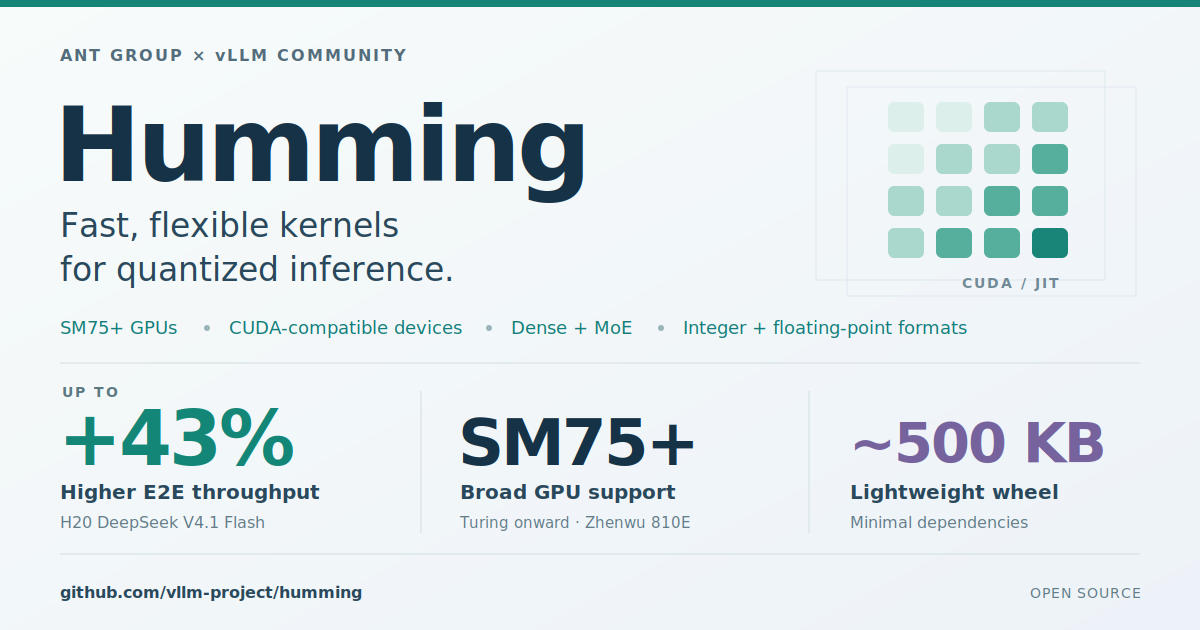
The vLLM project team and Ant Group officially open-sourced Humming (humming-kernels), a specialized high-performance kernel library designed for serving quantized MoE and dense LLMs at massive scale. Humming natively supports WnA16, W8A8, W4A8, and W4A4 across INT1–INT8 and FP4–FP8 formats, spanning NVIDIA architectures from Turing through Blackwell as well as T-Head Zhenwu 810E silicon. In production benchmarks, Humming kernels outpace cuBLAS by 3–4x at small batch sizes and surpass Marlin by 2x on H200 clusters. Serving DeepSeek-V4.1-Flash across 8x H20 GPUs, Humming drives a +43.3% throughput gain under 64 concurrent requests while reducing time-to-first-token (TTFT) by 32%, pre-integrated directly into vLLM v0.29.0+.

vLLM and Ant Group Open-Source Humming: Up to 5x Kernel Acceleration and +43.3% MoE Throughput

Key Takeaways

  • vLLM and Ant Group open-sourced Humming (humming-kernels), integrated out-of-the-box into vLLM v0.29.0+
  • Covers WnA16, W8A8, W4A8, and W4A4, compiling JIT kernels in just 1.82 seconds versus 23.35 seconds for CUTLASS
  • Serving DeepSeek-V4.1-Flash on 8x H20 GPUs yields a +43.3% throughput boost at 64 concurrency (442 to 634 tokens/sec)
  • Cuts time-to-first-token (TTFT) by 25% to 32% while delivering up to 5x kernel speedups on Blackwell B300 systems
Read full story

vLLM and Ant Group open-source Humming, one quantized-inference kernel library for many formats and every NVIDIA GPU since Turing, lifting DeepSeek-V4.1-Flash end-to-end throughput by 14-43%

On Oct 21 the vLLM community and Ant Group open-sourced Humming (Apache 2.0), a quantized-inference library that JIT-compiles GEMM kernels on demand. It supports every NVIDIA architecture from Turing on plus T-Head's Zhenwu 810E, and covers weight and activation combinations from INT1-INT8 and FP4-FP8 for dense and MoE workloads. In vLLM's microbenchmarks it runs 2-5x faster than vLLM Marlin, FlashInfer or DeepGEMM in some cases; on 8 H20 GPUs, switching DeepSeek-V4.1-Flash MoE from Marlin W4A16 to Humming W4A8 raised throughput 14-43%. vLLM 0.29.0 ships it built in.

vLLM and Ant Group open-source Humming, one quantized-inference kernel library for many formats and every NVIDIA GPU since Turing, lifting DeepSeek-V4.1-Flash end-to-end throughput by 14-43%

Key Takeaways

  • One JIT kernel framework instead of a hand-written kernel per format: WNA16, W8A8, W4A8, W4A4, INT1-INT8 and FP4-FP8 weights, dense and MoE
  • Hardware: every NVIDIA GPU from Turing (SM75) on, including Blackwell SM100/103/120/121, plus T-Head Zhenwu 810E
  • End to end: DeepSeek-V4.1-Flash on 8x H20 at TP=8, Humming W4A8 beats Marlin W4A16 by 14-43% in throughput and cuts mean TTFT 25-32%; at concurrency 64 output goes from 442 to 634 tok/s
  • Microbenchmarks run by the vLLM community: W4A8-MXFP4 on H200 is about 4.5x DeepGEMM W8A8, and the B300 MoE Grouped path is about 5x Marlin; one W4A16 kernel compiles in 1.82 s versus 23.35 s for CUTLASS
  • Use: pip install humming-kernels (about a 500 KB wheel); built into vLLM 0.29.0+, enable with --linear-backend humming --moe-backend humming
Read full story
ADSponsored

vLLM Narrows Gap with DeepInfer to 6% on NVIDIA GB200, Reaching 1M Tokens/s per GPU on GB300

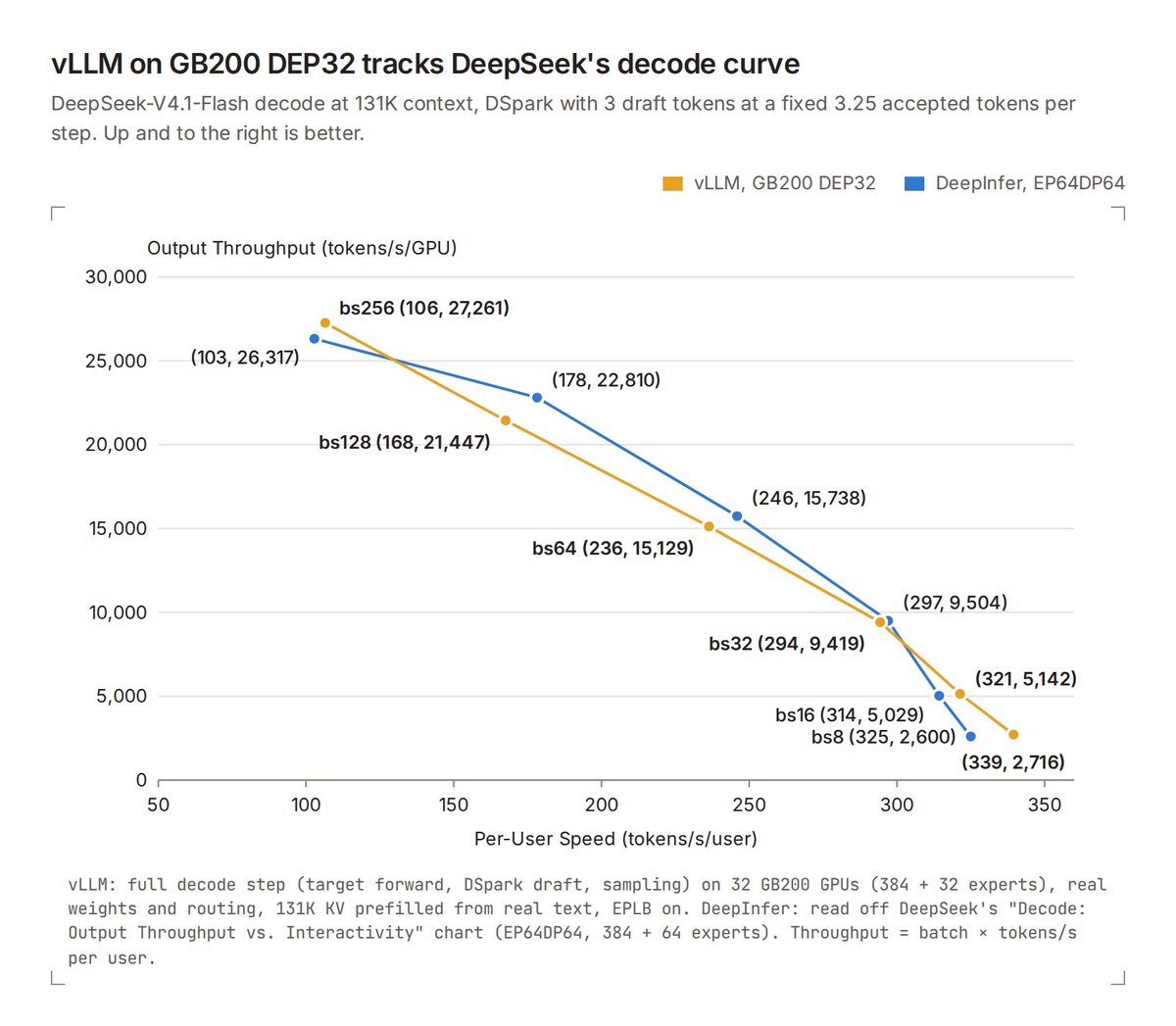
Hours after DeepSeek open-sourced DeepInfer, the vLLM project team released official benchmark parity data serving DeepSeek-V4.1-Flash. Utilizing DeepSeek's identical decoding setup (131K context window, nextn=3 speculative decoding), vLLM closed its throughput performance delta to within 6% of DeepInfer across batch sizes 8 through 256 on NVIDIA GB200 systems. On GB300 hardware, vLLM attained up to 1,000,000 tokens/second per GPU and 826 tokens/second per user, generating $38.96 in hourly GPU revenue at DeepSeek off-peak rates. vLLM simultaneously shipped day-0 runtime support for FastH3-Omni and Spark-X2.6-4B.

vLLM Narrows Gap with DeepInfer to 6% on NVIDIA GB200, Reaching 1M Tokens/s per GPU on GB300

Key Takeaways

  • vLLM published direct benchmark comparisons, demonstrating that its serving throughput on NVIDIA GB200 is within 6% of DeepInfer
  • Achieves unprecedented scaling on NVIDIA GB300: up to 1,000,000 tokens/second per GPU and 826 tokens/second per active user stream
  • Generates up to $38.96 per GPU-hour in revenue when mapped to DeepSeek's production off-peak API pricing schedule
  • Delivers immediate Day-0 support for the FastH3-Omni video model and the 1M-token Apache 2.0 model Spark-X2.6-4B
Read full story
Linked Models & Agents:

Modal will run agent Sandboxes on NVIDIA Vera CPUs: up to 2x the throughput of comparable x86 under heavy load

Modal said in an October 19 blog post that it will add NVIDIA's Arm-based Vera CPU to power Modal Sandboxes, its first step beyond an all-x86 fleet. Using Agentless Agent Bench, a 50-task suite built from Terminal-Bench, Modal measured up to 2x the task throughput of a comparable x86 GNR machine under heavy concurrency, with per-task latency equal or lower (vendor figures). On an idle host running tasks serially, Vera's edge was small. The capacity targets background coding agents and reinforcement learning rollouts.

Modal will run agent Sandboxes on NVIDIA Vera CPUs: up to 2x the throughput of comparable x86 under heavy load

Key Takeaways

  • Throughput: under heavy concurrency Vera reached up to 2x the task throughput of a comparable x86 GNR machine, with per-task latency equal or lower (Modal early tests, vendor figures).
  • Benchmark: Agentless Agent Bench uses 50 Terminal-Bench oracle solutions and verifiers with network calls removed, isolating CPU work such as compilation, grep, git and device emulation.
  • Idle serial runs: across the 50 tasks Vera was often but not always faster, and not by a large margin; the gap opens under contention.
  • Why: Modal credits Vera's high memory bandwidth for packing more containers per core without throttling; x86 alternatives plateaued earlier as CPU counts rose.
  • Rollout: this is Modal's first Arm support and needs infrastructure and image-build changes; no launch date or pricing was announced.
Read full story

vLLM Ships Precompiled Bytecode Images and Decision 3.0 Serving: Cold Start Accelerated by 18%, MI325X Decision Throughput Hits 1.8x

The vLLM team announced two major milestones: shipping precompiled Python bytecode via uv in v0.32.0 release images cuts cold-start container launch by 14–18% (~18s on NVIDIA H100) with zero runtime recompiles. Additionally, vLLM integrated the Decision 3.0 (D3) structured reasoning family (0.6B to 27B) into the /v1/systemone endpoint, ranking #1 on the Jev Decision Index and delivering 1.8x req/s on a single AMD MI325X under 64 concurrent clients.

vLLM Ships Precompiled Bytecode Images and Decision 3.0 Serving: Cold Start Accelerated by 18%, MI325X Decision Throughput Hits 1.8x

Key Takeaways

  • vLLM ships precompiled Python bytecode via uv in official images, reducing H100 cold starts by 14–18% (~18 seconds saved)
  • Natively serves the Decision 3.0 (D3) family (0.6B to 27B) via the /v1/systemone structured decision endpoint
  • D3 models rank #1 on the Jev Decision Index with 66.3 in text and 71.3 in vision
  • D3 27B achieves 1.8x the request throughput of standard checkpoint servers on a single AMD Instinct MI325X under 64 concurrent clients
Read full story
Linked Models & Agents:

SGLang v0.5.22 Released: DeepSeek-V4.1 Throughput Jumps 2.3x on H200 and 1.9x on MI355X, InstantTensor Loads Models 10x Faster

The SGLang team released v0.5.22 featuring 950 PRs from 245 contributors: DeepSeek-V4.1 delivers up to 2.3x more throughput per GPU on NVIDIA H200 and 1.9x on AMD MI350X/MI355X via DSpark. The new InstantTensor loader cuts model loading time by 10x. B200 decodes Qwen3.8-Flash-Next 12% faster, while B300 speeds up GLM-5.3-Flash by 10% and yields 1.85x decode throughput for MiMo-V2.6-Pro. SGLang also adds native Apple Silicon PyTorch support and ComfyUI integration.

SGLang v0.5.22 Released: DeepSeek-V4.1 Throughput Jumps 2.3x on H200 and 1.9x on MI355X, InstantTensor Loads Models 10x Faster

Key Takeaways

  • SGLang v0.5.22 released with 950 PRs from 245 contributors across heterogeneous platforms
  • DeepSeek-V4.1 achieves up to 2.3x throughput per GPU on NVIDIA H200 and 1.9x on AMD MI350X/MI355X via DSpark
  • New InstantTensor loader speeds up large model checkpoint ingestion by 10x
  • Qwen3.8-Flash-Next decodes 12% faster on B200; MiMo-V2.6-Pro reaches 1.85x decode throughput on B300
  • PD disaggregation cuts p95 TTFT in half (-50%) on long prompts, alongside native Apple Silicon and ComfyUI diffusion support
Read full story
Linked Models & Agents:

When Remote KV Cache Is Slower Than GPU Recompute: Sharded LMCache Cuts p99 from 83.32s to 0.67s on 8xB300, While Baidu VHA Halves KV Cache and Beats MLA

Addressing KV cache bottlenecks in long-context LLM serving, a new production study on 8xB300 nodes serving GLM-5.3 (arXiv:2610.21500) reveals that unsharded remote KV caches inflate hit-heavy p99 TTFT to 83.32s, and resolves it via rank-sharded asynchronous LMCache loading—boosting GET bandwidth 6.3x to 10.76 GB/s and slashing p99 to 0.67s (+34% throughput). Meanwhile, Baidu PaddlePaddle open-sources Virtual Head Attention (VHA, arXiv:2610.17959), folding linear Q-Premix and Postmix into standard GQA-2 weights at inference to halve KV cache while beating MLA (+0.70%) and GQA-4 (+2.60%) on a 30B-A3B MoE and lifting 8K-128K RULER from 73.0 to 84.4.

When Remote KV Cache Is Slower Than GPU Recompute: Sharded LMCache Cuts p99 from 83.32s to 0.67s on 8xB300, While Baidu VHA Halves KV Cache and Beats MLA

Key Takeaways

  • On 8xB300 nodes serving GLM-5.3 with PCP8, sharding LMCache across ranks and adding async loading boosts GET bandwidth 6.3x to 10.76 GB/s, cutting hit-heavy p99 TTFT from 83.32s to 0.67s (+34% throughput)
  • Baidu's Virtual Head Attention (VHA) folds linear Q-Premix and low-rank Postmix directly into W_Q and W_O at inference, reducing to a zero-overhead GQA-2 architecture with half to a quarter of the KV cache
  • On a 500B-token 30B-A3B MoE, VHA outperforms both MLA (+0.70%) and GQA-4 (+2.60%), and boosts 8K-128K RULER on a 10B-A1B MoE from 73.0 (GQA-4) to 84.4 using only 2 KV heads
Read full story
Linked Models & Agents:

vLLM and OpenRouter Launch Day-0 Serving for DeepSeek-V4.1-Flash-1017: 830K tok/s per GPU and 1.3B Tokens/$ TCO on SemiAnalysis AgentX

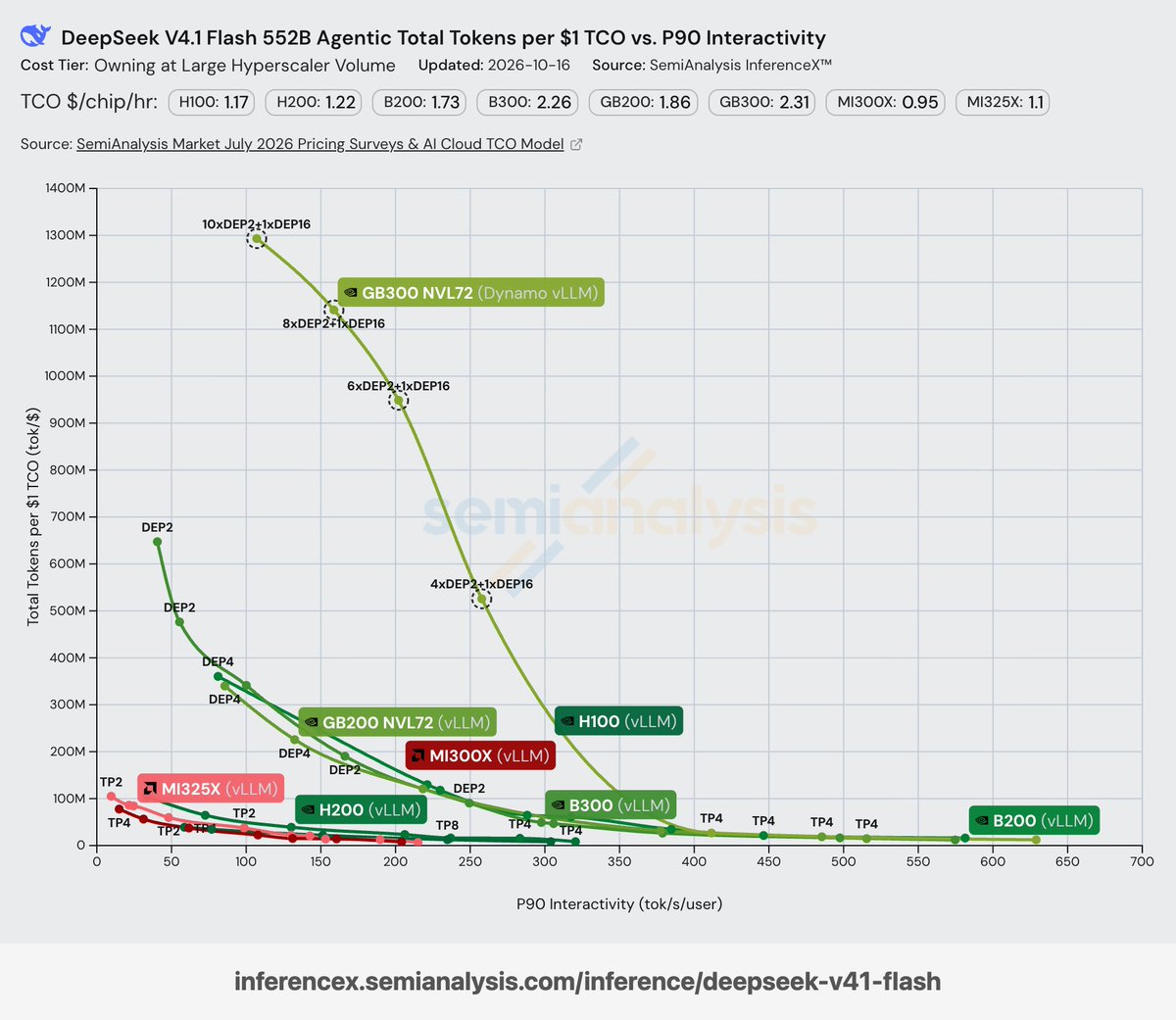
Following the release of DeepSeek-V4.1-Flash-1017, vLLM announced Day-0 serving optimization delivering 1.3B tokens per dollar TCO and 830K tok/s per GPU at 100 tok/s/user on SemiAnalysis AgentX (5x agentic throughput gain since Day 0), while OpenRouter launched live multi-provider routing starting at $0.10/M input and $0.50/M output tokens.

vLLM and OpenRouter Launch Day-0 Serving for DeepSeek-V4.1-Flash-1017: 830K tok/s per GPU and 1.3B Tokens/$ TCO on SemiAnalysis AgentX

Key Takeaways

  • vLLM delivers 830K tok/s per GPU (cached + input + output) at 100 tok/s per user and 1.3B tokens/$ TCO on SemiAnalysis AgentX for DeepSeek-V4.1-Flash-1017 (5x faster since Day 0)
  • DeepSeek-V4.1-Flash-1017 reaches 77.0% on DeepSWE v1.1 (beating Claude Opus 5 at 74.0%), 68.2% on NL2Repo-Bench, and 72.1% on Apex Bench with shorter agentic outputs
  • Live on OpenRouter from $0.10/M input and $0.50/M output tokens, while DeepSeek's official API alias deepseek-flash remains at $0.15/M input and $0.60/M output
Read full story
Linked Models & Agents:
ADSponsored

Microsoft unveils Azure Maia 300: up to 7× Maia 200 rack token throughput, multi-gigawatt deployments from 2027 as primary inference system

On 2026-10-12 Microsoft EVP Scott Guthrie announced that Azure Maia 200 is in production for Copilot-class workloads, and third-generation Maia 300 targets long-context reasoning, latency-sensitive chat, and multi-step agentic inference. A 96-accelerator / 167 kW rack is claimed to deliver up to 7× Maia 200 rack-scale token throughput and >2.5× performance per watt, plus ~40% more tokens per megawatt vs leading GPU systems. Each accelerator has eight HBM4 stacks (~288 GB / 18 TB/s), TSMC N2P compute chiplets, and Ethernet-based AI transport scaling to a 12,288-accelerator superpod. Production deployments begin in 2027; more at Ignite 2026.

Key Takeaways

  • Official: Microsoft Blog and Azure architecture deep dive (2026-10-12)
  • Role: Maia becomes Microsoft’s primary inference stack; Maia 200 already serves Copilot; GitHub Copilot/Foundry by year-end; Maia 300 production from 2027 at multi-gigawatt scale
  • Rack (vendor): 96 accelerators, 167 kW, ~27.6 TB HBM / ~1.7 PB/s aggregate; up to 7× Maia 200 rack token throughput and >2.5× perf/W
  • Per accelerator: 8×HBM4 (~288 GB, 18 TB/s, ~950 W TDP), enhanced MXFP4, SDLA dataflow; superpod up to 12,288 accelerators
  • Caveat: 7× / +40% tokens/MW are Microsoft claims vs own/leading GPU baselines—no independent rack bake-off yet
Read full story

Microsoft Releases CABRA: Rigorous Blueprint Proves Code Comprehension Bottlenecks Autonomous Coding Agents

As autonomous coding agents achieve surging scores on benchmarks like SWE-bench, the prevailing assumption has been that coding proficiency primarily correlates with lines of code modified when aided by terminal search tools. However, agents routinely fail on subtle modifications in real repositories. Microsoft Research introduces CABRA (arXiv:2610.10610, code: github.com/microsoft/CABRA), a synthetic evaluation blueprint designed to isolate code comprehension from simple editing throughput. CABRA synthesizes programs as Directed Acyclic Graphs (DAGs) and scales task difficulty systematically along four orthogonal axes parameterized by n: Function Traversal, Function Search, Runtime Resolution, and Instruction Following. The findings establish that code comprehension—rather than tool invocation or editing volume—is the true bottleneck of autonomous coding agents. Crucially, the volume of tool calls allocated to code comprehension operations (such as READ and ANALYZE) serves as a substantially stronger predictor of an agent's success on SWE-bench Verified than the number of lines of code edited, with code and datasets fully open-sourced.

Microsoft Releases CABRA: Rigorous Blueprint Proves Code Comprehension Bottlenecks Autonomous Coding Agents

Key Takeaways

  • Microsoft open-sources CABRA, synthesizing DAG codebases to decouple code comprehension from raw lines edited
  • Demonstrates comprehension is the key bottleneck, causing a 50%-78% pass rate collapse as traversal depth scales
  • Comprehension tool invocations predict real-world SWE-bench success far better than editing volume or search counts
Read full story
Linked Models & Agents:

TokenRouter: Tsinghua Unveils NeurIPS 2026 Serving System for Token-Level LLM Routing, Boosting Throughput by up to 64x

Token-level LLM routing—routing easy tokens to small models and switching to frontier models for critical reasoning tokens—presents an optimal trade-off between output quality and inference cost. However, current LLM serving engines (such as vLLM and TGI) are architected for single-model execution, suffering severe step desynchronization, batch admission latency, and extreme orchestration complexity when handling high-frequency token transfers across heterogeneous models. Researchers from Tsinghua University's NICS Lab present TokenRouter (arXiv:2610.12242, accepted at NeurIPS 2026, code: github.com/thu-nics/TokenRouter), an efficient and developer-friendly serving system engineered for token-level routed LLM inference. TokenRouter introduces a 'request-centric programming and model-centric execution' paradigm, enabling developers to write routing logic intuitively per request while the runtime handles asynchronous execution across subservers. Incorporating a Delayed-Batching Scheduler parameterized via discrete-time Markov chain modeling, a decoupled tri-loop architecture, and an instant handoff-resume mechanism, TokenRouter achieves 2.01x to 64.15x higher decoding throughput compared to existing serving platforms across diverse routing workloads, with complete code open-sourced.

TokenRouter: Tsinghua Unveils NeurIPS 2026 Serving System for Token-Level LLM Routing, Boosting Throughput by up to 64x

Key Takeaways

  • Tsinghua University open-sources TokenRouter (NeurIPS 2026), an optimized serving architecture for token-level LLM routing
  • Introduces request-centric programming and a delayed-batching scheduler, delivering 2.01x to 64.15x higher decoding throughput
  • Decoupled tri-loop execution cuts P99 inter-token latency by 43.6%, reducing enterprise cloud GPU costs by 50% to 70%
Read full story
Linked Models & Agents:

vLLM adds NVIDIA Vera Rubin NVL72 support: up to 7.84x per-GPU throughput over GB200 on AgentX with MiniMax M3

On Oct 9 the vLLM team, with Inferact, Red Hat and NVIDIA, shipped early Vera Rubin NVL72 support: CUDA 13.4 nightly images already serve DeepSeek, Kimi, GLM and MiniMax. Vendor-reported results: up to 7.84x per-GPU throughput vs GB200 on SemiAnalysis AgentX (MiniMax M3, matched interactivity) and up to 3.7x vs GB300 NVL72 on the MLPerf Inference v6.1 VLM benchmark (Qwen3-VL-235B-A22B).

vLLM adds NVIDIA Vera Rubin NVL72 support: up to 7.84x per-GPU throughput over GB200 on AgentX with MiniMax M3

Key Takeaways

  • Versus GB200 NVL72: 5x NVFP4 FLOPS, ~2.4x HBM4 bandwidth, 1.7x bidirectional NVLink, 2–4x faster softmax exponentials (vLLM blog)
  • AgentX with MiniMax M3: up to 7.84x per-GPU throughput at matched interactivity, 5.18x under a 150 TPS cap (vendor-reported, early)
  • MLPerf Inference v6.1: Qwen3-VL-235B-A22B on vLLM + Dynamo, up to 3.7x vs GB300 NVL72
  • CUDA 13.4 locality domains split MoE weights for ~1.2x average MoE-layer speedup in small-token decode
  • Image: vllm/vllm-openai:cu134-nightly (CUDA 13.4 + PyTorch 2.15)
Read full story

SparseEngine: Harbin Institute of Technology Open-Sources Sparse-First Inference Engine Delivering 2.5x Faster Decoding Than vLLM for Long-Horizon Agents

Long-horizon LLM agents accumulate expanding interaction histories that saturate GPU KV-cache memory and choke self-attention throughput. While sparse attention algorithms mitigate these bottlenecks mathematically, existing production serving engines (e.g. vLLM) are tightly coupled to dense tensor layouts, preventing heterogeneous sparse mechanisms from sharing infrastructure. Researchers from Harbin Institute of Technology (HIT) release SparseEngine (arXiv:2609.39068), an open-source, sparse-first inference engine built from the ground up for long-horizon agent workloads. SparseEngine establishes a shared lifecycle contract enabling 15 diverse sparse attention methods across four distinct families to control their custom KV representations while unifying memory management. It introduces Chain Cache to resume stateful KV-evicted contexts across multi-turn requests and Controllable Prefix-Cache Pruning to discard stale history without disrupting prefix matching. Empirical evaluations on long-horizon agent benchmarks show that SparseEngine delivers over 10x higher throughput under KV eviction, over 2.5x faster decoding throughput than vLLM at matched concurrency, and more than 2x end-to-end task speedups with zero degradation in model reasoning accuracy.

Key Takeaways

  • Harbin Institute of Technology open-sources SparseEngine, a sparse-first inference engine natively supporting 15 sparse attention algorithms
  • Introduces Chain Cache and Controllable Prefix-Cache Pruning to preserve prefix-cache benefits across multi-turn sparse agent sessions
  • Delivers 2.5x faster decoding than vLLM, lifts throughput by 10x under KV eviction, and halves end-to-end agent task latency
Read full story