AI Coding Live News

OpenAI Plans Its Next Internal Security Sprint With Cathedral, More Than Quadruples Critical Bug Bounty Rewards to Up to $172,000

On November 2 (US time) OpenAI said it is planning its next internal security sprint and partnering with security firm Cathedral, whose researchers will use OpenAI models alongside OpenAI teams to challenge its defenses. It is also changing its Security Bug Bounty program, more than quadrupling rewards for critical findings; OpenAI's X post says exceptional findings can earn up to $172,000 including bonuses. Per OpenAI, the last sprint dedicated 25% of its product engineers to finding and fixing weaknesses, using Codex to reproduce vulnerabilities and prepare patches, and it has committed $1 billion in subsidized access over six months for frontline defenders.
OpenAI Plans Its Next Internal Security Sprint With Cathedral, More Than Quadruples Critical Bug Bounty Rewards to Up to $172,000

Key Takeaways

  • Critical bug bounty rewards are more than quadrupled; per OpenAI's X post, exceptional findings can earn up to $172,000 including bonuses.
  • Researchers from partner Cathedral will use OpenAI models alongside OpenAI teams to test its defenses.
  • Per OpenAI, the last sprint dedicated 25% of product engineers and used Codex to reproduce vulnerabilities in isolated environments and prepare patches.
  • OpenAI has committed $1 billion in subsidized access over six months for defenders of essential services and digital infrastructure.
  • Timing, scope and finding counts for the next sprint were not disclosed.
Read full story
Linked Models & Agents:

Altman at ADIPEC: The Internal Model Behind the 10,000-Agent Navier-Stokes Proof Is "the Next GPT," Coming Soon

Speaking at the ADIPEC energy conference in Abu Dhabi on November 2, OpenAI CEO Sam Altman said the September run in which 10,000 agents collaborated for about four days used "the model that is going to be released soon, the next GPT," stressing that the agents had no hierarchy and were fully decentralized. It is the first public statement tying the internal model behind OpenAI's September Navier-Stokes proof to its next flagship, though OpenAI has given no name, release date or price.

Altman at ADIPEC: The Internal Model Behind the 10,000-Agent Navier-Stokes Proof Is "the Next GPT," Coming Soon

Key Takeaways

  • Quote (ADIPEC keynote video): "It was 10,000 agents of the model that is going to be released soon, the next GPT, working for about four days, nonstop."
  • OpenAI's September 8 blog post: about 10,000 concurrent agents reached the result in about 88 hours, and GPT-6 Astra took another 17 hours for Lean formalization and verification.
  • Scale (OpenAI figures): 2.7 million agent messages and about 130 billion output tokens for Navier-Stokes alone; 4.9 million messages and about 300 billion output tokens across all attempted problems.
  • The Lean proof is public at openai/NavierStokesAndEuler and establishes statements C and D of the official Clay formulation (breakdown with smooth forcing).
  • Not disclosed: the next GPT's name, release date, price or benchmarks; names like "GPT-6.2 Astra" circulating on X are speculation.
Read full story
Linked Models & Agents:

X Discussion: DHH Says the Age of Agents Will Be Great for Most Programmers but Hard on Cantankerous Ones Who Relied on Rare Skills

Ruby on Rails creator and 37signals CTO DHH (David Heinemeier Hansson) posted two related takes on X on November 2. First: "The great gift of agents is how they allow you to route around every insufferable gatekeeper in software." Then: the age of agents will be amazing for most programmers but hard on the cantankerous ones, because specialized knowledge and rare skills will no longer offer immunity to people who are a pain to work with, so they should learn basic people skills. The second post drew about 3,600 likes, 106K views and 280+ replies in roughly four hours. This is a personal opinion, not an announcement from any company.

Key Takeaways

  • This is a personal opinion post by DHH, not an official statement from 37signals or any AI company, and it cites no data or study.
  • The main post (2026-11-02 13:03 UTC) had about 3,609 likes, 180 reposts, 282 replies, 60 quotes, 106K views and 400 bookmarks at fetch time.
  • His earlier post about 1.5 hours before, saying agents let you route around every insufferable gatekeeper in software (11:41 UTC), had about 2,831 likes, 131 reposts and 80K views.
  • Supporters: tech analyst Ben Dickson (@bendee983) quoted it saying great engineers used to get a free pass for being difficult, and AI is leveling the field, though solid engineering knowledge is still required.
  • Pushback and additions: one reply joked that cantankerous people just found a coworker who never complains back; another argued an agent will do the work but will not make you nicer, so being easy to work with becomes more valuable.
Read full story
Linked Models & Agents:

X Discussion: Elon Musk Says Grok Bot Serving Costs Were Unsustainably High Relative to Revenue; Replit CEO Amjad Masad Warns Subsidized AI Subscriptions Face a Rug Pull

After users on X complained that their Grok Bot usage ran out early this cycle, Elon Musk replied that "the cost of serving Grok Bot was unsustainably high relative to revenue", a reply with about 13K likes and 5.5M views. Replit CEO Amjad Masad then quoted the news, saying people enjoying subsidized AI subscriptions should "get ready to get rug pulled", sparking a debate over whether flat-rate AI plans can last. This is an X discussion with personal views; xAI has not published a formal pricing or limit announcement.

Key Takeaways

  • Trigger: user @DogecoinNorway said their Grok Bot usage hit 100% with 4 days left until reset, a post with about 1.24M views.
  • Musk replied that the cost of serving Grok Bot was unsustainably high relative to revenue, with about 13.2K likes, 5.51M views and 1,900+ quotes.
  • Amjad Masad (Replit CEO) quoted it, warning subsidized AI subscriptions are about to get rug pulled, with about 2,347 likes and 146K views; in replies he said Replit never subsidized.
  • xAI has not published a formal limit or pricing change; rely on official notices for specifics.
Read full story
ADSponsored

X discussion: is GPT-6 Astra robotics' "GPT-3 moment"? Ex-OpenAI researcher Will Depue says specialized ML got "bitter lessoned"

Over the past day, X has been debating whether GPT-6 Astra can work directly as a robot policy. Former OpenAI researcher Will Depue (whose bio lists Sora 1 and 2 and o3/4o post-training) called Astra beating specialized robotics models "deeply surprising", then described it as "the final death of specialized ML". Investor Freda Duan posted that "Astra IS robotics' GPT-3 moment", drawing about 84K views. Third-party evaluations point both ways: in a RoboDojo paper, Astra averages 22.48% success and ranks above all 40 public policies, while an EBench report puts it at 46.7%, third of nine models. This is a discussion of opinions, not an official OpenAI conclusion.

X discussion: is GPT-6 Astra robotics' "GPT-3 moment"? Ex-OpenAI researcher Will Depue says specialized ML got "bitter lessoned"

Key Takeaways

  • Reach: Will Depue's two posts have about 597 and 566 likes and 59K and 37K views; Freda Duan's "10 takes" has about 455 likes, 559 bookmarks and 84K views (as of 19:10 SGT)
  • RoboDojo: over 42 tasks and 2,100 trials, Astra averages 22.48% success (Score 28.97), ranking above all 40 public policies; GPT-5.5 gets 0.88% in the same setup (arXiv 2609.24170, as reported by the paper's authors)
  • Counterpoint: in the EBench report, Astra with single-shot in-context learning scores 46.7%, behind OpenWAM-alpha at 55.3% and AMapbot 1 at 48.9% (EBench tech report)
  • Real arms: Robocurve measured 19 of 20 successes on a block-into-bowl task on YAM arms at about $0.94 per run, but only 2 of 20 on a puzzle insertion task (Robocurve)
  • Weak spots: several evaluations find Astra clearly weaker on high-precision control, dynamic control and bimanual coordination
Read full story

YC Labs pits AI agent swarms in Minecraft and Mindustry: GPT swarms win 12 of 16 head-to-head games against Claude, while a 50-agent colony slides into bureaucracy

YC Labs, a research project at Y Combinator, and multi-agent environment startup Olam Labs published "Agents in Games" on Oct 29. Fifty GPT-6.1 Sol agents told to "build a thriving civilization" in survival Minecraft spent three hours huddled in shelters rationing food, sending about 5,900 messages and inventing ration ledgers, permits and job titles. In nine Bed Wars games, 10 GPT-6.1 Sol agents beat 10 Claude Opus 5.5 agents 6–3; in seven 50-vs-50 Mindustry matches lasting about 9.5 hours, GPT won 6–1. The leader was almost always whichever agent was listed first in the directory, and stuck GPT agents fetched the game's public source code on their own. The Minecraft harness is open source. These are one lab's experimental observations, not a standardized benchmark.

YC Labs pits AI agent swarms in Minecraft and Mindustry: GPT swarms win 12 of 16 head-to-head games against Claude, while a 50-agent colony slides into bureaucracy

Key Takeaways

  • Head-to-head: GPT-6.1 Sol won Bed Wars 6–3 over nine games and Mindustry 6–1 over seven, 12 of 16 overall (see the YC Labs report)
  • Civ50: 50 GPT agents sent about 5,900 messages in three hours; 22 of 34 deaths came on the first night, after which the colony turned cautious
  • No election: 46 of the other 49 agents first messaged Ada, first on the roster, who received 616 DMs and became leader
  • Communication: in one Bed Wars game GPT players sent 1,147 DMs versus Claude's 82; GPT drifted into compressed shorthand while Claude voted with "+1"
  • Open source: the long-running Minecraft agent harness is public at yc-software/minecraft-agent-harness
Read full story
T
Tsinghua University & Z.AI (HarnessPro, arXiv 2610.26770)arxiv.org·
👀16
🔥80

Tsinghua and Z.AI open-source HarnessPro: agents rewrite their own harness, reaching 80.8% on Terminal-Bench 2 at 34% lower cost per task

HarnessPro (arXiv 2610.26770, submitted Oct 19 and revised Oct 20), from Tsinghua University, Z.AI (Zhipu) and collaborators, is a label-free way to improve an agent harness: specialized agents diagnose execution traces, rewrite instructions and runtime policies, score candidates with LLM-generated tests, and keep Lite, Medium and Heavy harnesses along the performance-cost frontier. Per the paper, with GPT-5.5 and Codex the Heavy mode reaches 80.8% on Terminal-Bench 2, 4.5 points above the prior RHO method, while cost per task drops from $1.09 to $0.72. The code is MIT-licensed and drew wider media coverage this week, including from Pandaily.

Tsinghua and Z.AI open-source HarnessPro: agents rewrite their own harness, reaching 80.8% on Terminal-Bench 2 at 34% lower cost per task

Key Takeaways

  • Terminal-Bench 2 (GPT-5.5 with Codex, mean of 3 runs): Heavy reaches 80.8% at $0.72 per task, versus RHO at 76.3% and $1.09, a 33.9% cost cut (paper figures, arXiv)
  • Averaged over three benchmarks: +2.0 points pass rate and -26.1% cost per task versus RHO, across Terminal-Bench 2, SWE-Bench Pro and ProgramBench
  • Holds across models: with GLM-5.2 and Claude Code on Terminal-Bench 2, Heavy hits 81.4% at $0.62, versus vanilla at 74.6% and $0.92 and RHO at 78.0% and $1.00
  • Budget modes: Medium matches RHO at 76.3% on Terminal-Bench 2 for only $0.56 per task; Lite gets 72.9% at $0.43
  • Cheap to train: only 10 training tasks per benchmark and 3 to 4 evolution epochs, tested on 59, 100 and 100 held-out tasks; the three harness tiers are MIT-licensed on GitHub
Read full story

OpenAI says Daybreak Blue sessions on personal accounts may be used for training even with the training toggle off, drawing security researcher backlash on X

OpenAI's "Data controls in ChatGPT" Help Center page now has a "Trusted Access on personal accounts" section: during sessions in Trusted Access programs such as Daybreak Blue, OpenAI may use interaction content to improve its models even when "Improve the model for everyone" is off, to strengthen safeguards against cyber misuse, while other activity still follows the user's setting. Emails that several users shared on X say the change takes effect November 29, and researchers including Sean Heelan criticized it for pulling unreported vulnerabilities and research into training data.

Key Takeaways

  • Official wording: Trusted Access sessions such as Daybreak Blue on personal accounts may be used to improve models regardless of the "Improve the model for everyone" toggle
  • The exception covers only Trusted Access sessions; other chats on the account still follow the existing setting
  • Managed workspaces such as Business and Enterprise, and the API, are still not used for training by default
  • Emails users shared on X say it takes effect November 29, and some users say individuals lose Daybreak Blue API access on November 20 (the official pages do not state either date yet)
  • Sean Heelan's critical post drew 600+ likes and 100+ reposts, and several bug bounty hunters said they would reconsider using the program
Read full story

Krea launches Ad Studio, its first Krea 3 Expert model, turning a website URL into on-brand ads

On Oct 29 Krea released Ad Studio, the first Krea 3 Expert, a version of Krea 3 specialized for one job. Paste a brand URL and it builds an editable brand kit and product catalog, then generates up to 12 ads per batch for chosen placements; it also works in Claude through the Krea MCP server.

Krea launches Ad Studio, its first Krea 3 Expert model, turning a website URL into on-brand ads

Key Takeaways

  • Ad Studio is the first Krea 3 Expert, and Krea says more Experts are on the way
  • From a URL it extracts logo, colors, fonts, tone, selling points and products (Shopify catalogs supported), with up to 20 products per kit
  • Outputs 4:5, 1:1, 9:16 and 16:9 placements, up to 12 ads per batch, with conversational edits through Krea Agent
  • Krea's own timed run: brand kit in 49 seconds and six Story ads in 2 min 28 s; available on paid plans from Basic, no benchmarks published
Read full story
Linked Models & Agents:

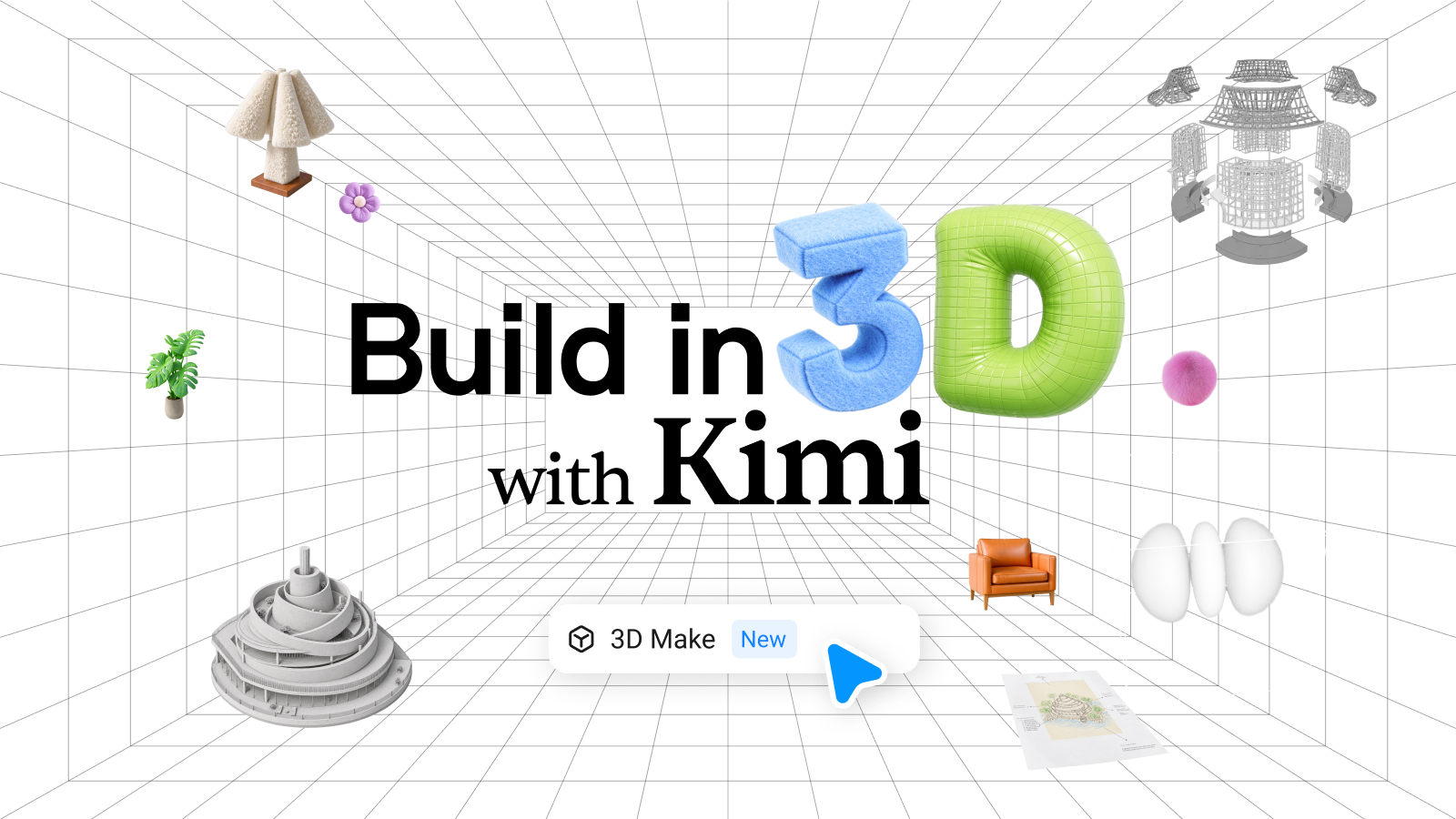
Kimi launches 3D Make: K3.1 Pro drives Blender, CAD tools and Unreal, Unity and Godot to build models, scenes and games

Moonshot AI's official Kimi account announced 3D Make at 03:14 UTC on Oct 30, saying Kimi connects to tools such as Blender and CAD software to create models, assemble scenes and develop games, available now on kimi.ai and Kimi Work. The companion 3D guide says K3.1 Pro was specifically trained to drive 3D software through Python scripts, so specialized tools without MCP support can join the workflow, while meshes such as people and animals are handed to diffusion services like Tripo. Plugins that need locally installed software work only in Kimi Work.

Kimi launches 3D Make: K3.1 Pro drives Blender, CAD tools and Unreal, Unity and Godot to build models, scenes and games

Key Takeaways

  • Availability: 3D Make is live on kimi.ai and Kimi Work; plugins that need locally installed software are Kimi Work only
  • Two modeling routes: parametric models (furniture, mechanical parts, buildings) via Python scripts written by K3.1 Pro, and meshes via services such as Tripo, Meshy and Hyper3D
  • Engines: Kimi says it is adapted to Unreal Engine, Unity and Godot to import models, assemble scenes and build gameplay step by step
  • Showcase: the celestial palace in the K3.1 Pro launch video was built in Unreal Engine 5.8 from source models totaling 36 million triangles, rendered with Nanite and Lumen
  • Benchmarks: no 3D benchmarks were published; the guide admits some tasks need several rounds, and rigging and complex materials remain weak spots
Read full story
ADSponsored

Mistral releases the open weights of Mistral Large 4 "Le Chonk": a 1T-total, ~52B-active multimodal MoE that Mistral says leads open models on FrontierCode 2.0

On Oct 29 Mistral released an improved Mistral Large 4 (Le Chonk) with open weights on Hugging Face (plus an NVFP4 quantized checkpoint), served on its API as mistral-large-4. After about three more weeks of reinforcement learning since the early-October preview, Mistral reports 19.7% on FrontierCode 2.0, Terminal-Bench 4.0 up from 28% to 41%, and new low/medium/high reasoning modes. The license is a modified MIT that allows commercial use, but running a model-as-a-service business needs a separate commercial license.

Mistral releases the open weights of Mistral Large 4 "Le Chonk": a 1T-total, ~52B-active multimodal MoE that Mistral says leads open models on FrontierCode 2.0

Key Takeaways

  • Specs: about 1T total parameters with 49B active per token (about 52B including embeddings and output layers), 128 routed experts with 4 active plus 1 shared expert, 1M context, text and image input
  • Per Mistral: 19.7% on Cognition's FrontierCode 2.0, ahead of DeepSeek V4.1 Flash at 19.3% and GLM-5.3 at 17.8%, first among open models
  • 48% on the Artificial Analysis Coding Agent Index, roughly tied with GLM-5.3 while using 47% fewer tokens per task on average; Terminal-Bench 4.0 rose from 28% in preview to 41%
  • 51% on the Artificial Analysis Cyber Index, and a 96.6% average refusal rate on malicious cyber requests, which Mistral says is the highest among open models
  • Trained from scratch on 3,800 NVIDIA Grace Blackwell GPUs in Mistral's own European datacenters; in Surge Code blind pairwise tests it ranked behind only Claude Opus 5.5
Read full story
Linked Models & Agents:

Symantec finds a grey-market relay that installs the real Codex and Claude Code CLIs, then turns off sandboxing and routes every request through its own servers

On Oct 29 Symantec's Threat Hunter Team disclosed an unauthorized AI relay seen at about a dozen organizations since early 2026, mostly in mainland China. Users install the genuine Codex or Claude Code CLI via npm, then run a one-line script from the reseller that rewrites ~/.codex/config.toml or ~/.claude/settings.json, points base_url at relay domains, swaps in relay-issued keys, sets the sandbox to danger-full-access and disables telemetry. Symantec says this is not a CLI vulnerability and it has seen no abuse so far.

Symantec finds a grey-market relay that installs the real Codex and Claude Code CLIs, then turns off sandboxing and routes every request through its own servers

Key Takeaways

  • About a dozen affected organizations, mostly in mainland China, plus Chinese or home-market units of South Korean, Taiwanese and Malaysian firms in semiconductors, electronics, pharma, shipping and petrochemicals
  • A one-line iwr | iex or curl | bash command fetches a fileless script from lookalike domains such as vibe.aiok[.]me, installs the genuine CLI, then rewrites its config, so it looks like a normal setup step
  • The Codex sandbox is set to danger-full-access with network access on, and DISABLE_TELEMETRY=1 and DISABLE_ERROR_REPORTING=1 are set
  • Relay-issued Claude Code keys use the sk-ant-oat01- prefix of subscription OAuth tokens, which Symantec says is consistent with, but not proof of, pooled subscription resale
  • Symantec says this is not a vulnerability in Codex or Claude Code and it has no evidence the operator has abused its access; the risks are potential
Read full story

DiffuSpace, founded by the HKU Dream team, open-sources Clover-35B-A3B, a diffusion LLM hitting 680 tokens/s on one GPU and 73.6 on SWE-bench Verified

On Oct 28 DiffuSpace, whose members come from the HKU NLP group behind Dream 7B, released its first model, Clover-35B-A3B-Preview: a mixture-of-experts diffusion language model initialized from Qwen3.6-35B-A3B, with 35B total and about 3B active parameters, a 128K context window and block-parallel denoising. Vendor-reported results include 73.6 on SWE-bench Verified, 51.7 on Terminal-Bench 2.1 and 83.8 on GPQA Diamond, with 680 tokens/s on a single GB300 in agent workloads. Weights are Apache 2.0 on Hugging Face, ModelScope and GitHub, with SGLang and llama.cpp support.

DiffuSpace, founded by the HKU Dream team, open-sources Clover-35B-A3B, a diffusion LLM hitting 680 tokens/s on one GPU and 73.6 on SWE-bench Verified

Key Takeaways

  • A 35B-total, roughly 3B-active MoE diffusion model initialized from Qwen3.6-35B-A3B, with 128K context and a thinking mode
  • DiffuSpace says it tops all six agent benchmarks it compared: SWE-bench Verified 73.6, Terminal-Bench 2.1 51.7 and tau3 Overall 65.3, ahead of LLaDA2.2 flash, Mercury 2.5 and Qwen3.6-35B-A3B
  • Speed (vendor-reported): 680 tokens/s on one GB300 at BF16 and batch size 1 in agent workloads, and 515 tokens/s on one H200 versus 365 tokens/s for Qwen with DFlash2
  • An INT4 build runs on a 16GB RTX 5070 Ti at 101.8 tokens/s on MATH-500
  • Weights on Hugging Face are Apache 2.0, about 69GB in BF16, and SGLang is the recommended serving path
Read full story
Linked Models & Agents:
⚡ Clover-35B-A3B-Preview⚡ Qwen3.6-35B-A3B⚡ Dream 7B⚡ LLaDA2.2 flash⚡ Mercury 2.5🌐 DiffuSpace🌐 HKU NLP🌐 Alibaba Qwen🌐 NVIDIA

Anthropic study: 50 professional data analysts working with Claude Code followed the agent's secretly assigned lean on 86% of key judgment calls

On Oct 27 Anthropic's Alignment team published a randomized controlled trial, "How AI agents shape experts' judgment calls", shared on X by researcher Alex Tamkin. Fifty analysts experienced in causal inference used Claude Code (Claude Opus 4.8) to evaluate a program for a fictional farming cooperative, and on each analytical decision the agent's lean was set by coin flip without the analyst being told. Their choices matched the agent's lean 86% of the time (about 50% would mean no effect), and 77% later repeated the agent's arguments while only 15% credited the agent.

Anthropic study: 50 professional data analysts working with Claude Code followed the agent's secretly assigned lean on 86% of key judgment calls

Key Takeaways

  • Agreement with the agent's lean was 92%, 82%, 81% and 90% on the four analytical decisions, 86% overall; the final rollout recommendation shifted too (54% recommended rollout when the agent leaned that way vs 36% when it leaned against)
  • In 38 cases where analysts stated a preference first, they switched 60% of the time when the agent disagreed vs 6% when it agreed (small sample; 95% CI 24 to 82 percentage points)
  • The four coin-flip leans alone let a statistical model predict 82% of final recommendations (61% baseline); none of 10 traits such as experience, education or trust in AI reliably predicted who deferred
  • 52% of analysts called the final recommendation more their own than the agent's, and their confidence was about the same as everyone else's (71 vs 73)
  • 6 of 11 analysts who skipped the agent made serious methodological errors vs 3 of 50 who used it, though the groups differed in experience; the study covers one task and one model, with the agent's lean deliberately strengthened
Read full story

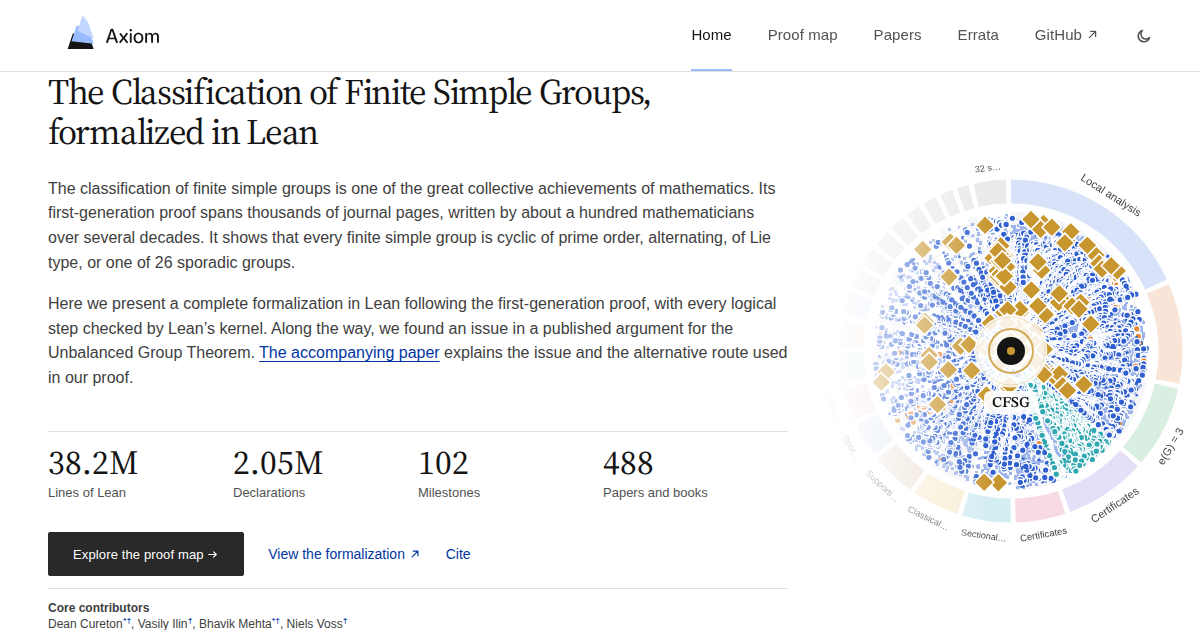
Axiom uses AI agent swarms to fully formalize the Classification of Finite Simple Groups in Lean in 24 days: about 43.1M lines, the first complete computer-checked proof of the longest proof in math history

AI math company Axiom announced on Oct 27 that swarms of dozens of AI agents formalized the Classification of Finite Simple Groups (CFSG; the original proof runs about 15,000 pages across 500+ articles by about 100 mathematicians) in the Lean proof assistant in 24 days, producing about 43.1M lines of Lean and 2.05M declarations, with the repo public on GitHub. The work surfaced 34 noteworthy deviations from the published record, and AxiomProver produced a new alternative argument for the Unbalanced Group Theorem.

Axiom uses AI agent swarms to fully formalize the Classification of Finite Simple Groups in Lean in 24 days: about 43.1M lines, the first complete computer-checked proof of the longest proof in math history

Key Takeaways

  • Per Axiom: 24 days and swarms of dozens of AI agents produced about 43.1M lines of Lean, 2.05M declarations and 100 milestones, drawing on 715 papers and books
  • The original CFSG proof spans about 15,000 pages in 500+ articles by about 100 mathematicians; this is the first time it has been fully computer-checked
  • Formalizing it exposed 34 noteworthy deviations from the literature, the biggest a closure assertion in Walter's 1986 Unbalanced Group Theorem argument, with explicit counterexamples such as PSL2(49)
  • AxiomProver produced an alternative argument built on Solomon's 1976 theory and proved a new theorem, "Preservation of simple tops", published on Hexagon (2610.00575)
  • Humans stayed essential: original CFSG group theorists including Richard Lyons and Ronald Solomon were consulted, and an errata list will be published with an advisory board
Read full story
Linked Models & Agents:
⚡ AxiomProver🌐 Axiom