AI Coding Live News

GitHub Copilot Comes to Xcode's Built-In Coding Assistant in Public Preview With Xcode 27.3 Beta, Supported on All Copilot Plans

GitHub's official changelog says Copilot now works directly in Xcode's built-in coding assistant, in public preview starting with Xcode 27.3 beta. It needs macOS Tahoe 26.6 or later, is set up under Xcode > Settings > Intelligence, and supports all Copilot plans; the existing Copilot for Xcode extension stays available.

Key Takeaways

  • Copilot joins Xcode's native coding assistant in public preview, starting with Xcode 27.3 beta
  • Requires macOS Tahoe 26.6 or later
  • Set it up under Xcode > Settings > Intelligence; all Copilot plans are supported
  • The existing GitHub Copilot for Xcode extension remains a separate option
  • Apple's Xcode 27.3 beta 1 release notes list it under Coding Intelligence
Read full story

Fireworks Forge Launches: Ultra-fast Inference Preview Hits 1,500 Tokens/s, Half-Price Background Mode, Nexus Desktop for Codex and Claude Desktop, Sovereign Private Preview

At its first Forge conference on November 3, open-model inference platform Fireworks launched a batch of products. Ultra-fast, powered by NVIDIA Blackwell, is in public preview at up to 1,500 tokens per second on DeepSeek V4.1 Flash, cutting a 30-turn agent task from 1 minute to 8 seconds. Background Mode runs deferrable work at half price, alongside multi-day prompt caching and higher rate limits. Nexus Desktop brings open-model routing into the Codex app, Claude Desktop and OpenCode, with Pro plans from $8 per month. Fireworks also announced No Eval, serverless LoRA inference, the Fireworks Sovereign private preview and a 60+ partner Frontier Ecosystem.

Fireworks Forge Launches: Ultra-fast Inference Preview Hits 1,500 Tokens/s, Half-Price Background Mode, Nexus Desktop for Codex and Claude Desktop, Sovereign Private Preview

Key Takeaways

  • Ultra-fast public preview: on NVIDIA Blackwell, up to 1,500 tokens per second on DeepSeek V4.1 Flash; in Fireworks' benchmark a 30-turn agent task fell from 1 minute to 8 seconds (Fireworks blog)
  • Cost options: Background Mode runs deferrable work at half price; multi-day prompt caching cuts the cost of resuming long context; higher serverless rate limits and Elastic Burst are generally available
  • Nexus Desktop launches: personalized routing across open and closed models inside the Codex app, Claude Desktop and OpenCode; Pro from $8 per month, Teams from $10 per seat per month
  • Training: No Eval (private preview) turns production traces into task evals; serverless LoRA inference (public preview) starts with GLM 5.3 Flash at per-token pricing with no idle charge; free training on Muse Glimmer 30B through November 30
  • Enterprise: Fireworks Sovereign (private preview) runs the inference engine in a customer's own cloud or data center; Fireworks says it already manages over 25,000 GPUs in customer environments; plus a 60+ partner Frontier Ecosystem
Read full story

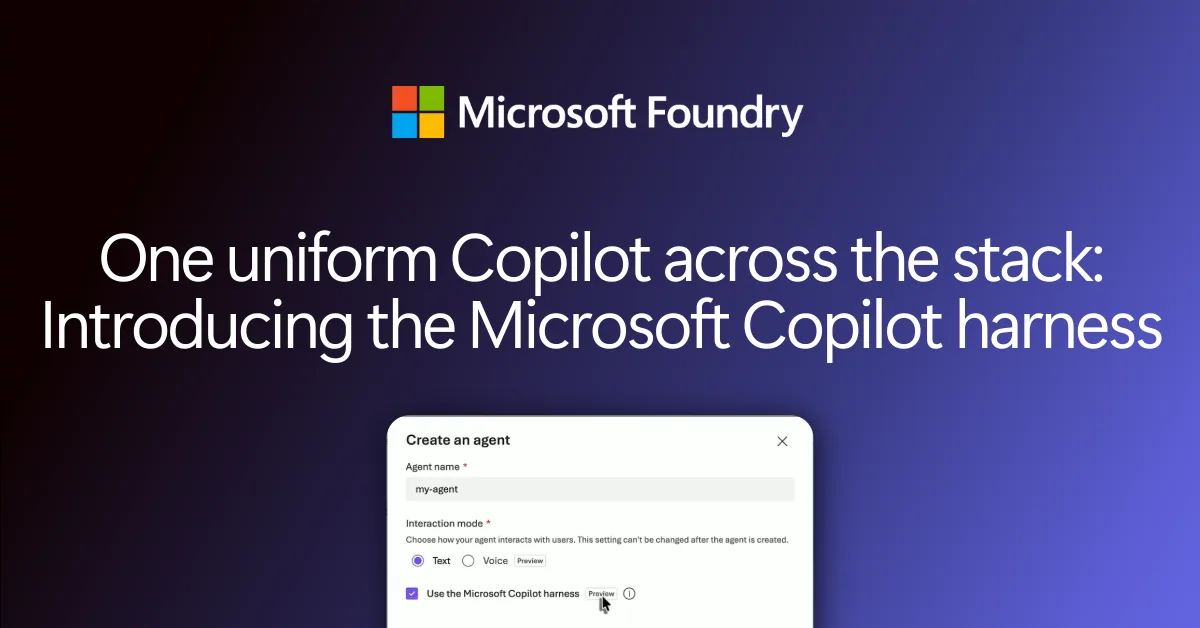
Microsoft opens the GitHub-built Copilot harness in Foundry Agent Service: public preview, 20+ frontier models plus BYOK, billing from Dec 1

During GitHub Universe on Oct 28, Microsoft put the Microsoft Copilot harness, the shared agent execution layer behind Copilot Code, Copilot Studio, the GitHub Copilot app, the CLI and VS Code, into Foundry Agent Service as a public preview. Microsoft runs the agent loop and sandbox while developers supply instructions, skills, tools and model choice; Microsoft says it works across 20+ frontier models plus bring-your-own-key. Long-running resilience for hosted agents also reached GA. Harness runtime usage is free until Dec 1.

Microsoft opens the GitHub-built Copilot harness in Foundry Agent Service: public preview, 20+ frontier models plus BYOK, billing from Dec 1

Key Takeaways

  • Microsoft says the harness spans 20+ frontier models plus bring-your-own-key, so you can swap models without rewriting orchestration (official blog)
  • Preview building blocks: reusable skills, Foundry and MCP tools with explicit auth and approvals, file and code execution with built-in subagent delegation, and source-controlled agent definitions
  • Pricing: harness runtime is free until Dec 1; after that sandbox compute is USD 0.0994 per vCPU-hour and 0.0118 per GiB-hour, with model inference billed separately (Foundry blog)
  • Long-running resilience for hosted agents went GA the same week: interrupted work restarts with its original input, and your app saves checkpoints
  • Limits: you pick the harness only when creating a new agent; existing agents are unchanged and switching later is not supported yet
Read full story

Mistral launches its Responses API in public preview: OpenAI Responses-compatible, returning the answer, reasoning and tool calls as separate items for building agents

Mistral AI announced on X on Oct 28 that its Responses API is in public preview, positioned as the interface for building agents on Mistral. The official docs say it uses the OpenAI Responses format, and each response's output array carries the models messages, its reasoning and its function calls as separate items, which is easier to handle step by step than Chat Completions. The preview is stateless, so the app keeps the conversation history and sends it back; it supports text, image and file input, JSON Schema structured output, streaming events, client-executed function calls, reasoning.effort, and token counting via POST /v1/responses/input_tokens. It is served in the EU and US on Mistral AI Cloud Inference. The same thread says Mistral now also serves DeepSeek V4.1 Flash (public preview) and GLM 5.3 Flash (generally available).

Key Takeaways

  • The Responses API is in public preview and uses the OpenAI Responses format, so existing Responses integrations can move to Mistral more easily
  • Each response splits the answer, reasoning and function calls into separate output items, which suits step-by-step agent loops
  • The preview is stateless: the app keeps the history and sends earlier output items back along with function_call_output results
  • It supports image and file input, JSON Schema structured output, streaming, function calling (including namespaces), reasoning.effort and token counting via /v1/responses/input_tokens
  • It is served in the EU and US on Mistral AI Cloud Inference; Mistral also added DeepSeek V4.1 Flash (preview) and GLM 5.3 Flash (GA)
Read full story
ADSponsored

Google brings Gemini Robotics ER 2, DeepMind's embodied reasoning model, to Google Cloud in public preview so enterprises can orchestrate VLA models and multi-robot teams

On Oct 27 Google Cloud announced that Gemini Robotics ER 2, Google DeepMind's embodied reasoning model, is in public preview on the Gemini platform via Model Garden, under the model ID gemini-robotics-er-2-preview and built on Gemini 3.5 Flash. It acts as a robot's high-level brain: it reasons over space and time in video, plans multi-step tasks, checks whether an action succeeded, and calls VLA models and navigation APIs as tools, including across teams of different robots. Google says it pinpoints key video frames with 91.3% accuracy.

Key Takeaways

  • Model ID gemini-robotics-er-2-preview, built on Gemini 3.5 Flash, takes text, image, video and audio input, with a 131,072-token input and 65,536-token output limit
  • The core pattern is declaring VLA models, navigation APIs or custom functions as tools, with ER 2 planning and orchestrating them while explaining itself and accepting redirection in natural language
  • It classifies task progress as binary, discrete or continuous scores; Google cites 91.3% accuracy and a 0.96-second mean frame distance for finding key moments in video
  • It reads values from more than 10 instrument types, including dials, sight glasses, digital displays and rulers
  • The enterprise version adds IAM, security controls and function calling; the Cloud preview supports GenerateContent but not the Live API, and Boston Dynamics and Arm are among early users
Read full story
Linked Models & Agents:

Subquadratic launches SubQ Snap: a 384K-context decision model for agent routing, tool picks and checks at $0.05/M input

On Oct 12 Subquadratic released SubQ Snap (public preview, subq-snap-preview), a decision model that scores a fixed answer set instead of generating text. Built on Subquadratic Sparse Attention, it reads up to 384K tokens of text and images, returns a decision on 100K tokens in about a second, and—per vendor numbers—scores 61.7 on Decision Index 0.2.1 vs Jev's 57.9. Input costs $0.05/M tokens; output is free.

Subquadratic launches SubQ Snap: a 384K-context decision model for agent routing, tool picks and checks at $0.05/M input

Key Takeaways

  • 384K multimodal context (text + images), 12x Jev per vendor
  • Decision Index 0.2.1: 61.7 vs Jev 57.9 (vendor-reported)
  • 16 enterprise tasks: 67.6 vs 61.6 avg, leads 13/16; trails on When2Call by 7.6
  • Decision LCR (72K–115K multi-doc): 74.0 one-shot vs Jev 48.0 chunked
  • $0.05 per M input tokens, output free; ~1s for 100K tokens
Read full story
Linked Models & Agents:
⚡ SubQ Snap⚡ SubQ⚡ Jev🌐 Subquadratic🌐 TypeSafe

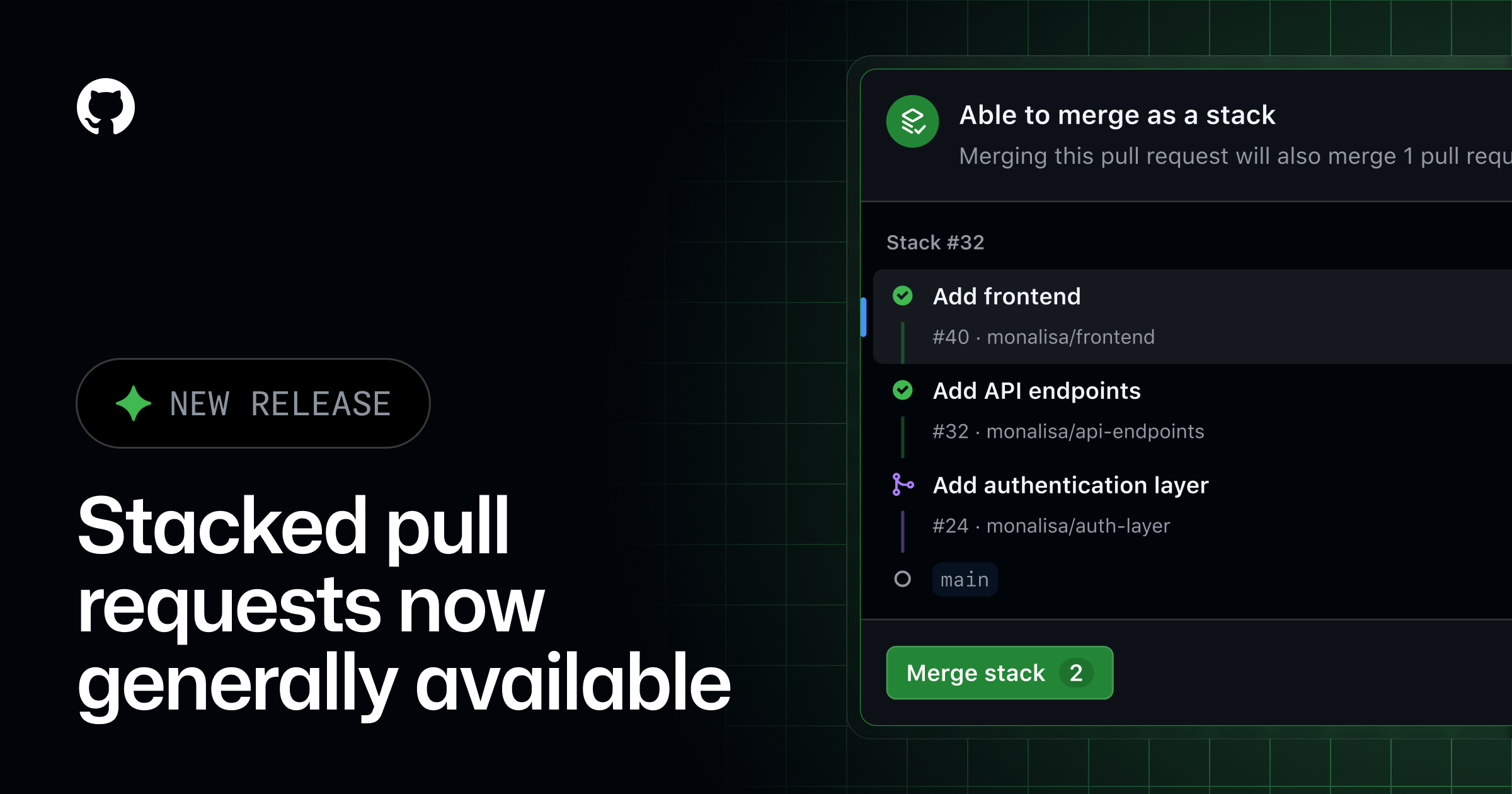
GitHub stacked pull requests are generally available on all github.com plans: approvals survive rebases, whole stacks land via merge queue, and gh stack ships an AI-agent skill

On 2026-10-06 GitHub made stacked pull requests generally available on all github.com plans, with GitHub Enterprise Server support coming in a later release. Since the public preview, repos using stacks have merged 9% more code than their peers, and more than two-thirds of the top 1% of repos now use them, with a 5% faster time-to-merge. New in GA: approvals are kept for unchanged code after a rebase, replacement commits are signed automatically, a whole stack enters the merge queue as one merge group, stacks retarget automatically when their base branch is deleted, and stack auto-merge is rolling out over the coming weeks. The gh-stack CLI extension (v0.2.0) now supports Git worktrees, and gh skill install github/gh-stack teaches AI coding agents how to split large changes into stacked PRs.

GitHub stacked pull requests are generally available on all github.com plans: approvals survive rebases, whole stacks land via merge queue, and gh stack ships an AI-agent skill

Key Takeaways

  • Impact (changelog): repos using stacks merge 9% more code; over 2/3 of the top 1% of repos use them, with 5% faster time-to-merge
  • Approvals and signing: Rebase stack keeps approvals on unchanged code even when stale approvals are dismissed; replacement commits are signed and keep the original authorship
  • Merge queue: a stack lands as 1 merge group; with the merge-commit method, each PR gets its own merge commit; stack auto-merge rolls out over the next few weeks
  • Agents: gh-stack v0.2.0 (2026-10-02, 1.6k stars) supports worktrees and installs an agent skill via gh skill install github/gh-stack; the pull_request webhook gains a stacked action
  • Coverage: all github.com plans now, GHES in an upcoming release; requires gh v2.0+ and Git 2.36+
Read full story

Mistral Large 4 "Le Chonk" public preview: 1.05T-total / 49B-active multimodal MoE, 1M context, open weights by month-end

On 2026-10-06 Mistral launched a public-preview API for Mistral Large 4: a granular MoE with 1.05T total / 49B active parameters plus a 1.6B vision encoder, 1M context, trained from scratch on 3,800 Grace Blackwell GPUs in Mistral's own European datacenters. It posts 61.7% DeepSWE v1.1 and 93% Cybench; weights are promised by the end of October.

Mistral Large 4 "Le Chonk" public preview: 1.05T-total / 49B-active multimodal MoE, 1M context, open weights by month-end

Key Takeaways

  • Scale: 1.05T total / 49B active MoE + 1.6B vision encoder, 1M context
  • Coding (Artificial Analysis private eval): DeepSWE v1.1 61.7%, SWE-Atlas-QnA 59.4%, Terminal-Bench 4 28.3%, Coding Agent Index 49.8%
  • Security: Cybench 93%; 82% on AA Cyber Index reproduce-and-patch test (highest of any model); Lakera B3 93.3% attack resistance
  • Agents: AutomationBench 59.9%, AA-Briefcase 1,393 Elo; Surge AI blind coding eval 3.74, behind only Claude Opus 5 (4.22)
  • Pricing per 1M tokens: $1.36 input / $0.14 cached / $4.18 output (docs also list a half-price tier); weights by end of month
Read full story
Linked Models & Agents:

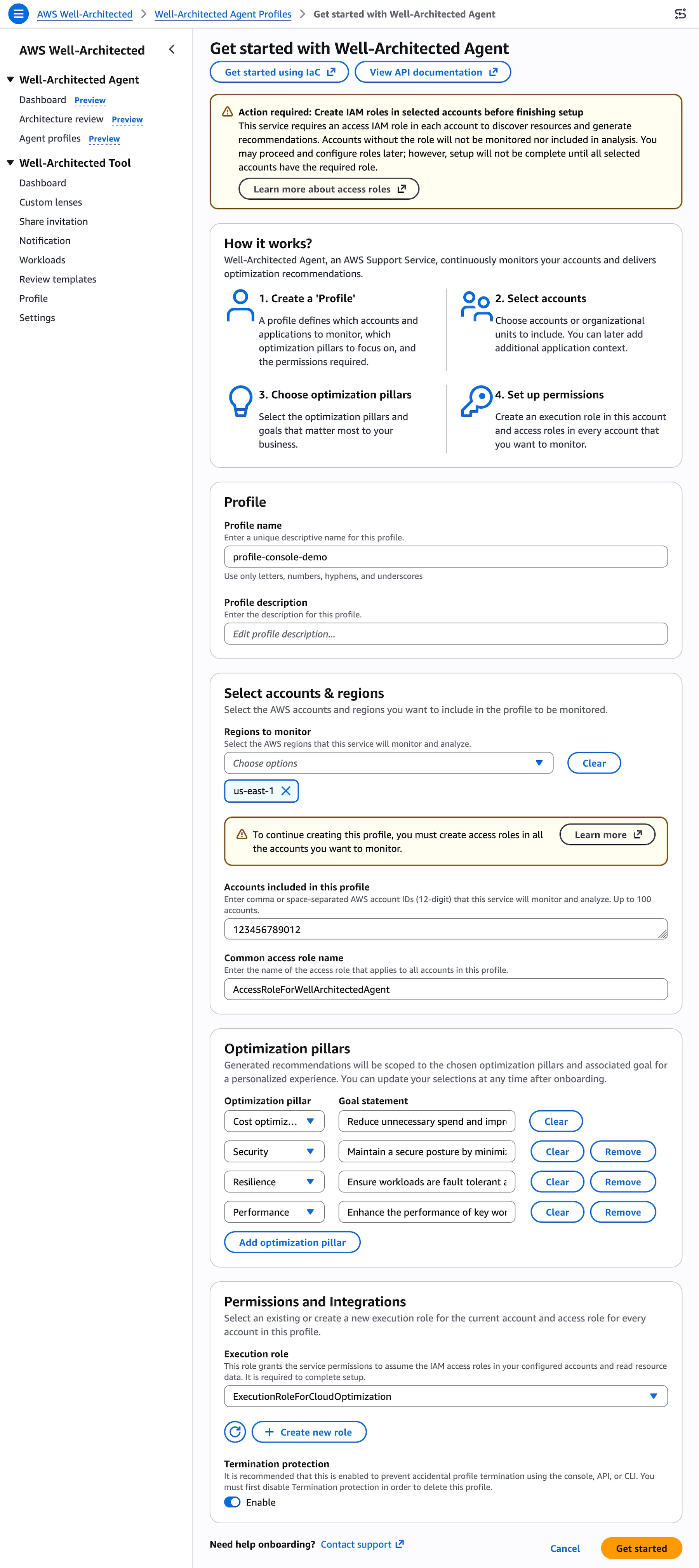
AWS Well-Architected Agent public preview: goal-aligned cloud optimization with IaC/CLI/console remediation packs

On 2026-10-01 AWS announced public preview of the Well-Architected Agent: it correlates metrics, configs, and topology against Well-Architected practices across 65+ services, prioritizes by declared business goals, and ships console / updated IaC (Terraform, CDK, CloudFormation) / CLI remediation. Available in us-east-1, us-east-2, us-west-2; delivered via AWS Support.

AWS Well-Architected Agent public preview: goal-aligned cloud optimization with IaC/CLI/console remediation packs

Key Takeaways

  • Launch: AWS News Blog 2026-10-01T20:04:04Z + What's New
  • Goal-aligned three-level findings with console / updated IaC / CLI packs
  • Cost/security/performance/resilience; 65+ services; pre-deploy IaC review (TF/CFN/CDK)
  • Agent regions: us-east-1/2, us-west-2; needs AWS Support; ~24h after profile
  • Docs: https://docs.aws.amazon.com/wellarchitected/latest/userguide/agent.html — evaluate GenAI output before applying
Read full story

DigitalOcean Agent Droplets: harness + inference + 16k tools in one monthly plan from $50/$200

On 2026-10-01 DigitalOcean launched Agent Droplets for Managed Agents (public preview): Pro $50/mo (15% off) and Team $200/mo (20% off) bundling Harness Runtime microVMs, DO-hosted open-model inference (Kimi K3, GLM 5.3), session storage, and Action Gateway (16,000+ tools). Works with Claude Code, Codex CLI, OpenCode. Paired with prepaid Inference and Agents Balance.

DigitalOcean Agent Droplets: harness + inference + 16k tools in one monthly plan from $50/$200

Key Takeaways

Read full story
ADSponsored

GitHub Copilot Dynamic Workflows public preview: code-defined multi-agent orchestration across CLI, app, and SDK

GitHub’s 2026-10-01 Changelog launched Dynamic Workflows in public preview for Copilot CLI, the Copilot app, and the SDK: code-defined reusable orchestration (sequential/parallel steps, pause checkpoints, subagent cross-checks)—unlike Autopilot or /fleet, where Copilot invents the plan each run. CLI needs --experimental or /experimental on; available on all Copilot plans.

Key Takeaways

  • Anchors: Oct 1 Changelog + docs concepts + how-to pages linked above
  • Code defines steps/conditions/handoffs; agents handle judgment. Distinct from Autopilot and /fleet
  • Surfaces: CLI workflow run + /workflows; App Workflows button; SDK/extension canvases; share via personal or repo extensions
  • Limits: max concurrent/total subagents, timeoutSeconds, approx maxAiCredits; prompt > workflow code > personal defaults
  • Public preview; CLI experimental flag; no published agent-bench deltas—don’t conflate with HydraFusion or Computer Use
Read full story

GitHub Copilot Computer Use enters public preview in CLI and Copilot app (macOS/Windows)

On 2026-10-01 GitHub announced Computer Use in public preview for Copilot CLI and the Copilot app on macOS and Windows: agents can drive local desktop apps via accessibility tree/screenshots, clicks, typing, scroll/drag, and cross-app workflows—targeting GUI-only legacy software. Off by default; enable with /computer on or Settings; enterprise policy can block it.

GitHub Copilot Computer Use enters public preview in CLI and Copilot app (macOS/Windows)

Key Takeaways

Read full story

Pinecone Launches Nexus in Public Preview with NoQL Code-Execution Agent

Pinecone released Nexus into public preview, featuring NoQL—a query-time code execution runtime agent. Instead of shuttling bulky context back and forth, NoQL generates and executes sandbox code on the fly to distill knowledge, slashing token consumption and query latency.

Key Takeaways

  • Introduces NoQL runtime agent to synthesize and filter query results on the fly
  • Dramatically curbs redundant token transfers in enterprise RAG workflows
  • Enforces rigorous sandbox isolation for enterprise-grade security and compliance
Read full story
Linked Models & Agents: