
AI Coding Live News

LiberAI Unveils Liber-0 World Action Model: Pretrained on 2.2M Hours of Human Experience, 36% Zero-Shot Success Across 60 Manipulation Tasks

Robotics company LiberAI announced Liber-0 on its official X account and technical blog. It is a World Action Model that jointly predicts future frames and actions, pretrained on more than 2.2 million hours of human experience and anchored by precise hand-motion data from its own LiberSense Glove. On 60 tasks proposed by GPT-6 across 600 trials, Liber-0 reached 36.0% overall success without robot demonstrations collected for those tasks, but only 10.5% on challenging multi-step tasks. No open weights or API have been announced.
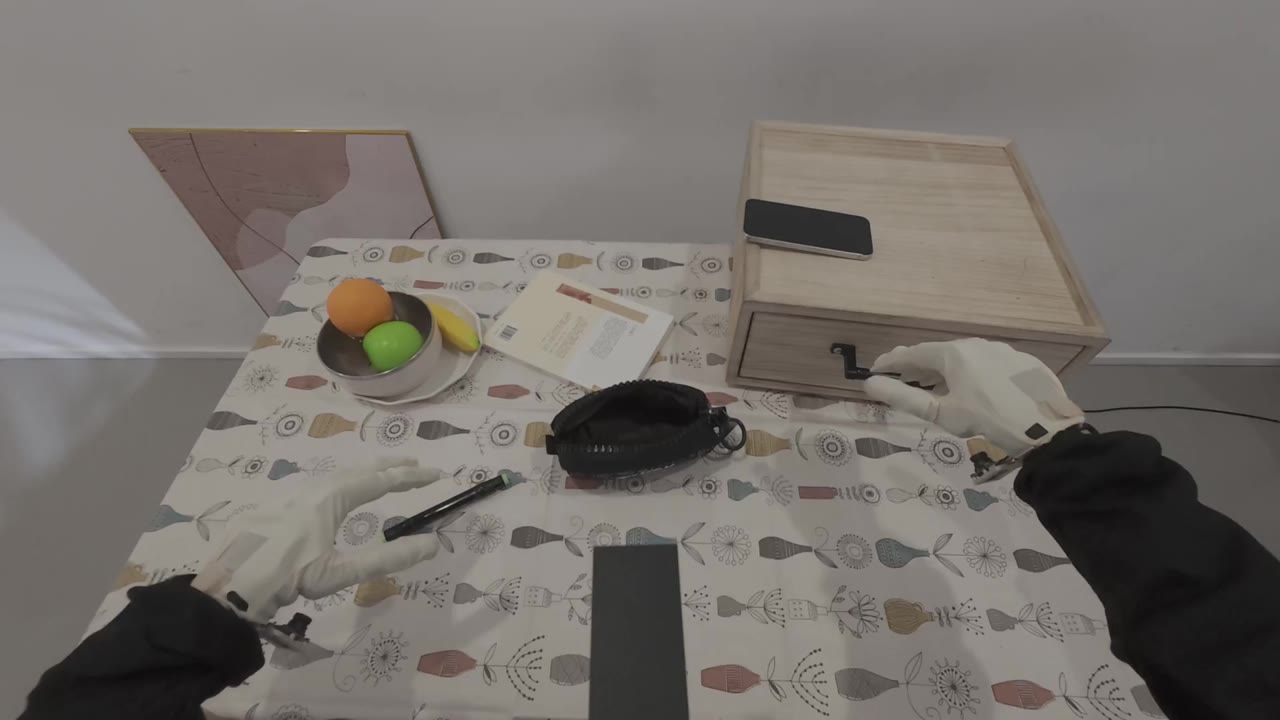
LiberAI Unveils Liber-0 World Action Model: Pretrained on 2.2M Hours of Human Experience, 36% Zero-Shot Success Across 60 Manipulation Tasks

Key Takeaways

  • Zero-shot results: 63.5% on pick-and-place, 34.0% on short non-pick-and-place tasks and 10.5% on challenging multi-step tasks, 36.0% overall (60 tasks x 10 trials)
  • For comparison, GPT-6 Astra used alone as a robot policy scored 8.3%, 5.0% and 1.7% on the same three task groups, with 87.3 s of reasoning per decision
  • 10K hours of glove data beat 200 times more web human video (2,000K hours), suggesting precise action labels matter more than raw video volume
  • Glove data plus 25% of the robot demonstrations reached a progress score of 75.6, above the 72.8 from robot-only training with the full pool, using 75% fewer robot demos
  • All figures are LiberAI self-reported internal evaluations; no open weights, API or commercial timeline has been announced
Read full story
Linked Models & Agents:

Ex-NVIDIA team Dream Labs exits stealth with a $90M seed and Dream-1, a robot foundation model that zero-shot controls unseen bimanual robots via a public API from $3/hour

On October 19 Dream Labs came out of stealth with a $90M seed round and opened a public API for Dream-1. Dream-1 is a World Action Model (WAM) that learns to predict video and actions together. The company says it can zero-shot control bimanual parallel-gripper robots without any demonstrations from that robot, and it ran 27 unseen robots in simulation, including the 18-year-old PR2. Pricing is $3/hour for Dream-1 and $2/hour for Dream-1-flash. In an independent Robocurve evaluation, Dream-1 scored 59 on RoboDojo-RC Tier 1 versus 48 for the previous best. The company stresses it is a research beta not validated for safety-critical use.

Ex-NVIDIA team Dream Labs exits stealth with a $90M seed and Dream-1, a robot foundation model that zero-shot controls unseen bimanual robots via a public API from $3/hour

Key Takeaways

  • Funding and team: $90M seed; the founders introduced World Action Models in the DreamZero paper in February 2026 while at NVIDIA.
  • Pricing: $3/hour for Dream-1, $2/hour for Dream-1-flash; each call returns 1.6 seconds of actions, about 2,250 calls per hour, roughly $0.0013 per call (company figures).
  • Generalization: zero-shot control of 27 unseen bimanual robots in simulation (including PR2); beta testers at 12 sites in 8 countries ran real-robot tasks.
  • Benchmark: Robocurve's independent eval gives 59 on RoboDojo-RC Tier 1 (previous best 48), 16x lower cost per attempt than Gemini 4 Argon and 1.7x faster than GPT-6 Astra; all 120 runs are public.
  • Limits: it predicts end-effector poses and relies on each robot's IK solver; robots far from its training can be adapted with the FaaS fine-tuning service using a little of their own data.
Read full story
Linked Models & Agents:
⚡ Dream-1⚡ Dream-1-flash⚡ DreamZero🌐 Dream Labs🌐 Robocurve🌐 NVIDIA

Latent World Action Model for GUI Agents: Slashing Inference Latency by 98.9% While Boosting Task Success by 40.6%

Pixel-space world models for GUI agents require predicting future screen images prior to action selection. However, full-screen pixel reconstruction suffers from extreme latency and frequently triggers identity shortcuts, where generated screens merely copy the past rather than reflecting action-induced mutations. Researchers from KAIST introduced the first Latent World Action Model for GUI agents, shifting predictive objectives from pixel generation to action-conditioned transitions in latent space. Featuring shared multimodal representations with decoupled action and transition heads alongside action-aware contrastive losses, the framework achieves up to a 40.6% relative gain in online task success while reducing inference latency by 98.9%.

Latent World Action Model for GUI Agents: Slashing Inference Latency by 98.9% While Boosting Task Success by 40.6%

Key Takeaways

  • Eliminating pixel reconstruction overhead: shifts future-state modeling from costly pixel diffusion to action-conditioned latent transitions, bypassing the identity shortcut
  • Decoupled dual-head with contrastive alignment: leverages shared multimodal representations with specialized action and transition heads to isolate action-induced deltas
  • Dramatic efficiency leap: delivers up to a 40.6% boost in online GUI success rate while reducing inference latency by 98.9% for real-time desktop execution
Read full story
Linked Models & Agents:
⚡ Latent-WAM⚡ Pixel-World-Model⚡ Claude 3.5 Computer Use🤖 GUI Agents🤖 Desktop OS Agents🌐 KAIST🌐 Yonsei University

ProWAM: Meta FAIR and SJTU Advance World Action Modeling with Progressive Sparse Sub-Goal Visual Planning

World Action Models (WAMs) represent a foundational robotic paradigm by predicting future visual dynamics and Cartesian actions directly from initial observations. However, existing WAMs struggle with long-horizon execution: synthesizing dense video rollouts incurs prohibitive computational overhead and temporal drift, while predicting single terminal frames deprives the policy of progressive visual guidance. Meta FAIR and Shanghai Jiao Tong University introduce ProWAM (arXiv:2610.02508), an efficient architecture that jointly predicts actions and an ordered sequence of sparse visual sub-goals. Sub-goal prediction scales naturally by learning from large-scale action-free video datasets, decoupling complex visual foresight from low-level policy control. ProWAM executes a single video-backbone forward pass to cache sparse sub-goal features, enabling rapid closed-loop replanning through lightweight action denoising without full video re-generation. Evaluated across extensive robotic benchmarks, ProWAM sets SOTA records on LIBERO-Plus (85.8%, +35.9% relative gain) and randomized RoboTwin (75.7%). In real-world zero-shot physical manipulator trials, ProWAM achieves a 70.0% success rate in unseen environments, outpacing the strongest baseline by +15.0 percentage points (+27.3% relative gain).

ProWAM: Meta FAIR and SJTU Advance World Action Modeling with Progressive Sparse Sub-Goal Visual Planning

Key Takeaways

  • Introduces ProWAM, replacing dense video rollouts with progressive sparse visual sub-goals for robust robotic foresight
  • Executes a single video forward pass to cache sub-goal features, enabling rapid closed-loop action replanning
  • Reaches 85.8% success on LIBERO-Plus (+35.9% relative gain) and lifts zero-shot physical robot success from 55% to 70%
Read full story
ADSponsored

InternW0-Δ Open-Sourced: Unified World Action Model Pretrained on 20,000+ Hours of Open Robotics Data

Shanghai AI Lab and OpenDataLab open-sourced InternW0-Δ, a unified World Action Model (WAM) pretrained on over 20,000 hours of curated robotic demonstrations, UMI data, and egocentric videos. Built on a Mixture-of-Transformers (MoT) architecture that binds visual predictive dynamics with robot actions, it introduces 'Causal Imprint' to inject future representations directly into the action expert without requiring costly future-video rollouts during inference.

InternW0-Δ Open-Sourced: Unified World Action Model Pretrained on 20,000+ Hours of Open Robotics Data

Key Takeaways

  • 20,000+ Hours Open-Source Corpus: Unifies robot manipulation, UMI dexterous data, and egocentric human demonstrations into the largest publicly released robotic training corpus.
  • Mixture-of-Transformers (MoT): Coordinates video dynamics experts and action generation experts under semantic guidance from a frozen VLM, with 4D spatial priors distilled during pretraining.
  • Causal Imprint Without Future Rollout: Eliminates the critical latency bottleneck of traditional WAMs that require rendering future video frames at test time, providing predictive latent cues directly for real-time control.
  • Complete Open Source: Training code, model weights, data processing pipelines, and datasets released at internrobotics.github.io/InternW0-Delta/.
Read full story
Linked Models & Agents:

DeltaWAM Open-Sourced: Delta World Action Models for Bimanual Robot Manipulation Slash Latency by 36.6%

Embodied robotics researchers have unveiled DeltaWAM (arXiv: 2609.28811, GitHub: AIGeeksGroup/DeltaWAM), introducing Delta World Action Models and Streaming Delta Memory (SDM) for bimanual manipulation. While prior world-action models adapt heavy video generative backbones to predict full dense future frames—wasting compute on static visual backgrounds and creating catastrophic inference latency—DeltaWAM predicts compact visual deltas alongside actions. On the rigorous RoboTwin benchmark, DeltaWAM with SDM elevates clean task success to 85.4% and randomized visual success to 83.9% while cutting per-step inference latency by 36.57%.

DeltaWAM Open-Sourced: Delta World Action Models for Bimanual Robot Manipulation Slash Latency by 36.6%

Key Takeaways

  • Replaces dense full-frame video predictions with sparse visual deltas and synchronized bimanual action streams.
  • Introduces Streaming Delta Memory (SDM) to update cached observation context without invoking heavy video heads every frame.
  • Cuts training FLOPs by up to 23.8% while reducing one-step inference latency by 36.57% and compute by 31.55%.
  • Lifts RoboTwin manipulation success to 85.4% (clean) and 83.9% under visual randomization, outperforming Fast-WAM.
  • Validated across real-world physical bimanual robots; complete PyTorch harness and weights open-sourced on GitHub.
Read full story
Linked Models & Agents: